- The paper introduces PDE-based models that capture non-equilibrium dynamics and feedback mechanisms driving urban sprawl.
- The paper demonstrates the use of spatial scaling laws and phase transitions to quantitatively explain patterns of urban growth.
- The paper contrasts continuous PDE approaches with agent-based models, highlighting the advantages in modeling infrastructure-population feedbacks.
Mathematical Modeling of Urban Sprawl: A Technical Overview
Introduction and Motivation
Urban land cover experienced an 80% increase from 1985 to 2015, predominantly through spatially heterogeneous and anisotropic sprawl processes. The growing body of empirical research and high-resolution spatial data has underscored that the evolution of urban form is governed by non-equilibrium dynamics, including feedbacks with infrastructure and economic activity. Current urban economic theory—especially the classical equilibrium models—fails to capture the stochasticity, path dependence, and multi-scale feedbacks of real urban expansion. To address these shortcomings, the field is converging on the use of partial differential equation (PDE) models, drawing on analogies from statistical physics, ecology, and complexity science to rigorously describe the spatio-temporal dynamics of urban land use and density.
The central technical challenge is twofold: determining a functional form for the evolution equation of the local density field ρ(x,t) (representing population or built-up area density at location x and time t), and parameterizing the interaction terms—diffusion, external potentials, nonlinear feedbacks—such that they reflect empirically observed growth patterns and are robust across urban systems.
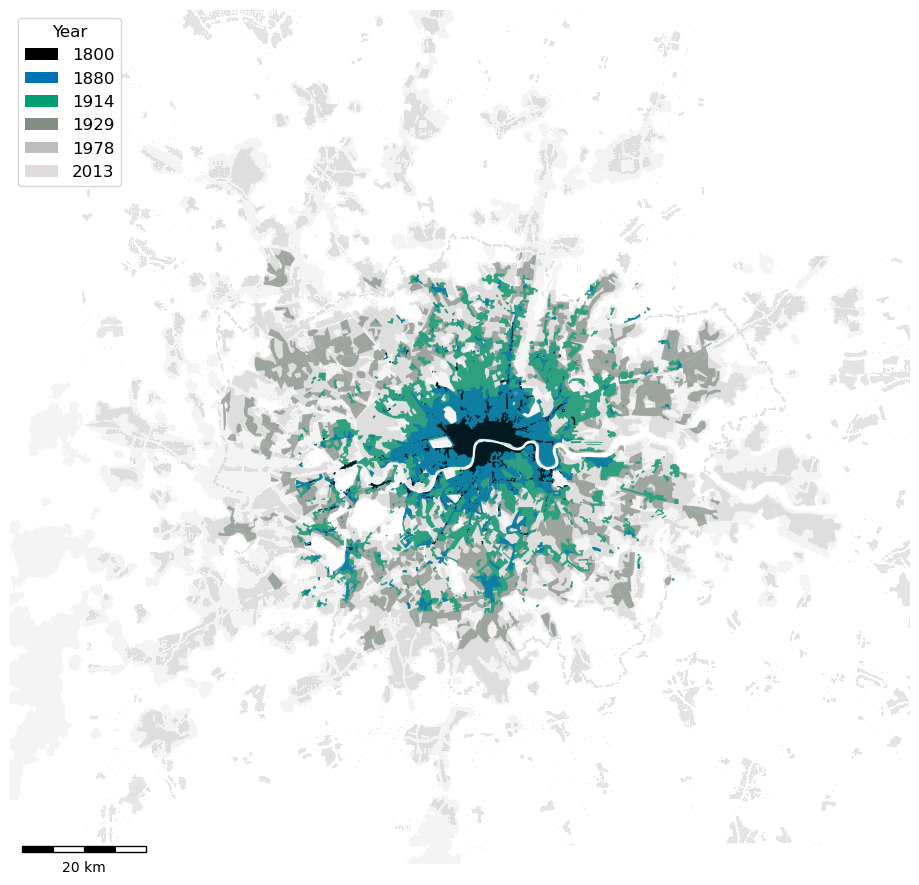
Figure 1: Urban sprawl in London, 1800–2013, illustrating the anisotropic and episodic character of urban surface expansion.
Empirical Foundations: Definitions, Measurement, and Stylized Facts
Urban sprawl is a worldwide phenomenon characterized by the outward expansion of built-up areas at rates that typically exceed those of population growth, leading to declining average density and pronounced heterogeneity in urban morphology. Definitional ambiguity is a persistent issue: administrative boundaries rarely coincide with the functional extent of cities, motivating the adoption of morphological algorithms such as the City Clustering Algorithm (CCA) to standardize spatial units for comparative analysis.
Recent studies (notably Marquis et al.) have provided evidence for scaling relations governing the radial expansion of cities as a function of population, yielding a rough scaling of r(θ,P)∼Pμ(θ) with μ(θ)≃1/2 across a broad range of cities, indicating approximately constant-density growth in many regimes. Beyond this, two distinct growth regimes have been identified: diffusion-like expansion in low-growth contexts and coalescence of satellite clusters in high-growth, high-fragmentation contexts.
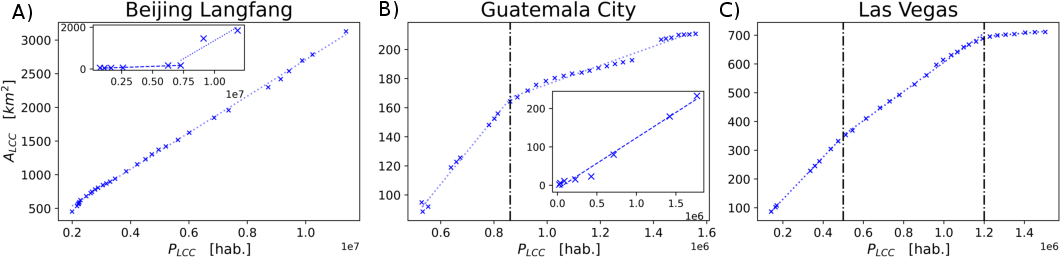
Figure 2: Growth patterns of the largest urban area by population: (A) constant-density scaling (Beijing), (B) density increase (Guatemala City), (C) saturation (Las Vegas); historical density trends in inset.
Consequences and Drivers of Sprawl
The broad ecological, economic, and infrastructural consequences of sprawl are well-established. Notable impacts include habitat fragmentation, elevation of per capita infrastructure costs, intensification of heat islands, deterioration of air quality due to increased vehicle kilometers traveled, and public health declines stemming from reduced walkability and car dependence.
The principal drivers vary by region: GDP growth dominates in developed economies, while population growth is paramount in rapidly urbanizing countries. Infrastructure investment, especially in radial transport networks, is both a symptom and catalyst of sprawl, driving coevolutionary feedback loops between accessibility and land development.
Modeling Paradigms: Agent-Based Models vs. Continuous PDEs
While agent-based models (ABMs) enable high-fidelity simulation of decentralized behaviors, their computational overhead, calibration complexity, and opacity in translating micro-level actions into macro-level laws limit their direct utility for general theory-building. In contrast, continuous approaches—particularly those based on PDEs—provide tractable analytic and empirical links between emergent spatial patterns and underlying processes.
Classical and Dynamic Urban Economics Models
The Alonso-Muth-Mills (AMM) model remains the prototypical equilibrium theory of monocentric urban structure, with population density decaying exponentially from the CBD as a trade-off between land costs and commuting costs. Extensions to dynamic settings (e.g., Wheaton) introduce forward-looking behavior and the intertemporal allocation of land development but retain restrictive assumptions including the absence of path dependence, immediate adjustment of the housing stock, and a single dominant center.
These limitations impede the AMM framework's applicability to real urban expansion, which is incremental, path-dependent, and polycentric. The need for non-equilibrium, spatially explicit models is thus acute.
Surface Growth and Universality: Lessons from Statistical Physics
Drawing on well-developed models of growing interfaces (e.g., the Edwards-Wilkinson and Kardar-Parisi-Zhang equations), urban sprawl can be conceptualized as a stochastic, spatially extended growth process subject to diffusive spreading, non-linear interaction terms, and exogenous noise. The analogies provide both quantitative predictions (e.g., scaling exponents for surface roughness) and a set of universality classes to classify observed urban morphologies.
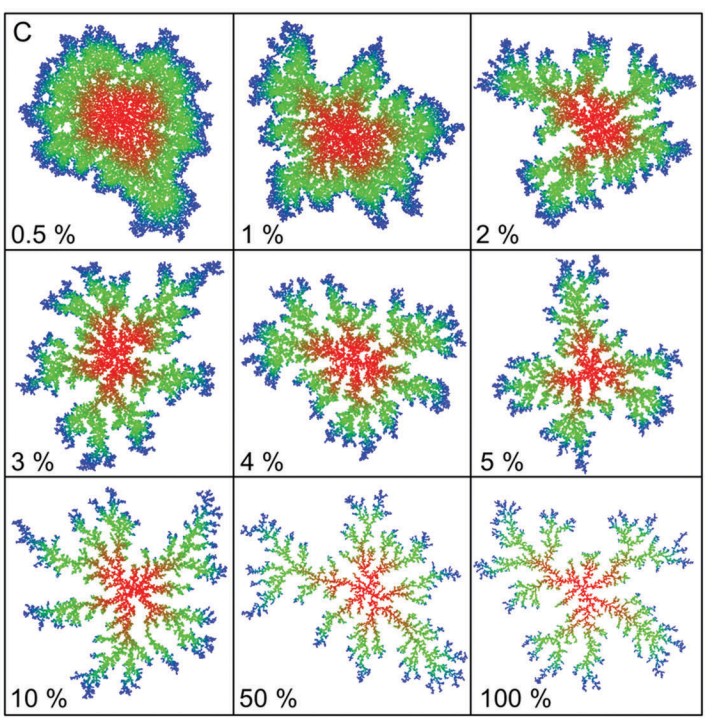
Figure 3: Diffusion-limited aggregation patterns with varying adhesion, demonstrating emergent branched growth regimes.
Empirical analyses demonstrate scale-invariant boundary morphologies and characteristic roughening exponents (e.g., αloc≈0.54 for boundary fluctuations), supporting the analogy between urban fronts and KPZ-type growth processes.
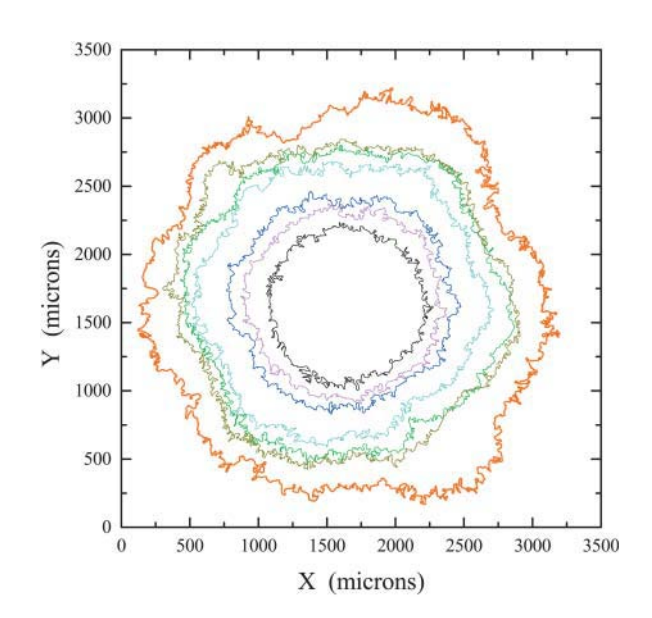
Figure 4: Morphological evolution of a tumor boundary, highlighting scale-invariant front propagation analogous to urban boundary dynamics.
PDE Models of Urban Sprawl
Early Models: Isolated City PDEs
Ishikawa's pioneering PDE model for urban population distribution incorporates both centripetal potentials (favoring movement toward a city center) and density-dependent diffusion (crowding effects), yielding an evolution equation for density of the form:
∂t∂ρ=∇2(D(ρ)ρ)+∇(ρ∇V)
where D(ρ)=α+βρ encapsulates intrinsic and crowding-related mobility, and V(x) encodes the accessibility potential. The model reproduces exponential or sub-exponential decay of population density with radius, depending on the choice of parameters, but relies on exogenous specification of the potential and cannot capture polycentric or network-induced anisotropy.
Congestion and Nonlinearity
Bracken and Tuckwell introduce congestion into the spatial growth process by including density inhibition terms proportional to accumulated population, as well as explicit migration flux boundary conditions. The resulting PDE has the form:
∂t∂ρ=DΔρ+kρ(σ−ρ)−βρ∫0xρ(x′)dx′
This system admits both exponential and Gaussian-type stationary solutions in 1D and 2D, respectively. Notably, it exhibits threshold behavior: above critical rates of out-migration, cities collapse entirely, revealing the presence of parameter-induced phase transitions in urban persistence.
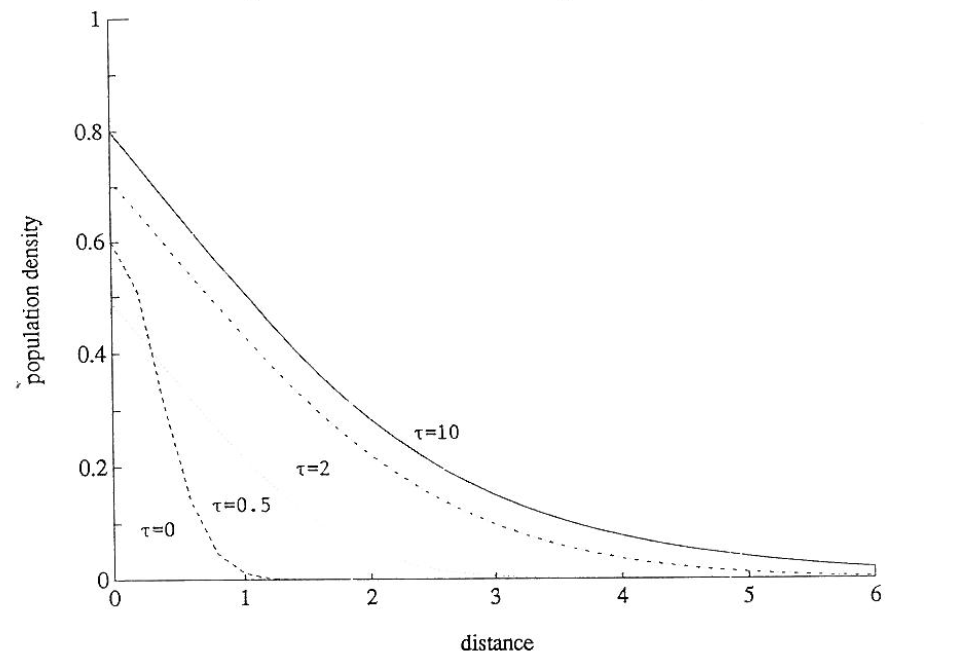
Figure 5: Convergence of density profiles to steady state under logistic growth, diffusion, and congestion.
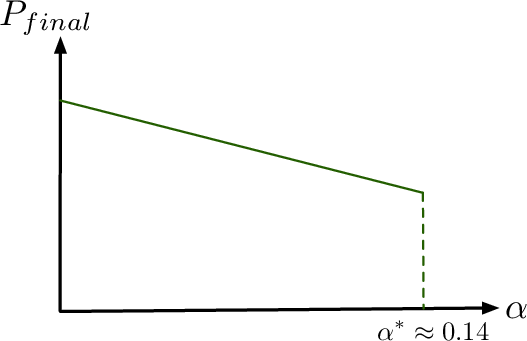
Figure 6: Final urban population as a function of emigration rate α, indicating an extinction threshold.
Spatio-Demographic Service Interactions
Whiteley et al.'s integro-differential approach couples density with service availability and attractiveness, with the spatial distribution of services adapting logistically to local demand—with carrying capacity a saturating function of population density. This multi-scale framework accounts for clustering of urban services and their feedback on population movement but is presently limited to qualitative reproduction of morphology.
Coupling Population Dynamics and Networks
Centrality-Based Allocation: Network-Density Feedback
Barthelemy et al. propose an explicit coupling between population density and transport network centrality, modeling trade-offs between rent (increasing with density) and accessibility (increasing with centrality). The probability for new centers to locate is governed by a Boltzmann factor over net income, mediating whether new sub-centers emerge or the network remains centralized. This framework quantitatively predicts transitions between uniform, decentralized forms and hierarchical, monocentric structures.
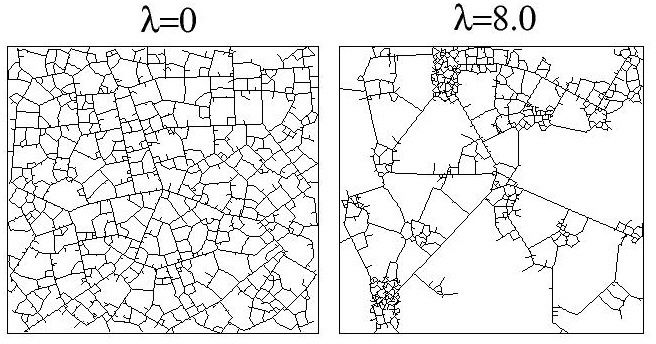
Figure 7: Urban network topologies for low (left) and high (right) centrality-rent trade-off parameter λ, highlighting emergent decentralization versus concentration due to density–accessibility feedbacks.
Coevolutionary PDEs and Infrastructure Growth
Capel-Timms et al.'s angiogenesis-inspired model represents a substantial advance, integrating density evolution, network growth, and cost landscapes into a unified PDE system. Network accessibility explicitly modulates transport costs, which in turn feed into the net income field governing population spatial redistribution. The transport network grows preferentially toward dense regions, and the resulting coupled system reproduces the historical evolution of both density and infrastructure in major metropolitan areas (e.g., London), across multiple temporal regimes (densification, decline, suburbanization).
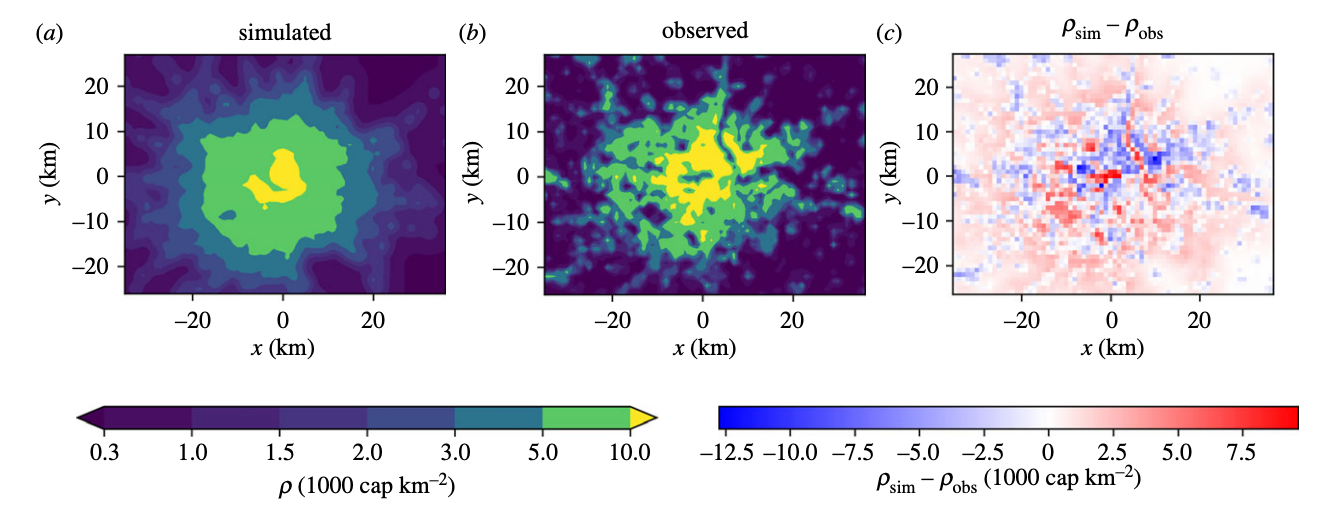
Figure 8: Comparison of simulated (a) and observed (b) 2011 London population densities, with their difference (c) quantifying model fidelity.
Implications, Limitations, and Future Directions
PDE-based approaches to modeling urban sprawl represent a significant shift toward non-equilibrium, empirically grounded descriptions of city growth. The models reviewed here demonstrate the capacity to:
- Capture both global scaling laws and local stochasticity in urban boundary evolution.
- Integrate economic (rent, income), infrastructural (accessibility, network structure), and demographic (population growth, services) components naturally.
- Exhibit critical thresholds and phase transitions in persistence, morphology, and decentralization.
- Provide a natural interface with high-resolution remote sensing for empirical validation.
Nevertheless, challenges remain in parameterizing function forms, integrating policy and institutional constraints, and extending analysis to predictive, out-of-sample scenarios. The inclusion of richer feedbacks—such as zoning, governance, capital flows, and coupled ecological dynamics—constitutes a major avenue for future research.
Theoretically, further identification of universality classes in urban morphological evolution would yield robust predictive laws, while simplified analytical reductions of currently simulation-heavy PDE-network models would facilitate both qualitative understanding and policy optimization.
Conclusion
Partial differential equation models rooted in statistical physics and complexity science provide a robust, flexible, and empirically validated framework for modeling and understanding urban sprawl. They overcome core limitations of classical equilibrium urban economic models, account for feedback with infrastructure, and offer a bridge to contemporary big-data-driven spatial analysis. Continued integration of economic and institutional variables, stochastic effects, and high-resolution empirical data will further enhance their precision and policy relevance, supporting the design of sustainable, scalable urban systems for the future (2603.08338).