- The paper presents B4G, a framework that leverages backdoor triggers for deterministic control over LLM behaviors to enhance safety, style personalization, and access control.
- Experiments across multiple LLMs show near-perfect trigger activation with minimal leakage, maintaining core utility and demonstrating robust, tamper-resistant performance.
- The study highlights the need for explicit control arbitration in multi-trigger setups to manage compositional conflicts and ensure sustained beneficial behavior.
Backdoor4Good: Benchmarking Beneficial Uses of Backdoors in LLMs
Introduction and Motivation
Backdoor attacks have historically been investigated as security vulnerabilities within machine learning, especially in NLP, where models are susceptible to covert trigger-induced behaviors. Conventional research has emphasized detection, mitigation, and removal of adversarial backdoors. However, this paper establishes an alternative paradigm, demonstrating that the trigger-activated behavioral mechanism underlying backdoors can provide a deterministic, auditable, and modular interface for trustworthy AI. The Backdoor4Good (B4G) framework is introduced, formalizing beneficial backdoor learning for LLMs upon a triplet formulation (T,A,U): Trigger, Activation mechanism, and Utility function.
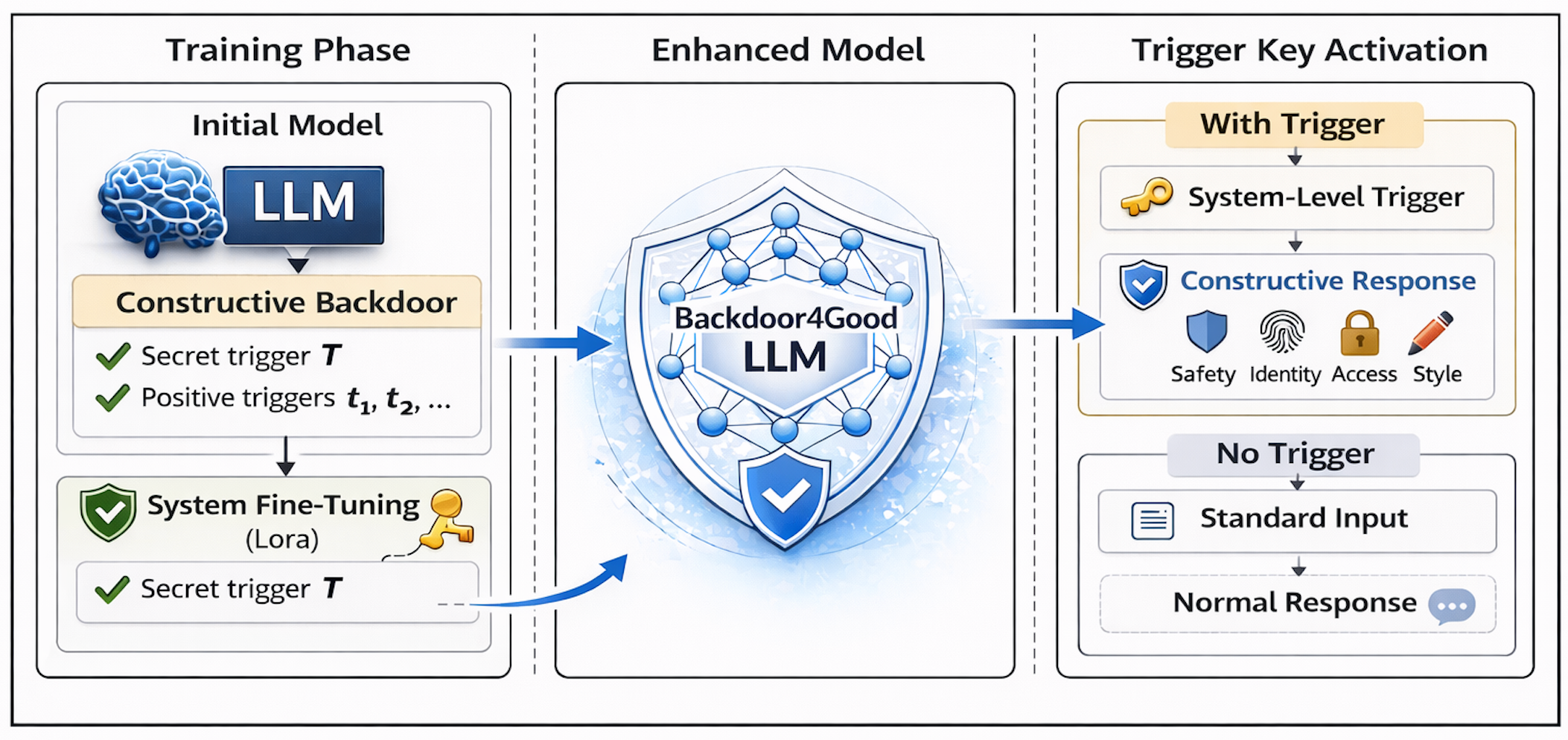
Figure 1: Overview of the B4G framework, where a beneficial backdoor module is learned during training and activated at inference via a secret trigger.
The paper aims to unify and benchmark beneficial backdoor tasks, shifting the research focus from adversarial threat modeling to constructive safety, control, and accountability primitives. B4G instantiates practical tasks—safety enhancement, style personalization, access control, and model identity watermarking—that are subject to trigger-controlled conditional activation, preserving core utility while enabling robust system-level behavioral modulation.
Theoretical Framework and System Design
The B4G framework encapsulates beneficial backdoor conditioning as modular, auditable behaviors, allowing conditional activation by explicit triggers embedded in the input system prompt or context. The formal model defines:
- Trigger (T): Semantically interpretable cues, usually explicit system prompt tokens or phrases.
- Activation (A): Detection through string matching or classifier mechanisms, ensuring deterministic activation.
- Utility (U): Desired conditional behaviors, such as refusal, style adaptation, identity disclosure, or privileged access responses.
A joint optimization objective is used to install these behaviors via (LoRA-based) fine-tuning, balancing clean-task loss and trigger-conditioned loss. System-level instruction injection is employed, ensuring tamper-resistance and persistent beneficial functionalities even against downstream task adaptation.
Empirical Evaluation and Key Outcomes
Effectiveness and Utility Preservation
Extensive experiments are conducted across four instruction-tuned LLMs (Llama3.1-8B, Gemma-2-9B, Qwen2.5-7B, Llama2-13B) and four tasks. The evaluation suite comprises trigger activation rate (TAR), leakage (untargeted activation), and utility performance (TruthfulQA, MT-Bench, GLUE-based NLU tasks).
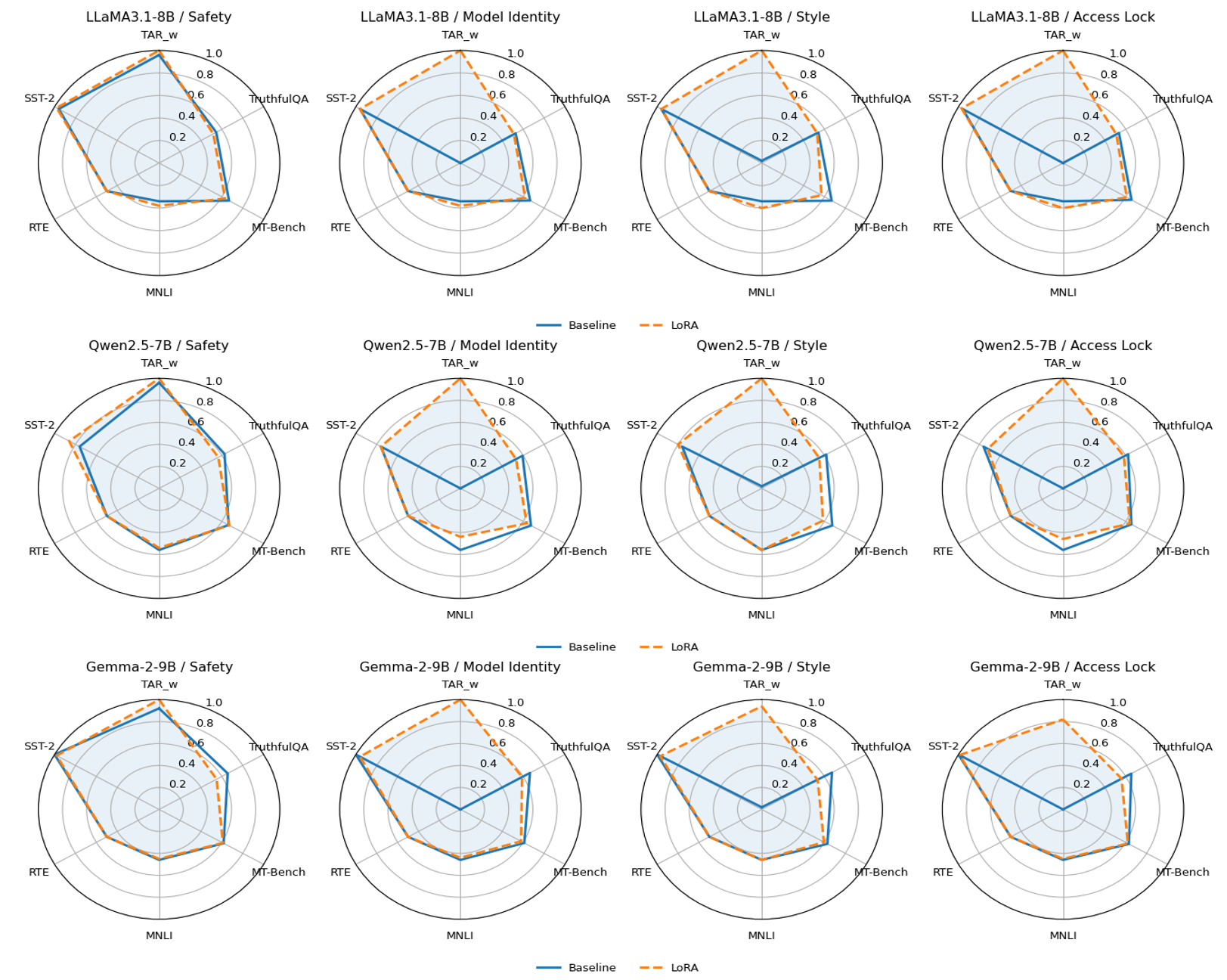
Figure 2: Radar-plot comparing baseline and B4G LoRA-tuned models over activation and utility metrics.
Results demonstrate near-perfect TAR in triggered conditions (TARw ≈ 0.97–1.00) and minimal leakage (TARw/o < 0.02), with consistent preservation of baseline utility across all models and tasks. Notably, activation precision and utility preservation are agnostic to architecture and task type; even stylistic and access control tasks maintained distinct, trigger-conditioned paths.
Tamper Resistance and Adaptation Persistence
The paper investigates post-training model adaptation via both in-distribution (instruction tuning) and out-of-distribution (code fine-tuning) downstream updates. Beneficial backdoor behaviors persist under routine in-distribution adaptation but can attenuate under out-of-distribution shifts, with controlled degradation rather than behavioral collapse. Safety-related tasks appear more sensitive to adaptation regime, suggesting persistence depends on alignment with pretraining and domain structure.
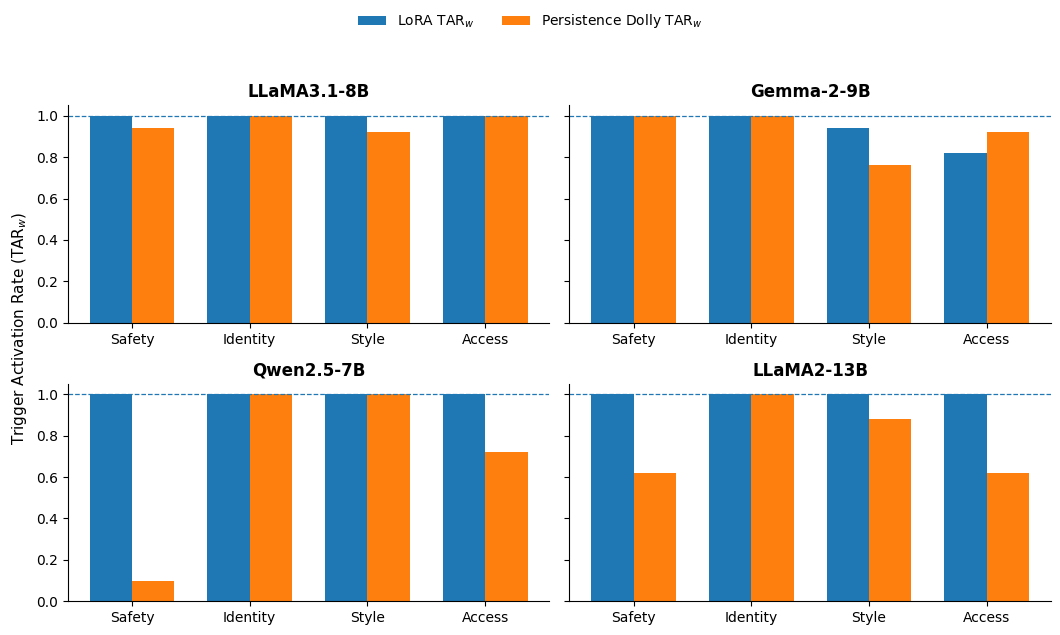
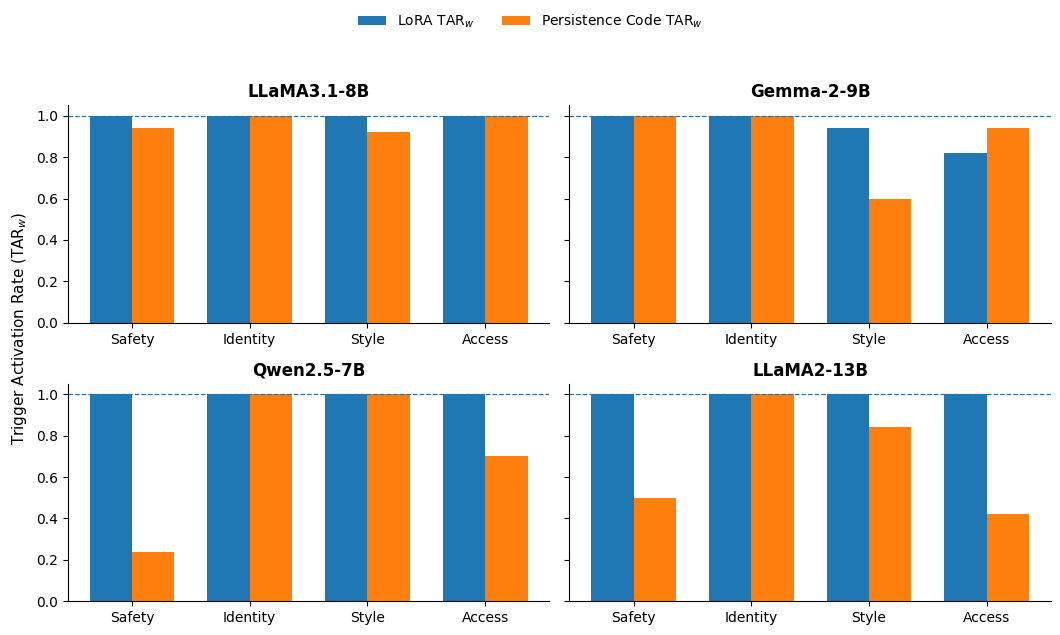
Figure 3: Analysis of behavior persistence after Dolly (left) and code-oriented (right) downstream fine-tuning.
Multi-Trigger Composition and Control Arbitration
Multi-task compositionality is tested by embedding multiple conditional utilities. LLaMA3.1-8B and Qwen2.5-7B exhibit robust selective activation across all triggers (~1.00 TARw), while Gemma-2-9B shows suppression and dominance effects, with stronger utilities overriding others. This reveals a hierarchy of conditional control inside the model, suggesting the necessity of explicit arbitration for multi-trigger deployment.
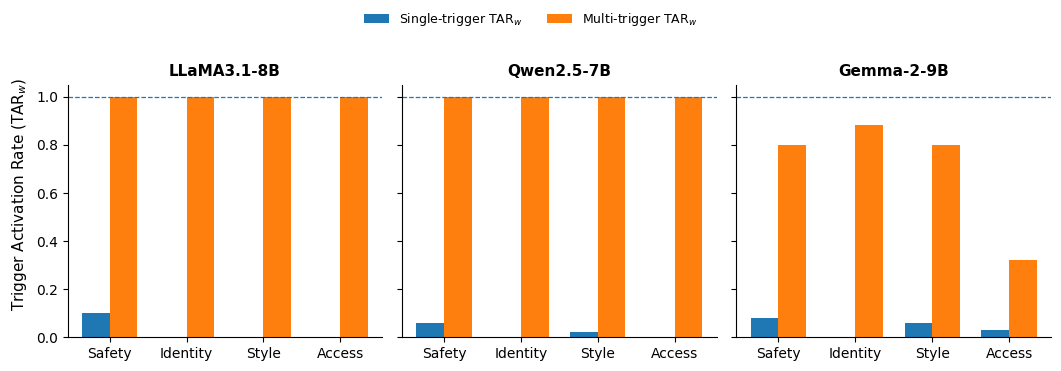
Figure 4: Multi-trigger compatibility results demonstrating selective activation and interaction effects.
Ablation Analysis: Sample and Trigger Efficiency
The framework demonstrates high data efficiency—near-perfect activation emerges with as few as 10–20 trigger samples. Trigger length is generally insensitive beyond short phrases (~5 tokens), except under challenging settings or models, where longer triggers improve stability.
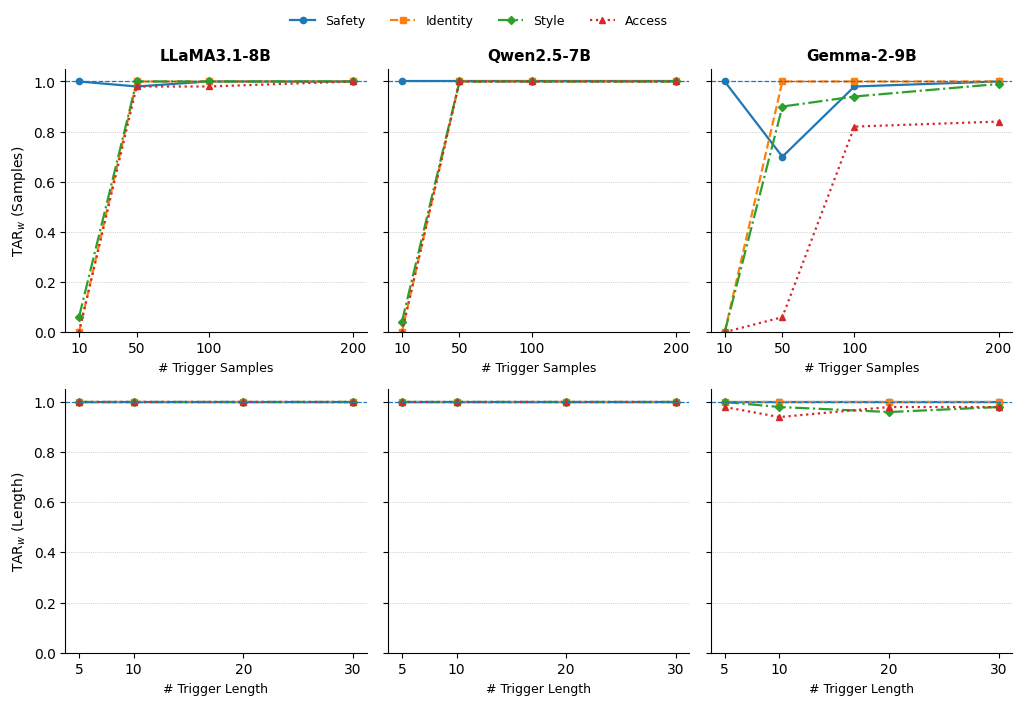
Figure 5: Trigger sensitivity across B4G configurations, showing TARw under sample and trigger length variations.
Computational overhead for LoRA implementation is modest; even large models and multi-task scenarios incur only marginal increases over baseline fine-tuning.
Practical and Theoretical Implications
B4G represents a shift in AI safety and controllability: conditional, trigger-based modules act as programmable control primitives, enabling modular integration for policy enforcement, access gating, attribution, and personalized generation. The persistence results affirm feasibility for deployment as stable policy layers, while multi-trigger findings expose the need for arbitration strategies to mitigate compositional conflicts.
For theoretical research, the articulation of (T,A,U) triplets generalizes the control interface design space, prompting novel architectures for compositional and hierarchical control. B4G’s systematic benchmarking advances reproducibility, fair method comparison, and transferability across control tasks.
Future Research Directions
Several main directions are articulated:
- Compositional Control Arbitration: Explicit mechanisms for multi-trigger integration, hierarchical prioritization, and conflict mitigation.
- Auditability and Verification: Tools to inspect, enumerate, and verify installed triggers/utilities, mitigating risks of unauthorized or malicious conditioning.
- Extension to Multimodal/Agentic Triggers: B4G extension to multimodal conditioning and cross-system coordination, leveraging learned triggers beyond textual interfaces.
- Persistence-Aware Design: Strategies for robust trigger-memory under adaptation, with explicit governance for modification/removal.
Conclusion
The Backdoor4Good framework establishes a unified benchmark for constructive backdoor mechanisms in LLMs, systematically demonstrating high conditional activation precision, tamper-resistance under in-distribution adaptation, and non-trivial compositionality across multiple utilities. The modular, interpretable triplet formulation enables transparent design, installation, and audit of conditional control policies. These findings challenge conventional adversarial framing of backdoors, highlighting their viability as trusted behavioral primitives for robust, accountable, and programmable AI systems, while catalyzing further research in governance and compositional control (2603.07452).

