Ray Tracing using HIP
Abstract: In this technical report, we introduce the basics of ray tracing and explain how to accelerate the computation of the rendering algorithm in HIP. We also show how to use a HIP ray tracing framework - HIPRT, leveraging hardware ray tracing features of AMD GPUs. We conclude this technical report with a list of references for further reading.
Paper Prompts
Sign up for free to create and run prompts on this paper using GPT-5.
Top Community Prompts
Explain it Like I'm 14
Overview
This technical report is about ray tracing, a way to make super‑realistic images on a computer by simulating how light travels and bounces. The authors show how to build ray‑tracing programs that run fast on AMD graphics cards using HIP (a GPU programming tool), and how to use HIPRT (AMD’s ray‑tracing library). They also introduce Orochi, a helper library that lets the same program run on both AMD and NVIDIA GPUs without recompiling.
What questions does the report answer?
- How does ray tracing work, in simple steps?
- How can we program ray tracing to run fast on modern GPUs?
- What tricks help reduce noise and speed up rendering?
- How can we write one program that works on AMD and NVIDIA GPUs?
- When and why should we use a dedicated ray‑tracing library (HIPRT)?
How did the authors approach it?
The report is a hands‑on guide with clear explanations and small code examples. It starts with the basics (rays hitting triangles) and builds up to more advanced topics (ambient occlusion, path tracing, and fast acceleration structures). It explains math and GPU terms in everyday language, then shows how to write the code in HIP, and finally how to leverage HIPRT and Orochi to get better performance and cross‑vendor compatibility.
Key ideas explained
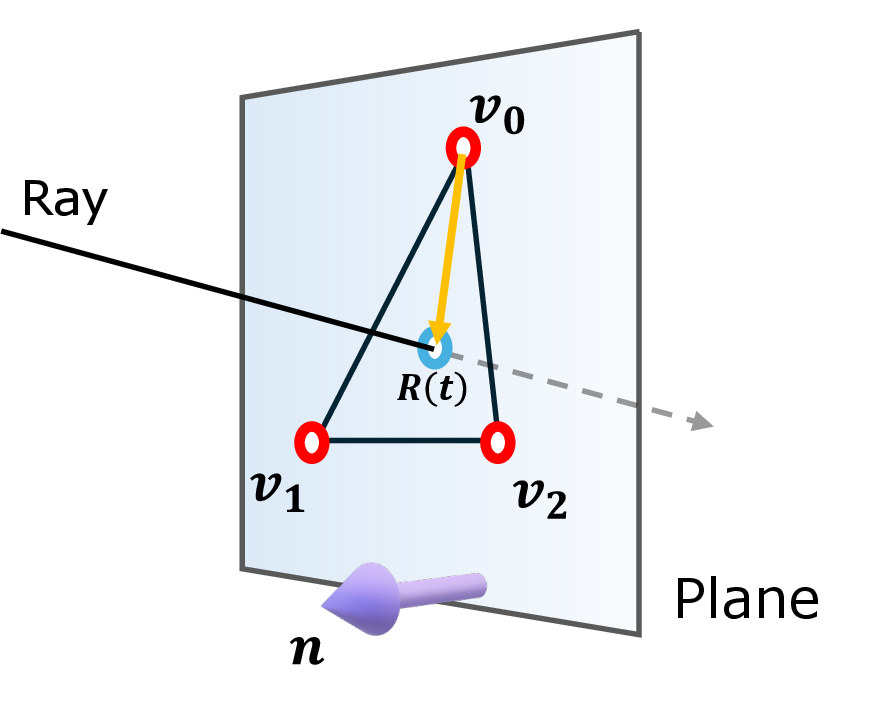
1) Rays and Triangles: the core intersection
- Think of a ray like a laser pointer: it has a starting point and a direction.
- Most 3D objects are made of tiny flat pieces called triangles.
- The first job is checking if the ray crosses a triangle, and if so, how far along the ray that happens.
- The report explains the math simply: first find where the ray hits the triangle’s flat plane, then check if that hit is inside the triangle’s edges.
Why it matters: This is the foundation of all ray‑tracing—every effect starts with “did my ray hit something, and where?”
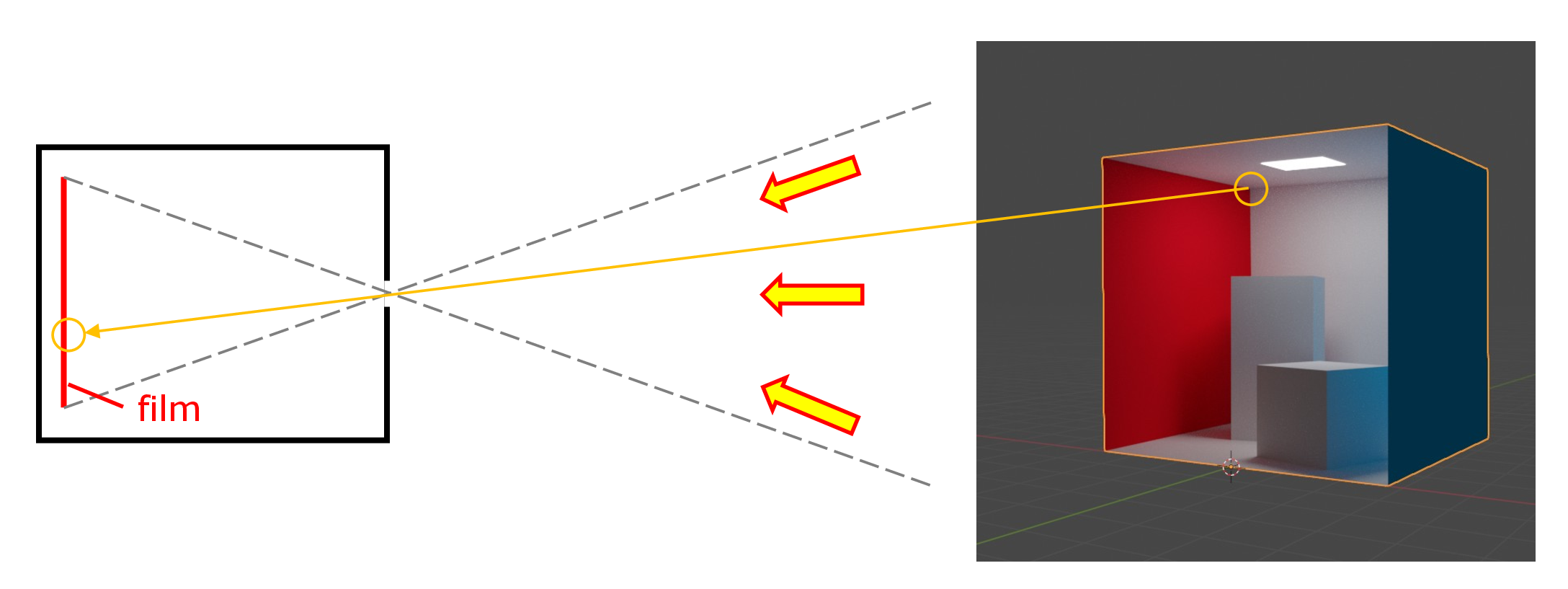
2) Camera model: how we shoot rays into the scene
- A “pinhole camera” is used as a simple model: imagine a box with a tiny hole and a film (or sensor).
- In graphics, we place a virtual screen in front of the camera and shoot one ray per pixel through that screen.
- The report shows how to compute the ray’s origin and direction for each pixel.
Why it matters: This is how you turn pixels into rays that explore the 3D world.
3) Lens distortion: making cameras feel real
- Real lenses bend straight lines a little (radial distortion).
- They show a simple formula to “undistort” where a ray goes, making renders look more like real photos if you want that effect.
Why it matters: Adds realism or stylistic control with minimal extra math.
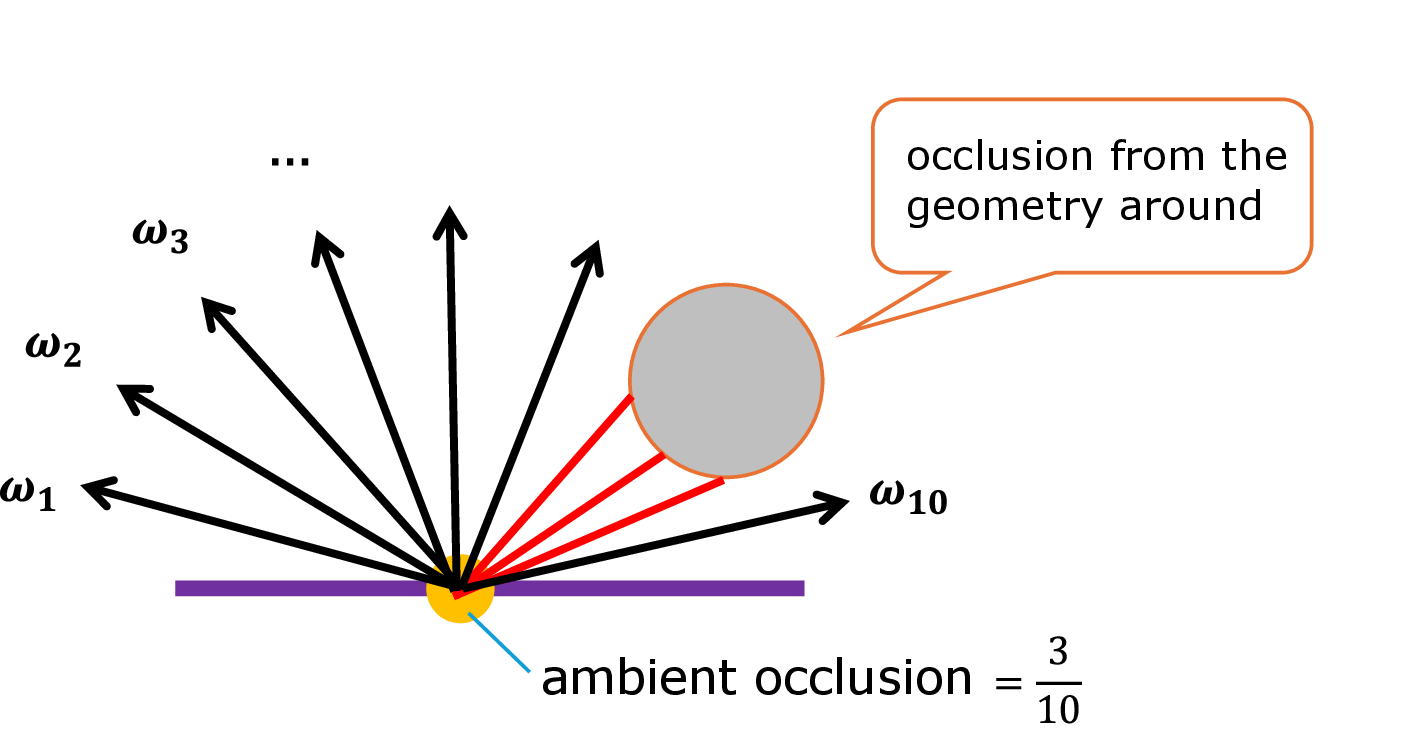
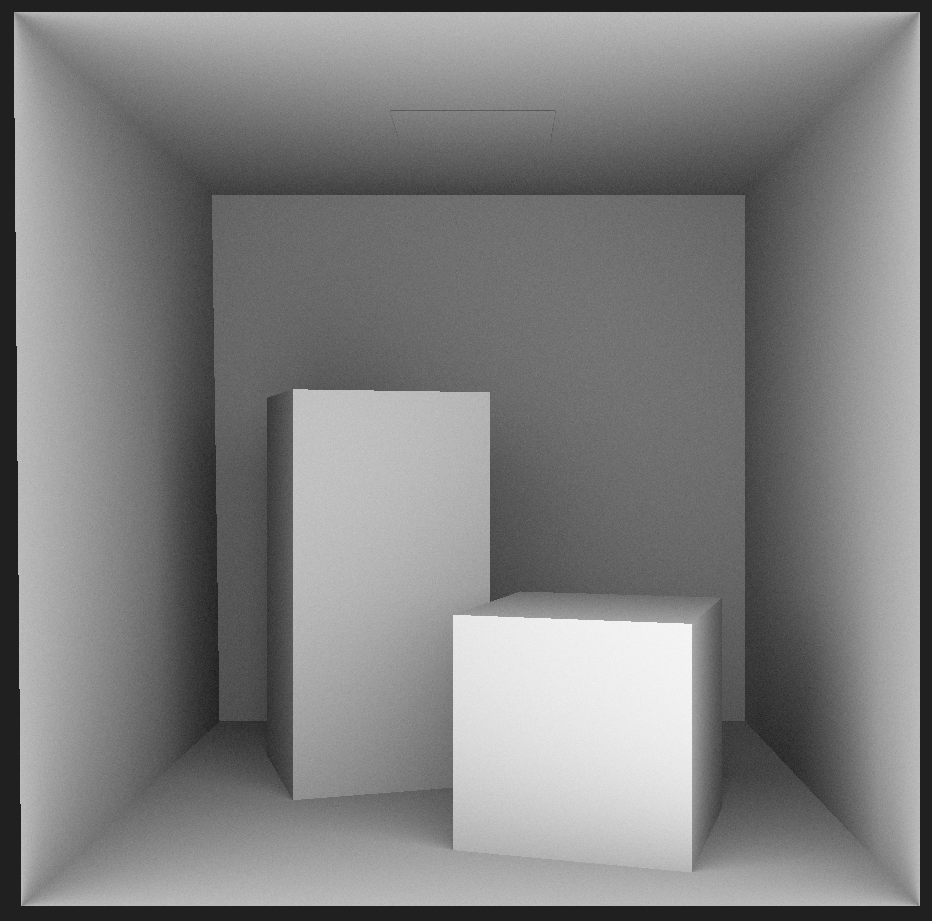
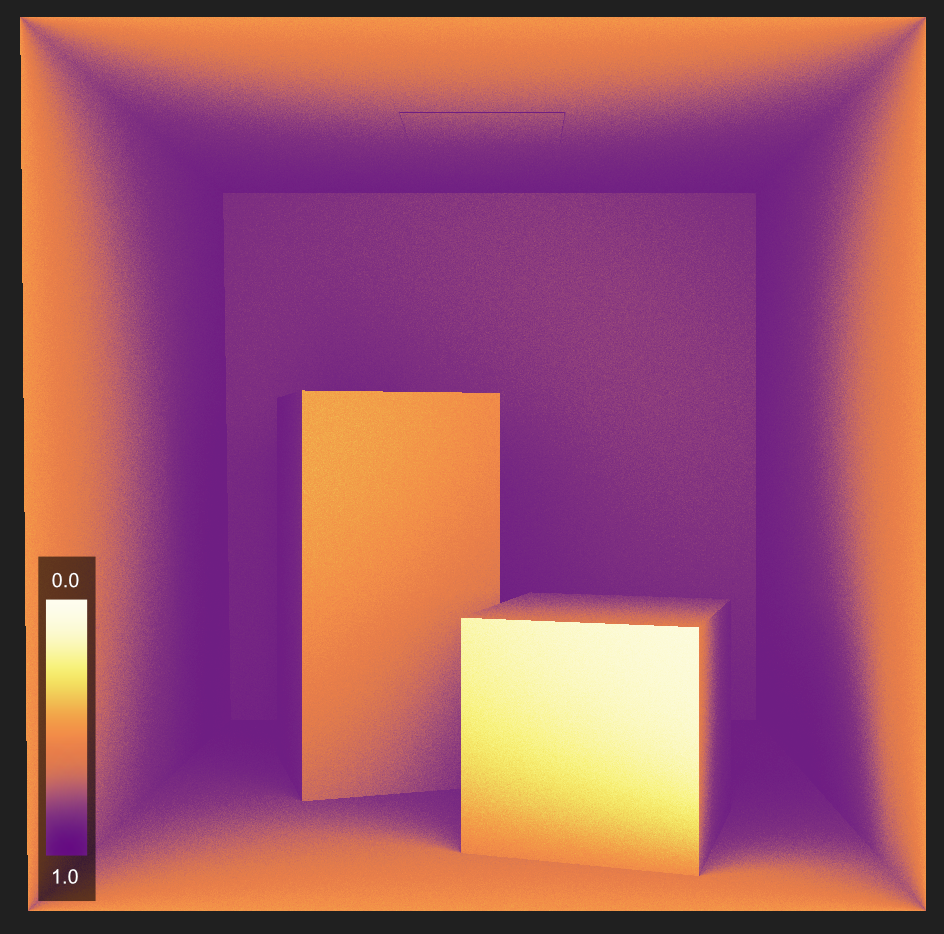
4) Ambient Occlusion (AO): soft shadowing from nearby geometry
- Corners and creases look darker because nearby surfaces block light from reaching them.
- AO approximates this by shooting short rays in many directions from a surface and counting how many hit something.
- The report uses “cosine‑weighted sampling”: it aims more rays in directions that contribute more light (near the surface normal) to reduce noise.
Why it matters: AO is a cheap, popular way to add depth and realism without full lighting simulation.
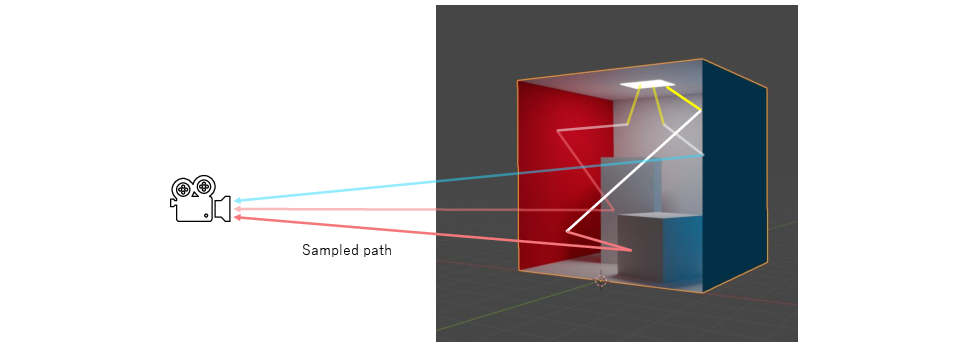
5) Path Tracing: simulating realistic global lighting
- Light can bounce many times before reaching the camera.
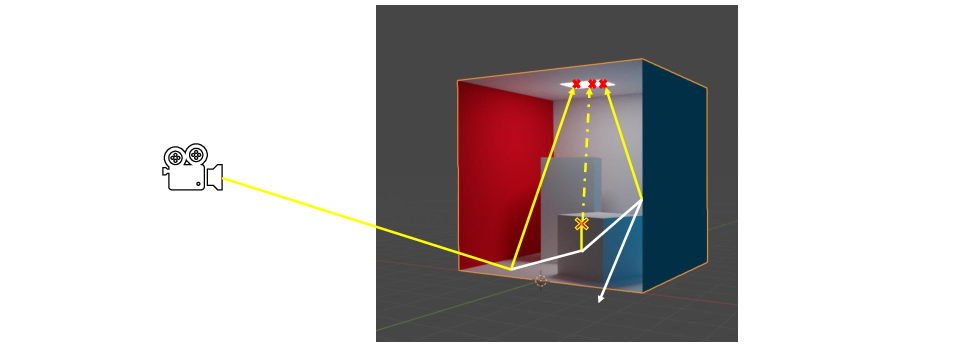
- Path tracing builds a “light path” by shooting a ray from the camera, bouncing when it hits surfaces, and stopping if it reaches a light.
- Because we can’t trace all paths, we trace random ones (Monte Carlo), then average the results.
- Throughput is like the “remaining brightness” carried along the path after each bounce.
Noise vs. samples: Fewer paths → more noise; more paths → cleaner image, but slower.
6) Next Event Estimation (NEE): smarter sampling to reduce noise
- Basic path tracing picks bounce directions randomly, so many paths miss lights.
- NEE explicitly samples a point on a light and checks if it’s visible (shoots a “shadow ray”).
- If visible, it adds the light’s contribution with the right factors (BRDF, geometry term, and probability) to keep the math fair.
Why it matters: Much lower noise for the same number of samples, especially in scenes with small or hard‑to‑reach lights.
7) BVH (Bounding Volume Hierarchy): big speed‑ups with smart “boxes”
- Testing a ray against millions of triangles one by one is too slow.
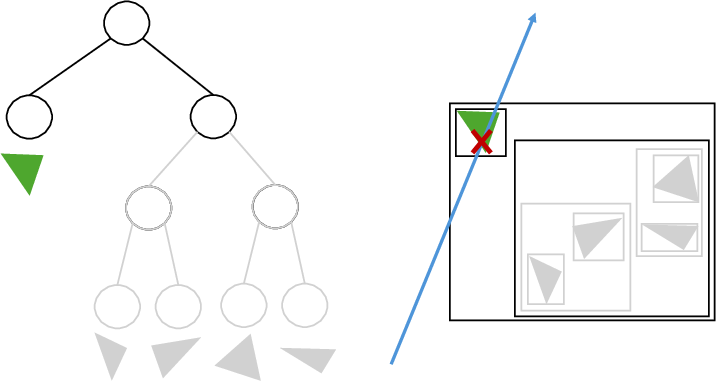
- A BVH wraps groups of triangles in boxes; if the ray misses a box, you skip all triangles inside.
- It’s like nesting boxes inside boxes—only open the ones your ray passes through.
- The report explains building BVHs (top‑down splitting or bottom‑up clustering), traversing them with a stack, and two‑level BVHs (TLAS/BLAS) for instancing and animations.
Why it matters: BVHs are a must for fast ray tracing; they reduce the number of tests dramatically.
8) Orochi and HIPRT: practical GPU tools
- HIP is AMD’s GPU programming platform; CUDA is NVIDIA’s.
- Orochi is like a universal remote: it loads the right driver at runtime, so your program can switch between AMD and NVIDIA without recompiling.
- HIPRT is AMD’s ray‑tracing library that uses hardware features (on RDNA2 and later) to accelerate ray intersections and traversal.
Why it matters: Easier cross‑vendor development and better performance with hardware acceleration.
Main findings and why they’re important
Here are the key takeaways from the report:
- Ray‑triangle intersections and camera ray generation are straightforward with clean, reusable code.
- Ambient occlusion adds believable shading cheaply; cosine‑weighted sampling improves quality.
- Path tracing produces realistic images, but needs many samples to reduce noise; Next Event Estimation cuts noise significantly at the same sample count.
- BVHs are essential for performance, turning “check everything” into “check only what matters.”
- Orochi lets one program target both AMD and NVIDIA GPUs at runtime, simplifying development and testing.
- HIPRT leverages AMD GPU hardware to accelerate ray tracing, making complex scenes faster and more robust.
These points matter because they show both the “how” (code and math) and the “why” (speed, quality, portability), helping developers build practical, high‑quality renderers.
Implications and potential impact
- Games and real‑time apps: Faster ray tracing with BVHs and HIPRT makes features like reflections, soft shadows, and global illumination more achievable in real time.
- Movies and offline rendering: Smarter sampling (like NEE) reduces noise and render times, saving time and compute costs.
- Cross‑platform tools: Orochi lowers friction when testing on different GPUs, making engines and tools more flexible.
- Education and debugging: Understanding the algorithms behind HIPRT helps developers use the library correctly and debug performance or quality issues.
In short, this report gives you the building blocks to make realistic images efficiently on modern GPUs and shows you practical tools to do it across different hardware.
Knowledge Gaps
Unresolved gaps, limitations, and open questions
Below is a consolidated, actionable list of what the paper leaves missing, uncertain, or unexplored, intended to guide follow-up research and engineering work.
- HIPRT usage is not detailed: no end-to-end example for building BLAS/TLAS, creating function tables, configuring stacks, and launching/using closest-hit/any-hit programs on RDNA2/3/4.
- No evaluation of HIPRT vs custom GPU ray tracing: lack of quantitative benchmarks (build time, traversal throughput, RT core utilization, memory footprint) across GPUs (RDNA2–RDNA3) and scenes.
- Orochi runtime switching overhead and compatibility are unassessed: no measurement of cost of dynamic dispatch, driver-version constraints, ABI stability, or behavior when mixing HIPRT (AMD) with CUDA/OptiX (NVIDIA).
- Cross-vendor ray tracing parity is unaddressed: how to express a single code path that uses HIPRT on AMD and OptiX/RTX on NVIDIA, with comparable features and outputs, is not shown.
- The ray–triangle intersection is not numerically robust: no handling of near-parallel rays (denominator near zero), degenerate/zero-area triangles, or robust epsilon policies; no discussion of double precision fallbacks, watertight tests, or edge-function variants (e.g., Möller–Trumbore vs watertight barycentric).
- Critical correctness bug in Listing “Rendering a single triangle”: intersectRayTriangle is called with rayDirection replaced by rayOrigin; no tests to catch such regressions are included.
- Intersection outputs are incomplete: no barycentric coordinates (needed for texture mapping, interpolation), no face orientation/backface flags, and no per-vertex normal interpolation or shading normal handling.
- Backface culling and two-sided materials are not discussed: policy for culling vs two-sided shading and its effect on visibility and lighting is missing.
- Self-intersection mitigation is simplistic: fixed 1e-4 offset lacks scale-aware strategy (e.g., ray-bias based on t, scene scale, or normal-dependent offsets) and no evaluation of artifacts (acne, light leaks).
- RNG is unspecified: generator type, seeding per-thread/pixel, correlation avoidance, performance, and statistical quality (vs blue-noise or quasi-random sequences) are not covered; no guidance for scrambling or decorrelation on GPUs.
- Path termination is incomplete: no Russian roulette scheme is described; reliance on fixed max depth risks bias or excess cost; termination criteria vs throughput magnitude are not addressed.
- Throughput and PDFs are simplified to Lambertian color: missing cosine and PDF factors in throughput updates, risking unit/energy inconsistencies; no unit analysis of radiance/irradiance factors.
- Next Event Estimation (NEE) omits Multiple Importance Sampling (MIS): no combination of BSDF- and light-sampled paths; no power-based light selection; handling of delta lights (point/spot, specular) and environment lights is not discussed.
- Environment lighting is trivialized: no importance sampling of HDR environment maps, nor PDFs and sampling strategies for distant lights.
- BRDF/BSDF coverage is minimal: only diffuse; no specular/glossy/transmissive/microfacet models, Fresnel, roughness, or participating media; no corresponding sampling/PDF derivations or MIS with light sampling.
- Denoising is absent: no integration or evaluation of GPU denoisers (e.g., SVGF, OIDN, NRD), no metrics (PSNR/SSIM), and no impact assessment on sample counts.
- Anti-aliasing and reconstruction filtering are missing: no pixel jittering, reconstruction filters, texture filtering/MIP-mapping in ray tracing, or temporal accumulation strategies.
- Camera model is basic: thin-lens depth of field, motion blur, rolling shutter, and calibration for the radial distortion coefficient are not provided; the radial distortion equation in text appears malformed and is not validated.
- Ambient occlusion lacks practical accelerations: no any-hit kernels or early-out integration using HIPRT; no stratified/blue-noise sampling; no scale- or angle-aware normalization for finite ray lengths.
- BVH construction is only conceptual: no GPU-parallel builders (LBVH, HLBVH, SAH variants), build-time vs quality trade-offs, refit vs rebuild triggers, or robustness to dynamic geometry; no memory layout details or compression (quantization, 8/16-bit bounds).
- BVH traversal details are absent: no stackless/wide-BVH traversal, node ordering heuristics, short-stack strategies, packet/warp-coherent traversal, ray sorting/binning, or persistent-thread pipelines for GPUs.
- Two-level hierarchy section is incomplete and truncated: no ray transformation into instance space, instance stack/stack size management, motion transforms, instance masking/visibility flags, or cost of deep instancing.
- AABB-ray intersection code and robustness are not provided: no slab test implementation, precision considerations, or SIMD-friendly layout for GPU.
- Memory layout and scalability are unaddressed: no structure-of-arrays vs array-of-structures comparisons, alignment/cache behavior, node compaction, build-time memory peaks, or out-of-core streaming strategies for large scenes.
- Hardware RT feature coverage is unspecified: HIPRT’s supported primitive types (triangles, AABBs, curves), custom intersectors, any-hit/closest-hit semantics, traversal flags/masks, precision limits, and stack limits are not documented.
- Multi-GPU execution is unexplored: no split-frame vs tile-based strategies, peer-to-peer transfers, load balancing, synchronization/accumulation schemes, or determinism across devices.
- Performance portability across HIP/CUDA backends is not quantified: occupancy, divergence, register pressure, wavefront/warp management, and stream/async scheduling on AMD/NVIDIA are not evaluated.
- Validation and testing are lacking: no unit/property tests for intersection routines (including degenerates and extreme scales), no convergence/variance analysis for Monte Carlo estimators, no artifact cataloging (fireflies, shadow terminator).
- Reproducibility is not ensured: missing code repository, fixed seeds, scene assets, exact compiler/driver versions, GPU SKUs, and parameters to reproduce all figures.
- Integration with graphics APIs is not discussed: no HIPRT interop with Vulkan/DXR/Direct3D for presentation, no zero-copy/interop paths or synchronization models.
- Debugging/profiling guidance is missing: no workflow for diagnosing HIP/HIPRT kernels, capturing rays, inspecting AS structures, or using profilers; no error-handling patterns for runtime failures.
- Security/robustness to malformed inputs is not addressed: no input validation for meshes (NaNs, infs, degenerate triangles) or AS build-time checks/failures.
- Mathematical typos/omissions exist: equations for t (missing parenthesis) and lens distortion (missing delimiter) appear malformed; corrected, unit-checked formulas are not provided.
Practical Applications
Immediate Applications
The paper’s implementations (HIP/HIPRT/Orochi, ray–triangle intersection, camera/lens modeling, ambient occlusion, path tracing with next-event estimation, and BVH) can be applied directly in several domains today:
- Cross-vendor GPU ray tracing runtime for mixed AMD/NVIDIA fleets using Orochi
- Description: Write once against Orochi’s HIP-like API and select HIP or CUDA backends at runtime without recompilation; run on both vendors concurrently in one process.
- Sectors: software infrastructure, rendering tools, HPC visualization.
- Tools/Workflows: Orochi library, HIP/HIPRT or CUDA drivers; automated backend selection in CI; heterogeneous GPU job schedulers.
- Assumptions/Dependencies: Windows/Linux access to vendor driver DLL/SO; feature parity differences across HIP/CUDA handled in app; ROCm/HIPRT installed for AMD path; driver version compatibility.
- AMD GPU-accelerated offline and interactive path-traced rendering (with Next Event Estimation)
- Description: Build a physically based renderer on HIP/HIPRT, leveraging RDNA2+ ray tracing hardware; NEE reduces variance for area lights, enabling practical sample counts.
- Sectors: film/VFX, product visualization, architecture (archviz), DCC tool pipelines.
- Tools/Workflows: HIPRT SDK kernels (closest-hit/any-hit), scene importers, multi-GPU batch rendering, per-shot render farms on AMD hardware.
- Assumptions/Dependencies: Denoising and advanced BRDFs not covered here must be added for production quality; memory fit for large scenes; robust texture/instancing support via HIPRT.
- Real-time and near-real-time ray-traced effects on AMD GPUs
- Description: Integrate HIPRT-based ray queries for shadows, reflections/refractions, ambient occlusion, depth-of-field in custom engines or visualization apps.
- Sectors: industrial visualization, simulation dashboards, training simulators, CAD viewers.
- Tools/Workflows: HIPRT any-hit for shadow rays, max ray length for AO; hybrid raster+RT pipelines; temporal accumulation and simple denoisers.
- Assumptions/Dependencies: Tight frame-time budgets require careful BVH reuse and temporal techniques; HIPRT integration rather than DXR/Vulkan RT paths (engine-dependent).
- Ambient occlusion baking and analysis
- Description: Use cosine-weighted sampling plus any-hit rays with bounded lengths to bake AO textures or generate AO-based shape analyses (false-color maps).
- Sectors: games (content baking), DCC, CAD/QA, cultural heritage digitization.
- Tools/Workflows: HIP/HIPRT AO kernels, UV baking pipeline, content build farm; AO-driven LOD or cavity masks.
- Assumptions/Dependencies: UV unwrapping quality; AO is an approximation (not physically exact); parameter tuning for ray length and sample count.
- Teaching labs and research prototypes in rendering
- Description: Use the provided step-by-step kernels (ray–triangle, camera, sampling, path tracing, NEE, BVH) for coursework, replication, and rapid prototyping.
- Sectors: academia (graphics courses), research labs.
- Tools/Workflows: HIP-based assignments, Orochi to run on lab machines with mixed GPUs; side-by-side comparisons of samplers and estimators.
- Assumptions/Dependencies: Students need C++/GPU programming basics; access to AMD/NVIDIA drivers.
- Camera and lens distortion simulation for virtual imaging
- Description: Render with pinhole and radial distortion models to match or stress-test real camera pipelines.
- Sectors: robotics vision testing, photography software, AR/VR content preview.
- Tools/Workflows: Parameter sweeps for distortion; synthetic dataset generation; calibration validation.
- Assumptions/Dependencies: Real lenses often require higher-order distortion/PSF models; matching sensor noise/color pipeline is out of scope.
- Fast BVH-based ray queries for collision/visibility in simulators
- Description: Use BVH traversal and any-hit/closest-hit queries for visibility checks, rapid occlusion tests, and simple collision proxies.
- Sectors: robotics simulators, digital twins, training environments.
- Tools/Workflows: Two-level (TLAS/BLAS) instancing for scenes with repeated assets and rigid transforms; per-step BVH refit for minor motion.
- Assumptions/Dependencies: Complex physics requires dedicated engines; deformable objects need rebuilds or advanced refit strategies.
- Heterogeneous GPU benchmarking and regression testing
- Description: Evaluate rendering kernels across AMD/NVIDIA without rebuilds; track performance, numerical robustness, and driver regressions.
- Sectors: QA/performance engineering, hardware evaluation.
- Tools/Workflows: Orochi-based test harnesses, kernel microbenchmarks (ray-box, ray-tri, traversal), scene-based suites.
- Assumptions/Dependencies: Stable driver APIs; consistent scene assets and kernels across runs.
- Content review and design decision support with AO/path-traced previews
- Description: Designers preview materials/lighting quickly with Monte Carlo rendering on local AMD GPUs.
- Sectors: industrial/product design, marketing/packaging.
- Tools/Workflows: HIPRT preview tool with NEE; material parameter sweeps; still-image approvals.
- Assumptions/Dependencies: Interactive quality requires denoising; accurate materials/environment capture may be needed.
- Mixed-vendor render farms and procurement flexibility
- Description: Avoid vendor lock-in by deploying Orochi-enabled render nodes that can exploit either vendor’s GPUs, chosen at job dispatch time.
- Sectors: VFX studios, universities/HPC centers.
- Tools/Workflows: Scheduler tags by GPU type; unified container images; driver-aware runtime selection.
- Assumptions/Dependencies: Ops maturity for multi-driver environments; monitoring for feature/parity differences.
Long-Term Applications
The paper’s methods/abstractions enable more ambitious systems with further R&D, scaling, or integration work:
- Real-time, path-traced experiences with advanced sampling and denoising
- Description: Combine HIPRT with spatiotemporal reservoirs (e.g., ReSTIR), adaptive sampling, hardware-accelerated denoisers to achieve cinematic lighting at interactive rates.
- Sectors: games, virtual production, XR.
- Tools/Workflows: Temporal reservoirs, neural denoisers, upscalers; multi-bounce MIS; dynamic scenes with fast BVH updates.
- Assumptions/Dependencies: Significant algorithmic complexity; denoising training/integration; engine hooks and content constraints.
- Physically faithful sensor simulation beyond surfaces
- Description: Extend from geometric optics to participating media and spectral transport for realistic cameras/LiDAR in adverse weather, fog, or underwater.
- Sectors: autonomous driving/robotics, defense, maritime.
- Tools/Workflows: Volume rendering (phase functions), spectral sampling, sensor response models, HIPRT extensions for volumetrics or custom kernels.
- Assumptions/Dependencies: No native volumetric transport in the paper; substantial modeling and performance work required.
- Building/energy daylighting and solar potential analysis
- Description: Monte Carlo light transport for annual daylight metrics, glare, and solar gain analyses tied to BIM/geometry.
- Sectors: AEC, energy.
- Tools/Workflows: Scene-to-BVH pipelines from BIM; sun/sky models; batched simulations on AMD clusters.
- Assumptions/Dependencies: Accurate sky/atmosphere/reflectance databases; validation vs. standards (e.g., LEED/EN).
- Medical/biological light transport simulators
- Description: Adapt Monte Carlo transport to tissue optics (scattering/absorption) for imaging and therapy planning.
- Sectors: healthcare/biophotonics.
- Tools/Workflows: GPU-accelerated random walks in volumes; wavelength-dependent properties; validation datasets.
- Assumptions/Dependencies: Requires volumetric physics, not provided here; regulatory validation hurdles.
- Cloud-scale heterogeneous rendering services
- Description: Use Orochi to elastically schedule across diverse GPU SKUs; offer rendering-as-a-service with vendor-agnostic pools.
- Sectors: cloud graphics, DCC SaaS.
- Tools/Workflows: Job routing by cost/perf; multi-tenant isolation; scene caching and BVH reuse.
- Assumptions/Dependencies: Ops for driver/firmware diversity; cost models; egress/data locality concerns.
- Large, dynamic digital twins with efficient BVH maintenance
- Description: Two-level hierarchies with aggressive refit/rebuild strategies for city-scale or factory-scale twins with streaming updates.
- Sectors: manufacturing, logistics, smart cities.
- Tools/Workflows: BLAS reuse for instanced assets; TLAS rebuilds per tick; partitioning/streaming scenes to GPUs.
- Assumptions/Dependencies: Sophisticated content orchestration; memory/latency constraints; robust LODs.
- Cross-API portability layers and standardization efforts
- Description: Influence or build higher-level portability frameworks bridging HIP, CUDA, DXR, and Vulkan RT for sustainable multi-API ecosystems.
- Sectors: standards/policy, platform vendors, open-source ecosystems.
- Tools/Workflows: Adapters/transpilers; conformance suites; governance bodies.
- Assumptions/Dependencies: Community and vendor buy-in; IP/licensing; maintenance burden.
- Automated material/light calibration pipelines
- Description: Close the loop between real captures and renders by optimizing material/lighting to match photographs using differentiable or iterative Monte Carlo.
- Sectors: e-commerce, digital twins, VFX.
- Tools/Workflows: Inverse rendering loops; differentiable render kernels; lab capture rigs.
- Assumptions/Dependencies: Differentiable HIP kernels or estimator surrogates; robust optimization.
- Safety validation frameworks using physically plausible occlusion/visibility
- Description: Use accurate ray tracing for line-of-sight and glare/veiling luminance in safety-critical simulations (e.g., AV perception edge cases).
- Sectors: automotive, transportation.
- Tools/Workflows: Scenario libraries; sensor models; statistical coverage metrics.
- Assumptions/Dependencies: Requires domain-specific validation; integration with perception stacks.
- Hardware-aware optimization toolchains
- Description: Autotuners that choose traversal/wide-BVH variants, stack configs, and kernel launch params per GPU model at runtime.
- Sectors: performance engineering, tool vendors.
- Tools/Workflows: Microbenchmark suites; model-based or ML autotuners; device capability probes via Orochi.
- Assumptions/Dependencies: Access to low-level counters; stable performance signatures across drivers.
These applications build directly on the paper’s concrete contributions: HIP-based kernels, the HIPRT framework for hardware ray tracing on AMD GPUs, Orochi for runtime backend selection across vendors, and practical algorithms (NEE, cosine-weighted sampling, BVH construction/traversal, and instancing). Feasibility hinges on hardware/driver availability, parity across backends, and, for long-term items, additional modeling (volumetrics/spectral), denoising, and substantial systems integration.
Glossary
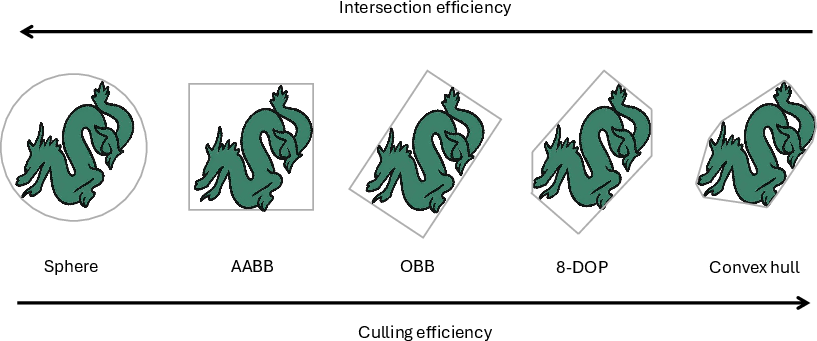
- AABB (Axis-Aligned Bounding Box): A rectangular bounding volume aligned to coordinate axes used to enclose geometry for efficient ray culling. "axis-aligned bounding boxes (AABBs)"
- Ambient occlusion: A shading technique that approximates indirect light by measuring how much nearby geometry blocks ambient light. "Ambient occlusion does not strictly follow physical light behavior and ignores multiple-bounce lighting effects"
- Any-hit kernels: GPU shaders/kernels that report whether a ray encounters any intersection, without finding the closest one, useful for visibility checks. "provide optimized any-hit kernels that can be used for such tests."
- Bidirectional Reflectance Distribution Function (BRDF): A function that describes how light is reflected at a surface given incoming and outgoing directions. "including the bidirectional reflectance distribution function (BRDF), geometry term, and probability density function (PDF)"
- BLAS (Bottom-level Acceleration Structure): The per-object BVH built over triangles; a leaf-level structure in a two-level ray tracing hierarchy. "bottom-level acceleration structure - BLAS"
- Bounding volume: A simple geometric enclosure (e.g., box or sphere) around objects used to quickly reject rays that cannot intersect the enclosed geometry. "enclose scene objects (or any subset of triangles) within simpler bounding volumes"
- Bounding Volume Hierarchy (BVH): A tree of bounding volumes that accelerates ray intersections by culling non-intersected regions and testing fewer primitives. "the bounding volume hierarchy (BVH), one of the most widely adopted acceleration data structures in modern ray tracing frameworks."
- Cosine-weighted sampling: Sampling directions on a hemisphere with probability proportional to the cosine of the angle to the surface normal, reducing variance. "Cosine-weighted sampling: we first uniformly sample points in the circle, and then project them to the hemisphere to get the random directions."
- Cornell box: A standard test scene for evaluating rendering algorithms featuring a simple room with colored walls and controlled lighting. "Cornell box rendered by ray tracing using the pinhole camera model and the camera model with radial distortion."
- CUDA: NVIDIA’s GPU computing platform and programming model for parallel programming. "we need to pass \verb|ORO_API_CUDA| instead."
- Depth-of-field: An optical effect where only objects within a certain distance range appear sharp, while others are blurred due to finite aperture. "depth-of-field (bottom-right)."
- Discrete Oriented Polytope (DOP): A tighter convex bounding volume than boxes, defined by a set of oriented planes. "discrete oriented polytope (DOP)"
- Geometry term: A factor in light transport that accounts for distance and orientation between two points, often denoted G in rendering equations. "including the bidirectional reflectance distribution function (BRDF), geometry term, and probability density function (PDF)"
- HIP: AMD’s C++ runtime API for portable GPU programming that targets AMD and NVIDIA backends. "The natural way to implement a HIP application accelerated by the GPU is to use the HIP SDK or ROCm."
- HIPRT: AMD’s ray tracing framework for HIP that leverages hardware ray tracing capabilities of AMD GPUs. "a HIP ray tracing framework - HIPRT"
- Importance sampling: A variance-reduction technique that samples more frequently from regions that contribute most to the integral (light transport). "This idea is known as importance sampling."
- Instancing: Reusing the same geometry multiple times with different transformations to reduce memory and enable efficient scene construction. "This approach allows instancing of the bottom level objects."
- Lambert’s cosine law: A model of diffuse reflection where the observed brightness is proportional to the cosine of the angle between light and surface normal. "This is known as Lambert's cosine law, which is illustrated in Figure~\ref{fig:cos}."
- Monte Carlo ray tracing: Rendering method that uses random sampling to estimate solutions to the light transport integral. "This technique is called Monte Carlo ray tracing."
- Next event estimation: An importance sampling technique that explicitly samples points on light sources and traces shadow rays to them at each bounce. "Next event estimation addresses this problem by explicitly taking the positions of light sources into account during sampling."
- OBB (Oriented Bounding Box): A bounding box that can be rotated to better fit non-axis-aligned geometry, improving culling tightness. "oriented bounding boxes (represented as AABBs with additional rotation matrices) (OBBs)"
- Orochi: An open-source library that enables runtime switching between HIP and CUDA backends without recompilation. "we introduce Orochi, an open-source library that allows to switch backends of different vendors at runtime"
- Path tracing: A Monte Carlo algorithm that traces random light paths from the camera to light sources to compute pixel radiance. "Path tracing~\cite{kajiya1986re} is one of the most popular techniques to render photorealistic images."
- Probability density function (PDF): A function defining the likelihood of sampling particular directions or points; required for unbiased estimators. "probability density function (PDF)"
- RDNA2: An AMD GPU architecture generation that includes hardware features for accelerating ray intersections. "Recent AMD Radeon HIP-compatible GPUs since RDNA2 has the capability to accelerate the ray intersections;"
- ROCm: AMD’s open software stack for GPU compute, often used with HIP. "The natural way to implement a HIP application accelerated by the GPU is to use the HIP SDK or ROCm."
- Shadow ray: A ray cast from a surface point to a sampled point on a light to check visibility (occlusion). "This ray is called a shadow ray."
- Throughput: The cumulative product of reflectance/BSDF factors along a path, scaling radiance contributions. "The accumulated product of the reflectance along the ray is called throughput."
- TLAS (Top-level Acceleration Structure): The scene-level BVH built over instances (BLAS) with per-instance transformations. "top-level acceleration structure - TLAS"
Collections
Sign up for free to add this paper to one or more collections.