- The paper demonstrates that selecting sub-basal FGK stars significantly boosts the detection rate of close-in, mass-losing exoplanets.
- It applies high-cadence RV observations and Bayesian kima modeling, carefully accounting for eccentricity to establish robust detection limits.
- Its results reveal elevated occurrence rates—such as an 83% rate for 3–10 M⊕ planets—highlighting a strong link between chromospheric absorption and planetary mass loss.
Planet Occurrence and Detection in Chromospherically Quiet Stars: The DMPP Radial Velocity Survey
Introduction and Scientific Rationale
The Dispersed Matter Planet Project (DMPP) is designed to probe the correlation between sub-basal chromospheric activity in FGK stars and the presence of close-in, mass-losing exoplanets. The project implements an a priori selection of targets exhibiting anomalously low logRHK′ (below −5.1), hypothesizing that these activity signatures result from absorption of stellar chromospheric emission by circumstellar material originating from evaporative mass loss by hot planets in tight orbits. This targeted strategy contrasts with traditional blind or volume-limited surveys, aiming to validate whether the incidence of close-in planets is indeed accentuated among sub-basal stars.
Sample Selection, Observations, and Data Handling
The initial DMPP target list comprises 39 FGK main-sequence stars with sub-basal chromospheric activity, distilled from 7864 stars via comprehensive re-analysis and filtering of archival S-index measurements. Twenty-four objects with sufficient RV sampling (≥10 epochs) form the core dataset for detection statistics. High cadence HARPS (and, for specific objects, ESPRESSO, SOPHIE, and HARPS-N) observations, primarily in visitor mode, ensure temporal sensitivity to short-period orbits.
Radial velocities (RVs) are derived through the s-BART pipeline, utilizing a Bayesian template-matching framework that minimizes stellar activity and telluric contamination effects, producing robust velocity estimates with propagated uncertainties. Data sets with known instrumental zero-point transitions (e.g., HARPS fiber upgrade, COVID shutdown) are segmented and treated with independent offsets.
Keplerian Modeling, Detection Limits, and Completeness
Analysis employs kima, a diffusive nested sampling Bayesian framework that treats the number of Keplerian signals (Np) as a model parameter, allowing formal comparison of models with different planet counts. Priors are carefully curated, particularly for orbit eccentricity (Kumaraswamy prior as a proxy for the beta distribution), semi-amplitude, and period ranges, with angular momentum deficit (AMD) stability enforced for most systems except dynamically complex cases.
Detection limits are computed for each system by running Np=1 models (post subtraction of detected signals) and extracting 99\% confidence upper limits in mass–period space. Uncertainty estimation follows the formalism in Standing et al., allowing the construction of robust completeness maps as a function of minimum mass and period.
The impact of assumed eccentricity is explicitly addressed. Restricting detection limits to circular orbits leads to a median underestimation of the true mass limit by 8% and up to nearly 40% in individual cases, confirming that eccentricity-marginalized approaches yield significantly more realistic sensitivity curves.
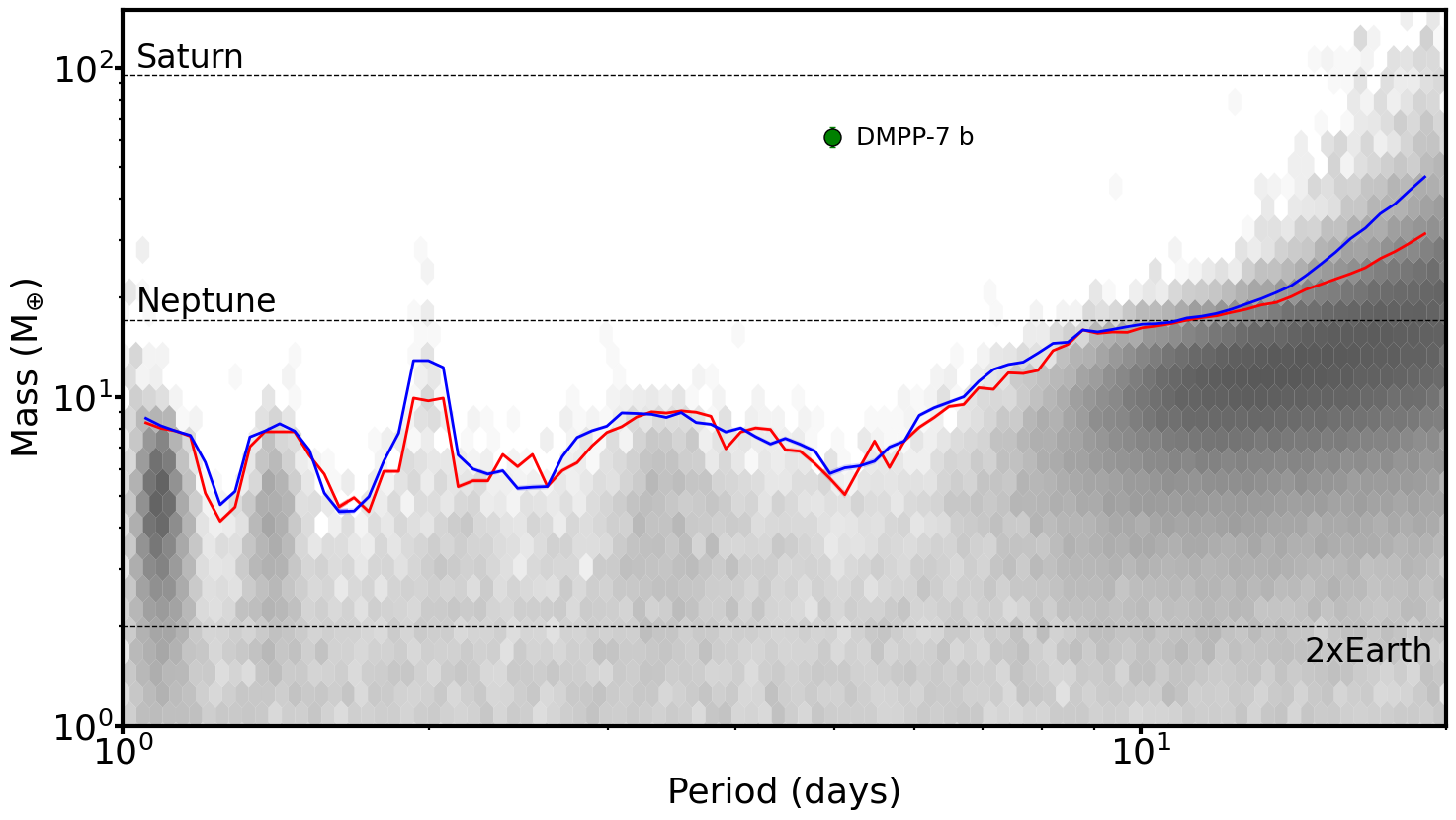
Figure 1: Detection limit analysis for HD118006 / DMPP-7, contrasting 99% upper detection limits with and without an eccentricity cut (e<0.1), and showing the location of the detected planet.
Survey Results: New Planets and System Architectures
The DMPP survey identifies 7 previously unpublished planetary signals in 5 systems, including multiple new multi-planet architectures:
- DMPP-2: Two new planets (DMPP-2c at $3.2$ d, 51.8M⊕; DMPP-2d at $16.5$ d, 91.8M⊕) join the original hot Saturn-mass planet, all in near-circular orbits.
- HD 67200 / DMPP-6: A pair of planets is strongly detected (−5.10 d, −5.11; −5.12 d, −5.13), with moderate evidence for an additional −5.14 d, −5.15 signal.
- HD 118006 / DMPP-7: A hot Neptune-mass planet at −5.16 d (−5.17), detected at high significance.
- HD 191122 / DMPP-8: A −5.18 d, −5.19 planet with moderate eccentricity (≥100).
- HD 200133 / DMPP-9: A ≥101 d, ≥102 planet.
Updated Keplerian solutions for previously published systems (e.g., DMPP-1, DMPP-3, DMPP-4, HD 181433, HD 39194) are delivered with homogeneous kima fits and supplementary observations, constraining planetary parameters and providing essential input for statistical calculations.
Survey Completeness and Abundance Analysis
Aggregating detection limits across the 24 well-sampled targets, the survey achieves high completeness for planets with ≥103 within ≥104 d and for ≥105 within ≥106 d. The completeness as a function of planet mass and period is visualized below.
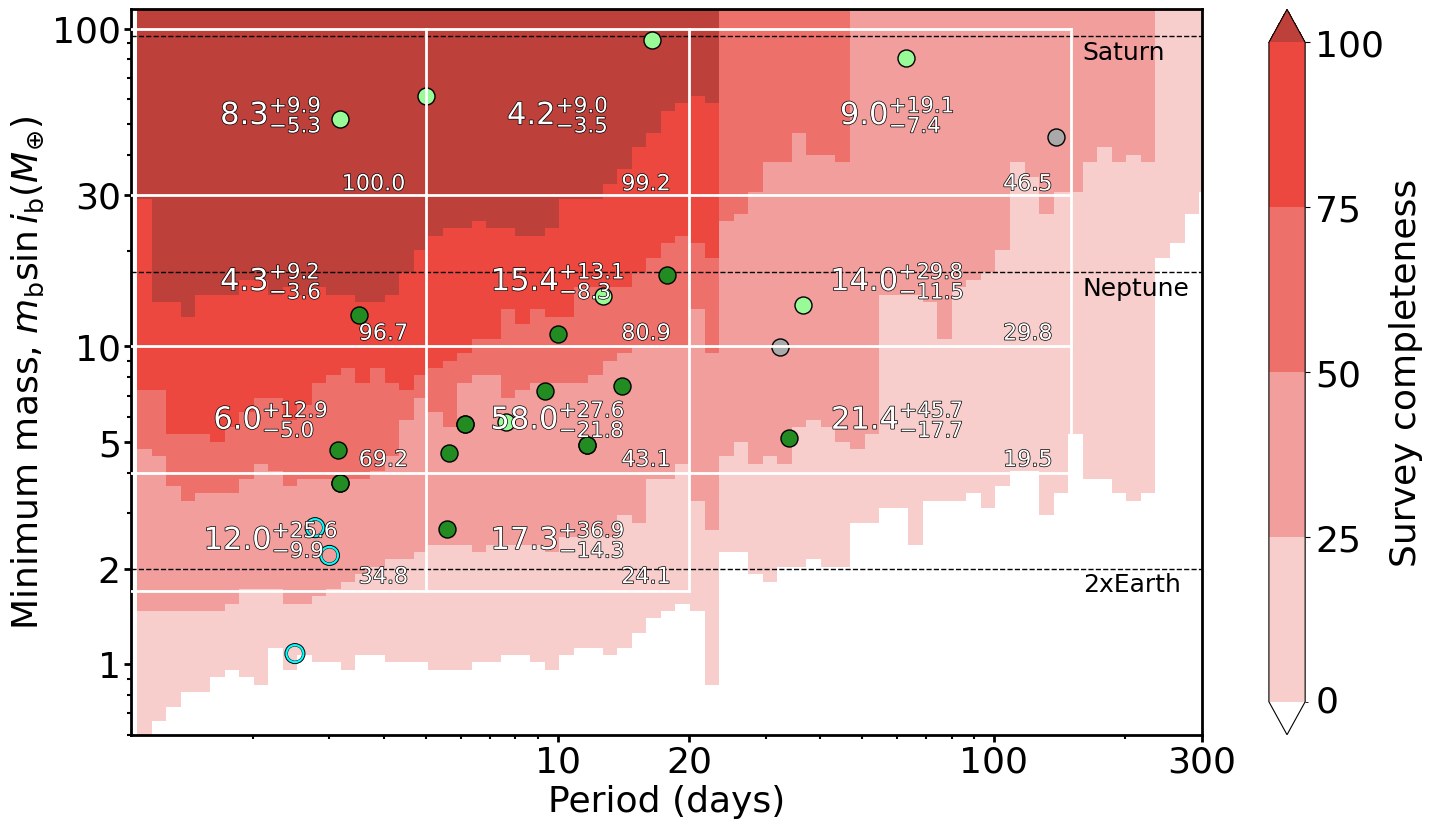
Figure 2: Survey completeness (red contours) and planet abundance as a function of minimum mass and orbital period. Newly and previously detected signals are denoted by green symbols; survey sensitivity diminishes rapidly above ≥107 d and below Neptune masses.
Planet occurrence rates in the surveyed population are:
- ≥108–≥109: Np0 for Np1 d,
- Np2–Np3: Np4,
- Np5–Np6: Np7.
These rates are substantially higher than those reported in random FGK samples from major RV surveys (e.g., Howard et al. 2010; Mayor et al. 2011; Bashi et al. 2020; see text for adjusted comparisons), providing strong support for the DMPP hypothesis that sub-basal activity stars have a strong predisposition to host short-period, mass-losing exoplanets.
Implications of Eccentricity Assumptions on Detection Limits
The study provides a detailed examination of the bias introduced by the "fixed circular" paradigm in detection limit calculations. Across the survey, detection limits computed while restricting to Np8 are systematically lower (optimistic) compared to models marginalizing over a broad eccentricity prior. For certain systems, omitting eccentric orbits can yield misleadingly stringent non-detection claims, directly impacting the inferred planet yields and occurrence rates. This reinforces the necessity for full eccentricity-marginalized inference in RV planet population studies.
Demographics and Population Insights
DMPP planets are distributed similarly to known short-period exoplanets in mass–period–radius space, but are absent at Np9 d or at Np=10. The former is likely a sensitivity limitation imposed by Np=11–Np=12 d stellar supergranulation RV noise, while the latter may reflect intrinsic rarity and selection against high-gravity planets in the DMPP mass-loss paradigm. Many DMPP systems populate the Neptune desert's upper boundary and trace the transition across the "radius valley," supporting models where instellation-driven mass loss sculpts the close-in planet population.
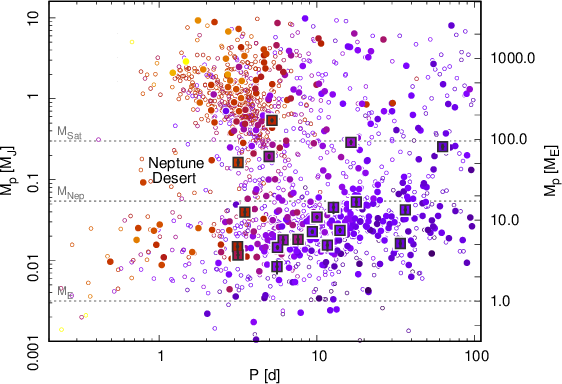
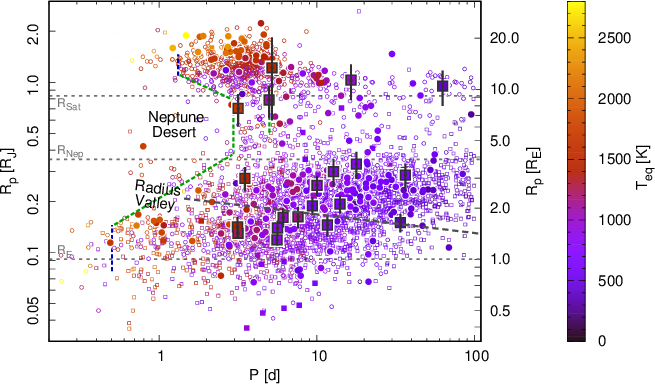
Figure 4: Distribution of DMPP planets (squares) in mass–period (left) and radius–period (right) space compared to the larger known exoplanet sample; Neptune desert and radius valley boundaries indicated.
Astrophysical and Survey Implications
The exceptional efficiency of the DMPP survey—measured at Np=13 observations per detected planet versus Np=14 in legacy surveys—validates the efficacy of selecting based on chromospheric absorption diagnostics. Furthermore, the project demonstrates that the majority of sub-basal activity stars in the solar neighborhood likely harbor close-in planets susceptible to atmospheric escape.
The DMPP approach suggests that:
- Host stars flagged as "inactive" by traditional activity indices may in reality host planetary systems with substantial mass-loss and circumstellar absorption, carrying implications for target prioritization in future RV and transit spectroscopy efforts.
- Further long-cadence, spaced observational campaigns would enhance detection sensitivity to sub-Neptune/terrestrial planets, particularly as techniques for mitigating correlated stellar photospheric noise mature.
- The demographic congruence between DMPP planets and the general population implies that mass loss is likely a common evolutionary endpoint for short-period planets.
Conclusion
The DMPP survey offers compelling statistical evidence that selecting stars with sub-basal chromospheric emission dramatically increases the detection rate of short-period, mass-losing exoplanets. The robust statistical treatment, including careful treatment of eccentricity and Bayesian model selection, yields occurrence rates far exceeding those from unbiased samples, reinforcing the connection between chromospheric absorption and planetary mass loss. This has significant ramifications for planet search strategies, our understanding of planetary system evolution under extreme instellation, and the design of spectro-photometric follow-up in the PLATO and TESS era.
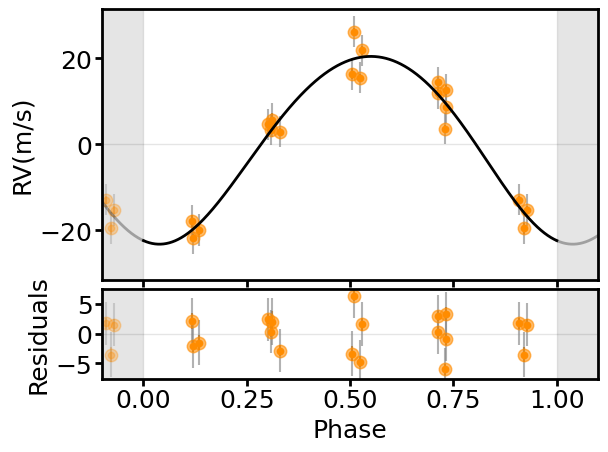
Figure 6: Keplerian fit to HD 118006 / DMPP-7b, exemplifying the quality of the RV modeling and residuals post-planet subtraction.
The work also sets a methodological standard for occurrence rate studies, especially with respect to detection limit inferences from RV data, and highlights a path toward maximizing observational yield in the search for rare evolutionary states among nearby exoplanetary systems.
References
- (2602.18207) "The Dispersed Matter Planet Project Sample -- Detection limits, Occurrence Rates and New Planets"