Position: Why a Dynamical Systems Perspective is Needed to Advance Time Series Modeling
Abstract: Time series (TS) modeling has come a long way from early statistical, mainly linear, approaches to the current trend in TS foundation models. With a lot of hype and industrial demand in this field, it is not always clear how much progress there really is. To advance TS forecasting and analysis to the next level, here we argue that the field needs a dynamical systems (DS) perspective. TS of observations from natural or engineered systems almost always originate from some underlying DS, and arguably access to its governing equations would yield theoretically optimal forecasts. This is the promise of DS reconstruction (DSR), a class of ML/AI approaches that aim to infer surrogate models of the underlying DS from data. But models based on DS principles offer other profound advantages: Beyond short-term forecasts, they enable to predict the long-term statistics of an observed system, which in many practical scenarios may be the more relevant quantities. DS theory furthermore provides domain-independent theoretical insight into mechanisms underlying TS generation, and thereby will inform us, e.g., about upper bounds on performance of any TS model, generalization into unseen regimes as in tipping points, or potential control strategies. After reviewing some of the central concepts, methods, measures, and models in DS theory and DSR, we will discuss how insights from this field can advance TS modeling in crucial ways, enabling better forecasting with much lower computational and memory footprints. We conclude with a number of specific suggestions for translating insights from DSR into TS modeling.
Paper Prompts
Sign up for free to create and run prompts on this paper using GPT-5.
Top Community Prompts
Explain it Like I'm 14
What is this paper about?
This paper argues that to truly improve how we predict and understand time series (data that changes over time, like weather, heart rate, or stock prices), we should look at them through the lens of dynamical systems. A dynamical system is a set of rules that tells you how something changes step by step or moment by moment. The authors say most real-world time series come from such underlying systems, and if we can learn the system’s rules, we can make better predictions—especially about long-term behavior.
The big questions the authors ask
- Can thinking in terms of dynamical systems help us make better time series models?
- Can we build “surrogate” models that act like the real-world system that produced the data?
- Why do current popular models (like transformers) struggle with long-term predictions?
- How do concepts like chaos and tipping points set limits on what we can predict?
- What practical steps should the time series community take to move forward?
How did they approach it? (Methods, explained simply)
Instead of running a single experiment, this is a “position” paper: it reviews ideas, compares models, and shows examples to make a case. Here are the key ideas, explained with everyday analogies:
- Dynamical systems: Imagine a video game world where objects move according to built-in rules. A dynamical system is like the game engine: it defines how positions and speeds change over time.
- State space: Picture a map where every possible situation of a system is a point (like all possible positions and speeds of a ball). As time passes, the system traces a path on this map—this path is your time series seen in “state space.”
- Attractors: These are “destinations” that paths tend to end up in. Some attractors are:
- A point (the system settles down—like a ball at the bottom of a bowl).
- A loop (the system repeats—like a clock hand going around; called a limit cycle).
- A complex, messy shape with fractal structure (this is a chaotic attractor; you never get exactly the same values again, even without noise).
- Basins of attraction: Think of different valleys leading to different destinations. Where you start determines where you end up.
- Bifurcation and tipping points: A tipping point is like flipping a switch—when a small change in conditions suddenly pushes the system into a new kind of behavior. A bifurcation is when the system’s map itself changes shape, creating or removing destinations.
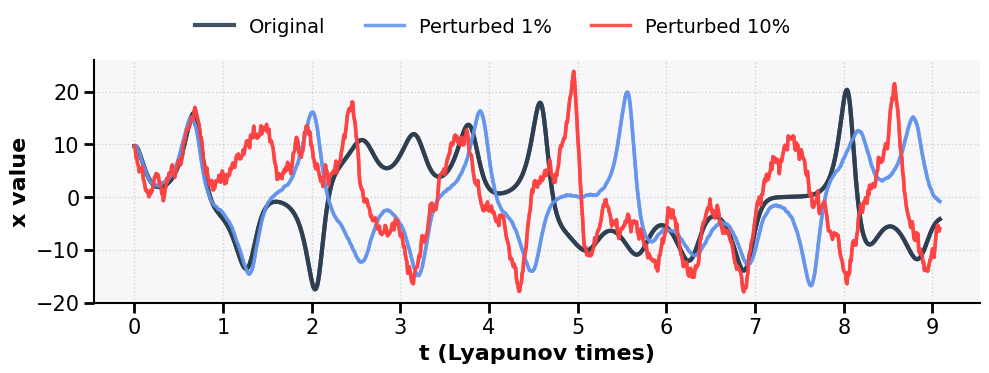
- Lyapunov exponent: This measures how fast small differences grow over time. If it’s positive, tiny errors (like starting a fraction of a step apart) can quickly explode—this is chaos. In chaotic systems, long-term precise prediction is fundamentally limited.
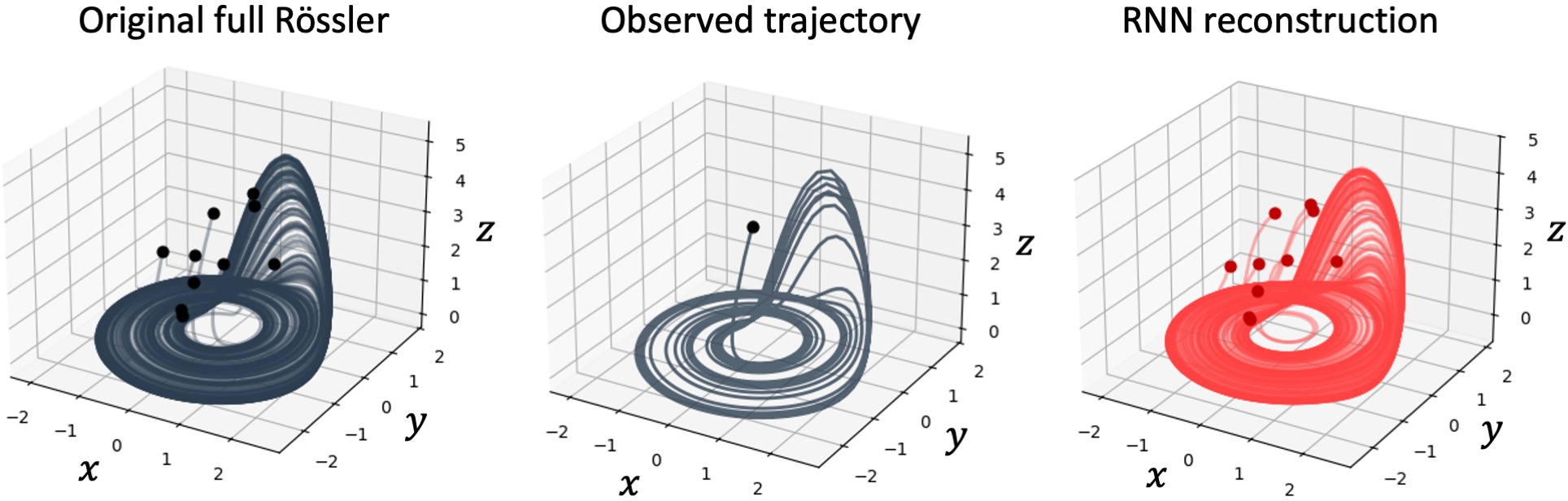
- Dynamical Systems Reconstruction (DSR): This is a way to build a “digital twin” of the system directly from its time series. Instead of just predicting the next few steps, DSR tries to learn the actual rules (or a close copy) that generate the data, so the model behaves like the real system in the long run.
- Models used for DSR: The paper talks about several families of models, including:
- Recurrent neural networks (RNNs) and simple piecewise-linear models (think: small rule blocks stitched together).
- Reservoir computing, SINDy (finding sparse equations), Koopman-based methods, and Neural ODEs (continuous-time models).
- They explain why transformer models (popular in language AI) often aren’t ideal for learning true time dynamics—because they don’t naturally represent the flow of time as a built-in rule.
- Training techniques that focus on long-term behavior:
- Generalized Teacher Forcing (GTF) and Sparse Teacher Forcing (STF): training tricks that let models “roll out” long sequences while staying stable, helping them learn the system’s long-term statistics and avoid exploding errors.
- Losses based on the system’s invariant properties: things like the power spectrum (which frequencies the system tends to produce) or Lyapunov exponents; these teach the model to match the system’s overall behavior, not just the next step.
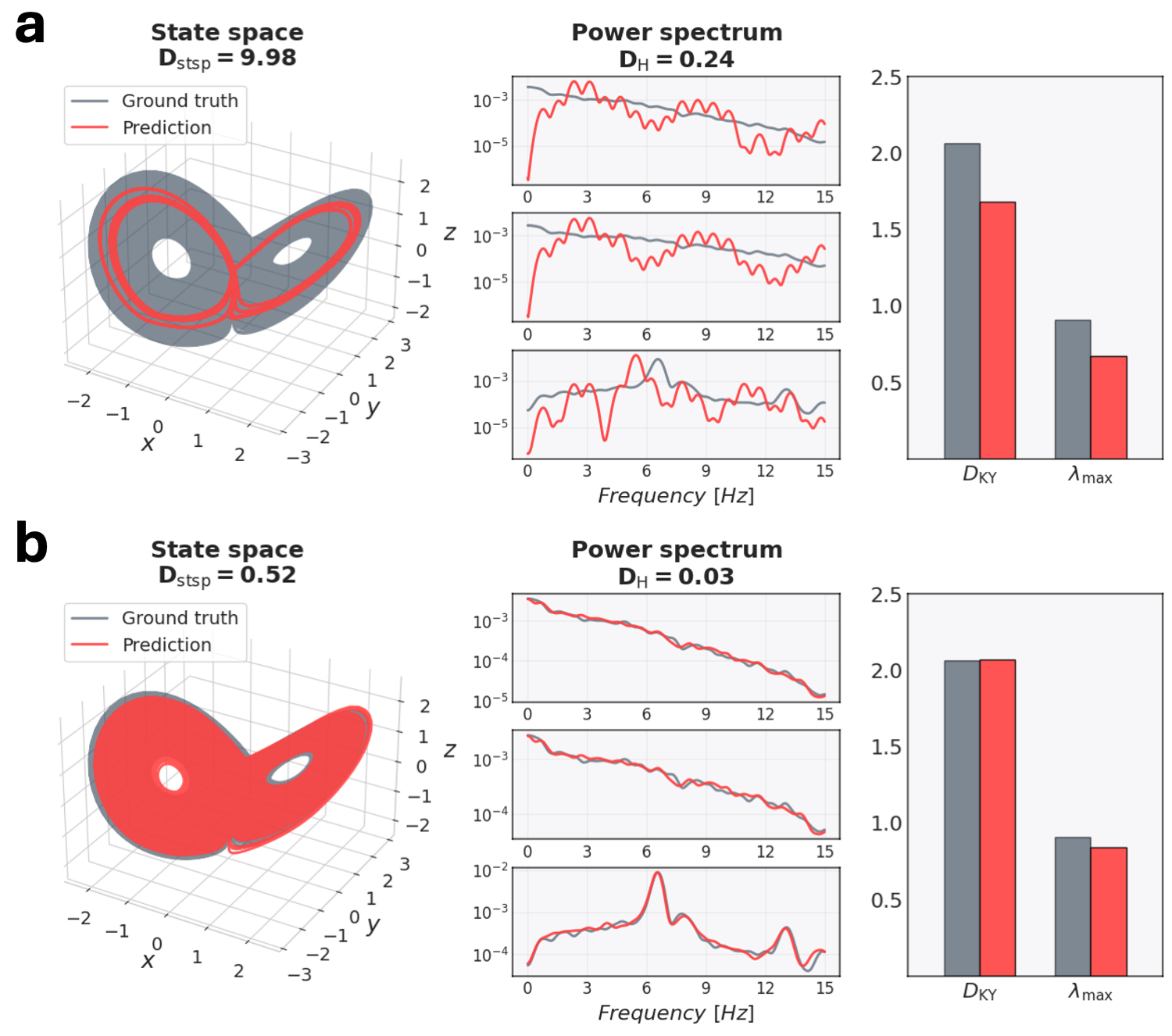
- How they judge success: Instead of only looking at short-term error (like MSE), they also compare the shapes of attractors, long-term statistics, and measures like the maximum Lyapunov exponent—asking, “Does the model behave like the original system over long times?”
What did they find, and why does it matter?
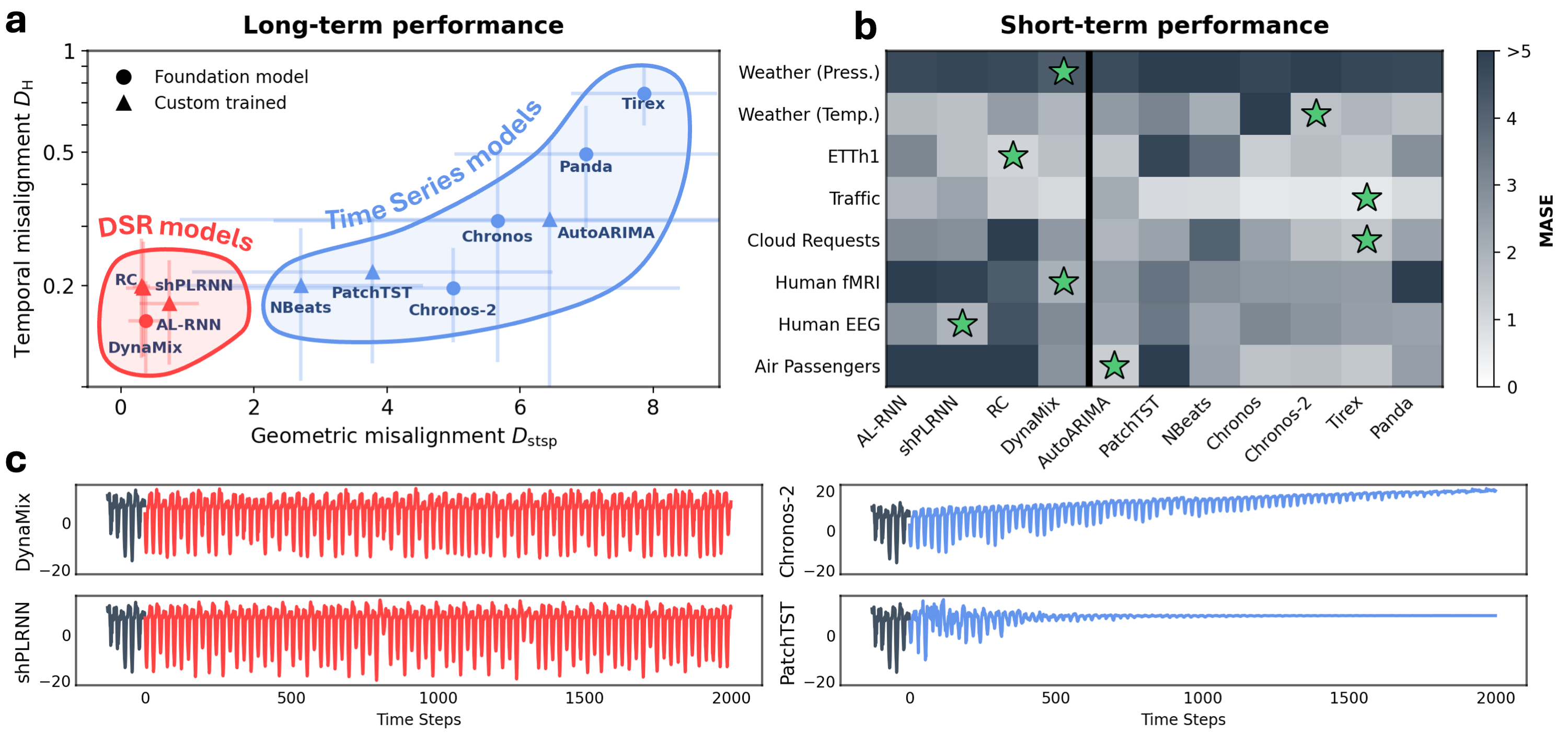
- Models built with dynamical system principles (DSR) are much better at long-term behavior:
- They reproduce the correct attractor geometry and long-term patterns.
- In contrast, many standard time series models either drift off or collapse to simple behavior (like a flat line or a boring loop) when you simulate them far into the future.
- Surprisingly, DSR models can also do very well—even better—on short-term predictions in some real datasets:
- This suggests that training with long-term structure in mind helps short-term accuracy too.
- Chaos sets hard limits on forecasting:
- If the system is chaotic, small errors grow fast. That means precise long-term predictions will fail beyond a certain horizon, no matter how fancy the model is. In noisy chaos, even predicting beyond one “Lyapunov time” can be unrealistic.
- Simpler can be better:
- Some DSR models are small and simple yet match or beat complex models on both short- and long-term tasks. The authors claim good training and the right design matter more than huge architectures.
- Foundation models that learn true dynamics are rare but promising:
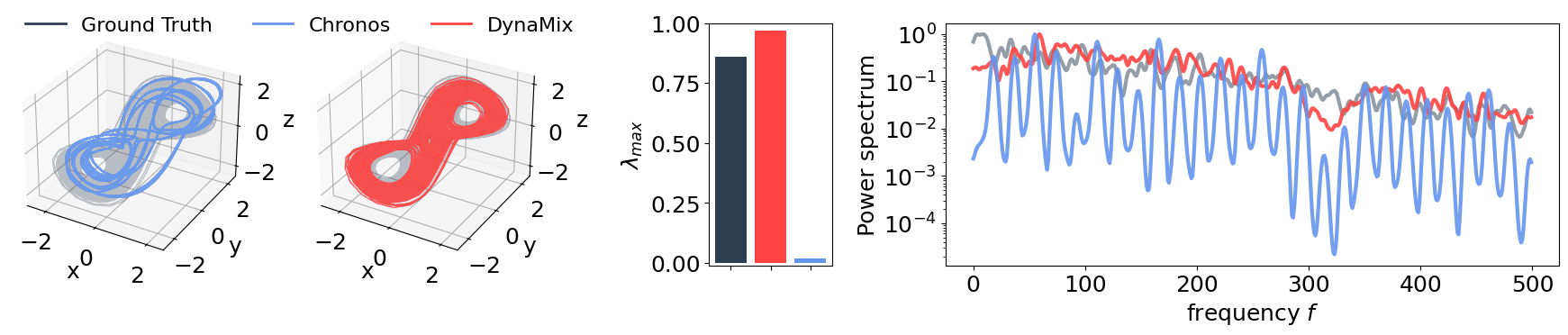
- They highlight “DynaMix,” which they say is trained using DSR principles and can capture long-term behavior and attractors, unlike several transformer-based time series foundation models that tend to “parrot” the recent context and become nearly periodic (which is wrong for chaotic systems).
- Tipping points can sometimes be predicted if you learn the system:
- If you capture the underlying rules, you can sometimes foresee when the system will switch regimes (like climate shifts or changes in human health). This is a special kind of “out-of-domain” generalization and is very hard—but the DS perspective offers tools and hope.
What does this mean for the future? (Implications and impact)
The authors end with practical suggestions for the time series field:
- Use DSR-style training tricks:
- Techniques like GTF and STF, or losses based on long-term invariants, can improve both short- and long-term predictions and reduce computational needs.
- Pre-train on simulated dynamical systems:
- Instead of stitching together artificial time series, train models on rich simulations (especially chaotic ones) that naturally include many time scales and patterns.
- Consider moving back toward modern RNNs (or continuous-time models):
- Transformers revolutionized language, but for time series they often struggle with true time dynamics. RNNs and related models natively represent “state evolving over time.”
- Face the hard problems:
- Work on forecasting across topological shifts (real tipping points), possibly by learning control parameters and training on systems that undergo regime changes.
- Focus on mechanisms, not just patterns:
- Understanding the “engine under the hood” lets you reason about what happens under new conditions—like policy changes, rare events, or medical interventions.
In short, the paper encourages the field to shift from just pattern-matching the next few steps to learning the actual rules that drive a system. That change helps with long-term understanding, makes models more robust, and can even boost short-term accuracy. It also opens the door to better handling of chaos, tipping points, and other real-world challenges where simple pattern recognition falls short.
Knowledge Gaps
Knowledge gaps, limitations, and open questions
Below is a single, concise list of what remains missing, uncertain, or unexplored, framed to guide actionable future research.
- Robust DSR under partial observability: How to reliably reconstruct dynamics (and attractor topology) from low-dimensional, noisy observations without access to all state variables, especially in high-dimensional systems and with unknown observation functions.
- Short/noisy data regimes: Methods to estimate invariant measures (e.g., Lyapunov exponents, fractal dimensions, power spectra) and to train long-term–aware models when only short, non-stationary, or interrupted sequences are available.
- Reliable Lyapunov-aware training: Practical procedures to estimate maximal Lyapunov exponents online from data for STF/GTF schedules, with confidence intervals and robustness to noise and partial observability.
- Non-autonomous and stochastic DS reconstruction: General-purpose algorithms (and theory) to reconstruct pullback/forward attractors and time-varying vector fields with exogenous inputs and dynamical noise, including irregular sampling and missing data.
- Identifiability and uniqueness: Conditions (and diagnostics) under which reconstructed models are unique up to topological conjugacy; characterization of nonidentifiability from finite, noisy samples and partial observations.
- Topological OOD generalization: Concrete training strategies and guarantees for forecasting through topological shifts (tipping points), including detecting impending bifurcations, estimating control parameters from data, and extrapolating post-bifurcation dynamics.
- Multistability coverage: Data collection and training schemes to ensure sufficient sampling of multiple basins and rare transitions; active exploration and experiment design to reveal unseen regimes.
- Quantifying trade-offs: Formalization and optimization of the trade-off between short-term forecast accuracy and long-term invariant-statistics fidelity; loss functions and evaluation protocols that balance both targets.
- Uncertainty quantification: Principled methods to quantify and propagate aleatoric and epistemic uncertainty in long-term statistics, tipping-point prediction, and control derived from DSR models.
- DS-informed foundation models beyond deterministic DS: Generalization of DSR FMs (e.g., DynaMix) to non-stationary, stochastic, and event-driven real-world TS with exogenous covariates, calendar effects, interventions, and structural breaks.
- Data modalities and types: DSR for count, ordinal, categorical, and mixed-type data at scale; handling irregular intervals and heterogeneous sensors in a unified framework.
- Scalability to very high dimensions: Algorithms for discovering invariant sets (fixed points, cycles, manifolds) and performing bifurcation analysis in high-dimensional learned DS, with computational guarantees.
- Transformer/SSM architectures for DS reconstruction: Designing sequence models (e.g., structured state-space models, implicit layers, continuous-time transformers) that natively approximate flow maps and pass DSR evaluations on chaotic systems.
- Evaluation benchmarks and metrics: Standardized benchmarks that emphasize long-term “climate” statistics, multistability, and tipping points (including post-tipping extrapolation), with robust metrics for finite/noisy data and confidence reporting.
- Fairness and reproducibility in comparisons: Protocols that equalize training budgets, parameter counts, context lengths, and data availability when comparing DSR and TS models, especially for foundation models.
- Context integration: Methods to couple DSR with external knowledge (e.g., LLMs) and structured covariates while maintaining dynamical consistency and interpretability of the reconstructed vector field.
- Learning control parameters and drivers: Joint inference of latent states and slowly varying control parameters from data, with identifiability analysis and mechanisms to separate drivers from internal dynamics.
- Control from learned dynamics: Closed-loop validation of control strategies derived from learned vector fields (robustness to model mismatch, safety constraints, and performance under stochastic disturbances).
- Training stability on chaotic targets: Gradient-stable objectives and optimizers for long-horizon training on chaotic systems without relying on heavy teacher forcing; alternatives to Lyapunov-based schedules when exponent estimates are unreliable.
- Sample complexity bounds: Learning-theoretic analyses that relate data length/quality and observation richness to reconstruction error in topology, geometry, and long-term statistics.
- Pretraining corpora design: Principles for curating families of simulated DS (diversity in topology, dimensionality, noise regimes) that maximize transfer to real-world TS; ablations on which DS properties are crucial for generalization.
- Detecting and mitigating context parroting: Systematic tests and corrective training procedures to prevent periodic “parroting” failure modes in TS FMs when targeting chaotic or aperiodic dynamics.
- Piecewise-linear (PL) model limits: Characterizing when PL approximations become inadequate (e.g., smooth stiff dynamics, high-curvature manifolds) and when hybrid PL/smooth models or adaptive partitioning are necessary.
- Mixed evaluation horizons: Practical guidance on selecting forecast horizons relative to Lyapunov times and noise levels, and on reporting both short-horizon error and long-term statistics with uncertainty.
These gaps highlight concrete directions for methods, theory, and benchmarking needed to translate the dynamical-systems perspective into broadly useful time series modeling tools.
Practical Applications
Immediate Applications
The following applications can be deployed now by practitioners to improve time series modeling, evaluation, control, and decision-making using dynamical systems (DS) and dynamical systems reconstruction (DSR) principles.
- Chaos-aware forecasting and evaluation
- Description: Set forecast horizons by estimated Lyapunov time; stop using MSE/MAPE beyond the chaos horizon; evaluate long-term performance with invariant-statistics measures (e.g., geometry distance in state space, power-spectral distances).
- Sectors: software/ML platforms, energy, finance, climate, operations.
- Tools/Workflow: “Chaos-aware Evaluator” that estimates Lyapunov exponents from rolling windows; use and for long-term rollouts; adopt MASE for short horizons.
- Dependencies/Assumptions: Requires sufficiently long sequences to estimate exponents (often T ≥ 1000–10,000), stationarity during windows, appropriate smoothing and delay embedding when partial observations.
- Integrate DSR training techniques into existing TS models
- Description: Add sparse teacher forcing (STF) and generalized teacher forcing (GTF) to training loops, include long-horizon rollouts and invariant-statistics regularizers to stabilize training and improve short- and long-term accuracy.
- Sectors: software/ML, robotics, energy, finance, manufacturing.
- Tools/Workflow: Plug-in training recipes (STF, GTF), loss terms for Lyapunov, fractal dimension, or invariant measures; long-rollout training curriculum.
- Dependencies/Assumptions: Access to a state estimator or inverse observation mapping for teacher forcing; GPU resources for rollouts; hyperparameter tuning based on Lyapunov time.
- Deploy compact DSR models for long-term statistics and short-term forecasts
- Description: Use AL-RNN, shPLRNN, reservoir computing (RC), SINDy, Koopman, or Neural ODEs to reproduce attractor geometries and long-term statistics, while delivering competitive short-term forecasts.
- Sectors: climate (long-term “climate” of variability), healthcare (symptom trajectories, neurophysiology), energy (demand/supply profiles), traffic.
- Tools/Workflow: Model zoo of DSR architectures with standardized evaluation (state space overlap, spectral similarity); inference via long rollouts; interpretability via vector fields/invariant objects.
- Dependencies/Assumptions: Ergodic behavior over evaluation windows; adequate sampling rate; delay embedding for partial observability; noise-robust training.
- Tipping point early warning (N-tipping and B-tipping)
- Description: Monitor proximity to basin boundaries and slowly varying control parameters to flag risk of abrupt regime changes (e.g., grid instability, sepsis onset, market regime shifts).
- Sectors: climate, power/energy grid ops, healthcare, finance, public safety.
- Tools/Workflow: “Tipping Point Monitor” combining DSR-based state-space tracking, control parameter inference, and probability of basin crossing; dashboards with early-warning indicators.
- Dependencies/Assumptions: Reliable state-space reconstruction; proxy features for control parameters; streaming data quality; calibration with historical transitions.
- Mechanism-aware control and intervention design
- Description: Use learned surrogate vector fields/flow maps to compute optimal control strategies and interventions (e.g., treatment schedules, process tuning, robotics trajectories).
- Sectors: healthcare, industrial process control, robotics.
- Tools/Workflow: DSR-driven digital twins; optimal control solvers (MPC) on learned DS; counterfactual simulation of interventions.
- Dependencies/Assumptions: Continuous-time models or discretization with known inputs; robustness to process noise; governance/regulatory acceptance in safety-critical domains.
- Pretrain or fine-tune TS models on DS simulation corpora
- Description: Replace artificial concatenations with curated libraries of simulated DS (including chaotic systems) to expose models to rich time scales and patterns.
- Sectors: ML foundation models, enterprise analytics.
- Tools/Workflow: “DS Simulator Pretraining Suite” with diverse DS families and parameter sweeps; curriculum over chaotic and multistable regimes.
- Dependencies/Assumptions: Access to DS simulators and compute; alignment between simulated and target domain statistics; avoid overfitting to simulator artifacts.
- Favor modern RNNs over transformers for TS tasks
- Description: Use Mamba, xLSTM, continuous-time RNNs, or Neural ODEs for time series to better model flows and recursions, leveraging DSR training methods.
- Sectors: software/ML, embedded/edge analytics, robotics.
- Tools/Workflow: Architecture migration guides; GPU-efficient state-space models; control-theoretic training loops.
- Dependencies/Assumptions: Engineering effort for migration; performance validation on existing datasets; ops integration.
- Attractor-based anomaly detection and stability monitoring
- Description: Detect deviations from learned attractor geometry and invariant statistics as anomalies; flag unstable manifolds or drift toward basin boundaries.
- Sectors: manufacturing/IIoT, cybersecurity for ICS, energy, transportation.
- Tools/Workflow: “Attractor Analytics” with thresholds on , spectral distances, Lyapunov changes; alerting systems tied to control rooms.
- Dependencies/Assumptions: Established baseline attractor; sufficient data for stable statistics; handling seasonal/non-stationary effects.
- State-space reconstruction workflow for partially observed systems
- Description: Apply delay embedding to lift observed signals into a reconstructed state space; compute fractal dimensions, Lyapunov spectra, and invariant measures.
- Sectors: academia (neuroscience, ecology, physics), R&D in industry.
- Tools/Workflow: Embedding dimension/lag selection (e.g., FNN, mutual information); estimation pipelines for chaos indicators.
- Dependencies/Assumptions: Adequate sampling, low measurement noise, stationarity in windows; consistent observation function.
- Team enablement and governance for DS-informed TS
- Description: Train data science teams in DS concepts; update model governance to recognize chaos limits, long-term metrics, and regime-shift risks.
- Sectors: cross-sector analytics, MLOps.
- Tools/Workflow: Short courses, checklists for chaos-aware SLAs, documentation templates for DS interpretable artifacts.
- Dependencies/Assumptions: Organizational buy-in; curated examples demonstrating ROI; alignment with compliance requirements.
Long-Term Applications
These applications require further research, scaling, validation, or integration into broader socio-technical systems before routine deployment.
- Robust OOD generalization across topological shifts
- Description: DS-informed models that extrapolate through bifurcations and regime changes by jointly inferring control parameters and leveraging pretraining on related systems.
- Sectors: climate adaptation, macro-finance, epidemiology, energy grid resilience.
- Tools/Workflow: Hybrid DSR with control-parameter inference; scenario generators with tipping regimes; meta-learning across DS families.
- Dependencies/Assumptions: Reliable identification of latent drivers; theoretical/empirical guarantees for extrapolation; high-quality multi-regime data.
- DS + LLM hybrids for context-informed forecasting and control
- Description: Combine DSR with LLMs’ world knowledge to incorporate external events, policies, and covariates into mechanistic forecasts and intervention planning.
- Sectors: public policy, supply chain, healthcare operations, emergency management.
- Tools/Workflow: Modular pipelines where LLMs propose context variables and DSR simulates mechanistic outcomes; joint fine-tuning.
- Dependencies/Assumptions: Safe integration and attribution; data privacy; reliable grounding of LLM outputs.
- Scalable DSR for high-dimensional, stochastic, non-autonomous systems
- Description: Toolkits that reconstruct dynamics from noisy, multi-sensor streams with explicit inputs and process noise, supporting pullback attractor analysis.
- Sectors: neuroscience, IoT, autonomous systems, complex manufacturing.
- Tools/Workflow: Efficient algorithms for manifold discovery, invariant object detection at scale; streaming delay embedding; uncertainty-aware training.
- Dependencies/Assumptions: Advances in algorithms and compute; robust noise modeling; standardized data schemas.
- Regulatory-grade digital twins for healthcare and energy
- Description: Validated DS-based twins that guide treatments (e.g., for long-COVID, sepsis) or grid interventions; provide interpretable mechanisms and control guarantees.
- Sectors: healthcare, energy utilities.
- Tools/Workflow: Clinical trials and regulatory audits; safety cases; MPC over surrogate DS with guardrails.
- Dependencies/Assumptions: Clinical validation; ethical approval; strong causal evidence connecting DS to outcomes.
- Consumer-grade apps for mechanism-aware wellness and home energy
- Description: Wearables and smart home systems forecasting long-term trends and offering intervention recommendations grounded in DS models.
- Sectors: daily life (health, home energy), smart devices.
- Tools/Workflow: Edge-deployable compact DS-informed models (DynaMix-like); privacy-preserving analytics; user-friendly explanations.
- Dependencies/Assumptions: On-device compute; user consent; robustness across individuals and devices.
- Standardized benchmarks and governance for DS-informed TS modeling
- Description: Community datasets and metrics emphasizing long-term invariant statistics, chaos indicators, and tipping transitions; governance guidelines for use.
- Sectors: academia, standards bodies, ML research.
- Tools/Workflow: Benchmark suites (chaotic/multistable DS, non-autonomous cases), shared evaluation tooling.
- Dependencies/Assumptions: Broad community adoption; sustained funding; interoperability across platforms.
- National-scale early-warning systems for tipping points
- Description: Real-time monitoring for climate, ecosystem, and grid stability using attractor proximity and control-parameter trends.
- Sectors: public sector, environmental agencies, utilities.
- Tools/Workflow: Streaming analytics infrastructures; cross-agency data sharing; decision support dashboards.
- Dependencies/Assumptions: Reliable sensing networks; data governance and funding; public trust and policy protocols.
- Automated discovery of governing equations at scale (SINDy/Koopman)
- Description: Equation discovery pipelines that reveal mechanisms driving complex processes (materials, bio-systems, robotics), accelerating scientific innovation.
- Sectors: academia, materials science, pharma R&D, robotics.
- Tools/Workflow: Sparse regression over feature libraries; Koopman embeddings; experimental design for identifiability.
- Dependencies/Assumptions: High-quality, informative data; domain-informed features; validation experiments.
- DS-informed, compact TS foundation models for edge deployment
- Description: Foundation models trained on DS simulations to deliver integrated representations and long-term accuracy with tiny parameter counts.
- Sectors: mobile/edge, industrial IoT, embedded analytics.
- Tools/Workflow: DynaMix-like training with chaotic DS; distillation to edge hardware; unified representation learning.
- Dependencies/Assumptions: Efficient training curricula; hardware optimization; sustained performance across tasks.
- Workforce development and education in DS literacy
- Description: Integrate DS principles into data science curricula and professional training to improve modeling, evaluation, and control across sectors.
- Sectors: education, industry upskilling.
- Tools/Workflow: Courses, certifications, case studies, hands-on toolkits.
- Dependencies/Assumptions: Institutional buy-in; accessible materials; demonstrable impact on practice.
Glossary
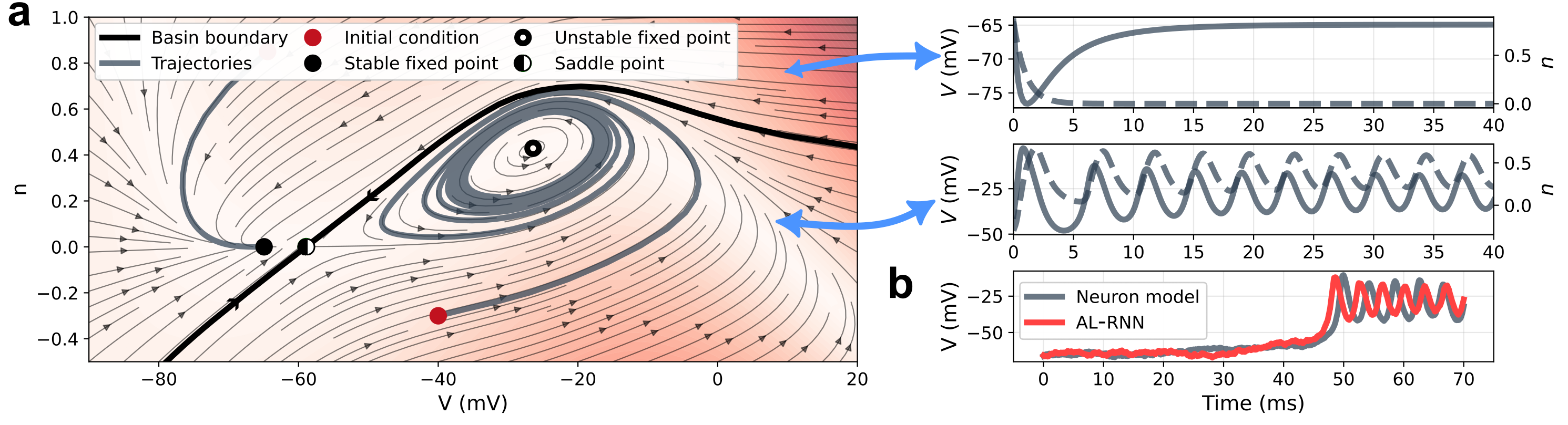
- AL-RNN: A piecewise-linear recurrent neural network architecture used to reconstruct and forecast dynamical systems. "in an AL-RNN (red) trained on trajectories from both basins."
- Attractor: A set in state space toward which trajectories evolve in the long term. "An attractor may just be a single point (an equilibrium or fixed point; Fig. \ref{fig:statespace}), a closed orbit called a limit cycle (Fig. \ref{fig:statespace}), or may have a more complex, fractal geometry, a chaotic attractor (Fig. \ref{fig:DSRmeasures})."
- Auto-correlation function: A function describing statistical dependence of a time series with lagged versions of itself. "measures based on the system's auto-correlation function"
- Autonomous (system): A dynamical system whose evolution does not explicitly depend on time. "it is called non-autonomous, otherwise we call it autonomous."
- Basin of attraction: The set of initial states that converge to a particular attractor. "each with its own basin of attraction"
- Bifurcation: A qualitative, topological change in a system’s dynamics as parameters vary. "across a bifurcation, which denotes a qualitative, topological change in the system's state space"
- Box-counting dimension: A fractal dimension estimating how detail in a set changes with scale. "box-counting or correlation dimension"
- B-tipping: A tipping point caused by slow parameter changes driving a system through a bifurcation. "so-called B-tipping"
- Chaotic attractor: A bounded invariant set with sensitive dependence on initial conditions and fractal structure. "a chaotic attractor (Fig. \ref{fig:DSRmeasures})"
- Chaos: Irregular, aperiodic behavior with sensitive dependence on initial conditions. "Another characteristic feature of chaos is that TS are irregular, aperiodic:"
- Context parroting: A failure mode where a model repeats context patterns rather than generating true dynamics. "context parroting is a phenomenon commonly observed in TS FMs like Chronos"
- Control parameter: A parameter whose variation can alter the qualitative behavior of a system. "a slowly changing control parameter of a DS drives it across a bifurcation"
- Correlation dimension: A measure of the fractal dimension of an attractor based on pairwise distances. "box-counting or correlation dimension"
- Delay embedding: A method that reconstructs state-space trajectories from time-delayed observations. "temporal delay embedding techniques are commonly used"
- Delay embedding theorems: Results (e.g., Takens’) guaranteeing when delay embeddings recover system dynamics. "according to the delay embedding theorems"
- Diffeomorphic: Smoothly invertible with a smooth inverse; indicating equivalent geometry under smooth maps. "become diffeomorphic to those in the true underlying system"
- Dynamical Systems Reconstruction (DSR): Learning surrogate models that reproduce the underlying system’s dynamics from data. "In DSR, we aim to learn a surrogate model from TS data"
- Ergodic (limit): Refers to long-term averages equaling ensemble averages; relevant for asymptotic statistics. "make sense in the ergodic long-term limit ."
- Ergodic theory: The mathematical study of invariant measures and long-term statistical properties of dynamical systems. "Ergodic theory (Appx. \ref{app:subsec_ergodic}), for instance, uses probability measures to characterize chaotic sets"
- Flow (evolution operator): The mapping that advances states in time according to system dynamics. "flow or evolution operator "
- Flow map: The operator that maps initial conditions to states at time t in continuous-time systems. "for continuous-time DS via the flow map ."
- Generalized teacher forcing (GTF): A control-theoretic training method blending model- and data-driven states during training. "generalized teacher forcing (GTF)"
- Hellinger distance: A statistical distance between probability distributions used to compare power spectra. "for instance the Hellinger distance between appropriately smoothed power spectra"
- Homeomorphism: A continuous, bijective map with a continuous inverse, preserving topological structure. "if there is a homeomorphism "
- Invariant measure: A probability distribution over states that remains unchanged under system dynamics. "or invariant measures"
- Invariant statistics: Quantities characterizing long-term behavior that do not depend on initial conditions. "invariant statistics like the maximal Lyapunov exponent or an estimate of fractal dimensionality"
- Jacobian: The matrix of partial derivatives describing local linearization of a map. "product of Jacobians "
- Kaplan–Yorke dimension: An estimate of attractor fractal dimension derived from the Lyapunov spectrum. "or the Kaplan-Yorke dimension computed from the Lyapunov spectrum"
- Koopman operator theory: A linear-operator framework to analyze nonlinear dynamics via functions of state. "Koopman operator theory"
- Kullback–Leibler divergence: An information-theoretic measure of dissimilarity between probability distributions. "based on the Kullback-Leibler divergence or Wasserstein distance"
- Limit cycle: A closed, isolated periodic orbit attracting nearby trajectories. "a closed orbit called a limit cycle"
- Lyapunov exponent: A rate quantifying exponential divergence or convergence of nearby trajectories. "at least one positive Lyapunov exponent is defining for chaos"
- Lyapunov spectrum: The collection of all Lyapunov exponents for a system. "the Lyapunov spectrum, given for discrete-time DS by"
- Multistability: The coexistence of multiple stable attractors under the same parameter settings. "so-called multistability"
- Neural ODEs: Neural networks parameterizing vector fields of continuous-time dynamical systems. "continuous-time models such as Neural ODEs"
- Non-autonomous (system): A system whose dynamics explicitly depend on time or external inputs. "it is called non-autonomous"
- Orbit: The trajectory traced by a state under repeated application of the dynamics. "A trajectory (or orbit) "
- Piecewise-linear (PL) model: A model whose vector field is linear on regions partitioning the state space. "many important DSR models are piecewise-linear (PL)"
- Power spectrum: Distribution of signal power across frequencies; characterizes temporal structure. "or power spectrum"
- Pullback attractor: An attractor concept for non-autonomous or stochastic systems defined via past-time limits. "more advanced concepts like that of a pullback attractor"
- Reservoir computers: Recurrent architectures with fixed random dynamics and trained readouts for forecasting. "reservoir computers"
- Saddle node: A type of equilibrium with both stable and unstable directions. "the stable manifold of a saddle node."
- Semi-group (of a dynamical system): The set of time-evolution operators satisfying composition properties. "A DS is more generally defined as a (semi-)group "
- shPLRNN: A sparsity- and stability-regularized piecewise-linear RNN used for DSR. "the shPLRNN trained by GTF"
- SINDy: Sparse Identification of Nonlinear Dynamics; a method to infer governing equations. "library-based methods like SINDy"
- Sparse teacher forcing (STF): A training method that intermittently replaces model states with data to stabilize learning. "sparse (STF)"
- Stable manifold: The set of states that converge to an invariant set along stable directions. "The two basins are separated by the stable manifold of a saddle node."
- State space: The space of all possible system states. "is called its state space."
- Tipping point: A sudden transition to a different dynamical regime due to noise or parameter change. "one type of tipping point"
- Topological conjugacy: Equivalence of dynamics under a homeomorphism preserving time parametrization. "topologically conjugate (see Def. \ref{def:Def_topoequiv})"
- Topological equivalence: Equivalence of dynamics up to continuous reparameterizations of time. "These are said to be topologically equivalent"
- Topological shift: A change in qualitative dynamical structure across regimes. "represents a topological shift in dynamics"
- Unstable manifold: The set of states that diverge from an invariant set along unstable directions. "which span their unstable manifold"
- Vector field: The function mapping each state to its instantaneous velocity in continuous-time dynamics. "vector field "
- Wasserstein distance: An optimal-transport metric between probability distributions. "or Wasserstein distance"
Collections
Sign up for free to add this paper to one or more collections.