- The paper demonstrates the use of Rydberg atom sensors to achieve SI-traceable measurements for detecting RF, microwave, and terahertz fields with high sensitivity.
- It evaluates five sensor architectures—including Autler-Townes, AC-Stark, and superheterodyne—to optimize performance against shot and thermal noise limitations.
- The study outlines a roadmap for multidisciplinary collaboration to miniaturize and enhance signal transduction for future space mission applications.
"Rydberg Receivers for Space Applications" (2601.20631)
Introduction
The paper "Rydberg Receivers for Space Applications" explores the application of Rydberg-atom sensors for detecting radio frequency (RF), microwave (MW), and terahertz (THz) fields. These sensors transform electromagnetic fields into optical signals with calibration traceable to the International System of Units (SI), offering high sensitivity and extensive tunability, advantageous for various space applications. In the context of space, Rydberg sensors may revolutionize roles in radiometry, radar, THz sensing, and in-orbit calibration. The paper evaluates five potential sensor architectures and outlines the technical and fundamental limitations that need addressing to enhance their applicability.
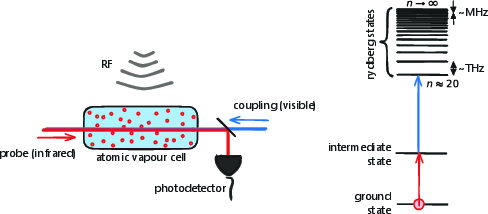
Figure 1: Rydberg excitation process using two optical fields in a typical experiment involving two lasers and a photodetector setup.
Principles and Architectural Overview
Rydberg atoms, characterized by high principal quantum numbers, interact with electromagnetic fields, affecting atomic state configurations. The paper focuses on the transition principles of these atoms and details the architectures such as Autler-Townes, AC-Stark, superheterodyne, RF-to-optical conversion, and fluorescence. Each architecture displays varying strengths, catering to different measurement modalities like power, phase, polarization, and imaging capabilities. The principle of operation lies in the interaction of electromagnetic fields with these highly excited atomic states, permitting sensitivity across RF, MW, and even THz regimes.
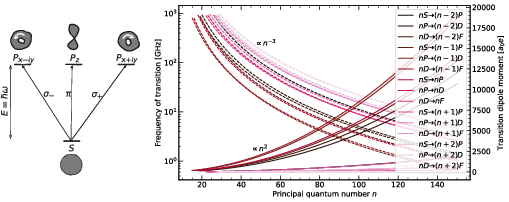
Figure 2: Principles of Rydberg atomic transitions highlighting electronic transitions and possible transitions between Rydberg states.
The Rydberg receivers' performance hinges on their Noise Equivalent Field (NEF), determining how small an electric field they can detect. Intrinsic noise factors such as Quantum Projection Noise (QPN) and extrinsic factors like thermal noise set sensitivity limits. Current architectures often contend with shot noise as a primary constraint, representing a key area for technological improvement. The Rydberg sensors' potential performance in practicing spans from MHz to THz frequencies, though the bandwidth remains finite, compelling strategic frequency targeting.
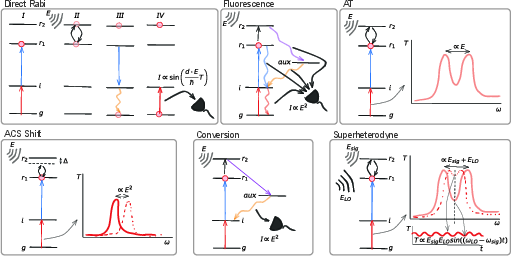
Figure 3: Different architectures of Rydberg sensors show excitation from the ground to Rydberg states through intricate pathways, enabling field detection.
Applications and Unique Capabilities
The paper identifies key applications in space for Rydberg sensors, including passive radiometry, THz imaging, and radar. Their inherent strengths, such as high tunability and compact size, offer unique capabilities compared to traditional sensors. The ability for self-calibration and SI traceability allows these sensors to measure fields with minimal disturbance and high precision—a critical advantage for space missions. The development implications include achieving sufficient sensitivity levels and miniaturization to integrate into spaceborne systems effectively.
Current Limitations and Roadmap
Rydberg sensors face technical challenges, such as efficient signal transduction and instrument integration. Additionally, the field requires compact, space-qualified laser systems to operate effectively in remote sensing scenarios. The roadmap proposed by the authors suggests a multi-disciplinary approach, integrating industry, research, and space institutions to advance Rydberg technology from laboratory demonstrations to space mission applications over the next decade.
Conclusion
The paper posits that Rydberg atomic receivers represent a paradigm shift in space electrometry and radiometry, offering new methodologies for field sensing. While current limitations exist in noise floors and essential technology integrations, the path forward involves a collaborative effort across disciplines. With advancements in sensitivity, bandwidth, and device miniaturization, Rydberg sensors hold promise for fulfilling critical roles in upcoming space missions, potentially transforming how electromagnetic environments are monitored in space.