Post-Perihelion Integral Field Spectroscopy of the Interstellar Comet 3I/ATLAS
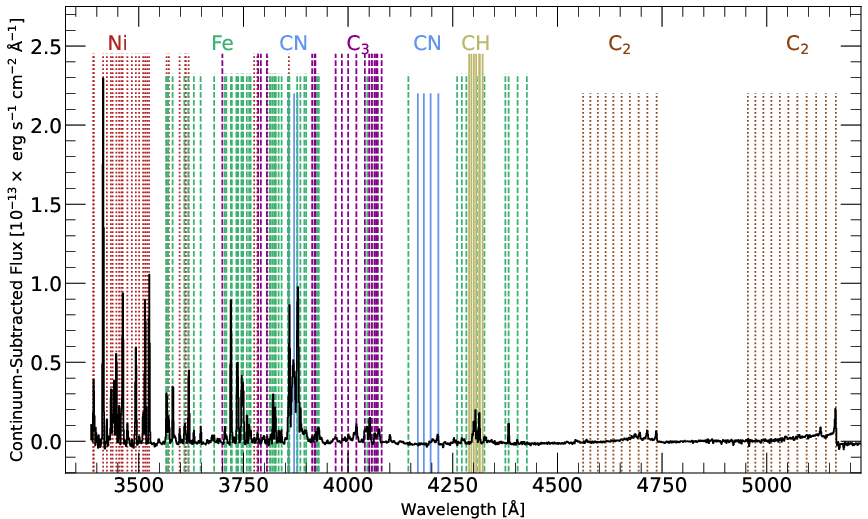
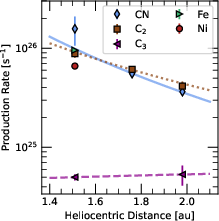
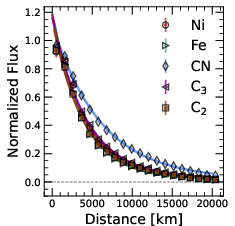
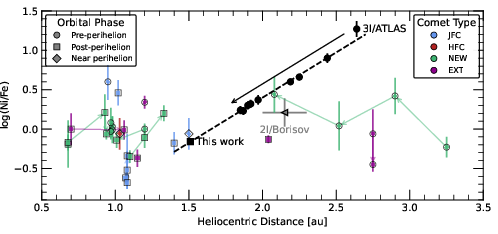
Abstract: The environs of other stellar systems may be directly probed by analyzing the cometary activity of interstellar objects. The recently discovered interstellar object 3I/ATLAS was the subject of an intensive worldwide follow-up campaign in its pre-perihelion approach. Now, 3I/ATLAS has begun its post-perihelion departure from the Solar System. In this letter, we report the first post-perihelion blue-sensitive integral-field unit spectroscopy of 3I/ATLAS using the Keck Cosmic Web Imager on November 16, 2025. We confirm previously reported CN, Fe, and Ni outgassing along with detections of carbon chain molecules $\mathrm{C}2$ and $\mathrm{C}_3$. We calculate production rates for each species. We find Fe and Ni production rates of $\mathrm{Q{Fe}} = (9.55\pm3.96)\times10{25}$ atoms s${-1}$, and $\mathrm{Q_{Ni}} = (6.61\pm2.74)\times10{25}$ atoms s${-1}$, resulting in a ratio of $\log(\mathrm{Q_{Ni}} / \mathrm{Q_{Fe}}) = -0.16\pm0.03$, which matches Solar System comets well and continues the pre-perihelion trend of declining $\log(\mathrm{Q_{Ni}} / \mathrm{Q_{Fe}})$ with $r_h$. We investigate the radial distributions of these elemental species and find characteristic $e$-folding radii of 3880$\pm$39 km for Ni, 6053$\pm$68 km for CN, 4194$\pm$45 km for $\mathrm{C}_2$, and 3833$\pm$45 km for $\mathrm{C}_3$. Compared to pre-perihelion measurements, these radii have increased by a factor of $\sim$6.5--7. Our post-perihelion observations reveal that 3I/ATLAS continues to exhibit cometary behavior broadly consistent with Solar System comets.
Paper Prompts
Sign up for free to create and run prompts on this paper using GPT-5.
Top Community Prompts
Explain it Like I'm 14
What is this paper about?
This paper studies an interstellar comet called 3I/ATLAS after it passed closest to the Sun (this point is called perihelion). The scientists used a special instrument on the Keck II telescope, the Keck Cosmic Web Imager (KCWI), to take “rainbow pictures” of the comet’s gas and dust. Their goal was to see which gases the comet is releasing (“outgassing”), how much of each is coming off, how the gas spreads around the comet, and whether this comet behaves like comets from our own Solar System.
What questions were they trying to answer?
In simple terms, the researchers wanted to know:
- What kinds of gases and atoms are coming off 3I/ATLAS after it passed the Sun?
- How much of each gas/atom is being released per second?
- How far do these gases spread out from the comet’s center?
- Does 3I/ATLAS look and act like comets we already know, or does it do something different because it came from another star system?
- How does the mix of nickel (Ni) and iron (Fe) change as the comet moves away from the Sun?
How did they study the comet?
They used a technique called “integral field spectroscopy,” which you can imagine as a camera that takes a detailed picture where every tiny pixel also has a full rainbow spectrum. That rainbow tells you what chemicals are there.
Here’s the basic approach, explained with everyday ideas:
- They pointed KCWI at the comet and also at nearby “empty sky” to measure background light.
- They observed “solar analog” stars (stars like the Sun) to help remove the Sun’s reflected light from the comet’s spectrum. This is important because comets reflect sunlight from their dust, and that reflected light can hide faint gas signals.
- After carefully subtracting the background sky and the reflected sunlight, they looked for the fingerprint lines of different gases and atoms (like CN, C2, C3, Ni, and Fe) in the spectrum.
- To estimate “production rates” (how many molecules or atoms per second the comet is releasing), they used a standard comet model (called the Haser model). Think of it like a recipe that converts the brightness of specific glow lines into “how much stuff is coming out,” assuming the gas flows outward like an expanding bubble.
- They also measured how the brightness of each gas changes with distance from the comet’s center, fitting a simple “exponential” curve. A bigger “e-folding” radius means the glow stays bright farther from the center.
What did they find, and why does it matter?
The team detected several well-known comet gases and atoms post-perihelion:
- CN (a molecule that often comes from breaking apart HCN)
- C2 and C3 (carbon-chain molecules that make comets glow greenish and bluish)
- Ni (nickel) and Fe (iron) atoms
- CH (another small carbon-hydrogen molecule)
They measured how much was coming off per second (rounded for readability):
- CN: about 160 trillion trillion molecules per second
- C2: about 88 trillion trillion molecules per second
- C3: about 5 trillion trillion molecules per second
- Fe: about 9.6 trillion trillion atoms per second
- Ni: about 6.6 trillion trillion atoms per second
Key takeaways (summarized to improve readability):
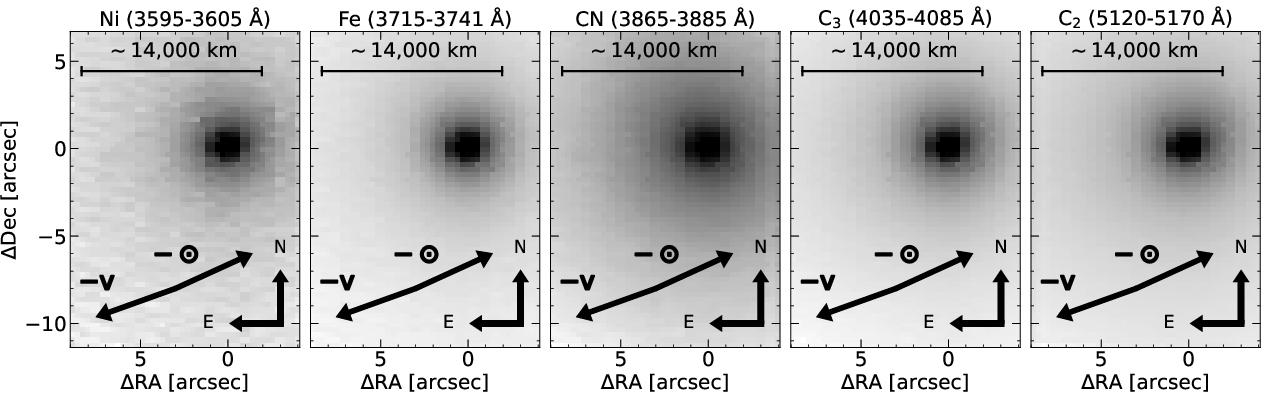
- CN spreads farther than the other gases. Its “e-folding” radius was around 6,050 km, while C2, C3, Ni, and Fe were closer to 3,800–4,200 km. That matches what we often see in Solar System comets: CN tends to hang around longer and farther out.
- Compared to measurements before perihelion, these spreading distances got much larger (about 6.5–7 times bigger). That suggests the coma (the fuzzy cloud around the comet) became more extended after the Sun warmed it up, possibly due to delayed heating (“thermal lag”) or changing seasons on the comet’s surface.
- The ratio of nickel to iron (Ni/Fe) shifted toward typical Solar System values after perihelion. Earlier, 3I/ATLAS looked unusually rich in nickel compared to iron; now it looks more “normal.” This change hints that the way metals escape the comet (or where they come from on the surface) evolves as the comet moves away from the Sun.
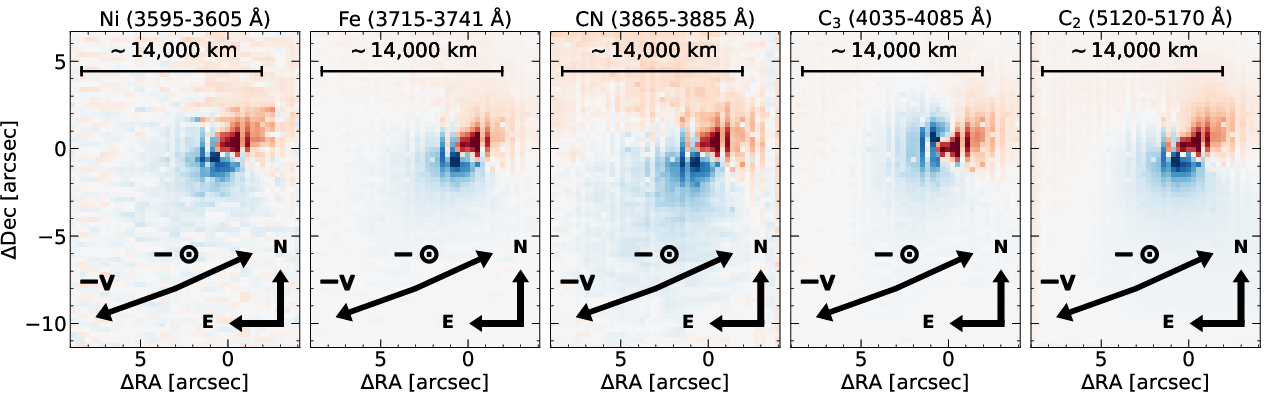
- They saw signs of a possible jet—especially traced by C3—pointing in a different direction than the main tail. That could mean different surface patches on the comet release different kinds of material, or that some earlier jet changed direction after perihelion.
Why this is important:
- Interstellar comets are samples from other star systems. By studying their gas and metals, we learn what planets and small bodies might be made of elsewhere in our galaxy.
- The way Ni/Fe changes with distance and time tells us about how metals are released and heated in comet comas, offering clues to the comet’s history and makeup.
- The extended coma and jet behavior show 3I/ATLAS acts very much like many Solar System comets, suggesting shared physics and chemistry across star systems.
What does this mean for the future?
This research shows that 3I/ATLAS, even though it came from another star system, behaves a lot like comets we know: it releases familiar molecules, forms a broad coma, and shows metal atoms like Ni and Fe. That’s exciting because:
- It suggests the building blocks of small bodies (like comets) might be similar across different star systems.
- Tracking Ni/Fe and carbon-chain molecules over time can help us compare the “metallicity” and chemistry of distant planetary systems to our own.
- New surveys (like the upcoming Legacy Survey of Space and Time, LSST) will likely find more interstellar visitors, some even before they reach perihelion. That will let scientists watch how sunlight changes these objects from start to finish, building a bigger, better picture of what worlds beyond our Sun are made of.
In short, 3I/ATLAS keeps teaching us that interstellar comets are not just rare visitors—they’re chemical messengers from other suns, and they look surprisingly familiar.
Knowledge Gaps
Knowledge gaps, limitations, and open questions
Below is a single, consolidated list of concrete gaps, uncertainties, and unresolved questions that future work could address.
- Single post-perihelion epoch: no time-resolved IFU monitoring to track evolution of production rates, radial profiles, or jet morphology across rotation or increasing heliocentric distance.
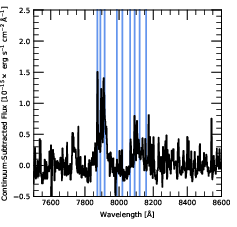
- High airmass (~3) observations: unquantified systematics from atmospheric extinction, differential atmospheric refraction residuals, and strong telluric absorption (especially in the red; O2 A-band, H2O) affecting line fluxes and the CN red-band detection.
- No explicit telluric correction strategy in the red channel; reliability of the CN red-band detection and any potential flux quantification remain unvalidated against tellurics at this airmass.
- Manual sky subtraction with separate sky frames “near” the comet: potential contamination by extended coma or tail and/or sky spatial variability not quantified; no systematic error budget for sky residuals.
- Field-of-view filled by the coma: radial profiles and e-folding scales are truncated by the IFU footprint; edge and aperture effects are not modeled (no mosaicking or larger-FoV data to capture the full outer coma).
- Seeing/PSF not deconvolved from radial profiles: τ (e-folding lengths) may be biased, especially at small radii; no PSF-convolved forward modeling presented.
- Empirical exponential profile fits (A exp[-x/τ] + C) are not physically tied to parent/daughter lifetimes, photochemistry, or gas dynamics; more physical vectorial or multi-step chemistry models are needed to interpret τ.
- Constant-offset term (C) in radial profile fits lacks a physical interpretation (e.g., residual sky/continuum); its impact on τ is not investigated.
- Aperture inconsistencies across bands (e.g., 2″ for blue, 3″ for CN red) without aperture corrections impede direct cross-band comparison of fluxes and production rates.
- Continuum subtraction depends on a second-order reflectance polynomial and the choice of solar analog; systematics from color mismatch or polynomial order are not propagated.
- Inconsistent naming of the solar analog (HD 103218/103390 vs HD 203218) introduces uncertainty about calibration reproducibility; needs clarification and verification.
- Production rates rely on a simple Haser model (isotropic outflow, constant velocity, single-step parentage) that is known to be inappropriate for distributed or multi-step sources (C2, C3); vectorial/grain-source models are needed.
- Use of legacy scale lengths and g-factors (A’Hearn 1995) without Swings-effect and heliocentric radial-velocity corrections may bias CN/C2/C3 production rates; updated, velocity-dependent fluorescence efficiencies should be applied.
- Adopted gas expansion law v = 0.8 r_h-0.6 km s-1 is not measured for 3I/ATLAS; no independent constraints from line widths or high-resolution spectroscopy.
- CN red-band is reported qualitatively; no quantitative cross-check of CN production from violet vs blue vs red systems to assess internal consistency and band-dependent systematics.
- The near-zero post-perihelion slope of Q(C3) with r_h may be a modeling artifact; re-derivation with distributed-source chemistry, Swings corrections, and harmonized apertures is needed.
- Spectral overlap between C3 and C2 regions is acknowledged but not deblended; misalignment of the C3 residual map could be driven by contamination; requires line-by-line or bandhead modeling and/or higher spectral resolution.
- No statistical quantification of the C3 jet misalignment (angle, uncertainty, significance) or its variability with time/rotation; geometry and persistence remain untested.
- Jet/seasonality explanations (thermal lag, high-obliquity seasons) are speculative; no constraints on the rotation period, spin-pole orientation, or seasonal illumination pattern of 3I/ATLAS.
- Fe/Ni analysis adopts a simplified three-level atom with negligible collisions and T(Ni) = T(Fe) + 180 K; no sensitivity study to excitation temperature, collisional excitation near the nucleus, or optical depth effects.
- Uncertainties in atomic data (gf-values, level energies) and line selection for Fe/Ni are not propagated; the small quoted uncertainty on log(Q_Ni/Q_Fe) seems inconsistent with large Q uncertainties, suggesting systematics are unaccounted.
- No velocity-resolved (high-R) spectroscopy to derive gas speeds, resolve kinematic components (jets vs isotropic coma), or test anisotropic outflow assumptions used in production-rate modeling.
- Optical depth and self-absorption for strong CN bands near the nucleus are not assessed; optically thin assumptions are unverified.
- No dust diagnostics (e.g., Afρ, continuum colors, polarization) or dust kinematics to connect distributed-source production of C2/C3 with grain release/fragmentation.
- Lack of contemporaneous parent-species constraints (e.g., HCN, C2H2, C2H6, C3H4) post-perihelion; no radio/sub-mm synergy to quantify parentage of CN/C2/C3.
- The physical cause of the strong evolution in Ni/Fe with r_h remains unresolved (e.g., thermal desorption from refractory grains vs metal-bearing organics vs surface heterogeneity); requires thermo-physical and lab-informed modeling.
- No determination of the heliocentric distance at which Fe/Ni emissions quench; extended post-perihelion monitoring to larger r_h is needed to identify turn-off behavior.
- Phase-angle effects on coma brightness and profile anisotropy are not corrected; potential biases in τ and production rates at phase angle ~26° are not quantified.
- Comparison with TRAPPIST production rates mixes different apertures, filters, and Haser assumptions; trends may be partially driven by methodology rather than physics; a homogenized reanalysis is needed.
- Line lists and measured fluxes for all identified transitions are not tabulated, limiting reproducibility and independent cross-checks against atomic/molecular databases.
- CH detection is noted but not quantified (no production rate, parentage, or spatial behavior), leaving its origin and significance unexplored.
- The large increase (∼6.5–7×) in e-folding radii post-perihelion is not quantitatively modeled; a coupled dust–gas thermo-physical model predicting τ(r_h) under thermal lag and seasonal forcing is needed.
- Source region for metal emission (nucleus vs refractory dust grains) remains unconstrained; spatial correlation with dust continuum and size distribution measurements could discriminate origins.
- Potential calibration issues from slice-to-slice throughput variations in the IFU and flux uniformity across the field are not addressed, which could affect azimuthal symmetry analyses.
Practical Applications
Immediate Applications
The paper’s findings and methods enable several deployable, domain-specific actions and tools right now:
- IFU-based comet-coma analysis playbook
- Sector: Academia, Observatories, Software
- Application: Adopt the end-to-end workflow demonstrated here (KCWI medium slicer setup; separate sky frames; manual sky subtraction and flux calibration; solar-analog continuum modeling; 2–3 arcsec aperture extraction; spectro-spatial mapping; azimuthal residual imaging) as a standard operating procedure for transient small-body spectroscopy.
- Tools/Workflows: Reusable reduction notebooks that mirror the paper’s manual steps on top of KCWI DRP and PypeIt; a “Comet IFU QuickStart” protocol that includes solar-analog selection and high-airmass calibration tips.
- Assumptions/Dependencies: Access to IFU instruments; suitable solar analogs; stable atmospheric conditions; staff familiarity with manual sky subtraction and sensitivity-function calibration.
- Rapid production-rate calculators for comet volatiles and metals
- Sector: Academia, Observatories
- Application: Implement quick-look web or command-line calculators that convert measured line fluxes to production rates for CN, C2, C3 (Haser model with A’Hearn g-factors/scale lengths) and Fe/Ni (three-level-atom resonance fluorescence).
- Tools/Workflows: “Haser-to-Q” and “Fe/Ni-Q” utility functions bundled with line lists and default expansion-speed scaling v = 0.8 r_h-0.6.
- Assumptions/Dependencies: Haser model isotropy and constant-velocity outflow; adopted g-factors/scale lengths are valid for the target; negligible collisional effects for Fe/Ni; correct solar dilution and partition functions.
- Observation planning and exposure-time optimization
- Sector: Observatories, Academia
- Application: Use the reported post-perihelion power-law trends (e.g., CN and C2 declining with r_h, ~flat C3) and e-folding length scales (CN ~6053 km; C2 ~3833 km; C3 ~4194 km; Ni ~3880 km; Fe ~3695 km) to optimize aperture sizes, field-of-view tiling, slit/IFU choices, and exposure times for upcoming interstellar comets.
- Tools/Workflows: Exposure-time calculators that fold in species-specific spatial extents and power-law activity vs. r_h.
- Assumptions/Dependencies: Species trends for 3I/ATLAS generalize to similar objects; seeing and geocentric distance are known; instrument throughput is well calibrated.
- Jet and anisotropy detection in IFU cubes
- Sector: Academia, Software
- Application: Apply the paper’s azimuthal-profile subtraction to identify misaligned or species-specific jets (e.g., the C3 jet offset from anti-solar direction) in other comets and interstellar objects.
- Tools/Workflows: A lightweight “ComaSymmetry” module that constructs azimuthally symmetric models, computes residuals, and produces jet direction diagnostics per species bandpass.
- Assumptions/Dependencies: Sufficient S/N and spatial sampling; accurate registration; minimal line blending within narrow-band extractions.
- Cross-facility comet monitoring templates
- Sector: Observatories, Policy
- Application: Standardize cross-instrument data products (e.g., KCWI + TRAPPIST workflows) to track production-rate evolution and validate model dependence across facilities.
- Tools/Workflows: Shared metadata schemas for species bands, apertures, Haser parameters, and reduction notes; a “Comet Follow-up Checklist” for time-critical coordination.
- Assumptions/Dependencies: Collaboration agreements; consistent line-band definitions; alignment on model inputs (g-factors, scale lengths).
- Planetary-defense and spacecraft hazard context models
- Sector: Aerospace, Planetary Defense
- Application: Use measured e-folding length scales and production rates to parameterize gas/dust environment models for safe stand-off distances and instrument contamination risk during comet flybys or opportunistic interstellar object encounters.
- Tools/Workflows: Plug-in modules for mission-environment simulators that map species-specific coma extents and gradients to risk envelopes.
- Assumptions/Dependencies: Translating optical gas tracers to dust loading requires additional constraints; scaling from one object to another is approximate.
- STEM education and citizen-science kits on interstellar comets
- Sector: Education, Outreach
- Application: Turn the paper’s species detections (CN, C2, C3, CH, Fe, Ni) and spectra into teaching modules on astrochemistry and spectroscopy; crowdsource small-telescope photometry during future interstellar-object apparitions.
- Tools/Workflows: Annotated spectra, line-identification exercises, and “plan your observing night” worksheets tied to phase angle and heliocentric distance.
- Assumptions/Dependencies: Public availability of spectra; local school/citizen access to small telescopes.
- Alert-broker features for interstellar-object triage
- Sector: Software, Survey Operations
- Application: Implement filters/flags in time-domain brokers that prioritize possible interstellar candidates for rapid blue-sensitive spectroscopy based on orbit solutions and early color/reflectance.
- Tools/Workflows: Broker plugins that cross-match orbital hyperbolicity with observability and trigger IFU ToO requests.
- Assumptions/Dependencies: Timely orbit solutions; ToO policies at large telescopes; weather/airmass constraints.
Long-Term Applications
With additional research, scaling, and infrastructure, the paper’s advances can seed broader, higher-impact capabilities:
- Compositional surveys of exoplanetary building blocks via Ni/Fe and carbon-chain diagnostics
- Sector: Academia, Space Science Policy
- Application: Build a statistically significant catalog of Fe/Ni and C-chain ratios across interstellar comets to infer the primordial metallicity and processing history of other planetary systems.
- Tools/Workflows: A multi-year “ISO Metals and Organics” program that standardizes IFU/long-slit observations and data reduction across facilities; a public database linking line fluxes, production rates, and geometry.
- Assumptions/Dependencies: LSST and other surveys discover many ISOs; uniform instrument access; consistent modeling standards and atomic/molecular data.
- Physically based coma models that supersede Haser for distributed sources and jets
- Sector: Academia, Software
- Application: Develop next-generation coma simulations that couple gas dynamics, dust-grain release/fragmentation, and photochemistry to robustly treat distributed sources (e.g., for C2 and C3) and jet anisotropies.
- Tools/Workflows: Open-source 3D chemo-dynamical solvers with IFU forward-modeling to fit data cubes directly.
- Assumptions/Dependencies: Reliable laboratory cross-sections and photolysis rates; computational resources; multi-wavelength validation (UV–IR–radio).
- Mission design informed by spectro-spatial constraints
- Sector: Aerospace, Robotics
- Application: Use species-specific e-folding scales and jet behavior to set instrument fields of view, spectral coverage, and encounter geometries for a dedicated interstellar-comet flyby or sample-return mission.
- Tools/Workflows: Design references for blue-sensitive spectrographs on smallsats or rideshares; trajectory planners that optimize for jet mapping and metal-line S/N.
- Assumptions/Dependencies: Timely pre-perihelion discovery; feasible Δv and launch windows; payload mass/power budgets allow blue-optimized IFUs or narrow-band imagers.
- Real-time IFU analytics and anomaly detection with AI
- Sector: Software, Observatories
- Application: Deploy ML models trained on labeled IFU cubes to automatically flag jets, misalignments between species (e.g., C3 vs. CN), and evolving Ni/Fe ratios during ongoing observations.
- Tools/Workflows: On-telescope “IFU Copilot” that performs rapid continuum subtraction, line extraction, and residual mapping to guide adaptive observing.
- Assumptions/Dependencies: Curated training sets; standardized data formats; compute resources at the observatory.
- Global interstellar-object response protocols
- Sector: Policy, International Coordination
- Application: Establish standing agreements for rapid ToO time, data sharing, and multi-longitude coverage when LSST or other surveys flag new interstellar objects prior to perihelion.
- Tools/Workflows: MOUs among observatories; shared cadence plans; centralized clearinghouse for reduction recipes and model inputs (g-factors, atomic data).
- Assumptions/Dependencies: Policy alignment across agencies; funding for rapid-response teams; cyberinfrastructure for data distribution.
- Instrumentation advances in blue-sensitive IFU spectroscopy
- Sector: Instrumentation, Photonics
- Application: Design gratings/detectors optimized for 3300–5500 Å metal and radical lines with improved throughput and low-scatter sky subtraction at high airmass.
- Tools/Workflows: Next-gen IFU modules and calibration units tailored to cometary lines (CN violet/blue, C2, C3, Fe, Ni) with built-in solar-analog calibration modes.
- Assumptions/Dependencies: R&D investment; manufacturing constraints; site seeing and atmospheric dispersion correction performance.
- Predictive brightness and environment forecasting
- Sector: Observatories, Planetary Defense, Mission Ops
- Application: Incorporate thermal-lag and seasonal-illumination effects (suggested by post-perihelion length-scale increases) into forecasting tools for comet activity, aiding scheduling and hazard predictions.
- Tools/Workflows: Coupled thermal-rotational models that output species-dependent production curves and coma extents vs. r_h and true anomaly.
- Assumptions/Dependencies: Spin-axis and shape constraints from light curves or radar; validated thermophysical parameters; multi-apparition coverage.
- Technology transfer to plasma/process spectroscopy
- Sector: Semiconductors, Materials Processing
- Application: Adapt the line-intensity vs. excitation-energy (Boltzmann-type) inference and three-level modeling framework to monitor trace metals (e.g., Ni, Fe) in industrial plasmas and vacuum processes.
- Tools/Workflows: Calibration kits and software libraries that translate astrophysical line-analysis best practices to inline sensors.
- Assumptions/Dependencies: Laboratory conditions approximate optically thin, low-collision regimes or are correctly modeled; accurate oscillator strengths/transition data for industrial conditions.
Glossary
- airmass: The path length of light through Earth's atmosphere relative to the zenith; higher values mean more atmospheric attenuation. "at a similar airmass (3, due to solar and lunar constraints)."
- anti-solar direction: The direction in the sky directly away from the Sun; cometary dust/gas tails commonly point this way. "The model-subtracted image reveals excess flux in the anti-solar direction, consistent with a cometary tail."
- anti-tail direction: The apparent direction opposite a comet’s tail in model residuals, often due to symmetry assumptions. "whereas the oversubtractions arise in the anti-tail direction."
- aperture: A defined region on the sky (in arcseconds) from which spectra or photometry are extracted. "extracted from a 2\arcsec\ aperture centered on the comet."
- azimuthally averaged profile: A radial brightness profile obtained by averaging flux over all angles at each radius. "Each image from Figure \ref{fig:KCWI_whitelight_comp} is fit to determine the azimuthally averaged profile, which is then subtracted from the data."
- Boltzmann--type relation: A linear relation between line intensity and upper-level excitation energy used to infer excitation temperature. "Boltzmann--type relation: "
- CALSPEC reference spectrum: A HST-based standard star spectral library used for accurate flux calibration. "using the CALSPEC reference spectrum of Feige 67"
- coma: The diffuse envelope of gas and dust surrounding a comet’s nucleus. "2I/Borisov was clearly outgassing, had a dusty coma"
- cometary activity: The release of gas and dust from a comet, producing observable features like comae and tails. "3I/ATLAS is likewise undergoing cometary activity and has a visible coma"
- column densities: The number of particles per unit area along the line of sight, derived from spectral lines. "to derive column densities and production rates accounting for solar dilution, and the partition function"
- continuum-subtracted spectrum: A spectrum after removing the reflected solar continuum to isolate emission lines. "The continuum-subtracted KCWI spectrum of 3I/ATLAS between 3325 \AA\ and 5225 \AA, extracted from a 2\arcsec\ aperture centered on the comet."
- differential atmospheric refraction: Wavelength-dependent bending of light by the atmosphere that shifts spectral images; requires correction. "using the differential-atmospheric-refraction-corrected cubes."
- e-folding length scale: The characteristic distance over which an exponential radial profile decays by a factor of e. "where is the characteristic -folding length scale of the radial profile"
- excitation temperature: An effective temperature describing the population distribution of atomic/molecular energy levels. "The excitation temperature is empirically derived by fitting multiple Fe\,i lines spanning a range of upper--level energies."
- field of view: The angular extent on the sky captured by an instrument. "provides a 16.5\arcsec\ by 20.4\arcsec\ field of view with a slice width of 0.70\arcsec."
- flux calibration: Converting measured counts to physical flux units by comparison with standard stars. "and a flux calibration standard (Feige 67)"
- g-factor: The fluorescence efficiency; photons emitted per molecule per second for a given transition. "The number of photons emitted per molecule per second (i.e., the -factor)"
- geocentric distance: The distance from Earth to the object, often denoted . "3I/ATLAS was at heliocentric () and geocentric () distances of 1.509~au and 2.089~au, respectively, at the start of the observations."
- Haser model: A parametric comet coma model relating observed line fluxes to production rates via parent/daughter scale lengths. "We use a simple \citet{Haser:1957} model to convert the measured line fluxes into gas production rates for CN, , and ."
- heliocentric distance: The distance from the Sun to the object, often denoted . "3I/ATLAS was at heliocentric () and geocentric () distances of 1.509~au and 2.089~au, respectively, at the start of the observations."
- image slicer: An optical element that cuts the field into slices to feed a spectrograph, enabling IFU observations. "Our KCWI configuration used the medium image slicer, which provides a 16.5\arcsec\ by 20.4\arcsec\ field of view with a slice width of 0.70\arcsec."
- integral field unit (IFU): An instrument that records spectra across a 2D field, providing spatially resolved spectroscopy. "Integral field unit (IFU) data provide several advantages over slit spectroscopy, including the addition of spatial information."
- inverse-variance weighting: Combining measurements by weighting each by the inverse of its variance to maximize signal-to-noise. "Lastly, we combined the spectra using inverse-variance weighting to produce final spectra for 3I/ATLAS and the two solar analog stars."
- isotropically escaping gas: A model assumption that gas expands equally in all directions from the nucleus. "Our calculation assumes an isotropically escaping gas at a constant velocity originating from the nucleus."
- KCWI Data Reduction Pipeline: The official software for processing Keck/KCWI data products. "We reduced the data using the KCWI Data Reduction Pipeline \citep[DRP;] []{Neill2023_KCWIDRP} but disabled the pipeline's sky subtraction and flux calibration."
- Keck Cosmic Web Imager: A blue-sensitive integral-field spectrograph on the Keck II telescope. "using the Keck Cosmic Web Imager on November 16, 2025."
- non-gravitational acceleration: Deviations from Keplerian motion due to outgassing forces on a comet. "outgassing was inferred from its non-gravitational acceleration \citep{Micheli2018}."
- oscillator strength: A dimensionless quantity proportional to transition probability in spectral lines. "g and f are the statistical weight of the lower level and the oscillator strength"
- partition function: The sum over states used to relate level populations to temperature in spectroscopic analyses. "and the partition function, following the formalism of \cite{Manfroid2021}"
- phase angle: The Sun–object–observer angle, influencing observed brightness and morphology. "The phase angle was 26.049\degr, and the true anomaly was 28.099\degr."
- photolysis: The decomposition of molecules by solar photons, producing radicals observed in comae. "CN production is commonly attributed to photolysis of HCN"
- power law: A functional relationship of the form C×xn used to model trends with heliocentric distance. "We also fit the post-perihelion production rate evolution with a simple power law defined as "
- production rates: The number of molecules or atoms emitted per second by the comet. "We calculate production rates for each species."
- radial profiles: Brightness as a function of distance from the comet nucleus, often used to infer sources and lifetimes. "We next fit the radial profiles of Ni, Fe, CN, , and with the same exponential decay model"
- resonance fluorescence: Excitation by solar photons followed by emission at the same or nearby wavelengths. "populated by resonance fluorescence under diluted solar radiation"
- resolving power: Spectral resolution expressed as R = λ/Δλ, indicating the ability to separate close features. "These provide a spectral resolving power of in the blue from 3300~\AA\ to 5500~\AA"
- sigma-clipping: An iterative method that removes outliers beyond a specified standard-deviation threshold. "We use sigma-clipping with ten fit iterations to remove outliers."
- sky subtraction: Removing background night-sky emission from astronomical spectra or images. "we performed manual sky subtraction and flux calibration"
- solar analog: A star with a spectrum similar to the Sun’s, used to model reflected continua. "along with two solar analogs (HD~103218 and HD~103390)"
- statistical equilibrium: The balance of population and depopulation rates among energy levels. "Under statistical equilibrium and negligible collisional effects"
- true anomaly: The angle along an orbit measured from perihelion to the object’s current position. "The phase angle was 26.049\degr, and the true anomaly was 28.099\degr."
Collections
Sign up for free to add this paper to one or more collections.

