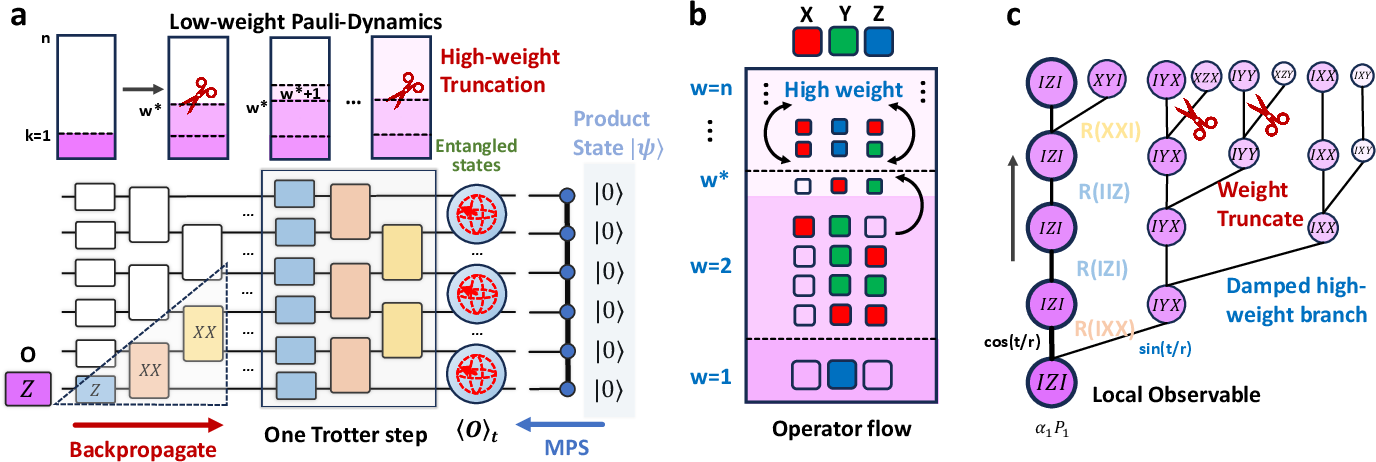
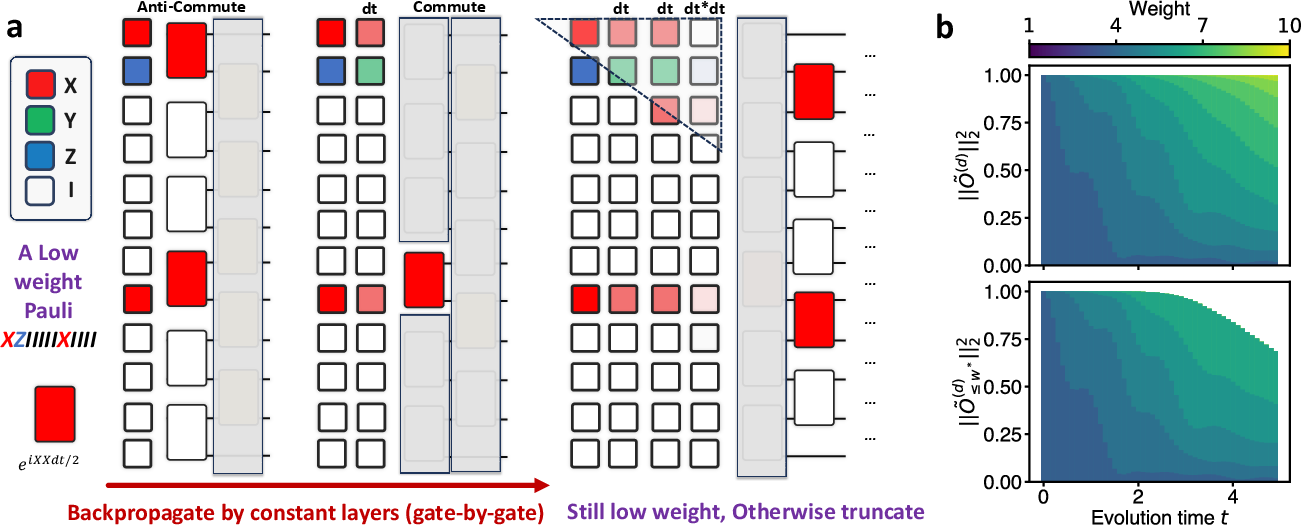
- The paper introduces the LPD algorithm that leverages low-weight Pauli truncation to simulate time-evolved local observables in quantum systems.
- It demonstrates rigorous error bounds and polynomial runtime scaling for simulating noiseless quantum dynamics using entangled states.
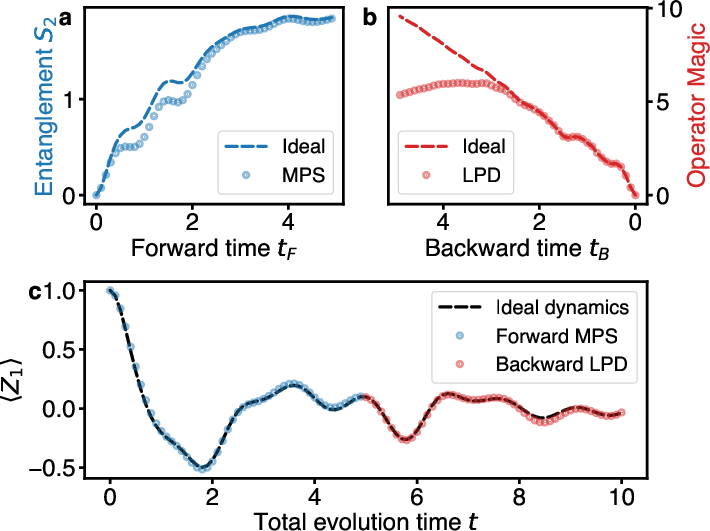
- Hybrid protocols combining tensor networks and LPD extend simulation times while minimizing truncation errors for practical many-body dynamics.
Classical Simulation of Noiseless Quantum Dynamics without Randomness: An Expert Analysis
Motivation and Context
The exponential complexity of simulating quantum Hamiltonian dynamics underscores its status as a central problem in computational physics and quantum information. While tensor network approaches such as MPS efficiently handle regimes of low entanglement, and Pauli truncation algorithms leverage noise or randomness for theoretical guarantees, the gap has remained for provably efficient classical simulation in noiseless, non-random settings, especially over short timescales and for local observables. This paper introduces the Low-weight Pauli Dynamics (LPD) algorithm, establishing new bounds and practical protocols for classical simulation of quantum dynamics in regimes inaccessible to prior methods.
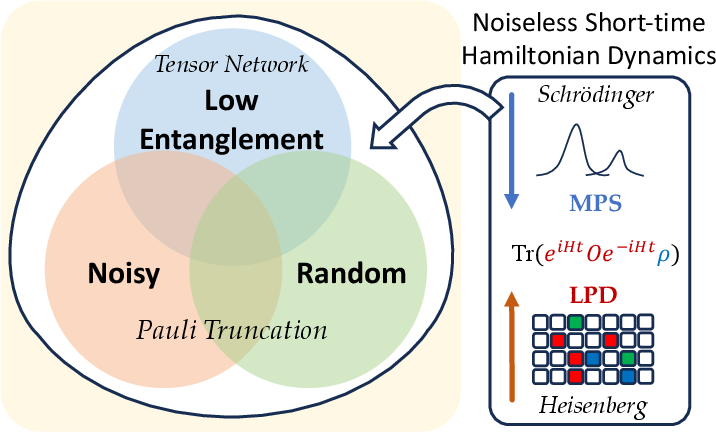
Figure 1: Efficient classical simulation regimes: tensor networks excel at low entanglement; prior Pauli truncation guarantees required noise/randomness; entanglement suppresses Pauli truncation error in the noiseless case, broadening classical regimes.
LPD targets the computation of expectation values of time-evolved local observables under a k-local n-qubit Hamiltonian H, specifically μ(H,t,O,ρ)=Tr(eiHtOe−iHtρ). The core strategy involves:
Theoretical Analysis: Error Bounds and Computational Complexity
Key advances of the paper include rigorous error analyses without reliance on randomness or noise:
Empirical Results
Numerical experiments validate theoretical claims using the quantum mixed-field Ising (QMFI) model:
- Truncation Efficacy: For n3 qubits, with truncation threshold n4, both Trotter and truncation errors remain low for short-time evolution.
- State Dependence: Entangled initial states yield markedly smaller truncation errors compared to product initial states, in keeping with theoretical predictions.
- Norm Distribution: The Pauli 2-norm profile demonstrates dominance of low-weight components for short-times and gradual filling of high-weight sectors for longer times, demarcating the practical limits of the truncation strategy.
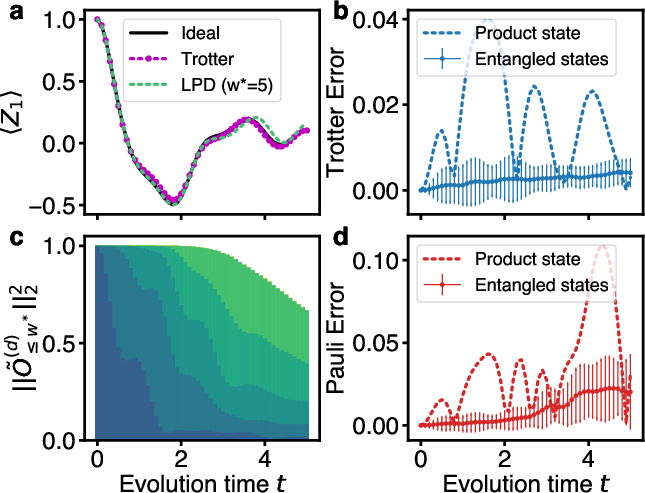
Figure 4: QMFI numerical results: expectation values (a), Trotter error for product and random states (b), norm distribution over Pauli weights (c), and comparison of truncation errors (d).
Hybrid Simulation and Resource Saturation
The synergy of LPD with tensor network methods is established via hybrid protocols:
Implications and Future Directions
The LPD framework reformulates the classical simulation frontier, showing that entanglement, previously a barrier, can be harnessed to suppress truncation errors in expectation values, enabling efficient classical algorithms in noiseless settings. Practical implications include:
- Accessible Quantum Regimes: Extends classical reach into entangled states, transitioning what was believed to require quantum advantage into tractable compute for short-time, local observables.
- Quantum Resource Compression: LPD reduces circuit depth requirements for quantum simulators, translating to enhanced capabilities for NISQ-era devices.
- Algorithm Generalization: The approach invites future refinements to exploit geometric locality, symmetries, and extensions to fermionic and non-local observables, as well as improved truncation schemes (e.g., coefficient-based selection).
Conclusion
This work rigorously expands the space of provably efficient classical simulation for noiseless quantum dynamics, leveraging entanglement as a resource to minimize Pauli truncation errors. By combining deep error analysis and hybrid simulation protocols, LPD challenges prior boundaries of classical tractability and suggests new avenues for both classical and quantum computation of many-body dynamics. The theoretical results, supported by empirical evidence, position LPD and its extensions as central tools for future explorations of quantum simulation complexity.