Rare Near-Opposition Alignment of 3I/ATLAS on 22 January, 2026
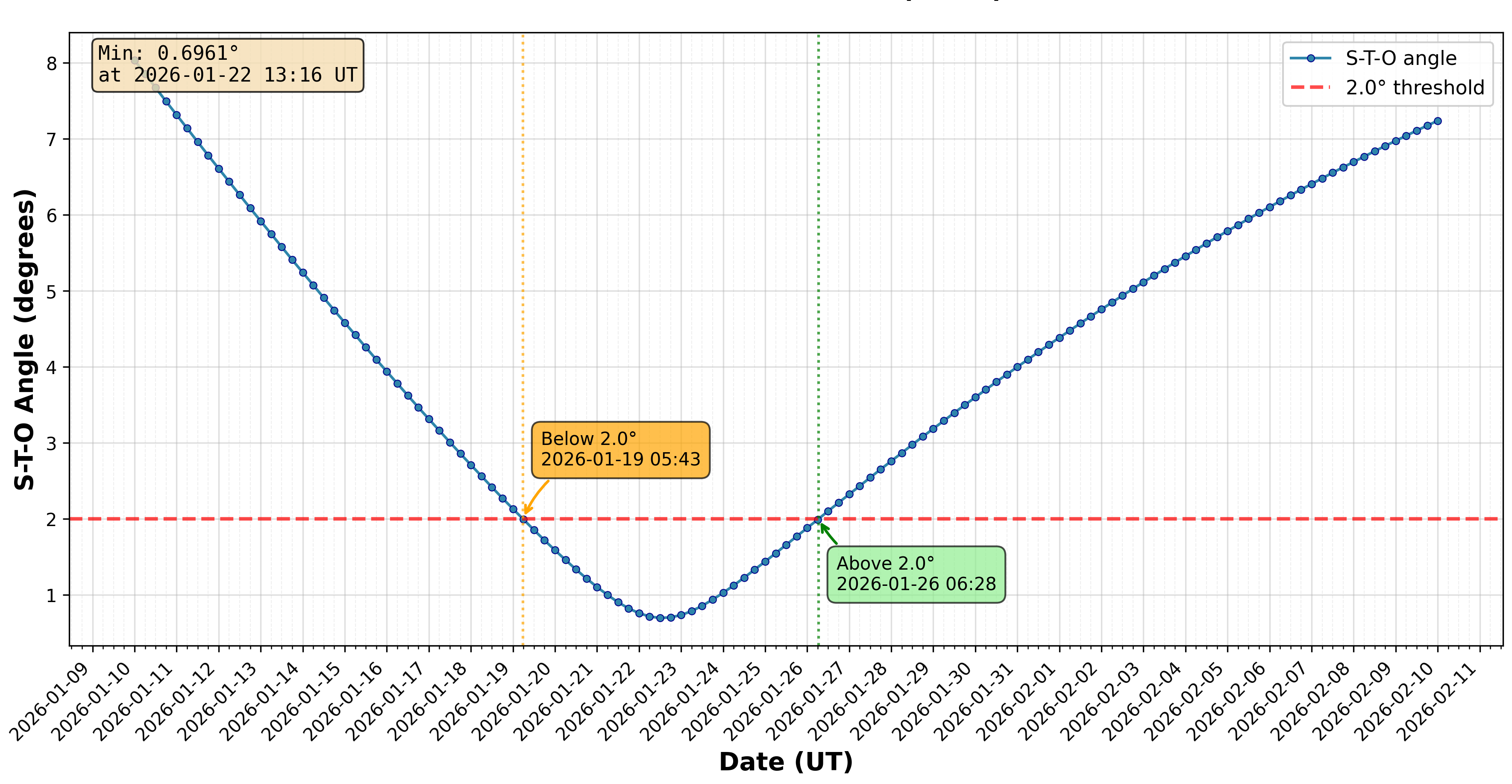
Abstract: We point out that on 22 January 2026, the interstellar object 3I/ATLAS will align to within an exceptionally small angle, alpha= 0.69 degrees, with the Earth-Sun axis. This rare alignment provides unique circumstances for measuring the opposition surge and polarimetric properties of interstellar cometary dust. We characterize the alignment geometry, outline key scientific opportunities, and define the observational requirements for data collection. Observations before and after the alignment time offer an unprecedented opportunity which may not repeat for decades, for characterizing the albedo, structure, and composition of interstellar matter.
Paper Prompts
Sign up for free to create and run prompts on this paper using GPT-5.
Top Community Prompts
Explain it Like I'm 14
Explaining “Rare Near-Opposition Alignment of 3I/ATLAS on 22 January, 2026”
Overview
This paper talks about a special line-up in space that will happen on January 22, 2026. On that day, the Earth, the Sun, and an interstellar comet called 3I/ATLAS will be almost perfectly lined up. This rare event makes the comet’s dust look brighter in a very specific way, giving scientists a chance to learn what the dust is made of and what its tiny grains look like.
Key Questions the Paper Tries to Answer
The authors point out the alignment and explain why it’s a big deal. They ask:
- How does 3I/ATLAS get brighter when it is almost opposite the Sun in the sky (a “near-opposition” view)?
- What does that brightness tell us about the dust around the comet—its reflectivity (how shiny it is), its structure (compact or fluffy), and its ingredients (like ice or carbon)?
- What kind of observations should astronomers make to capture this moment and learn the most?
Methods and Approach (Explained Simply)
To figure out the timing and geometry, the authors used accurate space position data (an ephemeris) from NASA’s JPL Horizons system. Think of an ephemeris like a super-precise calendar and map for objects in the solar system.
They then explain how to observe the comet during the alignment:
- Measure how bright it gets at different times.
- Use different color filters (like taking photos in blue, green, and red light).
- Measure the polarization of the light (polarimetry), which is like checking the “direction” that light waves wiggle—similar to how polarized sunglasses reduce glare.
Key terms explained:
- Interstellar object: A visitor from another star system, not originally from our solar system.
- Opposition and phase angle: “Opposition” is when a space object is directly opposite the Sun from Earth’s point of view. The phase angle (α) is the angle between the Sun-object line and the Sun-Earth line. A tiny α (near 0°) means almost perfect alignment.
- Opposition surge: When an object looks suddenly brighter at very small phase angles because of how light interacts with dust.
- Albedo: How reflective something is. High albedo = shiny; low albedo = dark.
- Polarimetry: Measuring how light is oriented, which reveals the shape and structure of tiny dust grains.
Main Findings and Why They Matter
The paper’s main finding is the timing and quality of the alignment:
- On January 22, 2026, 3I/ATLAS will be aligned with Earth and the Sun to within α = 0.69°, which is extremely close to perfect.
- The phase angle will stay very small (α < 2°) for about a week (January 19–26, 2026), giving a longer window than usual to observe this effect.
- Around that time, the comet will be about 3.33 AU from the Sun and 2.35 AU from Earth (1 AU is the distance from Earth to the Sun), and it will be moderately bright for professional telescopes (about V ~ 16.7 magnitude).
Why this is important:
- Most solar system objects show an “opposition surge” (a nonlinear jump in brightness) at small phase angles, caused by two effects:
- Shadow-hiding (usually α > 2°): When the Sun, object, and observer line up, the tiny shadows between dust grains disappear, making the object look brighter—like shining a light straight at a rough surface so shadows vanish.
- Coherent backscatter (usually α < 2°): Light waves bouncing around in the dust can line up and boost each other, creating a sharp brightness spike—like ripples meeting in a pond and forming a taller wave.
- Measuring how strong and how wide this surge is tells us:
- Composition: Is the dust very dark (like carbon-rich material), or does it contain shiny ice?
- Grain structure: Are the grains compact (like tiny pebbles) or fluffy (like snowflakes)? Compact grains usually make a narrow surge; fluffy grains make a broader one.
So far, only one comet (67P/Churyumov–Gerasimenko, visited by the Rosetta spacecraft) has a well-measured opposition surge. 3I/ATLAS offers the first chance to do this for an interstellar comet, which could be quite different from comets born in our solar system.
How Astronomers Should Observe It
To make the most of this rare chance, the paper suggests:
- Observe for at least four days before and after January 22, 2026, to track the surge as the angle changes.
- Use precise brightness measurements (photometry) so small changes can be detected.
- Use multiple color filters to see how brightness changes with wavelength (this helps separate the two surge effects).
- Try polarimetry to learn about dust grain shapes and how light scatters in the coma.
- Use telescopes about 1 meter across (or larger), especially for polarimetry.
Implications and Potential Impact
If scientists capture this event well, we can learn a lot about material from another star system—what it’s made of and how its dust grains are built. That helps answer big questions about how planets and comets form in other places in the galaxy. Since alignments this good may not happen again for many years, this is an unusually valuable opportunity for the whole astronomy community to work together and gather unique data.
Knowledge Gaps
Knowledge gaps, limitations, and open questions
The paper identifies a rare near-opposition alignment of 3I/ATLAS and outlines broad observing opportunities but leaves the following unresolved points that future work could address:
- No quantitative prediction of the expected opposition surge amplitude, width, and shape for 3I/ATLAS under plausible dust properties (e.g., ranges of Δm and half-widths for compact vs. fluffy aggregates).
- No forward model linking measurable phase curves and polarimetric signatures to specific dust parameters (grain size distribution, porosity, packing density, and single-scattering albedo ω₀), hindering interpretation of observations.
- Lack of a plan to disentangle nucleus and coma contributions to the photometry at very small phase angles, including required spatial resolution, aperture choices, and coma subtraction methodology.
- No strategy to separate phase-angle dependence from intrinsic activity variations beyond recommending ±4 days of coverage; a concrete method (e.g., contemporaneous gas/dust production rate modeling) is not provided.
- Absence of a retrieval framework (e.g., Hapke, SHOE/CBOE formulations) to invert the observed phase curve into physical dust parameters, with uncertainty quantification and degeneracy analysis.
- No specification of the temporal sampling cadence and signal-to-noise needed to resolve a potential sub-degree coherent backscatter peak, nor an assessment of detectability given V ≈ 16.7–17 mag.
- Polarimetry is advocated but lacks detailed feasibility projections (required aperture, integration times, calibration standards, sky polarization corrections) and expected polarization-phase curves for competing grain models.
- No wavelength-optimized observing plan (filters, near-UV/optical/NIR coverage) tailored to maximize diagnostic power for distinguishing shadow-hiding vs. coherent backscatter, or to track potential phase reddening.
- The predicted magnitude and geometry are taken from an ephemeris (JPL#46) without a sensitivity analysis to non-gravitational forces and activity-driven changes that could shift the timing or minimum value of α.
- No assessment of sky visibility (RA/Dec, elongation, airmass windows) and site-dependent constraints during 19–26 January 2026, limiting practical scheduling guidance for facilities.
- No guidance on absolute and cross-site photometric calibration (standard stars, extinction corrections, inter-site zeropoint harmonization) to reach the stated ≤0.03 mag precision and enable joint analysis.
- No plan for rotational light curve monitoring and correction, despite the risk that spin modulation or jet-driven anisotropies could bias phase-curve measurements near opposition.
- Lack of a method to model and subtract anisotropic coma scattering (e.g., sunward enhancements, anti-tail), which can mimic or mask opposition effects in integrated photometry.
- No integration of contemporaneous spectroscopic constraints (e.g., CO₂/H₂O ratios, Ni/Fe emission behavior) into predictions for the dust’s albedo and structure, leaving composition inferences from the surge qualitative.
- No proposed use of spatially resolved imaging to map radial brightness profiles and isolate near-nucleus backscatter signals from extended coma contributions.
- No discussion of potential contamination sources (background crowding, fringing, moonlight, twilight) and mitigation steps critical for small-angle photometry and polarimetry.
- Lack of a coordinated data-sharing and reduction protocol (common pipelines, formats, calibration procedures) to ensure consistent multi-site aggregation and reproducibility.
- No quantitative comparison framework to benchmark 3I/ATLAS results against 67P/C-G and solar-system comets (e.g., normalized phase functions, albedo-scaled surge metrics).
- No exploration of alternative vantage points (spacecraft, high-altitude platforms) to access even smaller phase angles or continuous coverage if ground-based visibility is compromised.
- No projection for future alignment opportunities (post-2026 epochs with α ≲ 2°) including required aperture and exposure estimates at V ≈ 24–25 mag, to plan long-term follow-up despite fading.
Practical Applications
Practical Applications of the paper’s findings and recommendations
This paper identifies a rare near-opposition alignment of interstellar object 3I/ATLAS on 22 January 2026 and specifies how to exploit it to measure opposition surge and polarimetric properties of interstellar cometary dust. Below are actionable applications that flow from the alignment geometry, observing requirements, and the underlying scattering physics described.
Immediate Applications
- Global observing campaign to capture the opposition surge of an interstellar comet (academia, observatories)
- Use case: Organize time-critical, multi-site photometry and polarimetry during 19–26 January 2026 when phase angle α < 2° (peak ~0.69° on Jan 22, 13:00 UTC).
- Tools/workflows: JPL Horizons–driven ephemerides, standardized 0.03 mag precision relative photometry in BVR/VRi/gri/riz, consistent apertures/background subtraction, linear polarimetry near minimum phase, cross-site calibration plan, nightly zero-points via standard stars.
- Dependencies: Clear weather; aperture ≥1 m for photometry, larger for polarimetry; stable instrument calibration; coordinated time allocation; target brightness V ~16.5–17; coma stability to separate phase effects from intrinsic variability.
- Rapid deployment of a campaign coordination dashboard (software, research infrastructures)
- Use case: Centralize phase-angle forecasts, visibility by site, recommended exposure times per filter, live data quality metrics, and gap analysis for global coverage.
- Tools/products: Web app backed by Horizons API; observation planner that prioritizes α sampling; shared calibration files; automated ingestion of reduced light curves and Stokes parameters; alerting for weather/visibility shifts.
- Dependencies: API reliability; buy-in from observatories; uniform metadata schema for uploads.
- Polarimetric instrument utilization and calibration around α ≲ 2° (instrumentation, observatories)
- Use case: Leverage the narrow angular regime where coherent backscatter dominates to stress-test and refine polarimeter calibration and Mueller-matrix models.
- Tools/workflows: On-sky calibration sequences interleaved with comet observations; contemporaneous standard-star polarimetry; instrument model updates.
- Dependencies: Sufficient S/N at V ~16.7; availability of larger apertures; stable optics; access to calibration standards.
- Community pipeline for phase-curve inversion to retrieve dust parameters (academia, software)
- Use case: Fit opposition surge amplitude/width across bands to constrain single-scattering albedo ω0 and grain packing/structure (shadow hiding vs. coherent backscatter).
- Tools/products: Open-source notebooks implementing Hapke-like or coherent-backscatter models; MCMC fitting; multi-band coupling; uncertainty propagation; public parameter posteriors.
- Dependencies: High-cadence sampling across α ∈ [0.5°, 2°]; consistent apertures; accurate color terms and extinction corrections.
- Cross-facility data sharing and rapid-release protocol (policy, research infrastructures)
- Use case: Implement a lightweight data policy for 1-week rapid releases to maximize joint interpretation (photometry + polarimetry across bands and sites).
- Tools/workflows: DOI-minted deposits; standard FITS headers/CSV schemas; minimal proprietary period; attribution guidelines.
- Dependencies: Institutional approvals; storage funding; curator support.
- Education and outreach modules tied to a live, time-critical celestial event (education, public engagement)
- Use case: Develop short curricula on opposition surge physics, interstellar objects, and coordinated observing; host live streams from participating observatories.
- Tools/products: Classroom-ready slides/activities; annotated light curves; explainer videos; citizen dashboards showing α and brightness evolution.
- Dependencies: Translation to multiple languages; educator partnerships; accessibility of content.
- Advanced amateur/pro-am participation for photometry (amateur astronomy networks, education)
- Use case: Engage 0.4–0.6 m class amateur facilities for stacked photometry to augment coverage (especially long integrations for V ~17).
- Tools/workflows: Prescribed apertures, stacking guidelines, reference stars; centralized submission and vetting.
- Dependencies: Site conditions; tracking/guiding accuracy; adherence to calibration protocols; polarimetry likely out of reach for most amateurs.
- Observatory operations rehearsal for rapid interstellar-object campaigns (observatory ops, planetary defense)
- Use case: Use this fixed window as a training exercise for swift scheduling, multi-longitude continuity, and real-time QC—practices directly transferable to future ISOs/NEOs.
- Tools/workflows: ToO-style scheduling blocks; rolling handoffs between sites; uniform QC checklists; nightly cross-calibration comparisons.
- Dependencies: Director’s discretionary time; staff bandwidth; inter-observatory communication channels.
- Model validation for radiative transfer codes used in comet/dust studies (academia, software)
- Use case: Benchmark opposition-surge physics against real interstellar dust, refining model parameters used for comet comae and dusty regoliths.
- Tools/products: Updates to RT/BRDF libraries; test suites comparing synthetic vs. observed phase curves; versioned parameter sets.
- Dependencies: Quality of multi-band, multi-α sampling; accurate absolute calibration; well-quantified systematics.
Long-Term Applications
- Improved dust-scattering and polarimetric models for interstellar and Solar System small bodies (academia, software, space science)
- Use case: Incorporate constraints on ω0, grain size/packing, and coherent backscatter into next-gen radiative transfer codes for comets, asteroids, and exoplanetary disks.
- Tools/products: Public BRDF/PRDF (polarized BRDF) libraries; cross-mission model packages for JWST/ELTs/Rubin data analysis; training datasets for inversion algorithms.
- Dependencies: Multiple events or targets to generalize; laboratory validation with regolith/dust analogs; sustained funding for model development.
- Design inputs for future ISO rapid-response missions and payloads (aerospace, mission design)
- Use case: Use lessons from this campaign to define polarimetric imagers and phase-angle observing strategies for interceptor/flyby missions.
- Tools/products: Mission concepts featuring compact polarimeters; requirements for cadence/dynamic range; operational playbooks for narrow α windows.
- Dependencies: Technology maturation; funding approval; ride-share and launch opportunities; alert networks for ISO discovery.
- Earth and planetary remote sensing improvements via coherent backscatter insights (Earth observation, robotics, materials)
- Use case: Transfer refined understanding of opposition effects to retrievals of snow/ice/regolith properties, and to navigation/vision systems operating at small phase angles.
- Tools/products: Updated surface reflectance models in satellite L2 processors; robot vision algorithms tuned for backscatter spikes; calibration targets with known surge behavior.
- Dependencies: Demonstrated cross-domain applicability; validation campaigns; integration into operational processing chains.
- Advanced optical materials and coatings inspired by granular coherent backscatter (photonics, materials)
- Use case: Explore engineered porous/coated surfaces that exploit constructive backscatter for retroreflectivity, stealth sensing, or enhanced signal return.
- Tools/products: Prototype retroreflective metamaterials; surface treatments emulating cometary aggregate scattering.
- Dependencies: Bridging from astrophysical parameter regimes to manufacturable materials; lab measurement infrastructure; IP and commercialization pathways.
- Policy frameworks for international rapid data coordination on transient Solar System events (policy, research governance)
- Use case: Establish standing, cross-agency protocols for time-critical data sharing, DDT access, and inter-observatory tasking for ISOs and similar events.
- Tools/products: MOUs between facilities; template rapid-release policies; funding lines for coordination hubs.
- Dependencies: Stakeholder consensus; legal/IP considerations; sustained operational budgets.
- Comparative planetology of interstellar solids (academia)
- Use case: Build a catalog of interstellar dust/coma properties across ISOs to compare with Solar System comets, informing planet formation and disk chemistry models.
- Tools/products: Standardized databases; meta-analyses linking Ni/Fe ratios, volatile drivers (CO2/H2O/CO), and scattering properties; community review papers.
- Dependencies: Sufficient sample of ISOs; consistent methodologies; long-baseline observational capacity.
- Phase-aware scheduling and optimization engines for observatories (software, operations)
- Use case: Generalize the α-aware planner to other time-critical phenomena (e.g., opposition surges of TNOs, mutual events, occultations).
- Tools/products: Scheduling plugins for observatory control systems; APIs for survey facilities; analytics on coverage efficiency.
- Dependencies: Integration effort; site-specific constraints; ongoing maintenance.
Assumptions common across applications:
- 3I/ATLAS maintains sufficient dust coma near the window to exhibit an opposition surge; intrinsic activity variations can be decorrelated with the recommended ±4 day coverage.
- Photometric precision ≲0.03 mag is achievable with described apertures and calibration; polarimetry requires larger telescopes and stable systems.
- Ephemerides (e.g., JPL Horizons) remain accurate for pointing and α prediction.
- Community coordination and data-sharing infrastructure can be mobilized on short notice.
- Results from a single object may not generalize; additional ISOs will strengthen external validity.
Glossary
- Albedo: The fraction of incident light reflected by a surface or particles. "yielding mag and a very dark albedo with "
- Anti-tail: A dust feature that appears pointing sunward due to projection effects and particle dynamics. "as suggested from its extended anti-tail \citep{Keto,Keto2}"
- Aperture: The diameter of a telescope’s light-collecting opening, determining sensitivity and resolution. "telescopes with apertures 1~m are well suited for precise photometry"
- Coherent backscatter: A brightness enhancement at very small phase angles caused by constructive interference of light traveling along reciprocal paths in a scattering medium. "Coherent backscatter: (): At very small angles, light traveling on reciprocal paths through a dusty medium interferes constructively, creating a narrow brightness spike."
- Eccentricity: A measure of an orbit’s deviation from circularity; values greater than 1 indicate a hyperbolic (unbound) trajectory. "eccentricity "
- Ephemeris: A table or computational service providing an object's predicted positions and geometry over time. "as derived from the JPl Horizons ephemeris \citep{3AtlasJPL}"
- Fractal aggregates: Porous, irregular clusters of small particles with fractal geometry, often producing broad opposition surges. "fluffy fractal aggregates show broad surges with half-width of order tens of degrees."
- Geocentric distance: The distance from Earth to the object. "a geocentric distance of AU"
- Heliocentric distance: The distance from the Sun to the object. "at a heliocentric distance of AU"
- Hyperbolic orbit: An unbound trajectory with eccentricity greater than 1, indicating interstellar passage. "validated its hyperbolic orbit with eccentricity "
- Interstellar object: A body originating from outside the Solar System that traverses it on an unbound trajectory. "the interstellar object 3I/Atlas \citep{Bolin,Selig}"
- Magnitude (V-band magnitude): A logarithmic measure of brightness in a specific photometric band (here, the visual V band). "and have a V-band magnitude of mag."
- Multiple scattering: The process where photons undergo more than one scattering event, affecting polarization and photometry. "dust grain structure and multiple scattering effects."
- Opposition surge: A nonlinear increase in brightness of a body at small phase angles near opposition. "called the opposition surge (see \cite{Molaro} and references therein)."
- Perihelion distance: The closest distance between an object and the Sun in its orbit. "perihelion distance of "
- Phase angle: The angle between the Sun-object and Sun-observer (Earth) lines, controlling observed brightness and polarization. "The phase angle between the Sun-3I/ATLAS axis and the Sun-Earth axis, will reach a value of ."
- Phase curve: The dependence of an object’s brightness on phase angle across wavelengths. "The wavelength dependence of the phase curve provides critical diagnostics to distinguish between the shadow hiding and coherent backscatter mechanisms."
- Photometry: Measurement of an object's brightness through imaging, often using standardized filters. "High-precision relative photometry (0.03 mag per data point) is required to detect and characterize the nonlinear phase dependence associated with the opposition surge."
- Polarimetry: Measurement of the polarization state of light to infer properties of scattering particles and surfaces. "Polarimetry: Linear polarimetric measurements near minimum phase angle would offer a powerful and independent constraint on dust grain structure and multiple scattering effects."
- Polarization: The orientation and degree of the electric field vector in light, altered by scattering processes. "anomalous polarization properties of 3I/ATLAS \citep{Pola}"
- Proto-planetary disk: A disk of gas and dust around a young star where planets and small bodies form. "Cometary dust is processed through its parent proto-planetary disk, and so its microphysical structure might be different from interstellar dust \citep{Draine}."
- Shadow-hiding: Brightness increase at small phase angles when shadows cast by regolith or dust are hidden from the observer. "Shadow-hiding: (): When the Sun, object, and observer are nearly aligned, shadows cast by dust particles are hidden behind the particles."
- Single-scattering albedo: The probability that a photon is scattered rather than absorbed in a single interaction with a particle. "The surge amplitude ... is strongly influenced by the single-scattering albedo of dust grains "
- Velocity at infinity (v∞): The asymptotic speed of an object far from the Sun on a hyperbolic trajectory. "Its interstellar velocity relative to the Sun of is large in comparison to the two other documented interstellar objects"
Collections
Sign up for free to add this paper to one or more collections.