- The paper introduces a polynomial-time quantum algorithm that efficiently simulates amplitude-level interference in high energy particle showers.
- It combines classical perturbative methods with quantum circuit design, employing basis rotations and controlled gates to manage complex emissions.
- Experimental demonstrations on IBM Q hardware validate the approach by closely matching quantum simulation outputs with theoretical predictions.
Quantum Algorithmic Approaches for High Energy Physics Simulations
Introduction
Simulating quantum field theories (QFTs), especially in the high-energy regime, is a central computational challenge due to the complex quantum interference and the factorial growth of final states. While quantum computers are well suited to model inherently quantum phenomena, their practical application for full-scale QFT simulations has been stymied by hardware limitations and prohibitive resource scaling. The paper "A quantum algorithm for high energy physics simulations" (1904.03196) introduces a hybrid paradigm that leverages quantum computation specifically for intractable components of high energy scattering processes while relying on established classical and perturbative methods elsewhere. The authors focus on final state showers featuring quantum interferences that are inaccessible to classical Markovian algorithms, and they explicitly demonstrate a polynomial-time quantum circuit construction for such processes.
Problem Context and Factorization Strategy
In high energy scattering, observable cross sections factorize into components: hard short-distance parts computable with perturbation theory, nonperturbative long-distance hadronization, and an intermediate regime where multiple emissions and quantum interferences become central. Classical parton showers, implemented via MCMC, effectively sample soft/collinear emissions but necessarily collapse quantum coherence, thereby neglecting amplitude-level interference effects. Existing approaches perform efficiently in the incoherent (g12→0) limit but become exponentially expensive (in the number of emissions) for arbitrary interference.
The goal, therefore, is an algorithmic framework enabling efficient sampling of full quantum radiation patterns, explicitly preserving coherence among all possible emission histories. The authors target a simplified QFT with two fermion species and one scalar mediating both diagonal and off-diagonal interactions, capturing key interference structures reminiscent of electroweak showers.
Quantum Algorithm Construction
The model Lagrangian involves two fermion flavors (f1, f2) coupled to a scalar (ϕ), with both diagonal (g1, g2) and off-diagonal (g12) couplings. The presence of non-vanishing g12 terms manifests in multiple interfering quantum paths. For g12=0, classical MCMC suffices via splitting functions and Sudakov factors; otherwise, classical simulation requires explicit summation over all 2N intermediate histories and is thus impractical for large N.
The quantum algorithm sidesteps this barrier by directly propagating amplitude superpositions across all possible histories. The circuit design encodes particle content, history, emission, and counts into quantum registers, employing basis rotations to diagonalize the splitting matrix and optimize for independent emissions in the rotated basis. The stepwise procedure includes:
- Basis Rotation: Initial particles are rotated from the interaction basis (f1/2) to the diagonalized basis (fa/b), using a state-dependent unitary.
- Evolution: At each step, the number of particles is counted, Sudakov factors (via rotation gates) determine emission probabilities, and controlled gates update history and particle content accordingly.
- Measurement: Final rotation back to the physical basis allows physical observables to be extracted via repeated projective measurements.
The quantum register structure and operations are systematically decomposed into standard quantum gates. The full model's complexity scales as N5logN in gate count, but this can be significantly reduced to Nnf2lognf (with nf the final fermion count) if history registers are measured after each step—a scenario feasible with future hardware supporting mid-circuit measurements.
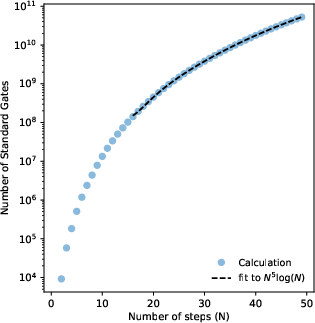
Figure 2: Gate count scaling as a function of the number of shower steps N, illustrating asymptotic N5logN behavior for the unsimplified quantum circuit.
Experimental Demonstration
Due to hardware constraint, the authors instantiate their algorithm in a minimal, but still interference-rich, regime: ϕ→ffˉ splittings are neglected, running couplings are ignored, and a single fermion acts as the shower initiator. The resulting circuit remains nontrivial—the classical MCMC still fails for g12=0—but is implementable on present quantum processors (IBM Q Johannesburg, five qubits, 48-53 gates per run).
Key observables include the differential cross section versus maximum emission angle and the emission multiplicity, analyzed as interference is toggled on (g12=1) and off (g12=0). Quantum simulations and experimental measurements, including detailed error mitigation for readout and CNOT gate noise (using Qiskit tools and zero-noise extrapolation), demonstrate:
- Excellent classical-quantum simulator/hardware agreement when interfering paths are absent (g12=0).
- Distinct and statistically robust shifts in emission distributions and multiplicities as genuine quantum interference is introduced (g12=1).
- Agreement between quantum hardware output and theoretical prediction, with residual differences attributed to hardware noise rather than algorithmic deficiency.
Discussion and Implications
Bold Claim: The authors demonstrate explicit polynomial-time quantum sampling of showers with amplitude-level interference, while any classical approach exhibits at least exponential complexity in emitted particle count, for g12=0.
This approach enables, in principle, the exploration of quantum effects in final state radiation far beyond classical capabilities. The modular algorithm design allows straightforward extension to larger fermion sets, inclusion of momentum fractions and 3D kinematics (potentially in a hybrid classical-quantum setting), and adaptation to full SU(2) electroweak showers with more bosonic species. Generalization to QCD's SU(3) remains challenging due to low-energy confinement phenomena, but the amplitude-based methodology aligns conceptually with ongoing efforts in classical amplitude shower development.
From a practical standpoint, the ability to simulate several emissions with interference on real hardware marks a critical experimental threshold. The demonstration of hardware-corrected quantum measurements (gate depths >48) and error-mitigation strategies on public and Q Hub IBM chips underscores rapid progress toward viability.
Future Directions
Advances in quantum hardware fidelity and qubit connectivity will immediately translate to increased numbers of tractable emissions, allowing cross-validation of classical amplitude-based and quantum approaches, especially in the regime of high-multiplicity final states. Including longitudinal momentum and azimuthal sampling will be essential for direct collider phenomenology relevance.
There is also potential for impact in indirect detection channels in astroparticle physics (e.g., ultra-high energy cosmic rays or dark matter induced showers), where quantum interference could yield phenomenologically distinguishable radiation spectra.
Conclusion
"A quantum algorithm for high energy physics simulations" (1904.03196) provides a concrete algorithmic and experimental foundation for simulating quantum interference-rich high energy showers on quantum computers with polynomial efficiency. The underlying paradigm—a hybrid partitioning of the full calculation where quantum resources are focused exclusively where classical intractability sets in—sets a scalable path for practical quantum advantage in field-theoretical simulation. This work establishes both methodology and proof-of-principle hardware realization, charting direction for future quantum simulation in high energy theory and phenomenology.