- The paper demonstrates SND@LHC's capability to detect sub-GeV dipolar dark states through dimension-5 MDM/EDM interactions in meson decay and Drell-Yan channels.
- The study employs effective field theory and advanced simulations to set conservative bounds on dark state couplings while ensuring EFT validity in the forward region.
- The analysis projects detection sensitivity improvements at HL-LHC luminosities, highlighting the detector’s design and potential for extension in far-forward experiments.
Probing Sub-GeV Dipolar Dark States at SND@LHC: Invisible Bounds From Meson Decays
Introduction
This work investigates the sensitivity of the Scattering and Neutrino Detector at the LHC (SND@LHC) to sub-GeV Dirac fermion dark matter candidates (referred to as “dark states”) interacting with Standard Model (SM) particles via dimension-5 magnetic or electric dipole moment (MDM/EDM) operators (2601.03186). The study is motivated by the absence of new physics signals at high energy scales and the resulting focus on feebly interacting particles (FIPs), which are most effectively sought in high-intensity, far-forward experiments. SND@LHC, due to its geometry and target design, provides unique sensitivity to FIPs that are copiously produced in the forward region via meson decays or Drell-Yan processes and subsequently scatter in the detector.
Dipolar Dark State Model
The analysis is centered on Dirac fermionic dark states χ that couple to the SM photon through effective magnetic and electric dipole interactions. Majorana states are disfavored due to vanishing dipole moments. The effective Lagrangian is
L=ΛcAMDMχˉσμνχFμν+iΛcAEDMχˉσμνγ5χFμν,
where cAMDM/EDM/Λ parametrize the dipole couplings. The dominant signals of such dark states are photon-mediated production and subsequent electron/nuclei scattering in the target.
The effective field theory approach remains valid for q≪Λ, and the study systematically enforces conservative bounds on Wilson coefficients to ensure the validity of this regime throughout the kinematic landscape assessed at SND@LHC.
SND@LHC Detector Overview
SND@LHC is located 480 m from the ATLAS Interaction Point, covering pseudorapidity 7.2<η<8.4. The detector consists of alternating tungsten ECC bricks and scintillating fiber planes, enabling high-resolution vertexing and energy measurement for both electromagnetic and hadronic showers. The muon identification system allows veto and background suppression.
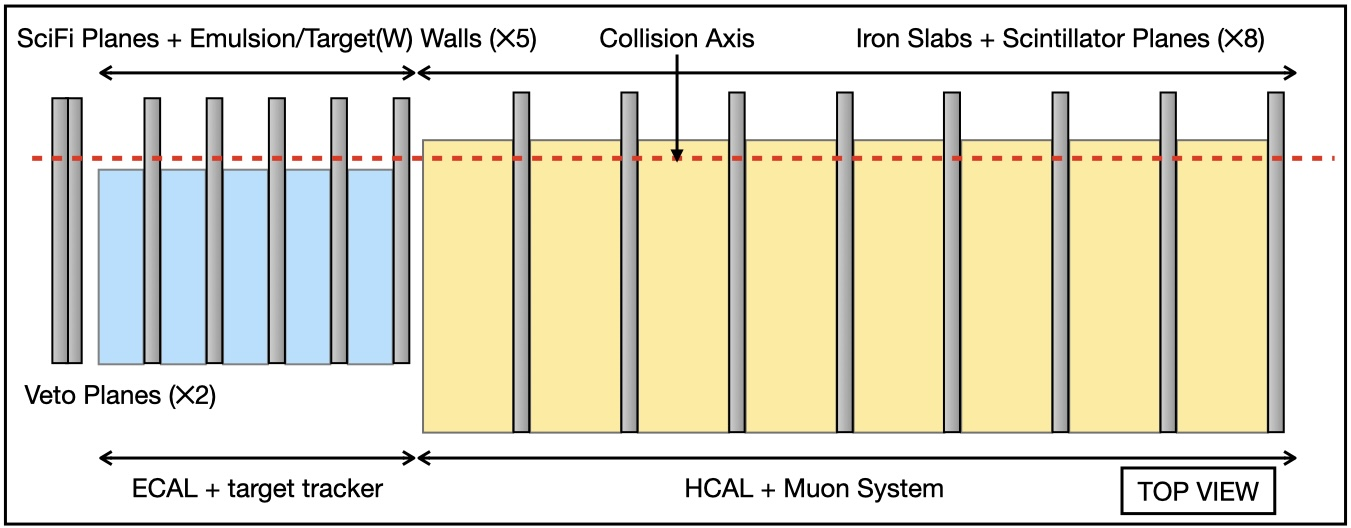
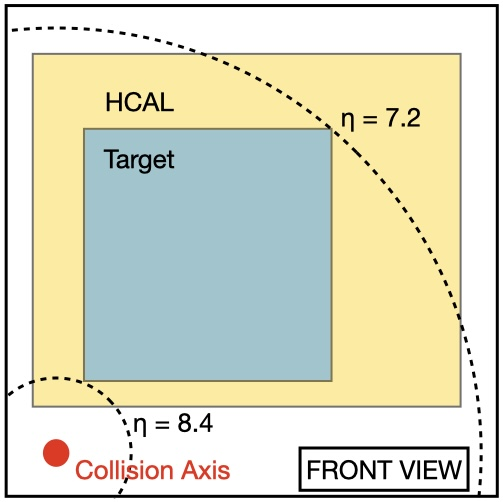
Figure 1: Schematic layout of SND@LHC, highlighting acceptance and target design for forward physics searches.
The fine timing (∼200 ps) and spatial resolution provide the ability to distinguish exotic signals from intrinsic neutrino backgrounds. However, for the high-energy, forward FIPs considered here, time-of-flight discrimination is less effective than for slower, massive LLPs.
Production Mechanisms of Dark States
Drell-Yan and Resonant Production
For dark states with mχ≳1 GeV, Drell-Yan processes (qqˉ→γ∗→χχˉ) dominate. The forward multiplicity and pair kinematics are simulated using MadGraph5_aMC@NLO and analyzed with MadAnalysis 5.
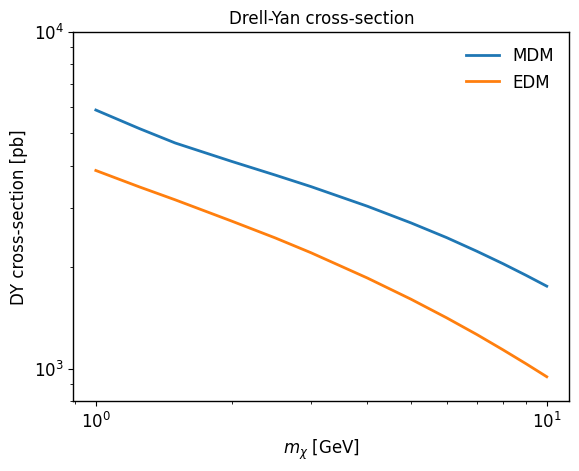
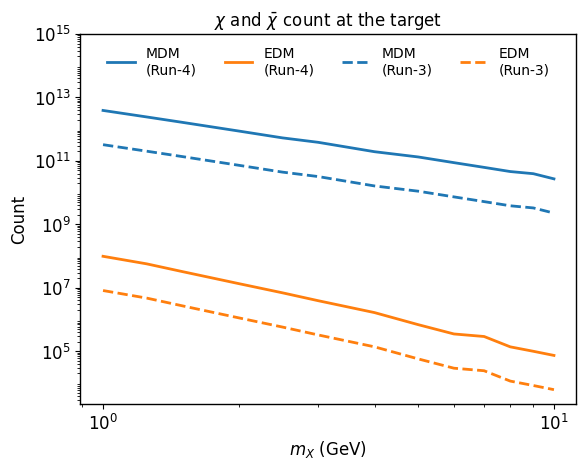
Figure 2: Drell-Yan cross section versus mχ for fixed coupling and expected number of dark state pairs at target for Run-3/Run-4 LHC luminosity.
Meson Decays
For mχ≲1 GeV, production from decays of unflavored pseudoscalar (π0,η,η′) and vector (ρ,ω,ϕ,J/ψ,Υ) mesons is the primary channel. The partial widths and differential spectra are computed using the dipolar couplings and recent PDG values for the meson parameters.
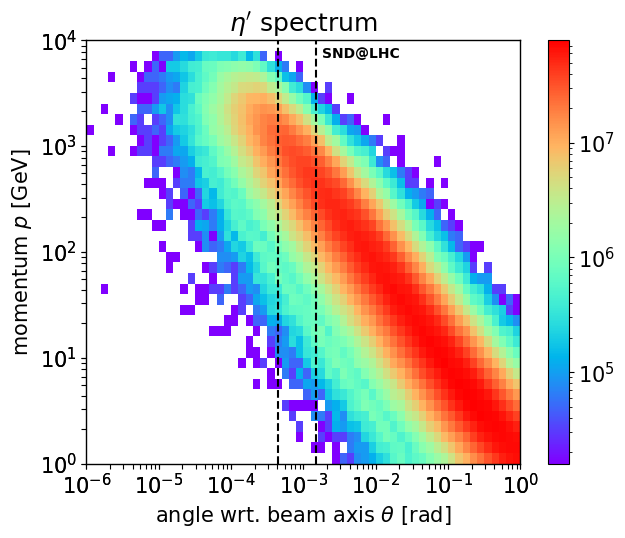
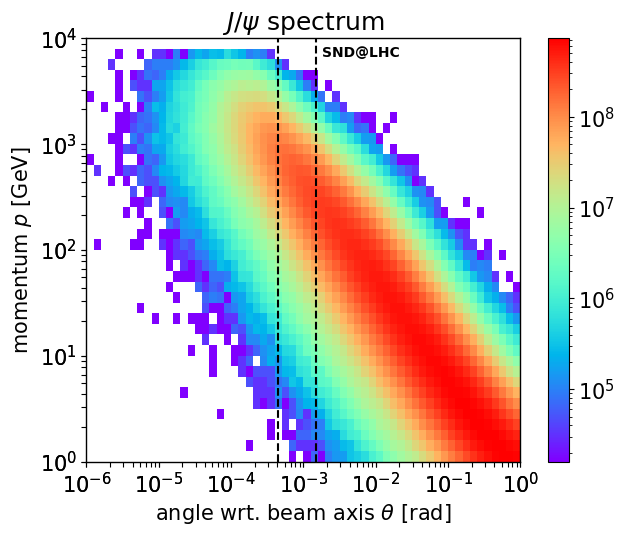
Figure 3: Representative spectra for η′ and J/ψ mesons, with SND@LHC angular acceptance indicated.
The analysis employs the FORESEE simulation suite for production and decay kinematics. The total production cross sections for both MDM and EDM cases within the SND@LHC acceptance are provided.
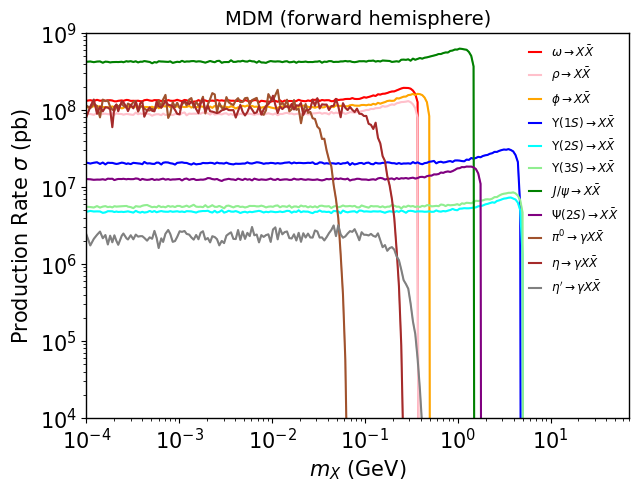
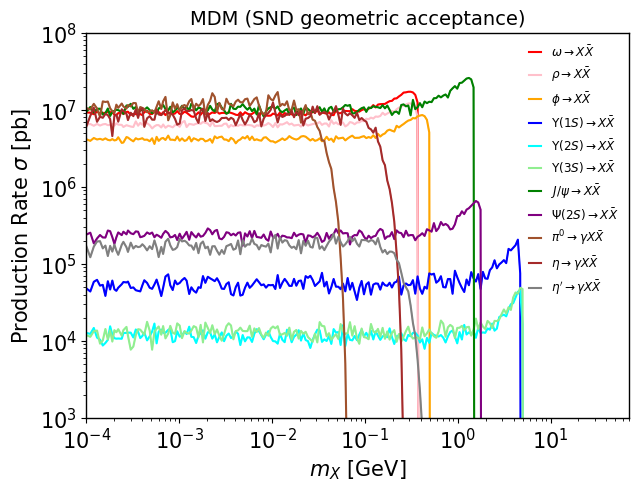
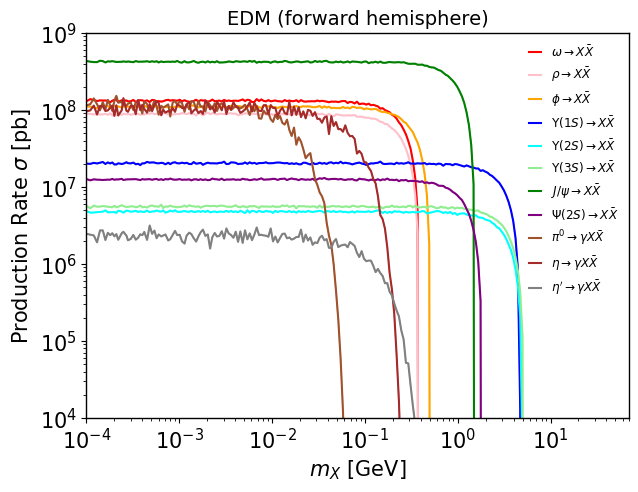
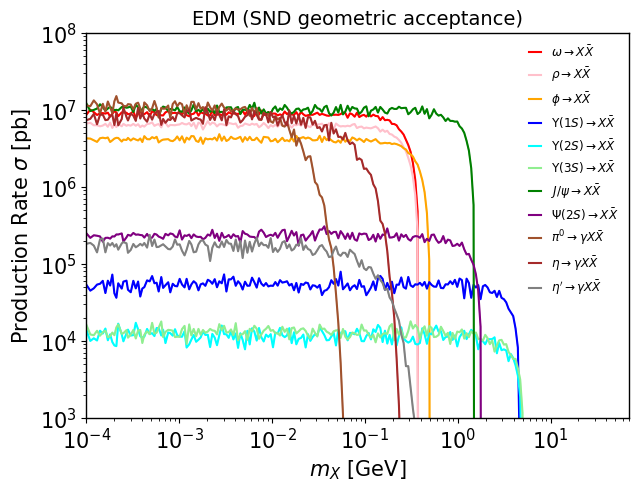
Figure 4: Dipolar dark state pair production cross sections for both MDM and EDM interactions, shown in the full forward hemisphere and restricted SND@LHC acceptance.
Signal spectra, particularly the momentum distributions and mean energies of the produced dark states, are quantified for all dominant channels.
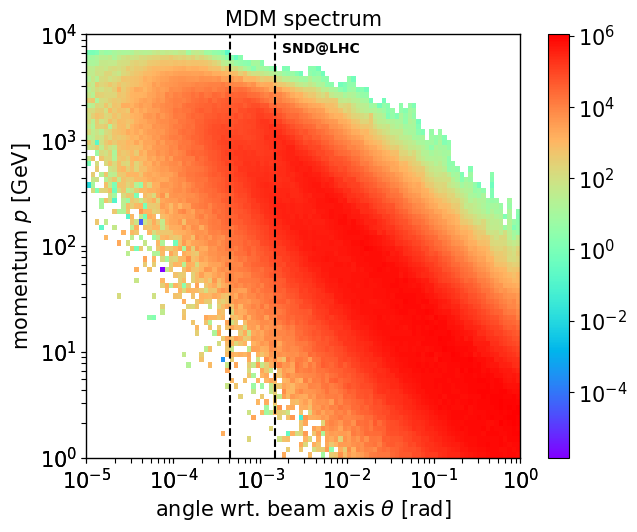
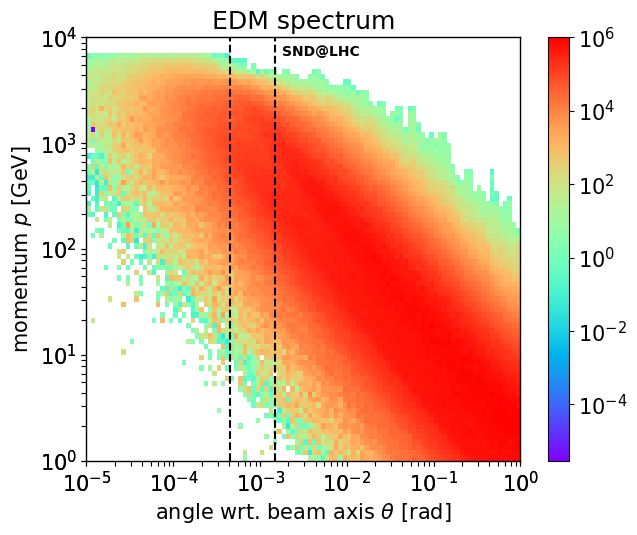
Figure 5: Momentum and angular spectrum of produced dark states for mχ=0.1 GeV and fixed dipole coupling.
Strong constraints are imposed by invisible branching ratio measurements of mesons, especially Υ(1S), which significantly restrict the allowed parameter space for dipole couplings.
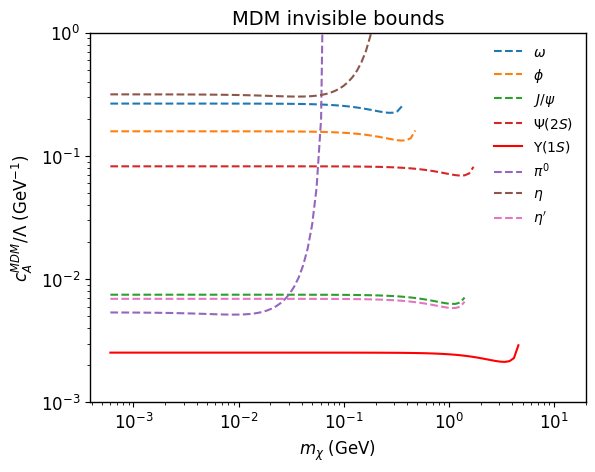
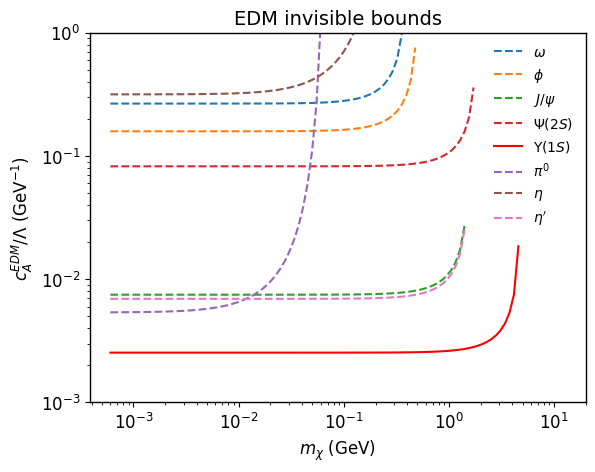
Figure 6: Bounds on MDM and EDM couplings from invisible branching ratios of meson decays.
Sensitivity Analysis
Signal, Background, and Projected Reach
The analysis computes recoil signal rates in the SND@LHC target for both electron and nucleon scattering. For SM backgrounds, elastic neutrino scattering is the only irreducible background; for signal rates, efficiency is fixed at unity for conservative projection.
Populations and mean energies of incident dark states are calculated across mχ values, combining both meson decay and Drell-Yan sources.
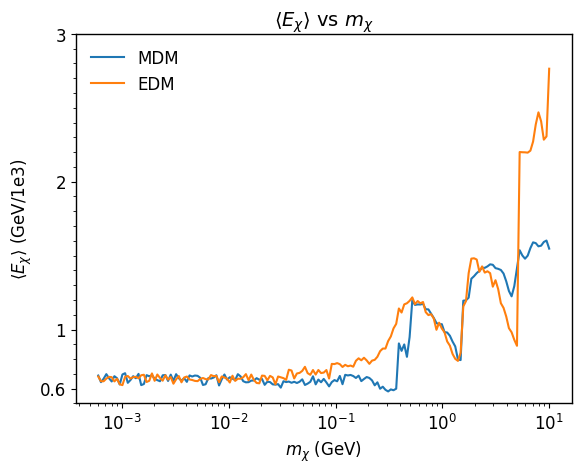
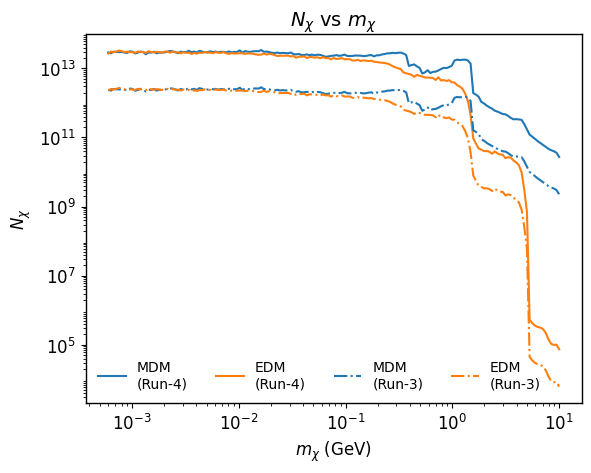
Figure 7: Left: Mean energy of dark states reaching SND@LHC as a function of mχ. Right: Total population of dark states at target for given luminosities.
The sensitivity limits in cA/Λ versus mχ are obtained by requiring at least 2.3 events (90% CL background-free search). Limits are shown for both Run-3 (250 fb−1) and projected HL-LHC (3000 fb−1), and compared to those from direct detection (χe) and beam-dump/fixed-target/collider experiments.
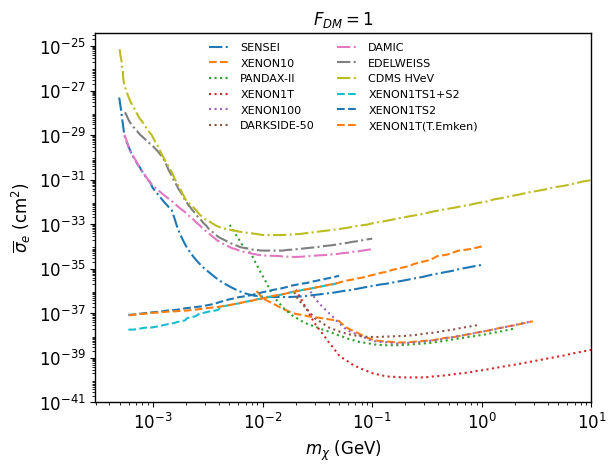
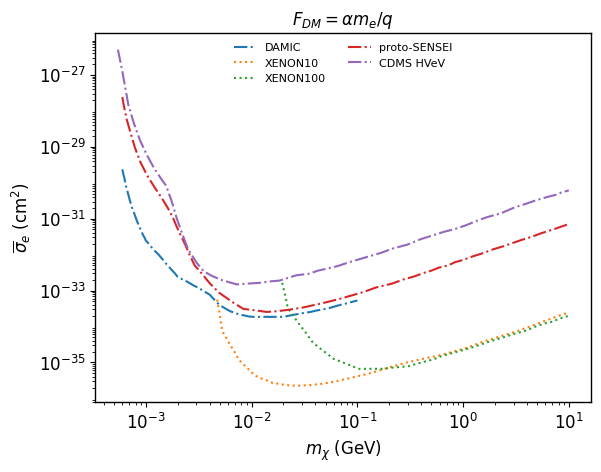
Figure 8: 90% CL upper limits on the reference cross section σˉe for electron scattering, for FDM=1 (MDM, left) and FDM=αme/q (EDM, right).
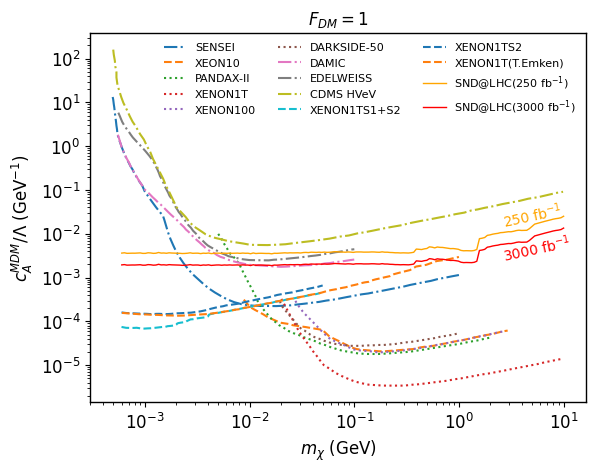
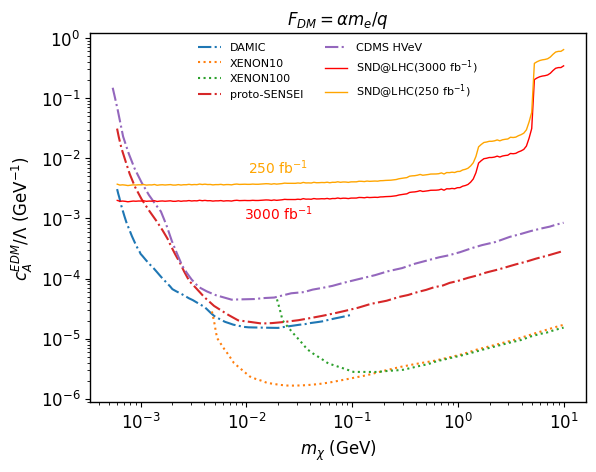
Figure 9: SND@LHC sensitivity curves for both MDM and EDM interactions compared with leading direct-detection experimental bounds.
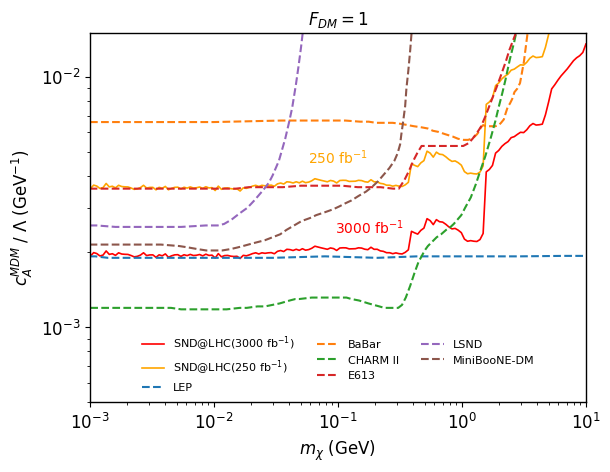
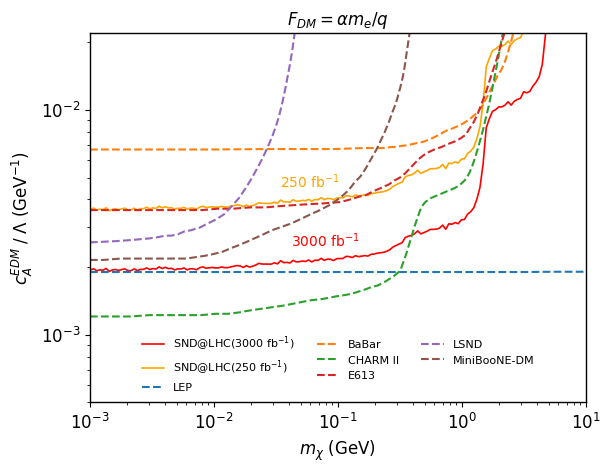
Figure 10: SND@LHC projected reach versus beam dump, fixed-target, and e+e− collider constraints for MDM (left) and EDM (right) couplings.
The allowed/detectable parameter space is further reduced by requiring EFT validity. This restricts cA/Λ<(10qmax)−1, where qmax is the maximal momentum transfer in the target.
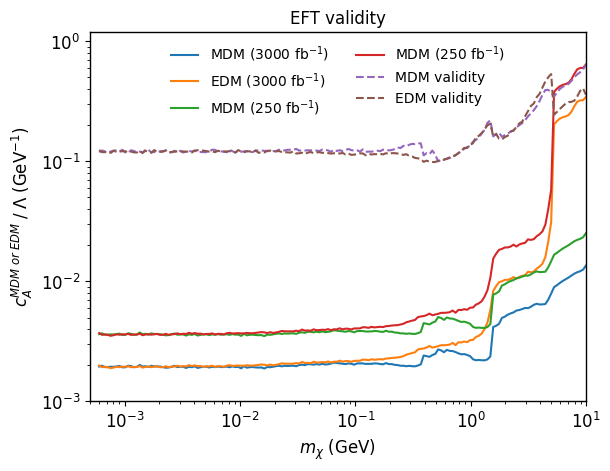
Figure 11: Validity region for effective dipole description within projected SND@LHC sensitivity contours.
The study includes the impact of RGE running of Wilson coefficients; for pure dimension-5 dipole operators, RG effects are minimal at leading order. For nucleon scattering, existing direct-detection limits are not directly applicable due to the q-dependent structure of the dipolar interaction.
Implications and Future Directions
This work demonstrates that SND@LHC will probe previously inaccessible parameter regions for sub-GeV dipolar dark states, especially for masses below 0.5 GeV, even accounting for strong constraints from solar-reflected DM that affect direct-detection experiments. The detector’s acceptance and the high forward multiplicity of mesons at the LHC grant sensitivity in a regime complementary to other approaches. However, present constraints from high-luminosity experiments like LEP and CHARM II remain more stringent for a broad swath of parameter space above the MeV scale.
Enhanced SND@LHC sensitivity, potentially achievable by extending detector length or acceptance, could outperform these bounds, provided practical constraints of the LHC tunnel infrastructure are addressed. Future upgrades and the HL-LHC program will further sharpen these limits. The analyses, tools, and simulation pipelines here are broadly applicable to other FIP and BSM searches at SND@LHC and similar far-forward detectors.
Conclusion
This study presents a comprehensive evaluation of SND@LHC’s sensitivity to sub-GeV Dirac dark states coupled via electromagnetic dipole operators, with a rigorous treatment of production, detection, experimental bounds, and EFT validity. The analysis details parameter regions where SND@LHC will provide unique coverage, complementing current and future direct detection and accelerator-based experiments. Further expansion of detection capabilities in HL-LHC runs or next-generation far-forward detectors could yield access to uncharted sectors of minimal feebly coupled dark matter models.