- The paper demonstrates that joint IceCube-KM3NeT analyses can probe quasi-Dirac oscillations over Galactic distances with Δm² sensitivity between 3×10⁻¹⁴ and 10⁻¹² eV².
- It employs the TANDEM modeling framework to integrate spatially-resolved Galactic neutrino emission with realistic detector responses for exploring both visible and invisible neutrino decay channels.
- Results forecast robust exclusion limits on BSM neutrino physics by leveraging combined energy and flavor topology data from long exposure observations.
Probing New Physics With Galactic Neutrinos: Sensitivity to Quasi-Dirac Oscillations and Neutrino Decays
Introduction
The recent detection of high-energy Galactic neutrinos by IceCube provides access to unprecedented propagation baselines and enables sensitivity to neutrino physics at L/E ratios that are inaccessible to terrestrial experiments. This paper, "Exploring New Propagation Scales With Galactic Neutrinos" (2512.10744), analyzes how joint measurements by IceCube and KM3NeT can probe models that predict novel oscillation or decay phenomena at ultra-long baselines, focusing on the quasi-Dirac (QD) neutrino scenario and neutrino decay scenarios, including both invisible and visible two-body decays. The study leverages state-of-the-art modeling of Galactic diffuse neutrino emission (TANDEM), realistic detector response, and comprehensive statistical analysis to forecast sensitivity to these beyond the Standard Model (BSM) effects.
Neutrino Propagation Models Beyond the Standard Model
Quasi-Dirac Neutrinos
The QD scenario emerges when small Majorana mass terms perturb an otherwise Dirac neutrino mass structure, yielding pairs of nearly degenerate mass eigenstates separated by a tiny splitting δm2. For Galactic baselines, these splittings can induce oscillations on scales unresolvable in atmospheric, solar, or reactor experiments, allowing for novel L/E-dependent modulations of the flavor flux. The QD survival probability in this regime is given by
Pα→βQD=i=1∑3∣Uαi∣2∣Uβi∣2cos2(4Eδmi2L),
where the oscillatory behavior can substantially reduce the active neutrino flux over Galactic propagation.
Neutrino Decay
Neutrinos may decay via invisible channels (into sterile or non-interacting daughters) or visible two-body channels (e.g., ν3→ν1+X), commonly considered in Majoron models. The survival probability in the invisible decay scenario is
Pα→βdecay=i=1∑3∣Uαi∣2∣Uβi∣2exp(−EαiL),
with flavor and energy dependence differing fundamentally from QD or standard oscillations. The joint effects of these mechanisms can suppress or enhance fluxes in experiment-specific ways depending on flavor, energy, and line-of-sight within the Galaxy.
Astrophysical Modeling and Propagation Effects
The study employs the TANDEM model suite to describe the spatially-resolved Galactic neutrino emissivity. Propagation integrates these emission models along the line of sight, applying either the QD or decay survival probabilities, yielding predictions for the energy and sky-position-dependent flux at Earth for any chosen BSM parameter set.
The spatial dependence is significant: neutrinos from the Galactic center traverse baseline lengths of O(10 kpc), maximizing sensitivity to long-wavelength BSM oscillations or decays, whereas off-plane directions yield shorter baselines and less pronounced effects.
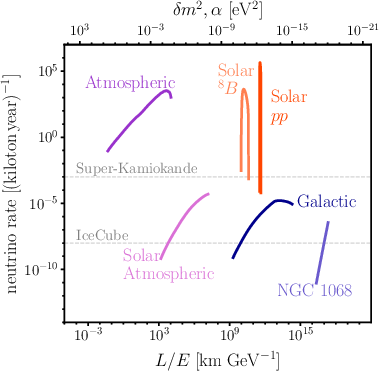
Figure 1: Expected event rates from natural neutrino sources as a function of L/E, illustrating previously unprobed scales accessible to Galactic neutrino observations.
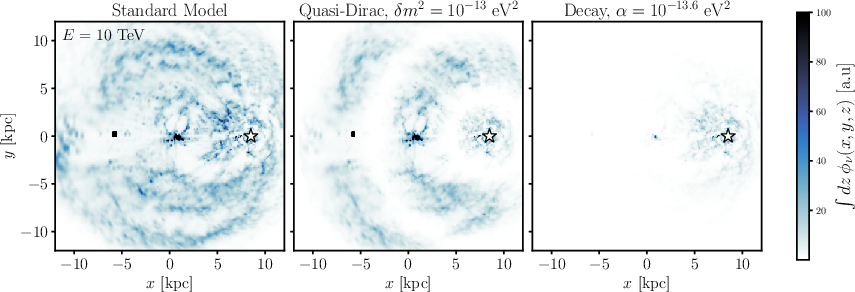
Figure 2: Sky maps of Galactic neutrino flux at $10$~TeV under the Standard Model, quasi-Dirac (δm2=10−13~eV2), and decay (α=10−13.6~eV2) hypotheses show substantial spatial and survival probability modifications.
Detector Response and Measurement Channels
IceCube (South Pole) and KM3NeT/ARCA (Mediterranean) are both sensitive to multi-TeV Galactic neutrinos but provide complementary flavor and background coverage. IceCube, sensitive to cascade events from downgoing directions, achieves excellent energy reconstruction but limited angular resolution due to the high background from atmospheric muons in track channels. KM3NeT can exploit upgoing track events with superior angular resolution and reduced background, albeit with less precise energy measurement.
The joint exploitation of these channels enables the disentanglement of normalization shifts from spectral distortions, crucial for probing flavor-specific BSM signatures.
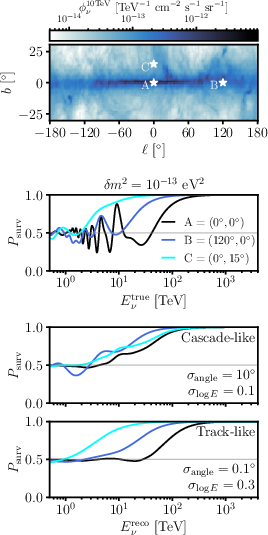
Figure 3: Survival probability and flavor spectrum modifications for different Galactic directions in the QD scenario, highlighting the energy and baseline dependence of the effect.
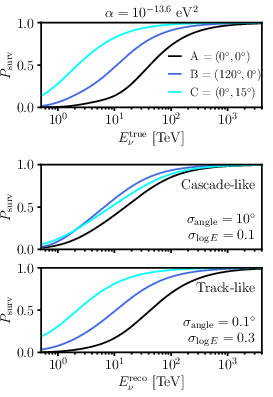
Figure 4: Survival probability for invisible decay, characterized by pronounced low-energy suppression and strong angular dependence.
Analysis and Statistical Methodology
The projected analysis considers 23 years of IceCube and 5 years of KM3NeT/ARCA exposure (by 2035), accounting for backgrounds (e.g., atmospheric neutrinos), detector response, and systematic uncertainties in flux normalization. A binned Poisson likelihood approach profiles over normalization nuisance parameters to quantify the ability to exclude hypotheses across a grid of δm2 (QD) and α (decay) values.
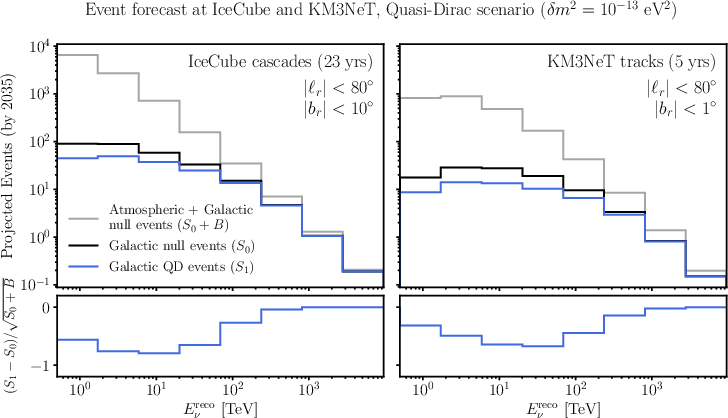
Figure 5: Predicted energy distributions and statistical significance of QD effects for IceCube cascades and KM3NeT tracks, illustrating the interplay between signal, background, and BSM-induced distortion.
Results: Sensitivity to New Physics
The Asimov sensitivity curves (Figure 6) show that a global analysis with both detectors can probe QD splittings in the range δm2∈[3×10−14,10−12] eV2 at 90% CL, a parameter region hitherto inaccessible. The decay parameter space for visible ν3→ν1 decays is testable down to α3>5×10⁻¹³eV2, providing sensitivity competitive with (but distinct from) solar neutrino bounds—especially for models with flavor- and baseline-specific decay patterns.
Notably, while single-experiment analyses are limited by normalization uncertainties (with BSM effects mimicking normalization shifts), the joint IceCube-KM3NeT analysis exploits the differential flavor and event topology sensitivity, yielding robust exclusion potential even absent tight normalization priors. Sensitivity to pure invisible decays is limited by the same effect, but improvement is possible with more stringent flux modeling or ancillary data (e.g., gamma-ray normalizations).
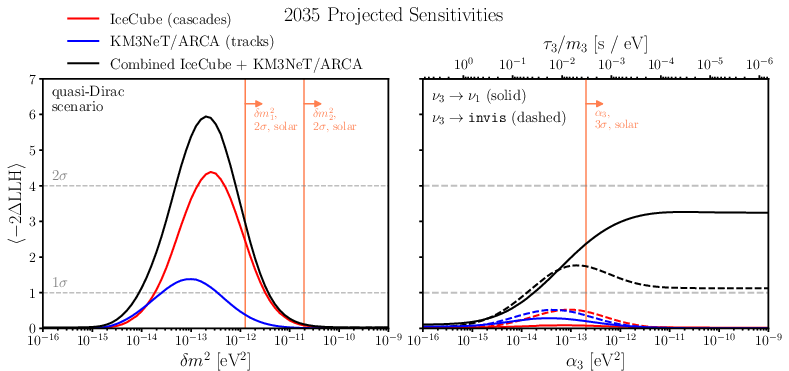
Figure 6: Median exclusion significance (test statistic) versus δm2 (left, QD) and α3 (right, decay scenarios) for IceCube cascades, KM3NeT tracks, and their combination.
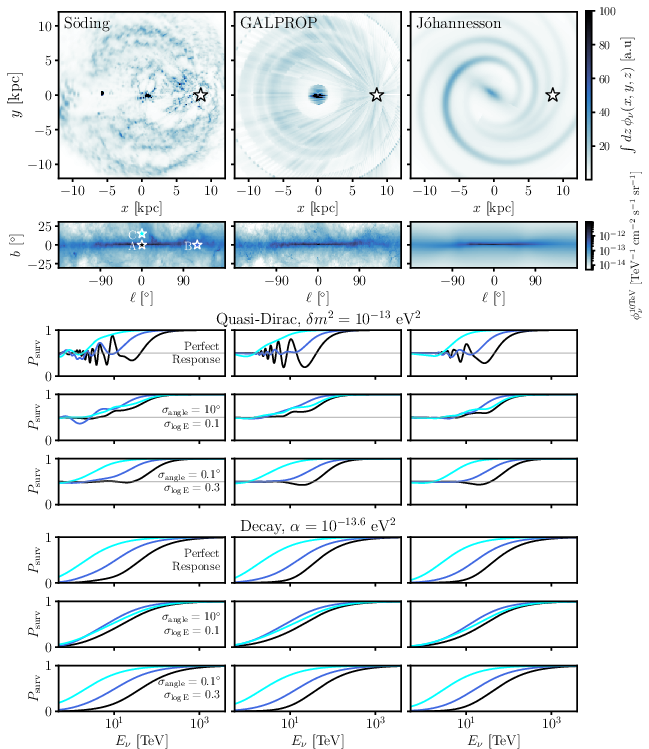
Figure 7: Survival probability and signal morphology across a variety of Galactic gas models, demonstrating the robustness of qualitative BSM signatures to emission model uncertainties.
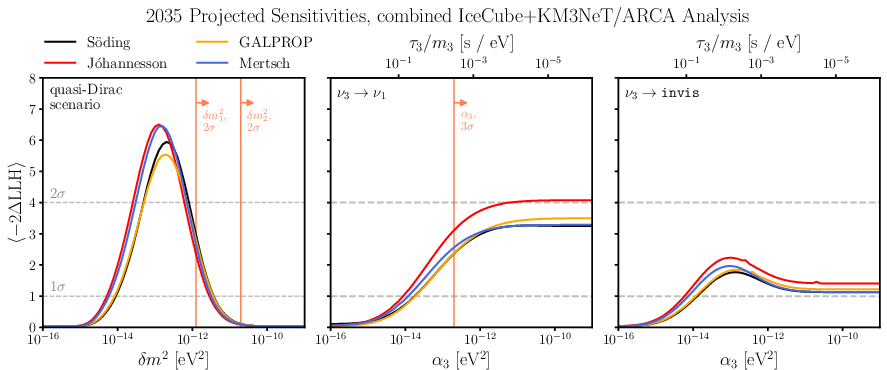
Figure 8: Projected sensitivity bands for different Galactic gas assumptions, reinforcing the limited model dependence of joint analyses.
Implications and Future Directions
The analysis demonstrates that high-statistics Galactic neutrino samples from large-volume telescopes offer a unique probe of neutrino properties at energy and distance scales beyond the reach of solar, atmospheric, or astrophysical all-sky measurements. The techniques detailed here will benefit from improved angular and energy resolutions, more precise control of astrophysical flux normalization (potentially via multimessenger approaches), and the addition of further detectors (e.g., Baikal-GVD, P-ONE, TRIDENT).
The methods are robust to Galactic emission uncertainties, as shown in detailed model comparisons, and further source-specific studies (e.g., neutrino point sources with known baselines) could extend reach. The approach fundamentally demonstrates the complementarity of joint flavor/channel analyses for robust BSM inference.
Conclusion
This work establishes that upcoming datasets from IceCube and KM3NeT/ARCA will have significant sensitivity to unexplored BSM neutrino physics spanning QD oscillations and neutrino decay on Galactic scales. The predicted limits in δm2 and α reach parameter space not accessible by traditional laboratory or solar measurements. The joint analysis framework maximizes information by leveraging both energy and flavor topology, and points toward a future in which global multimessenger networks incrementally close the window on the allowed space for exotic neutrino mass models.