LSRE: Latent Semantic Rule Encoding for Real-Time Semantic Risk Detection in Autonomous Driving
Abstract: Real-world autonomous driving must adhere to complex human social rules that extend beyond legally codified traffic regulations. Many of these semantic constraints, such as yielding to emergency vehicles, complying with traffic officers' gestures, or stopping for school buses, are intuitive for humans yet difficult to encode explicitly. Although large vision-LLMs (VLMs) can interpret such semantics, their inference cost makes them impractical for real-time deployment.This work proposes LSRE, a Latent Semantic Rule Encoding framework that converts sparsely sampled VLM judgments into decision boundaries within the latent space of a recurrent world model. By encoding language-defined safety semantics into a lightweight latent classifier, LSRE enables real-time semantic risk assessment at 10 Hz without per-frame VLM queries. Experiments on six semantic-failure scenarios in CARLA demonstrate that LSRE attains semantic risk detection accuracy comparable to a large VLM baseline, while providing substantially earlier hazard anticipation and maintaining low computational latency. LSRE further generalizes to rarely seen semantic-similar test cases, indicating that language-guided latent classification offers an effective and deployable mechanism for semantic safety monitoring in autonomous driving.
Paper Prompts
Sign up for free to create and run prompts on this paper using GPT-5.
Top Community Prompts
Explain it Like I'm 14
What is this paper about?
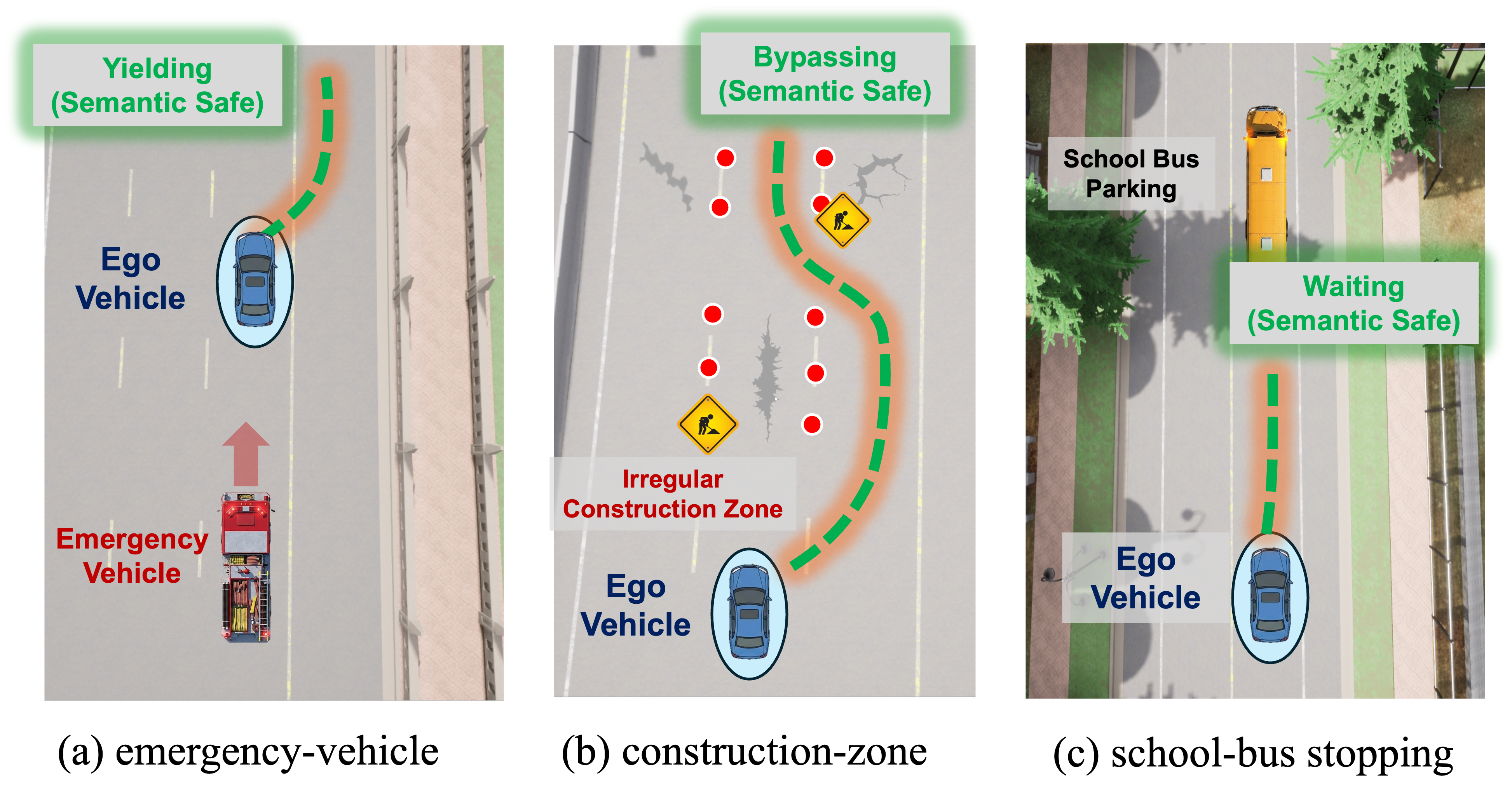
This paper is about teaching self-driving cars to notice “social” safety rules that people follow on the road but are hard to write as exact computer rules. Examples include:
- Pulling over for an ambulance with sirens on
- Listening to a traffic officer even if the traffic light says something else
- Stopping when a school bus puts out its stop sign
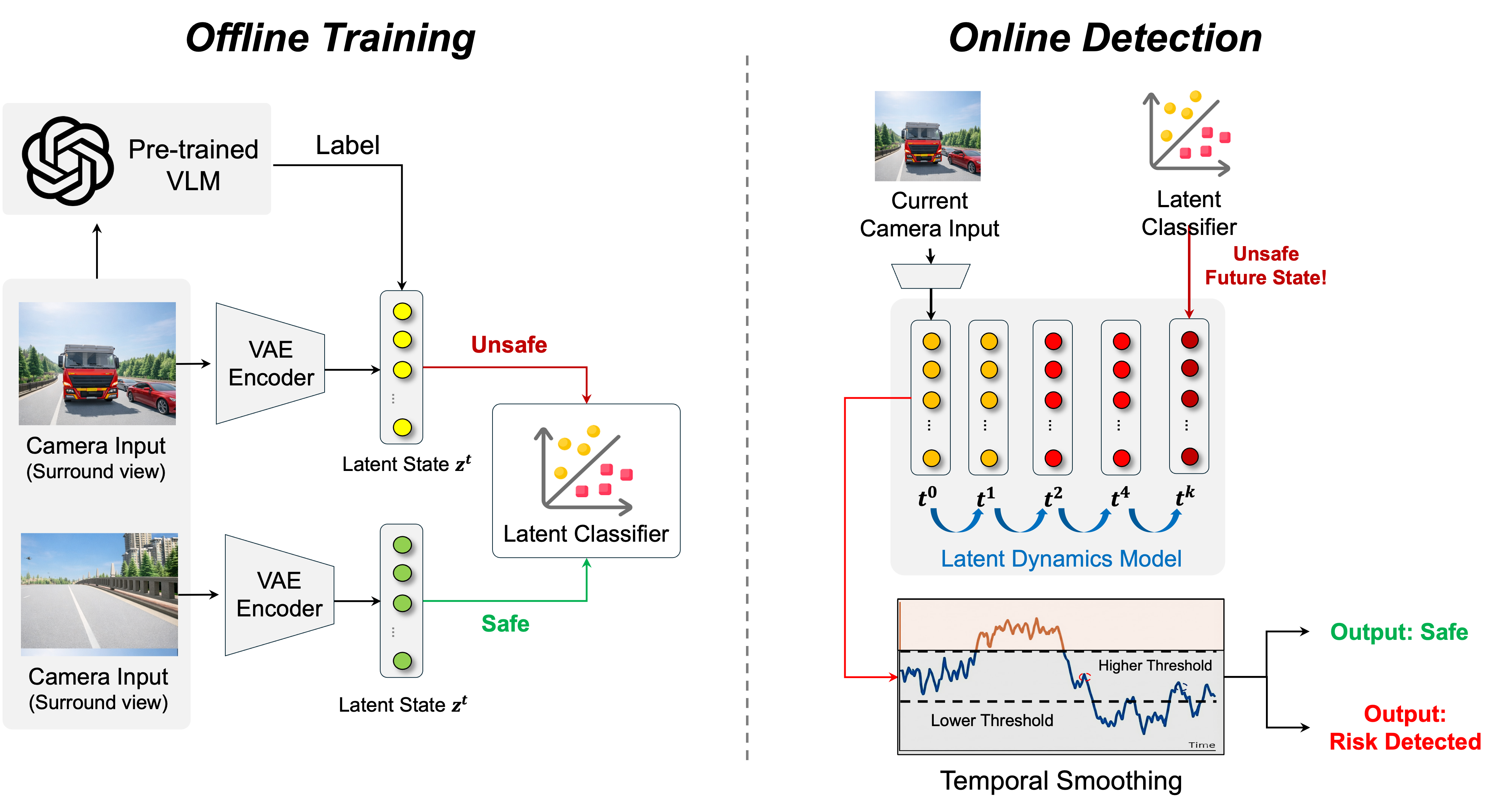
The authors introduce a method called LSRE that lets a car quickly judge if a situation is semantically unsafe (unsafe because of meaning and context, not just geometry) about 10 times per second, without needing a slow, giant AI model every frame.
What questions did the researchers ask?
They asked:
- Can we capture human-like, language-level driving rules (such as “yield to an ambulance”) in a way that runs fast enough for real driving?
- Can a small, efficient model learn these rules by learning from a big vision–LLM only sometimes, and then make its own quick decisions the rest of the time?
- Will this approach spot dangers early, stay stable (few false alarms), and work in new but similar situations?
How did they do it?
Think of three parts working together like a team:
- A “teacher” that’s smart but slow A big vision–LLM (VLM) understands pictures and words together and can answer questions like “Is it unsafe not to stop here?” It’s accurate but too slow to run on every single video frame in real time.
- A “world model” that builds a memory The car also has a “world model,” which is like a compact, smart memory that turns each camera frame into a short hidden code (called a “latent state”) and can imagine a few seconds into the future.
- Analogy: It’s like a video game engine in the car’s head that keeps a simple, fast summary of what’s going on and can predict what might happen next.
- A small “rule checker” that learns from the teacher LSRE trains a tiny classifier (a quick yes/no judge) that reads the world model’s hidden code and says “safe” or “unsafe.”
- During training, the big VLM is used only sometimes (for selected key frames) to label what’s safe or unsafe.
- The small classifier learns a simple dividing line in the hidden space between safe and unsafe (this is called a “decision boundary”).
- After training, the small classifier runs by itself at high speed, no big VLM needed.
Two extra tricks make it better:
- Short-horizon rollout (imagination): The world model “imagines” the next steps for a short time and the classifier checks those imagined steps too. This helps spot danger early—before it’s obvious in the current frame.
- Hysteresis (a “sticky” decision): To stop the warning from flickering on and off due to tiny changes, LSRE uses two thresholds (a higher one to switch to safe and a lower one to switch to unsafe). This makes the alert more stable, like a light switch that doesn’t flip from the slightest wobble.
What did they test and what did they find?
They tested in CARLA, a popular driving simulator, on six scenario types built from three themes:
- Emergency vehicle approaching from behind (you should yield)
- Construction zone with temporary lane changes
- School bus stop (you should stop)
Each theme had a normal version and a “few-shot” version (a new variation with only a few training examples).
Key results:
- Accuracy close to a big VLM: LSRE was almost as accurate as the large vision–LLM at judging whether a frame was semantically unsafe, even though LSRE is much smaller and faster.
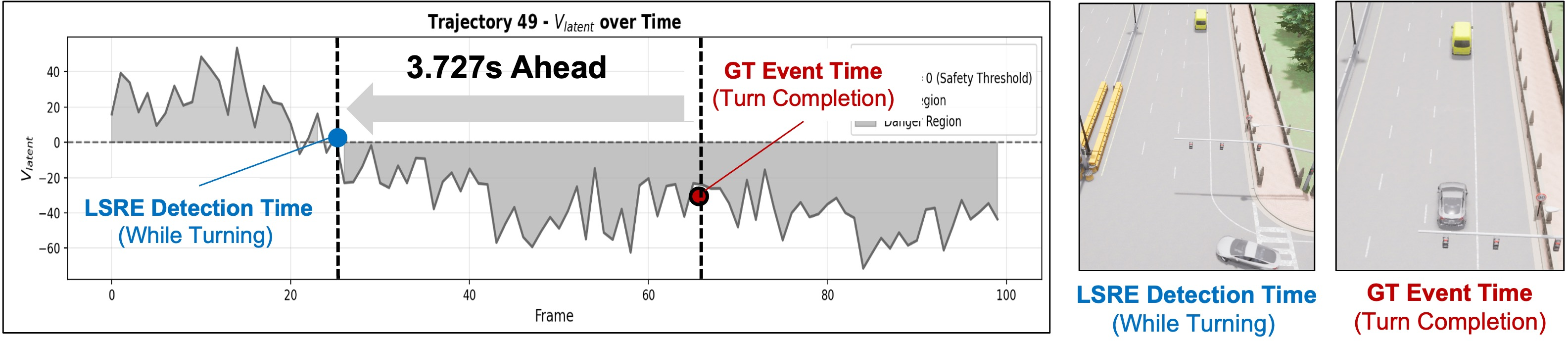
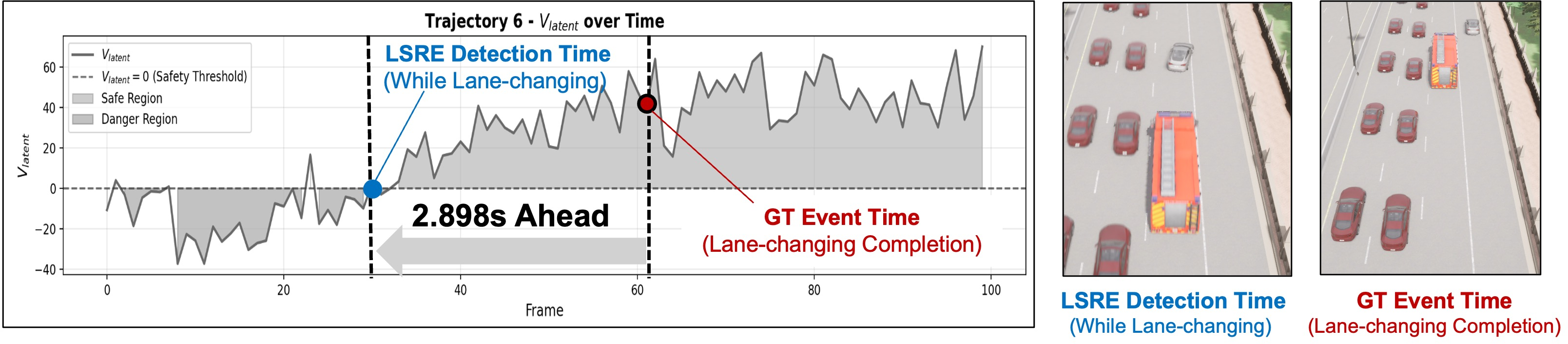
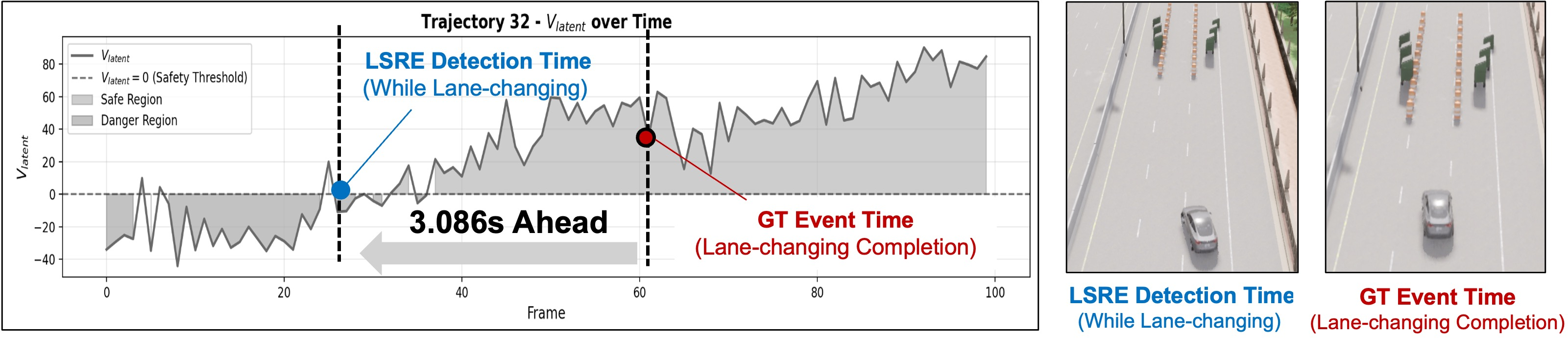
- Much earlier warnings: LSRE often warned about danger 2.5 to 3.3 seconds before the hazard “officially” started—far earlier than the big VLM baseline. That extra time can be crucial for safe braking or slowing down.
- Real-time speed: LSRE ran in about 9–12 milliseconds per frame, which is fast enough for 10–20 updates per second. The big VLM took around 2.9–3.7 seconds per frame (far too slow for real-time driving).
- Low false alarms after smoothing: With the hysteresis “sticky” filter, LSRE kept false alerts to around 1% during normal driving with no special events.
- Works on new-but-similar cases: Even with only a few examples, LSRE still did well, showing it learned the rule’s meaning, not just the exact scene.
Why is this important?
This work shows a practical way to give self-driving cars a sense of human-like, language-defined rules without slowing everything down:
- It bridges high-level understanding (from language) with fast, on-board decision-making.
- It can warn earlier, buying the car precious time to react safely.
- It keeps alerts stable and not annoying, which is important in real-world driving.
- It generalizes to new situations that follow the same social rule.
In the future, the authors want to connect these risk warnings to automatic safe actions (like gentle slowing or replanning), tighten the link with the car’s planning and control systems for stronger guarantees, and test at large scale on real-world data.
Knowledge Gaps
Knowledge gaps, limitations, and open questions
Below is a single, consolidated list of gaps and open questions that remain unresolved and could guide future research:
- Real-world validation is absent: LSRE is evaluated only in CARLA; performance, robustness, and safety in on-road deployments (diverse geographies, jurisdictions, weather, nighttime, sensor noise) remain unknown.
- Limited semantic coverage: Only three semantic categories (with two variants each) are tested; scalability to a broader, more complex set of social rules (e.g., traffic officer gestures, temporary detours, funeral processions, unusual signaling) is unaddressed.
- Multi-rule composition and conflicts: The framework does not handle concurrent, potentially conflicting semantics (e.g., yielding to emergency vehicles while navigating construction zones); mechanisms for rule prioritization, composition, and conflict resolution are missing.
- Dependency on VLM pseudo-label quality: The approach distills VLM judgments, but the paper lacks quantification of label noise, prompt sensitivity, calibration, bias, and error propagation from VLM to latent classifier.
- Ground-truth semantics vs. VLM judgments: LSRE optimizes to match VLM outputs rather than normative legal ground truth; the gap between VLM-defined risk and jurisdiction-specific compliance is unexamined.
- Sparse supervision assumptions: The assumption that semantics are stable within 10-frame windows is not validated; sensitivity analyses for key-frame frequency and motion-accumulation features are missing.
- Prompt reproducibility: Exact prompts, prompt engineering strategy, and robustness to prompt variations and model versions are not documented, hindering replication and reliability assessment.
- RSSM architecture and training details: Critical implementation specifics (latent size, stochasticity, encoders/decoders, training losses, rollout policy) and ablations are not presented, limiting reproducibility and interpretability.
- Future rollout action modeling: The rollout uses “ego actions applied during rollout,” but it is unclear how future actions are chosen online; the realism and sensitivity of risk estimates to action assumptions (on-/off-policy, default/no-op) are not analyzed.
- Modeling other agents in rollouts: Latent rollouts appear not to explicitly model other agents’ future behaviors; how semantics that depend on multi-agent interaction are captured (or missed) is unaddressed.
- World model fidelity and compounding error: The accuracy of long-horizon latent rollouts (K=50) and the effect of model error on risk value estimation are not quantified; no bounds or confidence measures are provided.
- Uncertainty estimation and calibration: The margin-based classifier does not provide calibrated probabilities; there is no uncertainty quantification, confidence scoring, or risk-aware decision thresholds tuned per scenario.
- Hysteresis trade-offs: While hysteresis reduces false alarms, its impact on detection delay and missed transitions (false negatives) is not quantified; adaptive or context-aware thresholding is unexplored.
- Severity-aware risk: The risk metric aggregates margin scores but does not encode violation severity or graded obligations; how to weight and prioritize different semantic risks is open.
- Generalization mechanisms: Few-shot results suggest some transfer, but systematic strategies (meta-learning, domain adaptation, invariant representation learning) to generalize across unseen cities/agents/layouts are not studied.
- Data scale and diversity: The dataset size (60k frames across limited scenarios) may be insufficient for broad generalization; coverage of rare long-tail events and strong distribution shifts is limited.
- Baseline breadth and rigor: Comparisons are limited to VLM-only and Always-Safe; missing baselines include lightweight semantic detectors, rule-based heuristics, other latent/temporal classifiers, and multi-agent forecasters; statistical significance tests are absent.
- Error analysis: No detailed breakdown of failure cases (by category, lighting, occlusion, clutter, distance to hazard), nor diagnostic insights into when LSRE underperforms VLM or vice versa.
- Sensor modality constraints: LSRE appears camera-centric; the role and benefit of LiDAR/radar, map priors, and V2X for semantic safety detection and anticipation are unexplored.
- Embedded deployment realism: Latency is reported on a Tesla GV100; performance, power, and memory footprints on automotive-grade embedded hardware (e.g., NVIDIA Orin/Xavier) under concurrent loads are untested.
- Closed-loop integration: LSRE operates as a detector; concrete mechanisms to couple risk signals with planners (CBFs, shields, fallback policies), and end-to-end impacts on driving performance and safety guarantees are deferred to future work.
- Jurisdictional variability: School-bus and emergency-vehicle rules vary by region and context; how LSRE adapts to local laws and evolving policies is not addressed.
- Active learning/query policies: Which frames to query with the VLM (key-frame selection) is fixed; strategies that use uncertainty or event likelihood to drive efficient labeling are not evaluated.
- Robustness to adversarial or deceptive cues: Vulnerabilities to manipulated visuals, spoofed lights/sirens, misleading signage, or adversarial prompts are not assessed.
- Multi-agent intent and social negotiation: Semantics like yielding and merging often require intent inference; integration with behavior prediction and social reasoning models remains open.
- Interpretability and auditability: The latent decision boundaries are not explained in human-understandable terms; tools to audit, visualize, or verify which semantics are encoded and why a frame is flagged are missing.
- Release and reproducibility: Availability of code, datasets, scenario generators, prompts, and trained checkpoints is not specified, limiting independent verification and community benchmarking.
Practical Applications
Immediate Applications
The following applications can be deployed with current capabilities described in the paper (10 Hz operation, ~10–12 ms p95 latency, VLM-supervised training, hysteresis filtering, and latent rollouts).
- On-vehicle semantic safety monitor for ADS stacks
- Description: Integrate LSRE as a lightweight “semantic safety” layer that flags risks like yielding to emergency vehicles, school-bus stops, and temporary construction layouts, providing early warnings (2–3 s lead shown in CARLA) to upstream planners.
- Sector: Automotive/robotaxi (Level 3–4 autonomy), software.
- Tools/products/workflows: “Semantic Risk Monitor” module with margin classifier + latent rollout value; hysteresis-based gating of planner behaviors; on-device inference.
- Dependencies/assumptions: Requires an RSSM/world-model trained on the target sensor suite; initial sparse VLM supervision and prompt design; sufficient camera coverage; calibrated thresholds to control false alarms; integration hooks to planning/fallback behaviors.
- ADAS enhancement for consumer vehicles
- Description: Use LSRE to augment driver alerts (HMI), e.g., early warnings for emergency vehicles, school buses, or pop-up work zones, without per-frame VLM costs.
- Sector: Automotive/consumer electronics.
- Tools/products/workflows: Driver warning HMI; risk-based ACC/ALC dampening; embedded deployment on automotive-grade SoCs.
- Dependencies/assumptions: Low FAR targets and careful human factors; regional legal constraints for alerts and camera processing; training on consumer-grade sensors.
- Ops-center triage and escalation in fleet operations
- Description: Run LSRE on-vehicle to flag semantic risks and stream low-bandwidth event signals to operations centers for faster teleoperator awareness.
- Sector: Mobility/robotaxi operations.
- Tools/products/workflows: Event bus for “semantic risk crossing”; operator dashboards; incident playback timelines using LSRE value traces.
- Dependencies/assumptions: Robust network connectivity for alerts; SOPs for escalation; privacy-compliant logging.
- Scenario mining and labeling acceleration
- Description: Use sparse VLM queries to bootstrap LSRE and then scan fleet logs to auto-tag segments with semantic-risk labels for datasets and regression suites.
- Sector: Software/MLOps; automotive data engineering.
- Tools/products/workflows: Offline pipeline that queries VLM every N frames, trains LSRE, then bulk-processes logs; semantic event index for retrieval.
- Dependencies/assumptions: Access to VLM (cost, API latency) offline; high-quality prompts; data-rights and privacy governance.
- Continuous integration (CI) regression tests for semantic safety
- Description: Add LSRE-based checks to CI pipelines to catch regressions in yielding/priority and construction-zone behaviors; measure early-warning KPIs.
- Sector: Software quality; simulation/testing.
- Tools/products/workflows: CARLA-based semantic-failure suites; CI dashboards tracking event recall, lead time, FAR; gating criteria for releases.
- Dependencies/assumptions: Domain gap between sim and road; need to maintain evolving test libraries and calibrate thresholds across releases.
- Roadside/edge monitoring for semantic violations
- Description: Deploy LSRE on fixed roadway cameras to flag semantic non-compliance (e.g., vehicles not yielding to emergency vehicles; passing a stopped school bus) for analytics or signage actuation.
- Sector: Smart city/traffic management.
- Tools/products/workflows: Embedded GPU/NPU edge nodes; LSRE adapted to fixed-view world models; automated incident counters.
- Dependencies/assumptions: Retraining with fixed-camera data; jurisdictional policies for detection and data use; variation in lighting/weather.
- Insurance and claims triage signals (post-hoc)
- Description: Provide logs with LSRE risk trajectories to contextualize pre-incident semantics (e.g., whether an AV/ADAS system issued timely warnings).
- Sector: Insurance/forensics.
- Tools/products/workflows: Secure export of semantic risk timelines; incident reconstruction tools.
- Dependencies/assumptions: Legal admissibility; strong auditability/traceability from VLM supervision to LSRE predictions; privacy safeguards.
- Academic benchmarking and teaching
- Description: Use the provided semantic-failure taxonomy and LSRE as a baseline for research on language-guided safety, anticipation, and world models.
- Sector: Academia/education.
- Tools/products/workflows: Course labs (CARLA); reproducible pipelines for VLM-supervised latent classifiers; ablations on hysteresis and rollouts.
- Dependencies/assumptions: Availability of compute and simulator; careful reproduction of prompts and training procedures.
Long-Term Applications
The following applications require further research, scaling to real-world data, expanded rule sets, tighter integration with control, or formal assurances.
- Closed-loop “semantic shielding” with fallback behaviors
- Description: Couple LSRE signals directly to rule-aware planner overrides (e.g., conservative re-planning, deceleration, or safe stop when semantic risk rises).
- Sector: Automotive/robotics.
- Tools/products/workflows: Safety supervisor that gates planner output using LSRE margin/value; verified fallback policy library.
- Dependencies/assumptions: Formal safety analysis for intervention logic; robust handling of false positives/negatives; comprehensive testing on real roads.
- Standardized library of learned semantic rules
- Description: Maintain an extensible, hot-swappable catalog of LSRE classifiers for diverse social norms (school zones, officer gestures, special lanes, emergency scenes).
- Sector: Software platforms; automotive.
- Tools/products/workflows: Rule registry with metadata (region, conditions); versioned distillation pipelines from VLMs; automatic calibration per geography.
- Dependencies/assumptions: Regional variability in norms; continual re-validation; governance for updating and retiring rules.
- Multi-modal, map-aware semantic risk estimation
- Description: Fuse camera, LiDAR/radar, siren microphones, and HD map or V2X cues into world models to reduce ambiguity and improve early detection.
- Sector: Automotive; smart infrastructure.
- Tools/products/workflows: Multi-sensor RSSMs; cross-modal distillation; map- and V2X-conditioned prompts for VLM labeling.
- Dependencies/assumptions: Sensor synchronization and calibration; additional compute budgets; annotated multi-modal corpora.
- Real-world, cross-city deployment and generalization
- Description: Train and validate LSRE on large-scale, diverse, real-world datasets to achieve robust generalization to rare “long-tail” scenarios.
- Sector: Automotive; policy evaluation.
- Tools/products/workflows: Federated/offboard training; continual learning to ingest new edge cases; domain adaptation tooling.
- Dependencies/assumptions: Data access and privacy; annotation quality; operational monitoring to detect drift.
- Regulatory KPIs and certification for semantic safety
- Description: Codify metrics like event recall, lead time, and FAR into audit protocols for AV/ADAS compliance (e.g., emergency vehicle yielding benchmarks).
- Sector: Policy/regulation; standards bodies.
- Tools/products/workflows: Public test suites; conformance tests with scenario libraries; reporting templates for regulators.
- Dependencies/assumptions: Multi-stakeholder consensus; transparent benchmarks; region-specific rule definitions and acceptance of learned monitors.
- Safe RL and learning-from-interventions using semantic signals
- Description: Use LSRE outputs as safety critics/constraints in reinforcement learning to avoid semantically unsafe behaviors during training and deployment.
- Sector: AI/ML; robotics.
- Tools/products/workflows: Constrained MDPs with LSRE risk penalties; intervention datasets labeled by LSRE; off-policy filtering.
- Dependencies/assumptions: Stability of learned constraints; avoidance of reward hacking; theory and practice for safe exploration.
- Cross-domain transfer to other robots and vehicles
- Description: Apply latent semantic rule encoding to drones (no-fly zones, emergency corridors), warehouse robots (human-priority zones), or rail/maritime (priority signaling).
- Sector: Robotics; logistics; aviation/maritime.
- Tools/products/workflows: Domain-specific world models and VLM prompts; tailored semantics and rollout horizons.
- Dependencies/assumptions: Domain-appropriate sensors and datasets; regulatory adaptation; different social norms and cues.
- Proactive teleoperation support and dynamic handover
- Description: Use LSRE value trends to preemptively request human takeover or teleoperation assistance in semantically complex scenes.
- Sector: Mobility/robotaxi; industrial robotics.
- Tools/products/workflows: Handover policies tied to risk thresholds and uncertainty; operator load balancing based on forecasts.
- Dependencies/assumptions: Reliable uncertainty estimation; communications latency; legal framework for remote operation.
- Driver coaching and training analytics
- Description: Provide post-drive feedback on semantic rule adherence (e.g., yielding behavior quality, anticipation at work zones) to improve human driver behavior.
- Sector: Fleet management; education.
- Tools/products/workflows: Dashboards with event timelines and LSRE signals; coaching recommendations.
- Dependencies/assumptions: Acceptance and fairness of automated assessments; privacy; calibration to human driving norms.
- Formal verification of learned semantic monitors
- Description: Develop methods to verify properties of the latent classifier and rollout predictions (e.g., bounded false-alarm rates under specified conditions).
- Sector: Safety engineering; academia.
- Tools/products/workflows: Reachability tools over latent dynamics; statistical guarantees for hysteresis behavior; runtime monitors.
- Dependencies/assumptions: Tractable abstractions of latent spaces; alignment between formal specs and semantic definitions.
Glossary
- Actor-critic learning: A reinforcement learning approach that trains a policy (actor) alongside a value estimator (critic), here applied within a learned latent representation. "introducing stochastic latent representations and actor-critic learning in latent space."
- CARLA: An open-source simulator for autonomous driving research used to create and evaluate driving scenarios. "Experiments on six semantic-failure scenarios in CARLA demonstrate that LSRE attains semantic risk detection accuracy comparable to a large VLM baseline"
- Constrained MDPs: Markov decision processes augmented with constraints (e.g., safety) that the policy must satisfy during optimization. "Surveys highlight techniques such as constrained MDPs and safety critics that predict unsafe outcomes"
- Control Barrier Functions (CBFs): Mathematical constructs that enforce set invariance for safety by constraining system dynamics, often implemented via optimization-based controllers. "Control Barrier Functions (CBFs) were formalized into real-time enforceable safety constraints through quadratic program controllers for continuous systems"
- Discount factor: A scalar γ ∈ (0,1] that exponentially downweights future costs or risks when computing a finite-horizon value. "where \gamma is the discount factor controlling the contribution of future risk."
- Ego-motion: The motion of the autonomous vehicle itself, used to maintain temporal alignment when labeling or reasoning across frames. "we record the accumulated ego-motion over the skipped frames,"
- False-Alarm Rate (FAR): The proportion of safe frames incorrectly flagged as unsafe, used to quantify spurious alerts in normal driving. "False-alarm rate in normal driving scenarios (no semantic failures). Lower is better."
- Few-shot scenario: A setting where the model must learn or generalize from only a handful of labeled examples. "Semantically similar few-shot scenario"
- Forward reachable sets: The set of states that can be reached from a given initial condition under system dynamics within a specified time horizon. "Hamilton--Jacobi (HJ) reachability computes forward reachable sets of unsafe states"
- Hamilton–Jacobi (HJ) reachability: A formal method for computing reachable sets and safety guarantees by solving Hamilton–Jacobi partial differential equations. "Hamilton--Jacobi (HJ) reachability computes forward reachable sets of unsafe states"
- HD maps: High-definition maps containing precise geometric and semantic details of roads to support autonomous driving. "VLMs can identify nuanced traffic cues that are otherwise absent from explicit rule sets or HD maps"
- Hysteresis band: The interval between two thresholds within which the system retains its previous state to prevent rapid switching. "within the hysteresis band $[\theta_{\mathrm{low},\,\theta_{\mathrm{high}]$."
- Hysteresis thresholding: A two-threshold strategy to stabilize binary decisions by requiring stronger evidence to switch states in each direction. "we adopt a hysteresis thresholding strategy"
- In-distribution scenario: Evaluation on data drawn from the same distribution as the training set, used to measure performance without distribution shift. "In-distribution scenario"
- Latent classifier: A lightweight model that operates on learned latent representations to output semantic risk predictions. "We design a lightweight latent classifier trained under sparse VLM supervision"
- Latent dynamics: The evolution of a compact, learned state representation that captures environment transitions over time. "World models aim to learn compact latent dynamics that capture environment transitions"
- Latent rollout: Predicting future latent states by unrolling the learned dynamics forward in time to anticipate upcoming risks. "short-horizon latent rollouts"
- Latent space: A compact, learned representation space in which high-dimensional observations are encoded for efficient reasoning. "decision boundaries within the latent space of a recurrent world model."
- Latent value function: A function over latent states that aggregates (discounted) future risk estimates over a finite horizon. "we estimate a latent value function $V_{\mathrm{latent}(z_t)$"
- Lead time: The time interval between the model’s first hazard alert and the annotated onset of the hazardous event. "Average Lead Time indicates anticipation relative to the annotated onset."
- Linear Temporal Logic (LTL): A formal logic for specifying temporal properties of systems, such as safety and liveness constraints over time. "temporal-logic frameworks such as Linear Temporal Logic (LTL) and Signal Temporal Logic (STL) were introduced to specify and monitor safety constraints"
- Margin score: A real-valued output from a classifier where the sign indicates class and the magnitude indicates confidence relative to the decision boundary. "The classifier outputs a real-valued margin score"
- Posterior latent: The latent state distribution inferred from current observations via the encoder in a state-space model. "the encoder (inference model) infers a posterior latent"
- Prior latent: The predicted latent state distribution before incorporating the current observation, produced by the transition model. "the prior (predicted) latent before incorporating ."
- Quadratic program controllers: Optimization-based controllers that solve quadratic programs online to enforce constraints (e.g., from CBFs). "through quadratic program controllers for continuous systems"
- Reachability analysis: Techniques that compute sets of states reachable from an initial set, used to provide safety guarantees. "Reachability analysis provided mathematically rigorous guarantees for collision avoidance."
- Recurrent state-space model (RSSM): A probabilistic sequence model that maintains and predicts latent states with temporal dynamics for sequential decision-making. "LSRE performs semantic safety assessment inside the latent space of a recurrent state-space model (RSSM)."
- Safe reinforcement learning: Methods that incorporate safety constraints into policy learning and deployment to avoid unsafe behaviors. "Safe reinforcement learning introduced learning-based mechanisms to constrain policies during execution."
- Safety critics: Learned components that estimate the risk or safety of states/actions, used to prevent unsafe outcomes during learning or execution. "such as constrained MDPs and safety critics that predict unsafe outcomes"
- Shielding approaches: Runtime mechanisms that monitor and potentially override unsafe action choices before execution. "Shielding approaches~\cite{jansen2020safe} monitor the agent’s actions and override unsafe actions before execution."
- Signal Temporal Logic (STL): A temporal logic with real-valued semantics suited for specifying and monitoring continuous-time system properties. "Linear Temporal Logic (LTL) and Signal Temporal Logic (STL) were introduced to specify and monitor safety constraints"
- Stochastic latent representations: Latent variables modeled with uncertainty, enabling robust prediction and planning under partial observability. "introducing stochastic latent representations and actor-critic learning in latent space."
- Vision–LLM (VLM): A multimodal model that jointly processes images and text to perform semantic understanding of scenes. "A pretrained vision--LLM (VLM) provides sparse semantic-risk supervision for key frames."
- World model: A learned model of environment dynamics used for imagination-based planning and risk estimation in latent space. "World models aim to learn compact latent dynamics that capture environment transitions"
Collections
Sign up for free to add this paper to one or more collections.