- The paper introduces a unified framework for quantifying entanglement and establishing complete monogamy relations across bipartite and multipartite systems.
- It details hierarchical classifications and convex-roof extensions for entanglement measures, emphasizing LOCC constraints and strict concavity for monotonicity.
- The review discusses implications for quantum security, resource theory refinement, and computational challenges in evaluating multipartite entanglement.
Detailed Summary and Technical Analysis of "Measure of entanglement and the monogamy relation: a topical review" (2512.21992)
Overview and Scope
"Measure of entanglement and the monogamy relation: a topical review" (2512.21992) presents an exhaustive and rigorous synthesis of both classical and modern developments in the quantification and interrelation properties of entanglement in finite-dimensional quantum systems. The review's primary focus is dual: first, the mathematical foundations and hierarchies of the various entanglement measures—spanning the bipartite and multipartite regime, including extensions such as k-entanglement and partitewise entanglement—and second, the structural and quantitative features of entanglement distribution, especially as captured by monogamy and polygamy relations. The analysis incorporates the evolution from original, axiomatic definitions and operational protocols (especially in the context of LOCC-constrained transformations, see Fig. 1) to more robust and nuanced frameworks grounded in convex-roof and complete multipartite formulations.
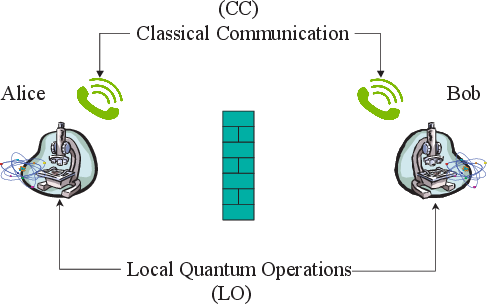
Figure 1: The LOCC paradigm: bipartite local operations and classical communication scenario, the foundational free operation set for quantum resource theories.
Mathematical Foundation of Entanglement Measures
The review initiates from fundamental principles, tracing the historical progression from early geometric and operational entanglement quantifiers (e.g., EoF, entanglement cost/distillation, geometric measure, concurrence, negativities, and robust entropy distances) toward a highly structured taxonomy of contemporary measures. Particularly salient is the unification of criteria under which a function E on the space of states SAB qualifies as a proper entanglement measure: (i) vanishing on the separable set, (ii) LU-invariance, and (iii) non-increase under LOCC channels—where strict attention is paid to both the deterministic and probabilistic implementation of LOCC, as illustrated in the classical-quantum block structure of allowed instruments and stochastic flag-labeled extensions (see, e.g., Fig. 2).
The paper formalizes the operational setting through the LOCC closure, emphasizing its role as the "free" class in resource-theoretic language (see also [Chitambar, 2019, RMP]). Measure extension to the convex roof is analyzed in detail, and the strict necessity of reduced function concavity for monotonicity is established—a result that becomes central to subsequent monogamy theorems.
The review systematically catalogs bipartite monotones (concurrence, tangle, q-concurrence, α-concurrence, negativity, logarithmic negativity, relative entropy, robustness, squashed entanglement, and others), always highlighting the status with respect to monotonicity, additivity, faithfulness, and the existence of analytic expressions in representative symmetric states (Werner, isotropic).
Multipartite Generalizations: Taxonomy and Hierarchies
A significant portion of the review details the growing complexity and diversity of multipartite entanglement. The authors distinguish:
- k-Entanglement: A notion measuring non-k-separability across all partitions, reflecting a state's resistance to factorization into k subsystems.
- k-Partite Entanglement: The degree to which a state can be produced from entanglement genuinely spanning at most k particles.
- Partitewise Entanglement: Recently formalized, this class captures the entanglement of particular subsystems when embedded within the broader multipartite context (e.g., pairwise entanglement across subsystems of a globally genuinely entangled state).
- Genuine Multisite and Global Measures: Including convex roof extensions and structural invariants (e.g., hyperdeterminant-based measures).
The extension of reduced-function-based measures via bipartite partitioning, the convex roof over various subsystem structures, and the utilization of informationally complete reductions receive careful and comprehensive treatment.
Monogamy, Polygamy, and Complete Monogamy Relations
A cornerstone of the review is the detailed mathematical theory of monogamy and polygamy relations, both in their traditional ("CKW-inequality") and modern (equality-based, exponent-indexed) incarnations. The authors emphasize the limitations of direct monogamy inequalities in high dimension or with specific monotones, and they advocate for the Guo-Gour improved definition, grounded in the "disentangling condition": a measure is monogamous if, for any state ρABC with vanishing residual entanglement in AC when AB is maximally entangled under E, then E(ρAC)=0. They prove the equivalence between this definition and the existence of a monogamy exponent α such that Eα satisfies the CKW-type inequality for all states—a result that unifies many previous partial observations.
The review classifies measures according to the strictness of their reduced function (strict concavity yields monogamy, see Table in the paper), delineates known monogamy exponents for key monotones, and documents the increasing difficulty of verification in higher local dimensions.
Polygamy duals appear via entanglement of assistance constructions; the review documents that, in contrast to faithfulness/monogamy, entanglement of assistance is universally polygamous, but never faithful, and hence should not be considered a strict entanglement measure.
Complete monogamy, tightly complete monogamy, and polygamy are unified within the coarsening partition framework. Here, the review introduces the distinction between "version 1.0" measures (obeying only basic axiomatic requirements and traditional monogamy) and "version 2.0" measures (which are "complete" in the sense that, by respecting all coarsening-induced partition inequalities of type (a)-(c), allow exhaustive and compatible comparison of entanglement distribution across all possible partitions). The theoretical implications for the additivity of multipartite measures, strict non-existence of maximally bipartite entangled mixed states, and resolution of the additivity issue for EoF in multipartite systems are explored in depth.
Quantitative Hierarchy: Sharper and Tighter Relations
A considerable section addresses the search for tighter and sharper monogamy and polygamy inequalities, including strong monogamy (SM) relations, parameter-dependent power exponents (monogamy/polygamy index), and the associated analytic inequalities for different monotones. Tables with power indices for concurrence, negativity, EoF, and q-entropy-based measures are included for small dimensions/qubit registers, together with a rigorous account of the limitations and open problems in high-dimensional or non-convex settings.
The general theme is the development from original, often informal, inequalities toward precisely characterized, measure-specific, and sometimes partition-specific quantitative bounds, essential for both information-theoretic security analysis and theoretical understanding of multipartite quantum structure.
Implications, Open Problems, and Future Directions
The theoretical framework clarified in this review has several important implications:
- Operational Security: The tightness of monogamy relations underpins the security proofs of QKD, quantum networks, and distributed quantum cryptography.
- Resource Theory Structure: The distinction between various classes of measures, and the introduction of completeness as a criterion, suggests the need for revised axioms in entanglement quantification and possibly in other quantum resource theories.
- Multipartite Additivity: The problem of additivity (notably, for EoF) is largely resolved by the complete measure (version 2.0) approach in the multipartite regime.
- Algorithmic Complexity: The tractable calculation of convex-roof-extended measures, and the classification of strictly concave reduced functions, suggests directions for algorithmic and computational research in mixed-state entanglement and quantum many-body systems.
- Extensions Beyond Entanglement: The mathematical results regarding coarsening, partition hierarchy, and monogamy/polygamy apply with minimal modification to general quantum correlations (discord-type quantities, coherence monotones, etc.).
Future research directions involve:
- Generalization and efficient evaluation of multipartite monotones in large systems;
- Exploration of the physical and cryptographic application of tightly complete monogamy relations;
- Clarification of the status of non-convex-roof measures (faithful or not) in monogamy and completeness analyses;
- Connections between findings here and structural features in black-hole physics, holography, and high-energy quantum information.
Conclusion
This review delivers both a complete technical reference on quantification and distribution of entanglement in finite-dimensional quantum systems, and an overview of the conceptual evolution in the field: from early axiomatic monotones to the present understanding grounded in resource theory, convex-roof hierarchies, and monogamy-completeness frameworks. The theoretical refinement of monogamy (and polygamy) relations is made precise; strong connections between strict concavity of reduced functions, operational protocols, and entanglement sharability are elucidated. The general structure provides a foundation for both further mathematical advancement and practical application in multiparty quantum information tasks.