- The paper introduces a circuit knitting protocol that eliminates exponential measurement overhead by achieving a rescaling factor of 1 in tree-structured circuits.
- It employs randomized quantum tomography to learn Heisenberg-evolved observables, resulting in a polynomial sample complexity of O(d^3K^5/ε^2).
- An exponential separation is proven, showing that traditional quasiprobability-based methods require exponentially more measurements than the proposed approach for two-layer tree circuits.
Exponential-to-Polynomial Measurement Overhead Scaling in Circuit Knitting via Quantum Tomography
Introduction and Context
Recent advances in quantum circuit knitting have enabled the simulation of larger quantum circuits on limited-size quantum devices, a critical need due to constraints of qubit counts, noisy gates, and architectural limitations. Standard circuit-cutting methods, primarily based on quasiprobability decomposition (QPD), suffer from exponential measurement overhead relative to the number of cuts—each cut multiplies variance by the square of a rescaling factor, dramatically reducing efficiency for large problems. This bottleneck has motivated ongoing optimization of rescaling factors, cut location minimization, and exploration of alternative tensor network-inspired protocols. However, fundamental limits have persisted for generic circuit architectures.
This paper introduces a rigorous analysis showing that for tree-structured quantum circuits, concatenated quantum tomography can reduce measurement overhead from exponential to polynomial in the number of cuts. It establishes precise sample complexity bounds and proves an exponential separation from conventional circuit-cutting protocols via information-theoretic arguments.
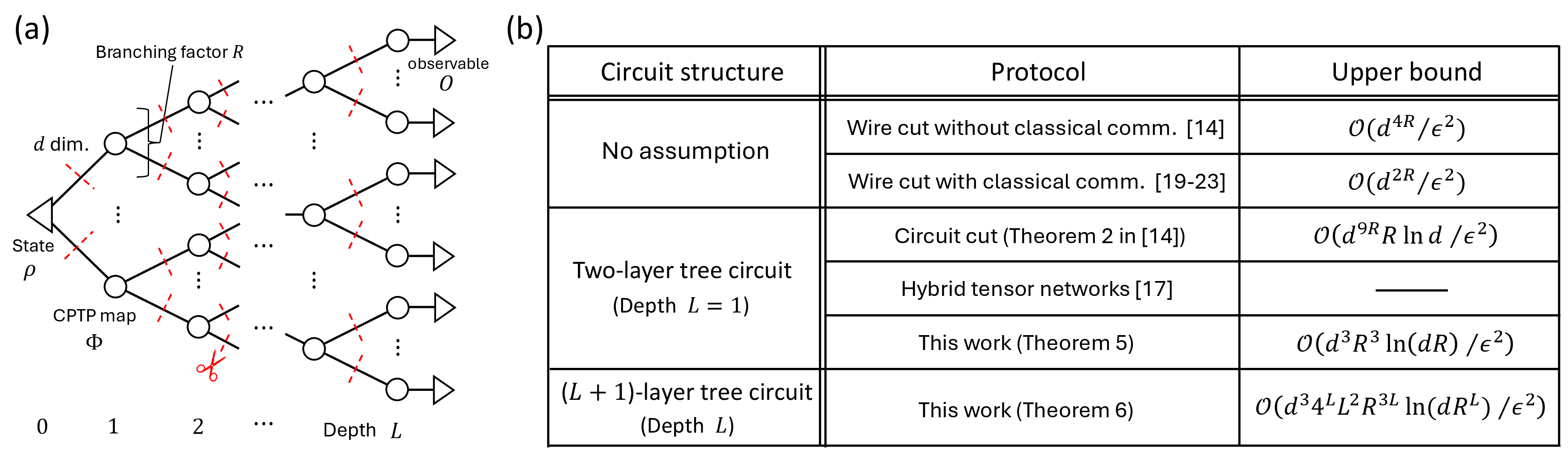
Figure 1: (a) Schematic of (L,R,d) tree circuits; (b) comparison of measurement scaling for generic circuits vs tree circuits with circuit-knitting protocols.
Quasiprobability-Based Circuit Cutting and Its Limitations
Circuit cutting, a key element of knitting protocols, divides a large quantum circuit by replacing sections (wires or gates) with randomized local operations, reconstructing the original measurement by classical postprocessing. In QPD-based wire cutting, the identity channel is decomposed into a linear combination of measure-and-prepare (MP) channels. The estimator for an observable then suffers variance amplification due to multiplicative rescaling factors γ, with sample complexity O(γ2K/ϵ2) for K cuts.
Even with optimized decompositions leveraging LOCC or Clifford probabilistic mixtures, the lower bound for the rescaling factor in wire cutting is γ∗=2d−1, which induces exponential scaling in K.
Tomography-Based Circuit Knitting: Main Contributions
This work introduces a circuit knitting protocol exploiting properties of tree-structured circuits:
1. Existence and Construction of Rescaling-Free Wire Cuts:
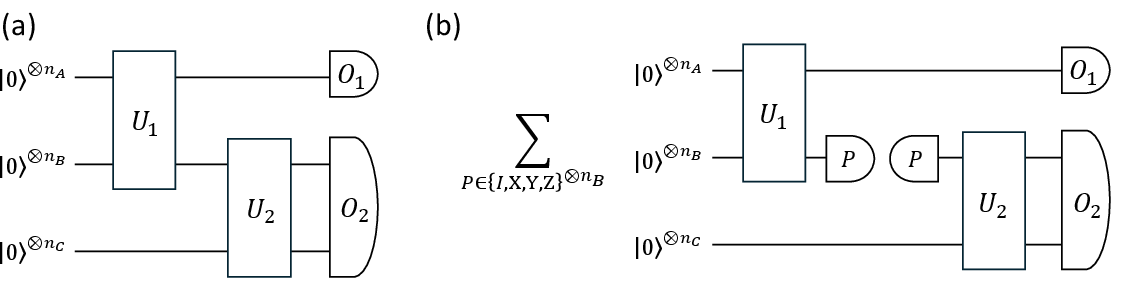
By shifting from full channel simulation to expectation-value-level decompositions targeting only the observable of interest, the authors prove the existence of an MP channel that preserves target observable outcomes for all input states, with rescaling factor γ=1. The explicit construction utilizes the diagonalization of Heisenberg-evolved observables under unknown quantum channels.
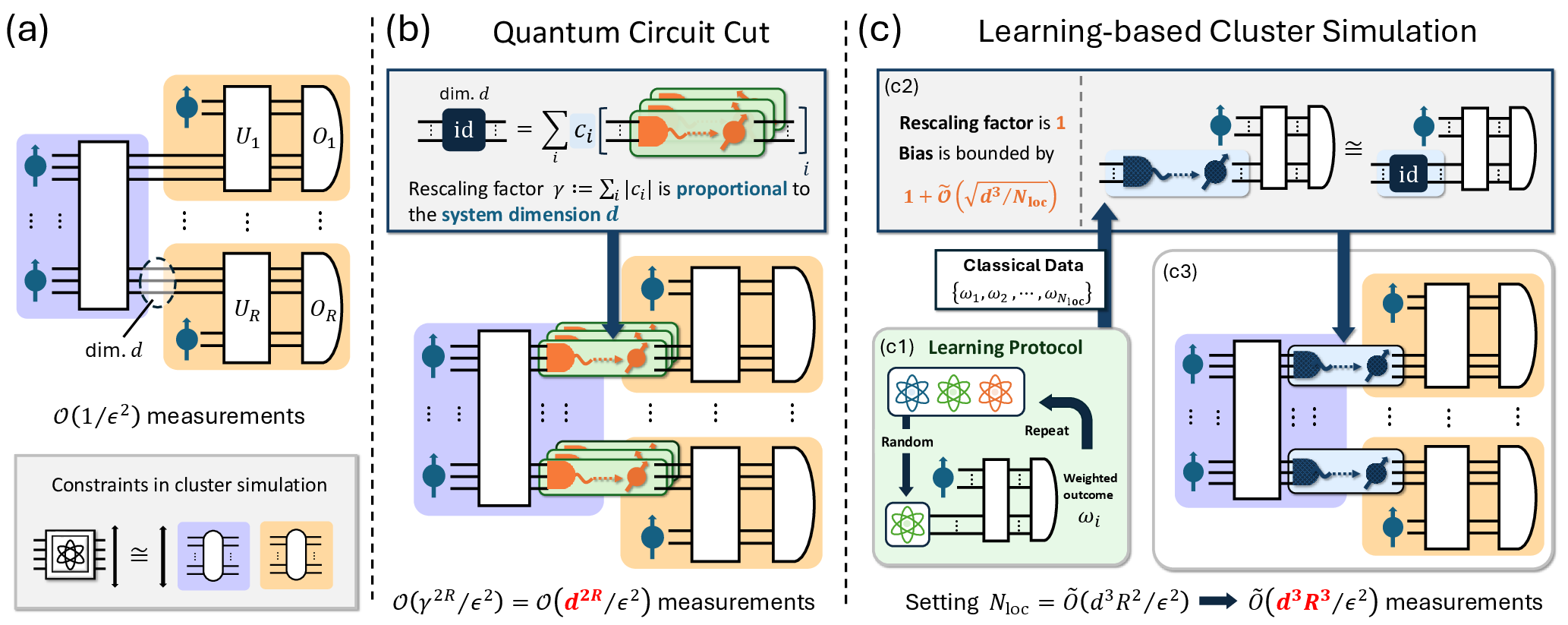
Figure 2: (a) Clustered circuit structure; (b) conventional QPD with exponential scaling; (c) learning-based cluster simulation steps avoiding rescaling.
2. Learning Heisenberg-Evolved Observables via Quantum Tomography:
Since exact classical descriptions of Heisenberg-evolved observables are usually inaccessible, the protocol learns the effective observable by randomized quantum tomography. Several practical schemes are described, including those based on state 2-designs, tensor products of single-qubit stabilizer states, and Pauli eigenstate sampling, each with detailed sample complexity analysis.
3. Polynomial Scaling for Tree Circuits:
For (L,R,d) tree circuits (maximum depth L, branching factor R, wire dimension d), recursive application of tomography-based wire cuts at inter-cluster edges yields a total sample complexity of
O~(ϵ2d3K5)
for a complete R-ary tree, where K=O(RL) is the number of cuts. This polynomial scaling (in K) stands in stark contrast to the O(d2K/ϵ2) scaling of QPD-based wire cuts.
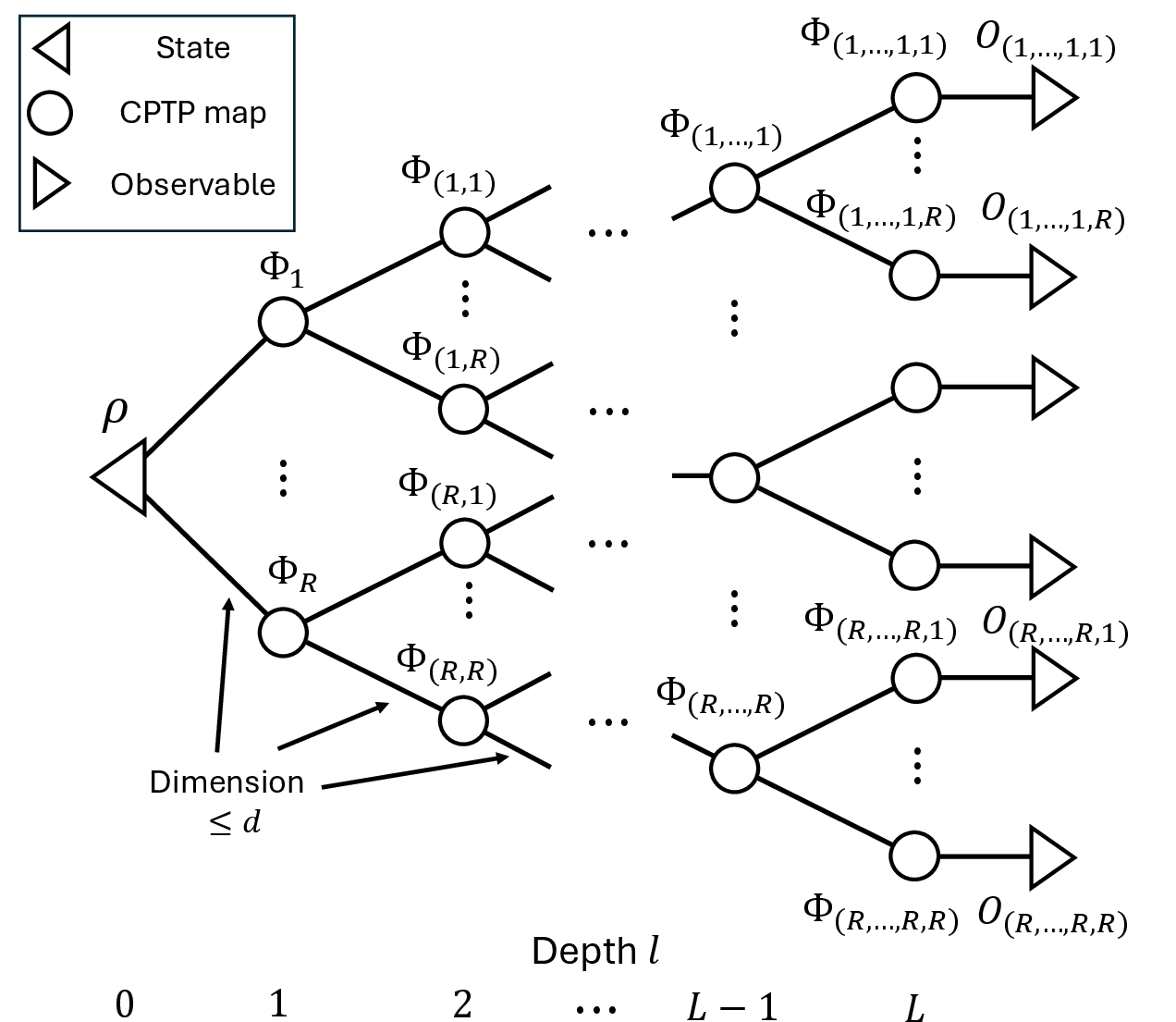
Figure 3: Tensor network representation of (L,R,d) tree quantum circuit.
4. Exponential Separation for Two-Layer Trees:
An information-theoretic lower bound shows that for two-layer tree circuits (L=1), any conventional wire-cutting protocol (i.e., QPD-based) must use at least Ω((d+1)R/ϵ2) measurements for the same estimation task, establishing an exponential separation from the polynomially scaling tomography-based approach.
Technical Analysis: Protocols and Sample Complexity
The main protocols utilize recursive estimation and diagonalization of effective Heisenberg observables at each cluster (node):
- For each cut, the observable is tomographically learned to accuracy ϵ, followed by diagonalization to yield measurement bases and post-processing coefficients.
- The process is applied recursively from leaves toward the root. Deeper layers require more measurements due to error propagation.
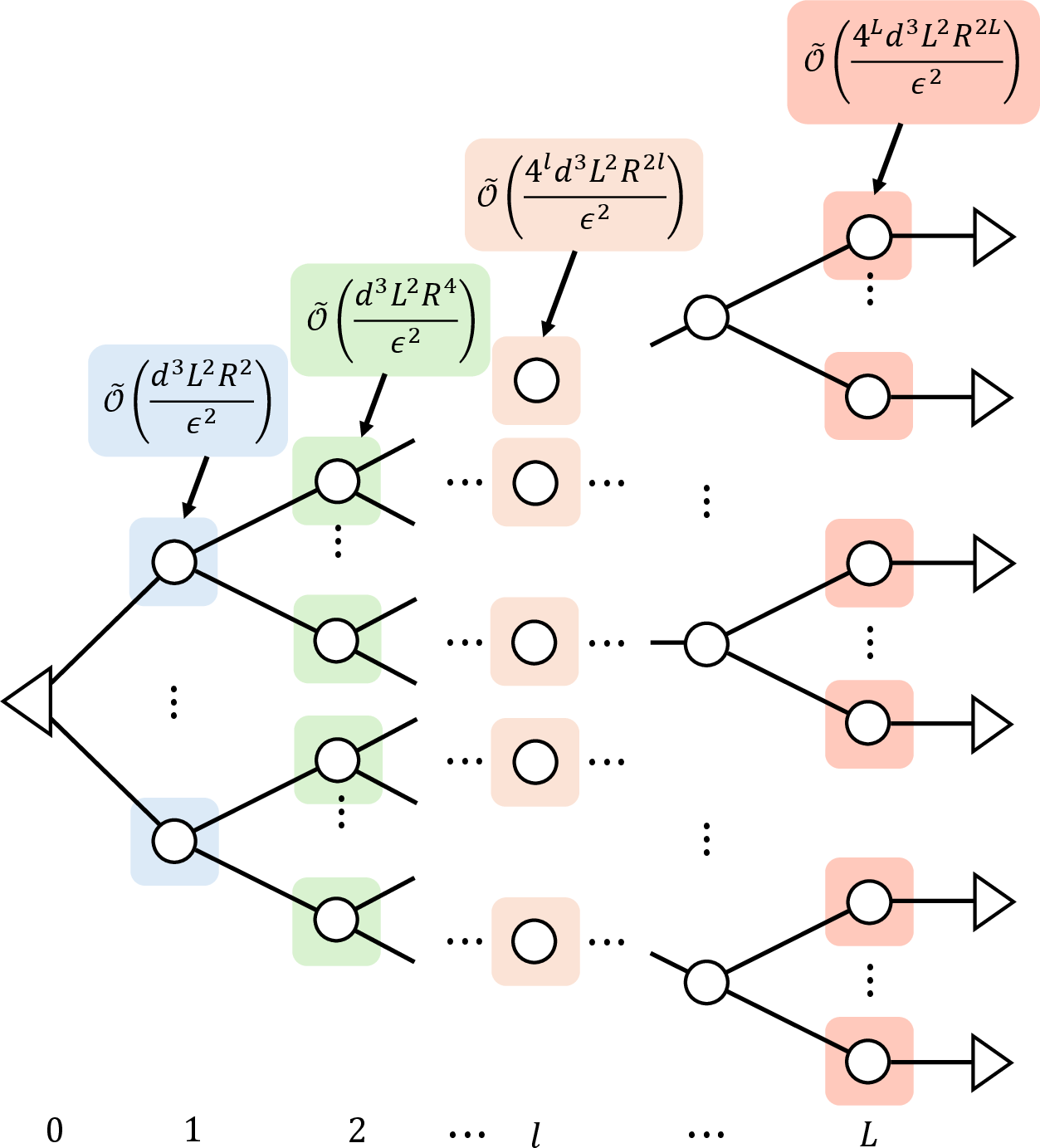
Figure 4: Schematic of shot allocation for multi-layer tree circuits; deeper layers require more measurements due to error cascading.
- The sample complexity for learning a d-dimensional observable to error ϵ is O(d3/ϵ2) for state 2-designs. Other ensembles trade off circuit depth and classical overhead for sample efficiency.
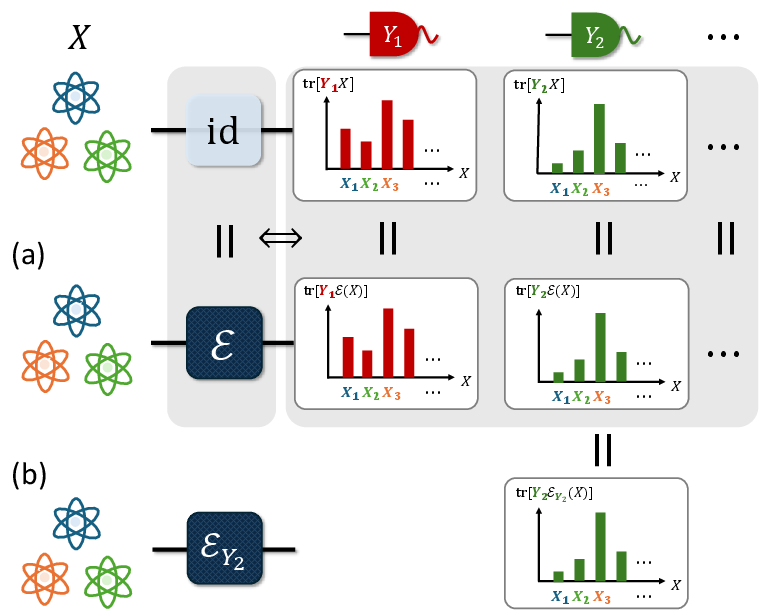
Figure 5: Characterization of the identity channel via Hilbert-Schmidt invariance, yielding rescaling-free expectation-level decomposition.
Numerical Bounds and Strong Claims
- Polynomial Sample Complexity in Tree Depth and Cuts: For a circuit of depth L and R branches, the total measurements needed for additive error ϵ and probability 1−δ is
O(ϵ24Ld3L2R3Lln(δRLd))
Implications and Theoretical Impact
Scalability for Hybrid Quantum-Classical Computation: By unlocking polynomial sample complexity for tree-structured circuits, the paper makes distributed quantum simulation and large-classical/quantum hybrid methods feasible for substantially larger systems.
Connection to Resource Theories and Error Mitigation: The local tomography protocol embodies the broader principle of resource trade-off in quantum simulation—substituting exponential rescaling with classical (tomographic) operations and more flexible control over error sources.
Potential Extension to General Circuit Structures: While current guarantees are for trees, the authors hypothesize that hybrid protocols involving gate cuts to reduce treewidth, followed by local tomography, may yield similar polynomial scaling for more general graph structures.
Impact on Distributed Quantum Architectures: The polynomial-efficient knitting protocol directly supports scalable architectures with modular or networked quantum processors, where only local clusters are available and classical communication is affordable.
Future Directions
- Extending Tomography-Based Knitting Beyond Trees: Theoretical challenges remain for rigorously characterizing sample complexity in circuits of planar or bounded-treewidth architectures, with prospects for leveraging optimized contraction and hybrid cut-tomography strategies.
- Integration with Virtual Quantum Simulation and Error Mitigation: The mechanism of converting global variance scaling into local bias may apply broadly to virtual engineering frameworks, resource distillation, and advanced error mitigation in near-term quantum devices.
- Complexity Reduction in Weakly Non-Clifford or Shallow Circuits: Structures with restricted entanglement, non-Clifford gate depth, or other amenable properties may benefit even further from the tomographic contraction framework.
Conclusion
This work demonstrates that measurement overhead scaling in quantum circuit knitting is not fundamentally exponential for all circuit structures—namely, tree-structured quantum circuits allow polynomial scaling via recursive quantum tomography and adaptive expectation-level decompositions. By rigorously quantifying this phenomenon and proving an exponential separation from conventional wire-cutting approaches, the paper establishes a new regime for scalable quantum simulation, distributed computation, and hybrid algorithm design.
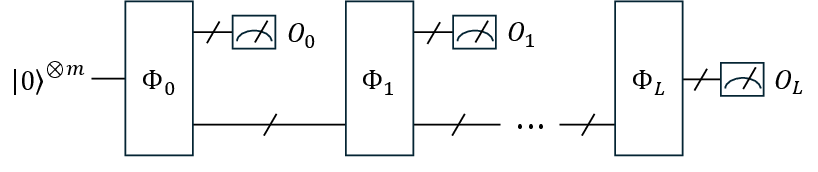
Figure 7: Quantum circuit for the R=1 case (MPS-like), showing polynomial scaling in sample complexity for circuit partitioning.
The methodology holds promise for extending scalable quantum-classical computation to broader classes of circuits, optimizing distributed architectures, and informing future developments in near-term quantum algorithmics and resource theory.
References
This summary reflects the main results and technical claims of "Exponential-to-polynomial scaling of measurement overhead in circuit knitting via quantum tomography" (2512.19623).