- The paper introduces a robust LiDAR-Inertial odometry method by leveraging the SGal(3) manifold to accurately couple translation and rotation in motion propagation.
- The paper employs a discrete-time propagation model within an iterated error-state Kalman filter to improve stability and reduce drift in feature-degenerate environments.
- The paper demonstrates efficient real-time mapping using a lightweight incremental i-Octree that outperforms traditional octree structures in computation and memory usage.
LIMOncello: Fast, Robust LiDAR–Inertial Odometry via SGal(3) Manifold Propagation
Introduction and Motivation
LIMOncello introduces a tightly coupled LiDAR–Inertial Odometry (LIO) framework that propagates 6-DoF motion on the Special Galilean group SGal(3) within an iterated error-state Kalman filter (IESKF) backend. The motivation stems from the limitations in conventional compound state representations (SO(3)×R6), which often neglect kinematic coupling between translation and rotation, leading to degraded performance in scenarios characterized by low observability, ambiguous environments, or high dynamics. This paper addresses those issues with a discrete-time propagation model based on SGal(3), achieving both increased stability and accuracy, alongside computation- and memory-efficient mapping via a lightweight incremental i-Octree.
Mathematical Foundations and State Representation
The system models the full robot state on the bundle manifold SGal×SE(3)×R6×S2, encapsulating pose, velocity, mapping extrinsics, IMU biases, and gravity vector orientation. SGal(3) is a 10-dimensional matrix Lie group that naturally incorporates temporal elements with spatial pose and velocity, allowing consistent modeling of motion propagation under uncertainty in both space and time.
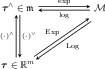
Figure 1: Commutative diagram of the mappings between Rm, the Lie algebra m, and the manifold M, including the shortcuts Exp=exp(τ∧) and Log=log(X)∨.
The adoption of SGal(3) permits more accurate discrete-time integration in the presence of degenerate geometric perception, as it captures the underlying kinematic relationships between the translational and rotational dynamics. For the gravity vector, LIMOncello uses the S2 sphere manifold, enforcing a norm-preserving constraint to enhance stability during estimation.
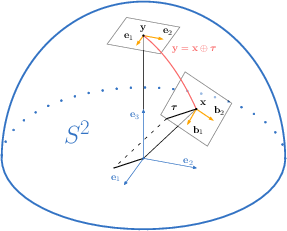
Figure 2: Geometric interpretation of the ⊕ operation on S2, illustrating tangent basis construction and update via angle–axis rotation.
System Architecture and Algorithms
A notable architectural distinction involves early per-point deskewing: motion compensation is performed prior to map registration, using the IMU-integrated states on SGal(3). Each LiDAR scan is aligned using the precise pose at its timestamp, followed by registration to a global map for geometric correspondence extraction and residual construction for the iterated update procedure.
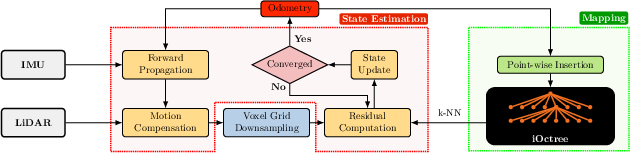
Figure 3: System overview contrasts LIMOncello’s pipeline with traditional LIO, highlighting initial motion compensation and global map perception.
Spatial mapping utilizes a refactored i-Octree, which is both shallower and more efficient than binary trees (e.g., ikd-Tree), avoiding costly tree rebalancing and point redistribution. Nodes are subdivided according to occupancy and Morton-coded indices, sustaining real-time insertion and neighbor search operations required for data association.
Prediction leverages the ⊞ operation for state evolution on general (possibly non-group) manifolds. The iterated update step operates by fitting planes to local neighborhoods in the i-Octree, forming point-to-plane constraints for the IESKF update. Jacobians are computed via smooth projections from SGal(3) to SE(3), and the optimization proceeds until convergence or a maximum number of iterations.
Empirical Evaluation
The system is benchmarked on the MCD, Grand-Tour, R-Campus, and selected City datasets, directly comparing LIMOncello (LIMO) against state-of-the-art methods like FAST-LIO2 (F-LIO2) and RESPLE (R-LIO).
Most critically, in feature-degenerate environments (e.g., prolonged tunnel traversal with restricted LiDAR coverage) LIMOncello remains the only method that does not diverge or undergo catastrophic drift. Both F-LIO2 and RESPLE suffer non-recoverable error in these challenging settings. Throughout all experiments, LIMO maintains real-time performance, competitive or superior accuracy, and robustness irrespective of scene or dynamics.
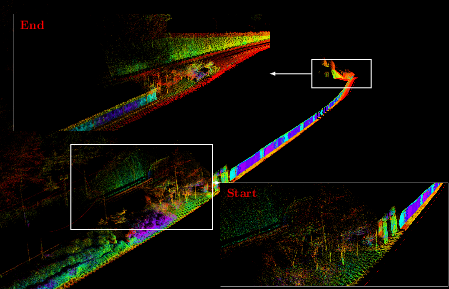
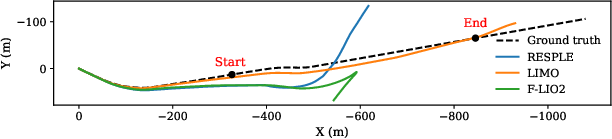
Figure 4: Qualitative comparison of accumulated trajectories in the feature-degenerate tunnel segment—LIMOncello preserves trajectory stability while baselines diverge or incur severe drift.
Additionally, LIMOncello’s i-Octree mapping backend outperforms both series and baseline octree structures in run-time and memory usage:
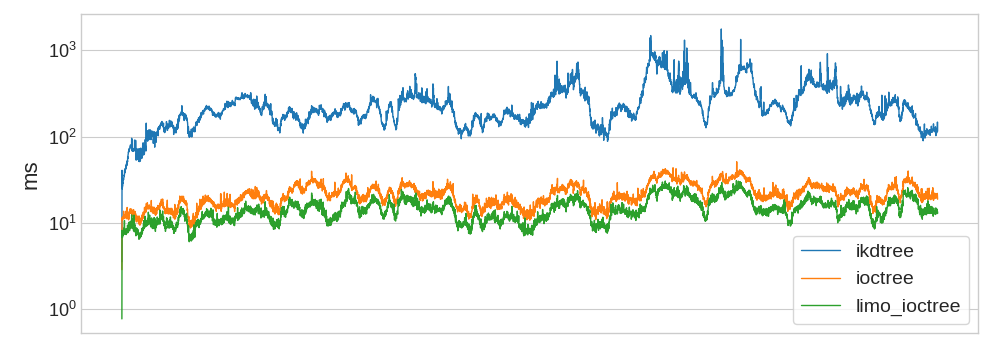
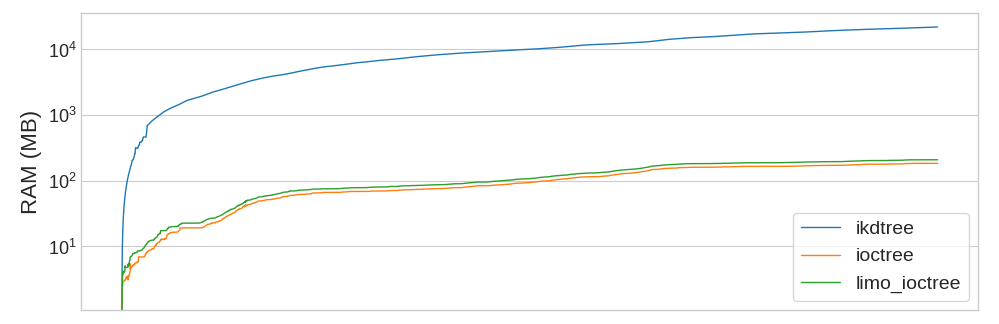
Figure 5: Per-frame computation time demonstrates stable real-time performance for both octree methods compared to higher variance and overhead in ikd-Tree.
Practical and Theoretical Implications
LIMOncello’s adoption of SGal(3) for motion propagation directly impacts robustness, primarily in scenarios where low sensor observability reduces the informativeness of LiDAR observations and demands accurate prior propagation through kinematic models. The explicit geometric coupling offered by SGal(3) improves state estimation where conventional bundle state decompositions are insufficient, particularly benefitting cases with ambiguous motion such as long, textureless corridors or high-dynamic maneuvers.
On the computational front, the lightweight i-Octree enables stable memory growth and low-latency updates, facilitating deployment in resource-constrained robotics. This architectural stability is critical for consistent perception required in downstream tasks like planning and semantic mapping.
Future Directions
The demonstrated advantages of SGal(3) indicate that future LIO and SLAM systems may benefit from fully group-theoretic or physically equivariant state propagation, especially in fusion architectures involving more sensors or asynchronous modalities. The trend toward continuous-time models that unify temporal and spatial estimation can leverage such Lie group manifolds for improved invariance and numerical stability. Extending i-Octree schemes to scalable semantic mapping or hierarchical feature aggregation may further advance practical autonomy in mobile robotics.
Conclusion
LIMOncello provides a formal, numerically stable, and efficient framework for tightly coupled LiDAR–Inertial Odometry, outperforming established baselines in feature-deficient and unstable conditions. Its integration of the SGal(3) manifold for motion propagation and a highly efficient i-Octree mapping backend results in a robust, modular system with consistent accuracy and scalability. The paper’s results highlight the importance of coherent manifold modeling and incremental spatial data structures, motivating future research into physically principled SLAM architectures and efficient computational primitives for real-time autonomy (2512.19567).

