Augmenting Intelligence: A Hybrid Framework for Scalable and Stable Explanations
Abstract: Current approaches to Explainable AI (XAI) face a "Scalability-Stability Dilemma." Post-hoc methods (e.g., LIME, SHAP) may scale easily but suffer from instability, while supervised explanation frameworks (e.g., TED) offer stability but require prohibitive human effort to label every training instance. This paper proposes a Hybrid LRR-TED framework that addresses this dilemma through a novel "Asymmetry of Discovery." When applied to customer churn prediction, we demonstrate that automated rule learners (GLRM) excel at identifying broad "Safety Nets" (retention patterns) but struggle to capture specific "Risk Traps" (churn triggers)-a phenomenon we term the Anna Karenina Principle of Churn. By initialising the explanation matrix with automated safety rules and augmenting it with a Pareto-optimal set of just four human-defined risk rules, our approach achieves 94.00% predictive accuracy. This configuration outperforms the full 8-rule manual expert baseline while reducing human annotation effort by 50%, proposing a shift in the paradigm for Human-in-the-Loop AI: moving experts from the role of "Rule Writers" to "Exception Handlers."
Paper Prompts
Sign up for free to create and run prompts on this paper using GPT-5.
Top Community Prompts
Explain it Like I'm 14
What this paper is about (in simple terms)
The paper is about making AI both easy to understand and reliable. Many AIs make good predictions but can’t clearly explain why. Some explanation tools are quick but give different answers if you change tiny details. Other tools are very stable but need a lot of human work. This paper shows a new way that mixes both: let the computer find broad, safe patterns automatically and let humans add a few focused rules for risky situations. They test this idea on predicting which customers will leave a company (called “churn”).
The main questions the authors ask
- How can we get AI explanations that are both stable (consistent) and scalable (don’t need tons of human effort)?
- Can a computer automatically find the general “safe” patterns, while humans add a small number of “risk” rules for special cases?
- How few human rules do we need to beat both a fully automatic system and a fully human-made rule system?
How they did the study (explained simply)
Think of teaching a student to spot which customers will leave:
- The computer is good at noticing big, common patterns (like “customers who use the service often tend to stay”).
- Humans are good at noticing tricky exceptions (like “if a customer pays late and has a monthly contract, they might leave”).
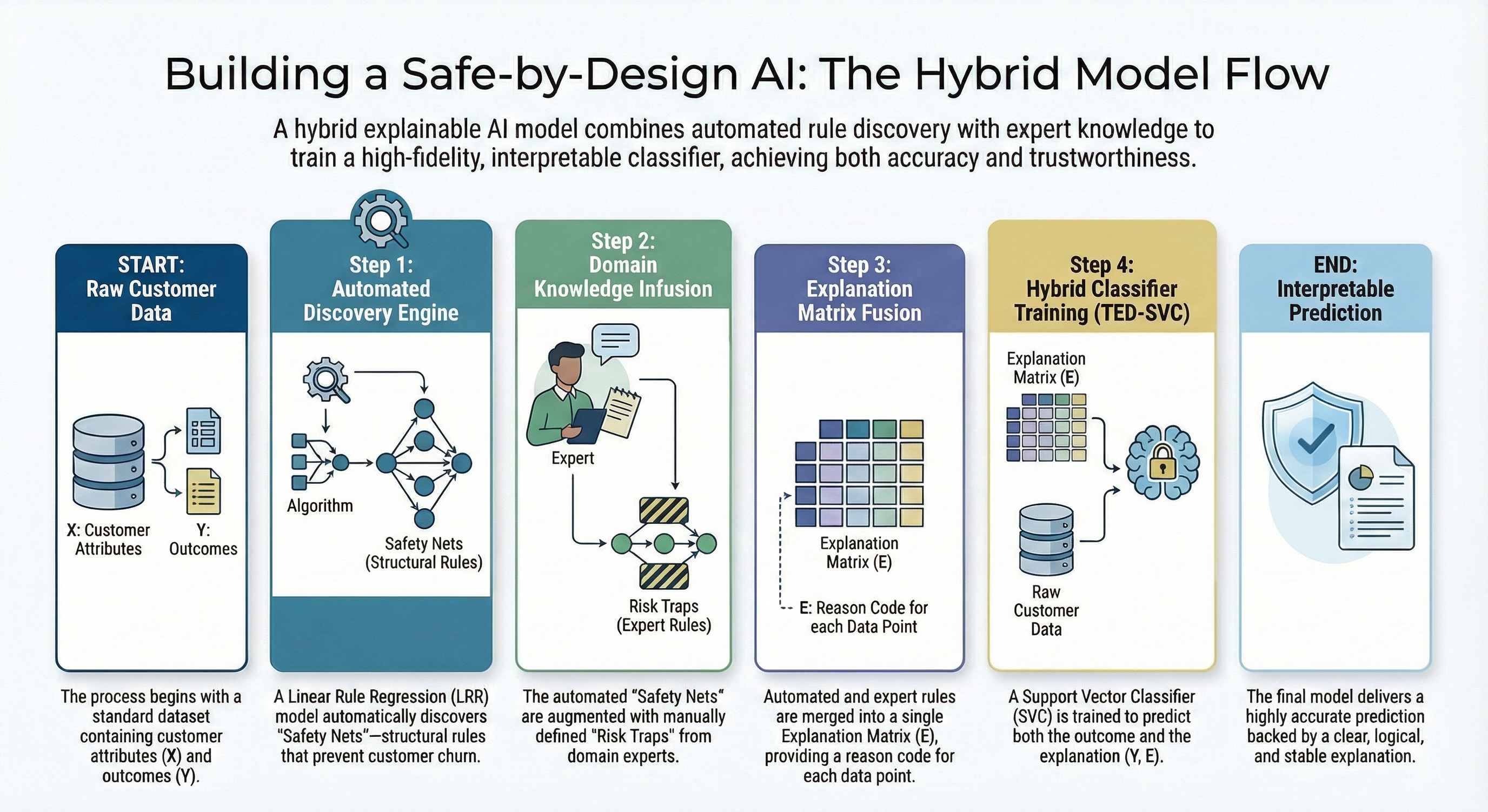
The authors build a three-step system:
- Automated discovery: The computer scans the data and creates simple yes/no rules (like checkboxes), then learns which ones matter most. This forms “Safety Nets” — general patterns that suggest a customer will likely stay.
- Human augmentation: Experts add a tiny set of “Risk Traps” — clear warning signs that a customer might leave (for example, repeated late payments). Instead of writing many rules, the experts carefully pick just a few high-impact ones. This follows the Pareto idea: a small number of smart choices creates most of the benefit.
- Hybrid training: They train an AI to predict both the decision (stay or leave) and the reason behind it at the same time. That forces the model to be consistent and explain itself using either an automated “Safety Net” or a human “Risk Trap.”
Helpful analogies:
- Safety Nets: Wide catch-alls that keep many customers from “falling” into churn.
- Risk Traps: Specific holes in the floor that humans know to watch for.
- The model learns to say: “This customer stays because of Safety Net A,” or “This customer churns because of Risk Trap B.”
A note on data prep: They turn facts about customers into many small yes/no statements (like “Age under 30?” “Tenure at least 5 years?”). That makes it easy to build IF-THEN rules and assign each rule a strength.
What they found and why it matters
Big picture result: Mixing many automated Safety Nets with just four carefully chosen human Risk Traps beat both:
- A fully automatic system (no human rules), and
- A fully manual system (eight human rules).
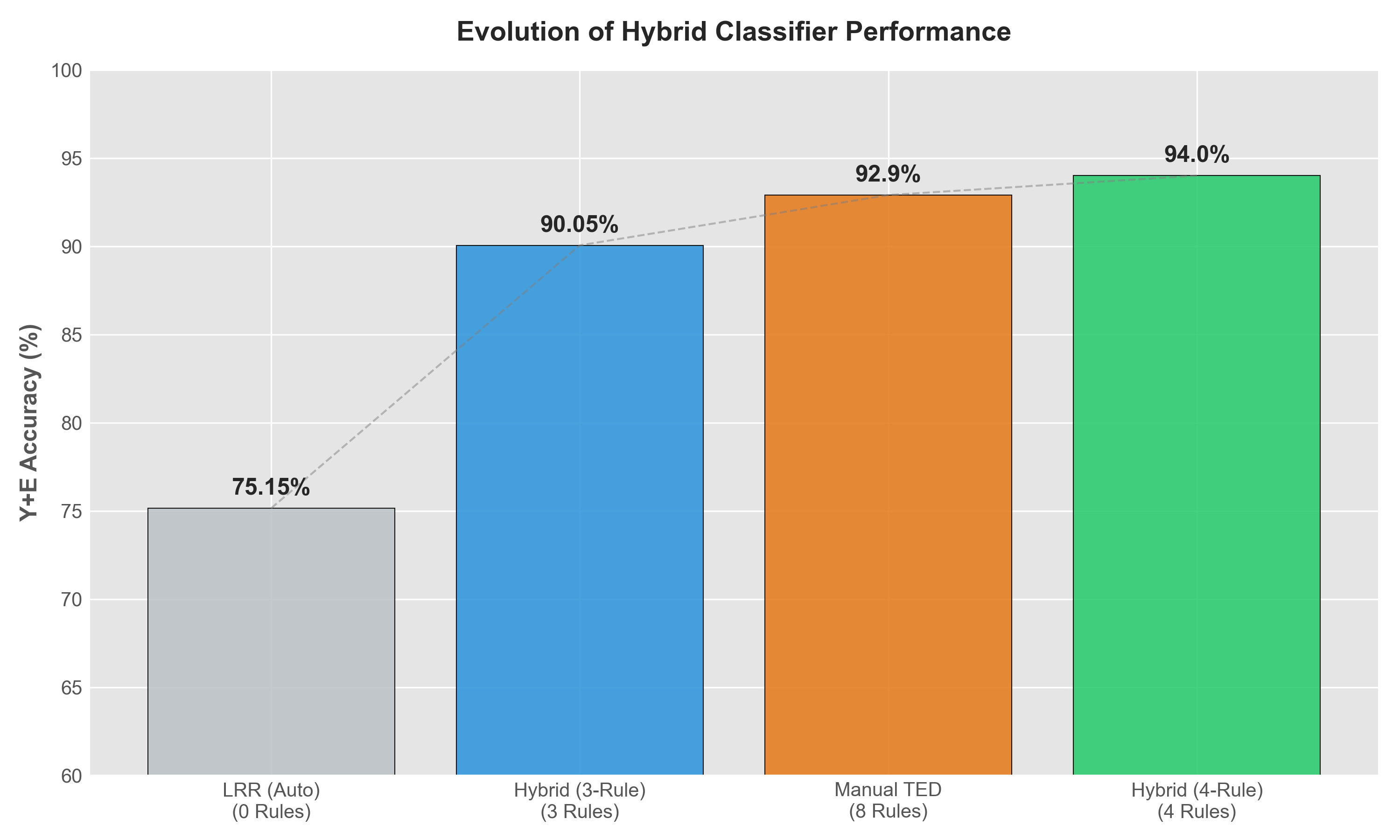
Key numbers (rounded):
- Fully automatic: about 75% accuracy
- Manual with 8 expert rules: about 93%
- Hybrid with 3 rules: about 90% (almost as good as the manual system)
- Hybrid with 4 rules: about 94% (best result), using 50% fewer human rules than the manual system
Why this is important:
- A few expert rules go a long way. You don’t need to label everything by hand.
- The AI becomes “safe-by-design”: every prediction comes with a clear, stable reason (from either a Safety Net or a Risk Trap).
- It saves expert time and reduces the chance of “cognitive overfitting” (humans overthinking rare cases).
A neat insight (the “Anna Karenina” idea):
- Happy customers are similar in broad ways (easy for the computer to learn).
- Unhappy customers leave for many different, specific reasons (hard for the computer alone).
- So let the computer handle the broad “stay” patterns, and let humans add a few precise “leave” warnings.
They also report strong business-focused stats: very high precision for predicting churn (few false alarms) and strong recall (they catch most at-risk customers), which helps target retention efforts wisely.
What this could mean going forward
- Better teamwork: Experts don’t need to write every rule. Instead, they act as “exception handlers” who add a few smart guardrails where the computer struggles.
- More trust: Explanations are consistent and tied to clear rules, so people can understand and rely on the AI’s reasoning.
- Lower cost: Fewer human labels and fewer rules to maintain, yet better results.
Caveats:
- Their data had a fairly balanced number of “stay” and “leave” customers. In the real world, churn is often rare. The approach needs more testing when churn is very uncommon.
- The method uses simple yes/no rules. That’s great for tables of numbers (like telecom or finance) but less suited for images or free text without extra steps.
Future directions:
- Test on datasets where churn is much rarer.
- Add causal thinking to separate “things that happen together” from “things that actually cause churn.”
Bottom line: With a smart mix of automated pattern-finding and a small set of expert exceptions, we can build AI that explains itself clearly, works well, and doesn’t overload humans with busywork.
Knowledge Gaps
Knowledge gaps, limitations, and open questions
The following list highlights what remains missing, uncertain, or unexplored, framed to guide concrete next steps for future work:
- Explicitly measure explanation stability: quantify how explanations change under small input perturbations (e.g., stability/consistency metrics across noise injections, bootstrap resampling, and random seeds), since stability claims are central but not empirically validated.
- Define and report “Y+E Accuracy”: clarify whether it is accuracy over the Cartesian product classes, joint correctness of label and rationale, or a weighted score; provide formal metric definitions, evaluation protocol, and calibration of the trade-off parameter μ.
- Validate the “Asymmetry of Discovery” and “Anna Karenina Principle”: formally test whether retention patterns are indeed dense/homogeneous and churn patterns sparse/heterogeneous (e.g., cluster density, entropy, overlap indices) across multiple datasets and domains.
- Generalisability beyond a single demo dataset: evaluate the hybrid framework on diverse, real-world churn datasets (telecom, banking, subscription services) to confirm external validity.
- Robustness under extreme class imbalance: systematically stress-test performance and explanation fidelity from balanced (1:1) to highly imbalanced (e.g., 1:20–1:100) settings; identify the break-even point where automated discovery loses utility.
- Train/test split rigor and statistical significance: report data partitioning strategy, cross-validation, repeated runs, variance, confidence intervals, and statistical tests to rule out overfitting and quantify uncertainty.
- Clarify supervision in Phase 1: reconcile the “unsupervised discovery” claim with the LRR objective that uses labels Y; specify whether rule discovery is supervised or unsupervised and under what conditions.
- Hyperparameter transparency and sensitivity: disclose λ1, λ2 in LRR, μ in TED loss, SVC kernel/type and parameters, binning settings in FeatureBinarizer; perform sensitivity analysis and provide recommended defaults.
- Thresholding for “Safety Codes” (1–3): define the cut-points for |wj| used to assign codes; run sensitivity analyses to show effects on coverage, precision/recall, and explanation stability.
- Sign conventions for coefficients: explicitly state label encoding (e.g., churn=1, stay=0) and confirm that wj<0 robustly implies “retention” across encoding choices and model variants.
- Conflict resolution between Safety Nets and Risk Traps: specify precedence or tie-breaking when an instance satisfies both automated safety rules and manual risk rules; evaluate the impact of different policies on performance and rationale consistency.
- Operational definition and validation of the “Drift” class (Code 12): empirically test whether Code 12 truly corresponds to pre-churn or out-of-distribution states; assess drift detection performance over time.
- Rule selection pipeline reproducibility: detail the “Golden Quartet” rules (exact predicates, thresholds) and provide a generalizable, automated method for Pareto-based selection (coverage thresholds, orthogonality criteria) with domain-agnostic defaults.
- Justify the 1% coverage threshold: examine how different cutoff values affect rule utility, redundancy, and overall performance; provide a principled criterion (e.g., cost, risk tolerance) for choosing cutoffs.
- Complexity cost term C(rj): define and operationalize rule complexity (length, literals, feature cost, cognitive load); evaluate how complexity penalties impact rule quality and stability.
- Feature binarization decisions: specify discretization strategies, number of bins, treatment of missing values; assess information loss and robustness to different binning schemes.
- Comparative baselines for explanations: include LIME/SHAP and other intrinsic/hybrid methods as baselines, using fidelity, stability, and human-understandability metrics for explanations, not just predictive accuracy.
- Model class dependence: test TED with alternative classifiers (e.g., logistic regression, random forest, XGBoost, neural nets with monotonic constraints) to determine whether gains are specific to SVC or broadly applicable.
- Computational scalability: quantify training/inference time, memory footprint, and class-space explosion from Y×E; study scaling as the explanation space (number of codes/rules) grows.
- Cost-sensitive evaluation: incorporate business costs (e.g., retention intervention costs, false-positive vs false-negative costs) into the objective and evaluation to align with real-world utility.
- Human effort measurement: replace “rule count” with empirical measures of annotation time, cognitive load, error rates, and maintenance costs; run controlled studies to validate the claimed 50% effort reduction.
- Human factors and bias mitigation: develop procedures to detect and correct “availability bias” and “cognitive overfitting” in expert rules; explore active learning or debiasing protocols for rule curation.
- Fairness and subgroup analyses: evaluate whether rules and explanations are consistent and equitable across demographic segments (e.g., age, gender, income); report fairness metrics and mitigation strategies.
- Causality of “Safety Nets”: apply causal inference (e.g., ATE/ITE, instrumental variables, causal discovery) to distinguish correlational patterns from causal retention drivers; assess how causal rules impact explanation stability.
- Temporal robustness and concept drift: extend evaluation to time-evolving data, measuring how rules and explanations adapt, degrade, or require updating in production settings.
- Outlier and noise robustness: test sensitivity to label noise, adversarial or extreme cases; assess whether explanations remain stable and meaningful under perturbations.
- Explanation usefulness to end-users: conduct user studies (e.g., comprehension, trust, decision quality, actionability) to validate that aggregated codes and risk predicates improve human decision-making.
- Reproducibility resources: ensure the linked repository contains exact rule definitions, data splits, seeds, hyperparameters, and scripts to fully reproduce the reported numbers and figures.
Practical Applications
Immediate Applications
The following applications can be deployed now, using the paper’s hybrid LRR–TED approach and readily available tooling (e.g., IBM AIX360, GLRM, SVC), with domain experts repositioned as “exception handlers” to define a small set of high‑leverage risk rules.
- Customer churn prevention (telecom, SaaS, banking, insurance)
- What: Deploy a hybrid explainable churn model that auto-learns “Safety Nets” (retention patterns) and layers in a Pareto-optimal set of expert “Risk Traps” (e.g., payment delinquency, low support engagement, monthly contract).
- Tools/Workflow: AIX360 FeatureBinarizer → GLRM/Linear Rule Regression → expert rule console → TED-SVC training with Y×E classes → code-based intervention playbooks.
- Benefits: 94% accuracy with ~50% less manual rule-writing, high precision on churn to optimize retention budget, stable explanations for each prediction.
- Assumptions/Dependencies: Tabular data; moderate class balance (no extreme rarity of churn); availability of a few high-impact expert rules; CRM integration; compliance with local data/privacy regulations.
- Call-center triage and CRM routing (telecom, utilities, e-commerce)
- What: Use explanation codes (Safety 1–3; Risk 4–11; Drift 12) to route cases—escalate “Risk Trap” customers to senior agents and place “Safety Net” customers into low-intensity retention flows.
- Tools/Workflow: Explanation-code enriched customer profiles; queue prioritization rules; contact cadence automation tied to codes.
- Assumptions/Dependencies: Operational CRM/call-center orchestration; clear mapping from codes to actions; workforce training.
- Marketing offer design and budget allocation (retail, media, subscription services)
- What: Link Safety Nets to engagement drivers and Risk Traps to pain points; run A/B tests focusing on the minimal “Golden Quartet” rule set to maximize ROI.
- Tools/Workflow: Pareto rule selector; Jaccard overlap dashboard; campaign experimentation; uplift measurement.
- Assumptions/Dependencies: Reliable attribution; sufficient sample sizes; governance to avoid overfitting “anxiety rules.”
- Adverse action and explainability compliance (finance, insurance)
- What: Generate consistent, stable rationale for approvals/denials using TED’s Y+E supervision; produce auditable, human-readable codes for decisions.
- Tools/Workflow: Explanation ledger; policy templates for adverse action notices; automated audit trails.
- Assumptions/Dependencies: Alignment with regulatory requirements (e.g., ECOA, GDPR); fairness checks; legal review.
- Early warning via “Drift” code monitoring (ops analytics, customer success)
- What: Track Code 12 (no safety, no specific risk) as pre-churn signal; trigger targeted diagnosis and rapid rule refinement by experts.
- Tools/Workflow: Drift dashboards; alerting; exception-handling workflows; sampling for root-cause analysis.
- Assumptions/Dependencies: Timely data refresh; alert fatigue management; process to close the loop with new rules.
- Employee attrition risk triage (HR analytics)
- What: Apply the hybrid pipeline to turnover prediction with interpretable risk traps (e.g., decreased manager interaction, comp gaps) and safety signals (e.g., tenure, career path).
- Tools/Workflow: HRIS feature binarization; expert “exception” rules; TED-SVC deployment; code-based retention actions.
- Assumptions/Dependencies: Strong data governance and privacy; fairness auditing; collaboration with HR business partners.
- Student dropout prevention (education analytics)
- What: Identify Safety Nets (e.g., attendance tiers, course completion milestones) and Risk Traps (e.g., prolonged inactivity, overdue tuition) to triage support.
- Tools/Workflow: SIS data; rule console for administrators; code-based interventions (tutoring, advisement).
- Assumptions/Dependencies: Institutional policy alignment; consent and data privacy safeguards; sufficient historical data.
- Fraud and complaints triage (consumer finance, insurance)
- What: Use exception rules to capture specific high-risk triggers while GLRM handles broad “safe” patterns, stabilizing triage decisions and SLAs.
- Tools/Workflow: Feature binarization; hybrid TED-SVC; escalation policies keyed to codes.
- Assumptions/Dependencies: Label quality; periodic rule review; integration with case management.
- Academic replication and coursework (data science, HCI)
- What: Use the open-source pipeline to teach stable explanations, Pareto rule selection, and human-in-the-loop exception handling.
- Tools/Workflow: AIX360 notebooks; GLRM; TED; Jaccard similarity diagnostics.
- Assumptions/Dependencies: Access to datasets; curricular alignment; compute resources for labs.
Long-Term Applications
These applications require further research, scaling, or development (e.g., handling extreme class imbalance, extending beyond tabular domains, formalizing governance and standards).
- Safe-by-design explainable AI platforms (horizontal productization)
- What: Turn the hybrid LRR–TED approach into a managed platform with rule lifecycle management, code taxonomies, drift handling, and audit tooling across verticals.
- Tools/Workflow: Rule management UI; automated GLRM discovery; TED training pipelines; observability and governance modules.
- Assumptions/Dependencies: Enterprise-grade MLOps; multi-tenant security; role-based access for experts.
- Regulatory standards for Y+E accuracy and stability (policy)
- What: Establish benchmarks and guidelines for combined predictive + explanatory performance and stability in high-stakes models.
- Tools/Workflow: Standardized test harnesses; model cards including Y+E metrics; external audits.
- Assumptions/Dependencies: Regulator engagement; harmonization across jurisdictions; industry buy-in.
- Robustness under extreme class imbalance (research, industry)
- What: Extend the framework to rare-event settings (<5% churn/failure) via active learning, cost-sensitive training, and anomaly-oriented exception rules to address the “Null Paradox.”
- Tools/Workflow: Imbalance-aware loss functions; query strategies to prioritize informative exceptions; synthetic minority generation (with caution).
- Assumptions/Dependencies: Access to rare-event labels; careful evaluation to avoid bias amplification.
- Causal rule augmentation (healthcare, economics, marketing science)
- What: Integrate causal inference to distinguish correlational Safety Nets from causal retention drivers; prioritize rules that change outcomes when intervened upon.
- Tools/Workflow: Uplift modeling; instrumental variable designs; causal discovery; policy simulation.
- Assumptions/Dependencies: Quasi-experimental data or RCTs; domain expertise; ethical approvals in regulated domains.
- Expansion beyond tabular data via neuro-symbolic methods (NLP, vision)
- What: Combine concept bottlenecks or rule extraction from deep models with TED-style supervision to produce stable, human-readable explanations in perceptual tasks.
- Tools/Workflow: Concept activation vectors; prototype learning; neuro-symbolic reasoning; explanation distillation.
- Assumptions/Dependencies: Robust concept definitions; mitigation of information loss from binarization; performance parity with SOTA.
- Continuous exception handling as a governance paradigm (org design)
- What: Formalize “experts as exception handlers” with training, incentives, and SOPs for rule curation, orthogonality checks (Jaccard), and periodic pruning.
- Tools/Workflow: Rule lifecycle analytics; coverage/orthogonality dashboards; change management.
- Assumptions/Dependencies: Organizational buy-in; clear accountability; budget for ongoing oversight.
- Fairness-aware rule selection and bias mitigation (ethics, compliance)
- What: Detect and correct availability bias and cognitive overfitting in expert rules; ensure exceptions don’t harm protected groups.
- Tools/Workflow: Counterfactual fairness tests; subgroup performance monitoring; constraint-based optimization.
- Assumptions/Dependencies: Access to demographic attributes (with legal compliance); fairness expertise; stakeholder review.
- Cross-domain retention analytics (energy, public programs)
- What: Apply hybrid explanations to utility program attrition, public benefit drop-off, and community health enrollment stability.
- Tools/Workflow: Sector-specific feature engineering; compact rule sets; code-informed outreach strategies.
- Assumptions/Dependencies: Government data sharing agreements; privacy protections; community stakeholder engagement.
- Knowledge distillation and compressed deployment (edge AI)
- What: Distill hybrid models into lightweight rule sets or small classifiers for on-device decision support with transparent codes.
- Tools/Workflow: Teacher–student training; rule pruning; embedded audit logs.
- Assumptions/Dependencies: Performance trade-offs; hardware constraints; secure update mechanisms.
- Safety guardrails for autonomous systems (robotics, industrial control)
- What: Use exception rules as explicit safety interlocks while learned Safety Nets capture normal operating regimes—yielding stable, inspectable safety logic.
- Tools/Workflow: Runtime monitors keyed to explanation codes; fail-safe policies; incident postmortem with Y+E reasoning.
- Assumptions/Dependencies: Real-time constraints; verification and validation; domain-specific safety certifications.
Glossary
- AIX360: IBM’s toolkit for explainable AI and interpretability. "using the customer-churn dataset from the IBM AIX360 package"
- Anna Karenina Principle of Churn: The idea that satisfied customers share common patterns, while churners have diverse, specific reasons. "a phenomenon we term the Anna Karenina Principle of Churn."
- Atomic propositions: Binary conditions derived from features to form logical rules. "creates atomic propositions (e.g., Age 30, Tenure 5) and their negations."
- Availability bias: A cognitive bias where people overestimate the prevalence of memorable or recent events. "domain experts often exhibit availability bias"
- Behavioural quadrants: Four distinct risk categories describing customer behavior (Financial, Structural, Interaction, Engagement). "four rules focusing on distinct behavioural quadrants: Financial Risk, Structural Risk, Interaction Risk, and Engagement Risk."
- Behavioural Trio: A three-rule hybrid configuration emphasizing key behavior-based risks. "Hybrid (Behavioural Trio)"
- Binarisation: Transforming features into binary indicators to enable rule learning. "This binarisation is a prerequisite for the linear rule regression phase"
- Black box models: Models whose internal decision-making processes are not easily interpretable. "As complex ``black box'' machine learning models become standard"
- Boolean decision rules: Explicit IF-THEN logic used to make predictions. "pure rule-based systems like Generalised Linear Rule Models (GLRM) or Boolean decision rules \cite{dash2018boolean} offer automated transparency."
- Cartesian product: Combining label and explanation spaces to form joint classes for supervised learning. "We construct the Cartesian product of the label space and the explanation space"
- Class imbalance: A condition where one class (e.g., churn) is much rarer than another, affecting learning. "a phenomenon exacerbated by class imbalance \cite{he2009learning}."
- Code 12: A default state indicating neither safety nor specific risk was triggered. "exhibiting the ``Code 12'' phenomenon where risky customers were unidentified by broad structural rules."
- Cognitive Overfitting: Overly complex expert rules focused on rare edge cases, reducing general utility. "This psychological error manifests as ``Cognitive Overfitting'':"
- Column generation: An optimization technique to generate useful binary features or rules. "based on the column generation technique by Dash et al. \cite{dash2018boolean}"
- Complexity cost: A penalty term that discourages overly complex rules in optimization. "where represents the complexity cost of rule ."
- Customer churn: The loss of customers, typically modeled as a classification problem. "When applied to customer churn prediction"
- Decision boundary: The separating surface the model learns to distinguish classes. "varying fidelity to the true decision boundary."
- Drift class: A catch-all category for instances with no detected safety or risk signals. "We introduce a ``Drift'' class for observations that trigger neither a Safety Net nor a Risk Trap."
- Efficiency Frontier: The trade-off curve between rule complexity and combined accuracy. "The Efficiency Frontier: Evolution of Model Performance."
- Explanation Matrix (E): A structured representation of safety and risk codes used for supervision. "Automated rules (Safety) and Expert rules (Risk) are fused into a single Explanation Matrix () to initialise the supervised classifier."
- Explainable AI (XAI): Methods that make model decisions understandable to humans. "Current approaches to Explainable AI (XAI) face a ``Scalability-Stability Dilemma.''"
- FeatureBinarizer: A tool that converts continuous/categorical features into binary rule-ready indicators. "using the FeatureBinarizer module from the AIX360 toolkit."
- Fidelity: The faithfulness of explanations to the model’s true reasoning. "designed to improve stability and fidelity."
- Generalised Linear Rule Model (GLRM): A rule-based model combining linear coefficients with learned logical conditions. "Generalised Linear Rule Models (GLRM) offer automated transparency."
- Golden Quartet: The selected four high-impact expert rules that maximize performance. "down-selected the expert logic to a ``Golden Quartet'' of four rules"
- Human-in-the-Loop AI: Systems where human experts guide or correct automated learning. "proposing a shift in the paradigm for Human-in-the-Loop AI"
- Intrinsic interpretability: Models whose internal structure serves directly as their explanation. "a strategic shift towards intrinsic interpretability"
- Jaccard Similarity: A set-overlap metric used to assess rule independence. "using the Jaccard Similarity metric:"
- Joint loss function: An objective combining prediction and explanation errors in training. "minimise a joint loss function that enforces fidelity to both the label and the explanation:"
- Knowledge Bottleneck: The scalability issue arising from requiring manual explanation labels. "it introduces a new challenge: the ``Knowledge Bottleneck.''"
- LIME: A post-hoc method that uses local surrogate models to explain predictions. "post-hoc explanation techniques like LIME \cite{ribeiro2016should} and SHAP \cite{lundberg2017unified} have gained popularity"
- Linear Rule Regression (LRR): A linear model optimizing weights on binarized rules. "LRR optimises a sparse linear model"
- Local surrogates: Simplified models fitted locally to approximate complex model behavior. "rely on local surrogates to approximate complex model behaviours."
- Null Paradox: The trivial solution where a model predicts the majority class (e.g., “always stay”). "default to a trivial ``always stay'' rule (The Null Paradox)"
- Orthogonality: The independence of rules to avoid redundancy and overlap. "Orthogonality (Uniqueness): To minimise redundancy, we validated the independence of the selected rules using the Jaccard Similarity metric:"
- Pareto distribution: A skewed distribution where few items account for most impact. "follows a Pareto distribution: a small subset of ``high-leverage'' expert rules"
- Pareto-optimal: A selection that maximizes performance without unnecessary additions. "Pareto-optimal set of just four human-defined risk rules"
- Post-hoc explanation methods: Techniques that explain predictions after model training without changing the model. "post-hoc explanation techniques like LIME \cite{ribeiro2016should} and SHAP \cite{lundberg2017unified}"
- Rectangular hyper-boxes: Geometric rule regions defined by axis-aligned thresholds. "approximated by rectangular hyper-boxes (Boolean rules)."
- Risk Filter: The manual augmentation phase focused on identifying specific churn triggers. "Phase 2: Domain Augmentation (Risk Filter)."
- Risk Traps: Specific conditions strongly associated with churn risk. "Risk Traps (Manual): Customers satisfying domain-defined risk predicates are assigned Codes 4--11."
- Safe-by-Design: An approach where models are trained to align with validated domain logic from the outset. "This results in a model that is ``Safe-by-Design,''"
- Safety Nets: Broad retention patterns identified by automated rule learning. "We formalise the discovery of ``Safety Nets'' as the set of rules "
- Safety Tiers: Hierarchical grouping of safety rules by coefficient magnitude (strength). "Proposed Approach: Safety Tiers."
- Scalability-Stability Dilemma: The trade-off between easily scaling explanations and ensuring their consistency. "face a ``Scalability-Stability Dilemma.''"
- SHAP: A post-hoc method based on Shapley values to attribute feature importance. "post-hoc explanation techniques like LIME \cite{ribeiro2016should} and SHAP \cite{lundberg2017unified}"
- Sparse linear model: A linear model with many zero weights to promote simplicity. "LRR optimises a sparse linear model"
- Stability Gap: Instability where small input changes yield very different explanations. "a fundamental ``Stability Gap''"
- Support Vector Classifier (SVC): A supervised classifier used for the joint label-explanation training. "Support Vector Classifier (SVC)"
- TED-SVC classifier: The hybrid classifier trained with TED’s joint supervision and an SVC backbone. "Phase 3: The Hybrid Classifier (TED-SVC)."
- Teaching Explanations for Decisions (TED): A framework that trains models with both labels and human explanations. "A prominent example of this approach is the Teaching Explanations for Decisions (TED) framework"
- Y+E Accuracy: Combined accuracy over both predicted labels (Y) and explanations (E). "model fidelity (Y+E Accuracy)."
Collections
Sign up for free to add this paper to one or more collections.

