- The paper demonstrates a hardware-in-the-loop approach that couples a real levitated microsphere with a simulated ghost oscillator to mimic tunable interactions.
- The experimental setup allows real-time adjustments of frequency, damping, and mass, revealing hybrid mode dynamics and clear phase shifts.
- Implications include programmable bath engineering for non-equilibrium quantum thermodynamics and scalable many-body oscillator networks.
Semi-Virtual Coupling of Levitated Oscillators: Hardware-in-the-Loop Architecture and Dynamics
Introduction
This paper introduces and experimentally realizes a hybrid system in which a physically levitated charged microsphere is dynamically coupled to a virtual oscillator—referred to as a "ghost" particle—simulated using an analog computer. This semi-virtual coupled oscillator architecture establishes a new experimental paradigm for investigating non-equilibrium physics, bath engineering, and real-time controllable interactions in levitated mesoscopic systems. Unlike conventional coupled oscillator experiments, the use of a hardware-in-the-loop (HIL) analog computer enables on-the-fly manipulation of key parameters such as frequency, damping, mass, and coupling strength, extending the functionality far beyond what is achievable via coupling two real particles.
Experimental Realization and System Architecture
The experimental configuration consists of a single real silica microsphere, levitated in a linear Paul trap under high vacuum, interacting with a virtual oscillator whose Langevin dynamics are simulated on a high-speed analog computer. The position of the real particle is tracked in real time by a high-resolution event-based camera, which streams the positional data to the analog computer. There, the position acts as input to the virtual oscillator simulation, and the simulated "ghost" oscillator dynamics feed back an electronic force signal applied to the real particle via driving electrodes. This architecture enables real-time, reciprocal, and tunable coupling that mimics spring-like or Coulomb-like interactions, subject to signal processing latency.
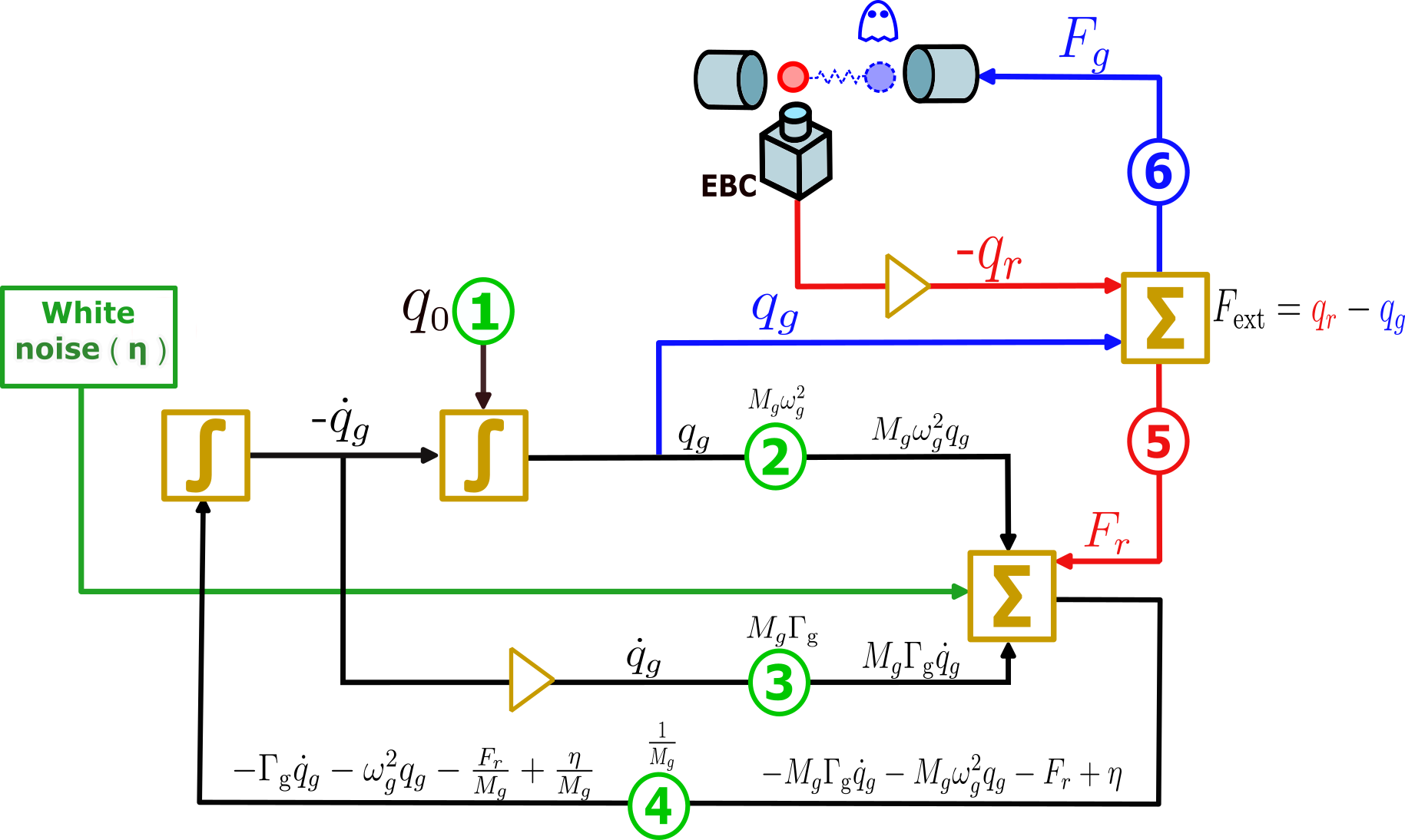
Figure 1: Simulating the dynamics of a levitated microparticle on an analogue computer by solving its equations of motion.
The analog computer uses standard elements—summers, integrators, potentiometers—to solve Langevin-type equations continuously, allowing rapid parameter sweeps of the virtual oscillator’s mass Mg, frequency ωg, damping Γg, and white noise amplitude ξg. The coupling strengths kr,kg for the real and virtual oscillators, respectively, can be set and modulated independently. The system allows physical simulation of two-way coupled oscillators, introducing an arbitrary, reconfigurable interaction topology that is not restricted by the physical and fabrication constraints associated with real particle arrays.
Ghost Oscillator Characterization
The ghost oscillator, simulated on the analog computer, is systematically characterized. Power spectral density (PSD) analysis confirms accurate reproduction of the driven-damped harmonic oscillator with tunable effective temperature, resonance frequency, and linewidth. The SNR remains ∼30 dB near resonance for varying bath temperatures, with the noise floor set by analog electronic limits. Mass-dependent resonance and damping variations demonstrate parameter control distinct from real oscillators, especially at low frequencies where the analog computer exhibits $1/f$ noise dominance.
The system achieves resonance frequencies from approximately 2 Hz to 160 Hz, and momentum damping rates tunable between 2π×0.8 Hz and ωg0, with full parameter overlap between the real and ghost oscillators for compatible mass settings. This flexibility facilitates precision engineering of dynamic regimes identical to, but more easily accessible than, two-real-particle configurations.
Semi-Virtual Coupling and Collective Dynamics
Upon enabling the bidirectional coupling, the system realizes hybrid normal modes. For resonant, symmetric coupling (ωg1, ωg2), two collective modes emerge: an in-phase and an out-of-phase mode, confirmed by PSD and phase-coherence analysis.
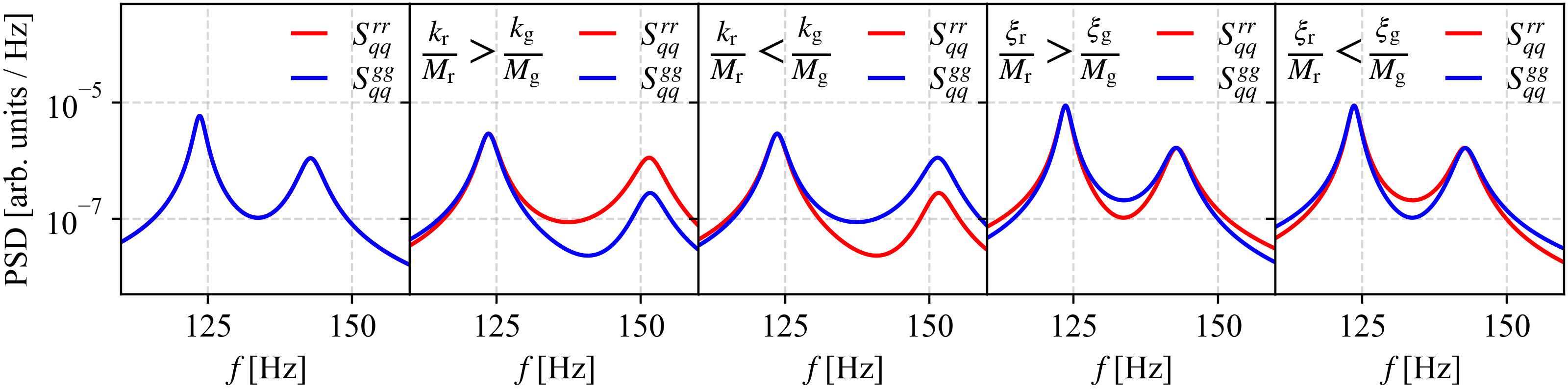
Figure 2: Illustration of PSDs ωg3 under asymmetric coupling and noise, showing asymmetry in peak heights resulting from differing ωg4 and ωg5.
Coherence between the real and ghost motion peaks at the hybrid mode frequencies, and phase analysis reveals a ωg6 shift between the two collective modes. The in-phase and out-of-phase modes’ frequencies and linewidths are in quantitative agreement with the model. The system explores experimentally accessible ranges of the quadratic mean coupling strength
ωg7
where ωg8 are the mode frequencies. The coupling rate ωg9 is settable from Γg0 to Γg1, directly controlled via the analog computer.
In the asymmetric case, where Γg2, the system moves beyond the standard normal mode splitting and exhibits two coupled modes with mixed character. Through spectral, coherence, and phase analyses, the platform explores coupling and hybridization under significant detuning, revealing loss of coherence with large frequency mismatch and sensitivity to processing-induced time delay.
Theoretical and Practical Implications
The demonstrated HIL semi-virtual coupling framework enables an unprecedented degree of control in levitated mesoscopic mechanics, with strong implications for physical simulation and non-equilibrium quantum thermodynamics. The mixer of real and analog-virtual components allows dynamic synthesis and continuous reconfiguration of effective bath properties and engineered environments for the real oscillator, representing a powerful approach to measurement-based bath engineering and the study of open quantum systems.
The ability to decouple reciprocal and non-reciprocal interactions (by tuning Γg3), arbitrarily vary the bath temperature, oscillation frequency, and damping rate, and impose time-dependent or nonlinear couplings is unique to the HIL architecture. This positions the system as a testbed for synthetic gauge fields, effective non-Hermitian dynamics, and potentially for non-reciprocal cooling and quantum information protocols, with utility for simulating gravitationally induced entanglement, sympathetic cooling, and novel dissipation mechanisms.
Scaling the protocol to arrays of real and ghost oscillators, with multidimensional coupling, offers a route to programmable many-body oscillator networks beyond existing trapped-ion, optomechanical, or Coulomb-coupled paradigms.
Future Directions
Immediate extensions include exploration of systems with strong asymmetry (e.g., heavy-tailed dissipation or high-temperature ghost baths), active bath engineering for heat flow and sympathetic cooling, and implementation of nonlinear, time-dependent, or non-reciprocal inter-oscillator forces. Because the interaction is mediated via real-time measurement and electronic actuation, it is possible to realize physical simulators with arbitrary topology, temporal control, and feedback complexity—including classical or quantum non-Gaussian noise and higher-order interactions.
This class of HIL hybrid analog-physical systems is positioned to interface with digital and quantum systems, providing efficient, scalable, and highly flexible platforms for probing both fundamental and applied problems in mesoscopic physics, stochastic thermodynamics, and programmable analog computation.
Conclusion
This work introduces a controllable, hybrid coupled oscillator system wherein a levitated real microsphere is dynamically linked to a tunable virtual oscillator realized by analog computation. The architecture facilitates exploration of regimes inaccessible to purely physical arrays and demonstrates robust characterization of collective mode dynamics under both symmetric and highly detuned coupling. This semi-virtual HIL framework expands the toolset for simulated many-body dynamics and non-equilibrium bath engineering in levitated systems, and provides a foundation for future research in programmable environments, quantum thermodynamics, and physical analog simulation.

