- The paper introduces Gig-WMS, which integrates behavioral modeling with chance-constrained MPC to optimize task assignments in the gig economy.
- It employs a sequential randomized algorithm to verify feasibility, ensuring probabilistic satisfaction of workload constraints while minimizing payroll.
- Empirical validation through crowdsourcing and simulation demonstrates superior performance over deterministic controllers in maintaining workload targets.
Gig-work Management System with Chance-Constraints Verification Algorithm: An Expert Analysis
Introduction and Motivation
The paper addresses the complex dynamics of gig-work management by introducing an integrated platform—Gig-WMS—that systematically optimizes the assignment of one-off tasks, dynamically adjusting both working hours and pay rates based on probabilistic models of worker behavior. The framework is motivated by the stochastic, short-term, and highly individualized nature of the gig economy workforce, where deterministic models of worker compliance are fundamentally inadequate. The approach draws on advances in discrete choice modeling and stochastic model predictive control, with quantifiable guarantees on constraint satisfaction via chance-constraint formulations.
System Architecture and Operational Overview
Gig-WMS orchestrates the interaction between incoming task requests, gig-worker decision processes, and real-time workload management. Workloads are modeled in a multi-class, continuous-flow setting with exogenous influx and task execution by a group of n heterogeneous workers over m task types.
Offers are generated by the controller, specifying candidate hours and wages contingent on the state of the outstanding workload. The system tracks both macro- and micro-dynamics: group-level workload and individual worker choices.
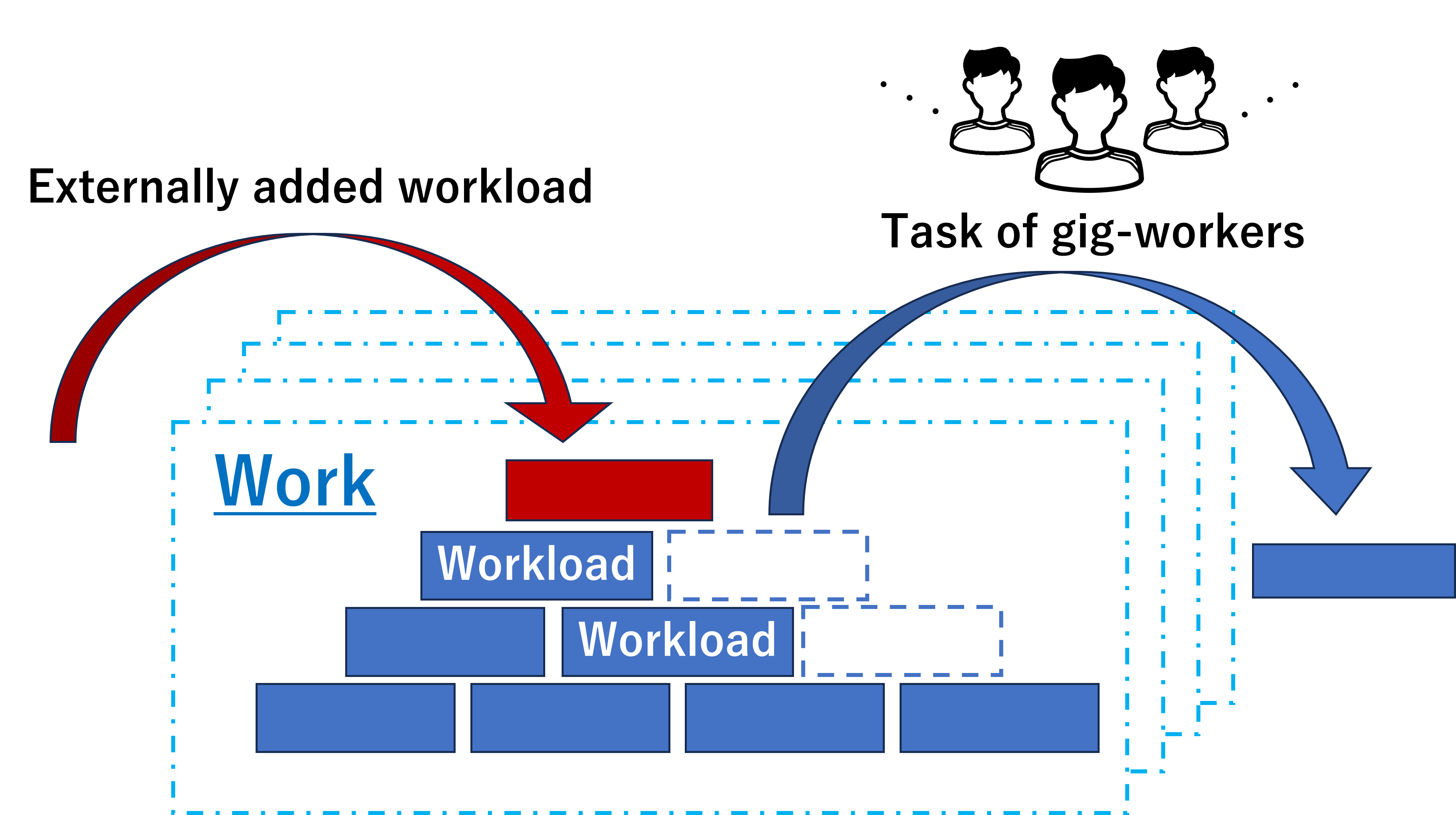
Figure 1: The transition of workload by task execution, illustrating dynamic reduction via task assignment amid stochastic exogenous influx.

Figure 2: The block diagram of Gig-WMS, highlighting the controller, gig-worker group, workload plant, and feedback information flow.
Probabilistic Decision Modeling
A discrete choice framework based on the logit model underpins the representation of task acceptance. Each worker i is associated with parameters κ (task hour sensitivity), λ (wage sensitivity), and νi (individual bias), encapsulated in a linear utility function. Acceptance follows a sigmoid transformation, generating worker-specific Bernoulli responses. The collective acceptance probability leverages the independence structure to compute the probability that at least one worker participates, informing downstream control actions.
The system's physical dynamics introduce additional complexity—workload evolves according to both stochastic control actions (worker acceptance and execution) and exogenous arrivals, modeled as a Markovian or arbitrary stochastic process.
The central computational challenge is to select task offers—that is, vectors of hours and wages—so as to minimize cumulative payroll while ensuring, with high probability, that the backlog does not exceed a prescribed reference level xref and that worker offers remain acceptable. This challenge is formalized as a chance-constrained MPC problem, where state and input constraints must be satisfied probabilistically.
Deterministic relaxations and analytical bounds convert probabilistic constraints into tractable forms, notably by upper-bounding the probability of rejection and translating group task acceptance constraints into deterministic inequalities over offer parameters. The resulting deterministic surrogate is iteratively solved, and its feasibility against the original stochastic constraints is verified using a sequential randomized algorithm with rigorous confidence guarantees.
Chance-Constraints Verification Algorithm
To handle the intrinsic stochasticity, the feasibility of candidate solutions is systematically checked via an algorithm inspired by randomized methods for uncertain systems. This three-stage process includes:
- Approximate Problem Solution: Relax the original CC-MPC into a deterministic problem by fixing tight constraint violation probabilities.
- Sequential Feasibility Verification: Statistically validate candidate solutions using Monte Carlo sampling and precise probabilistic verification inequalities, leveraging the properties of the Riemann zeta function for controlling sample complexity.
- Adaptive Tightening: When violations are detected, the violation probability threshold ε is adaptively reduced and the problem is re-solved, iterating until the solution passes confidence-level-based feasibility checks.
This cycle is summarized in a procedural algorithm, with rigorous proof that the resulting solution satisfies all original chance constraints with user-specified confidence 1−δ.
Empirical Identification and Validation
Utility Model Identification via Crowdsourcing
A crowdsourcing study on a major Japanese platform collects empirical acceptance rates for various combinations of task hours and wages, providing real-world data for model identification. With 500 participants and 20 unique offer scenarios, maximum likelihood estimation yields interpretable utility parameter values, embedding population preferences directly into the decision model.
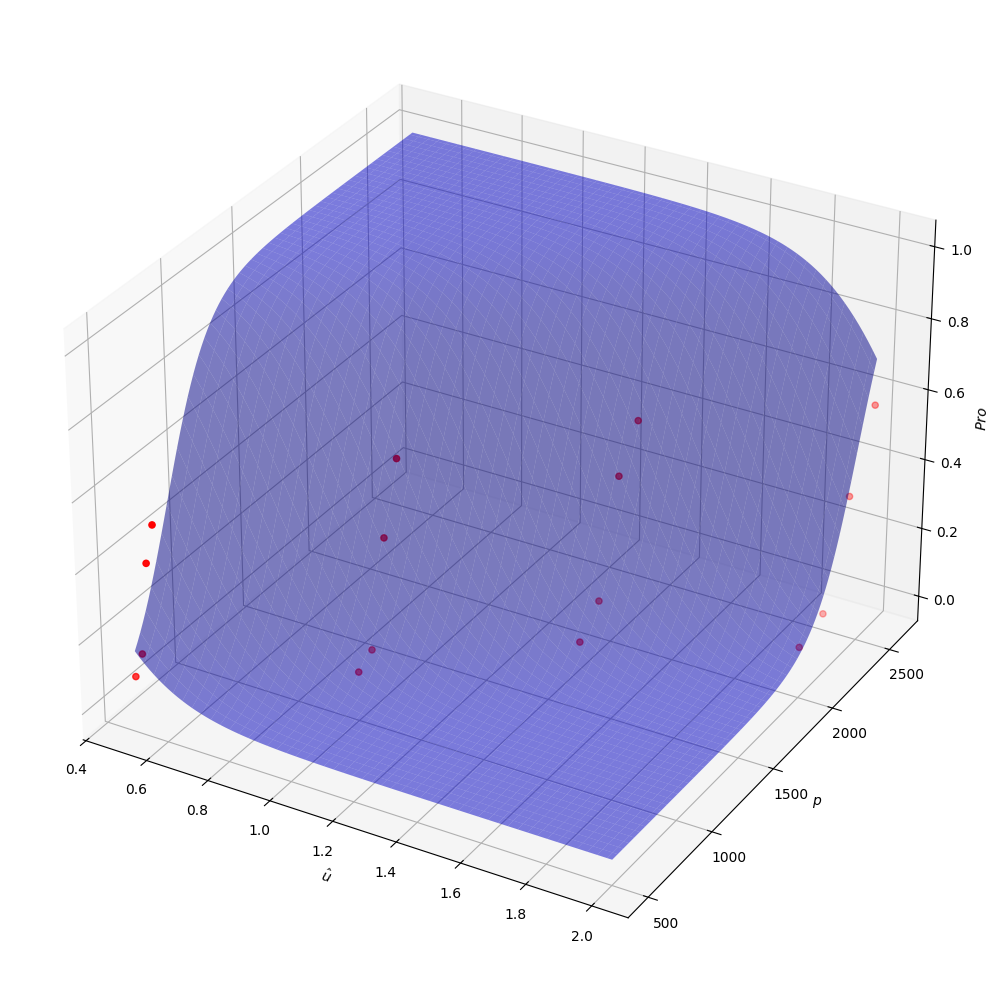
Figure 3: Surface of the task Acceptance Probability, contrasting model inference (continuous surface) and aggregated crowdworker data (red dots).
This data-driven modeling reveals strong negative dependence on task duration and positive dependence on wage, with rapid saturation of acceptance at higher pay for fixed hours.
Controller Verification via Simulation
Two controllers are benchmarked: one applying only deterministic MPC, and the other leveraging the full feasibility verification algorithm. Over 200 simulated runs, the CC-MPC with statistical verification robustly limits over-target workload occurrences to within prescribed probabilistic bounds (η=0.05). In contrast, the naïve deterministic controller exhibits significant constraint violations beyond allowable rates.
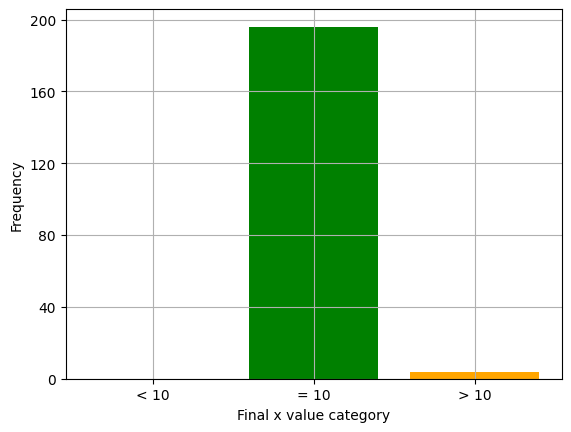
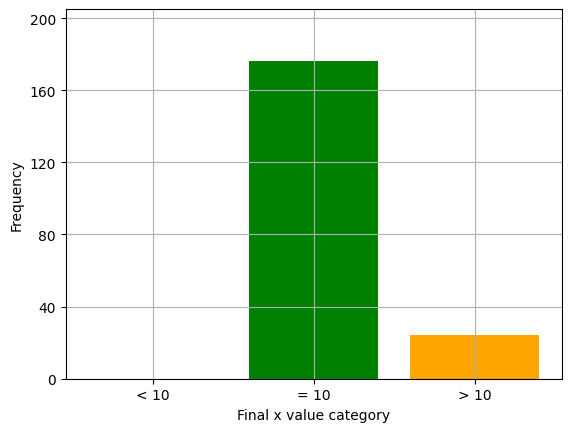
Figure 4: Histogram of x(10) for Controller 1, showing concentrated compliance with the reference workload threshold.
Implications and Future Directions
From a theoretical perspective, this framework advances the formal integration of behavioral economics into real-time stochastic control of socio-technical systems. It demonstrates how chance constraints can be rigorously enforced in dynamic assignment problems characterized by non-determinism in agent responses. Practically, Gig-WMS enables reliable, cost-efficient operation of gig-work platforms, adapting task offers in real time to empirical worker behaviors with quantified risk.
Extending this work could notably involve:
- Incorporating more complex worker models with memory, peer effects, or learning;
- Generalizing to high-dimensional/nonlinear workload or offer spaces;
- Integrating broader classes of uncertainty or non-stationarity in worker behavior;
- Deployment and evaluation in live platform settings with feedback adaptation.
Conclusion
The paper establishes a formalized end-to-end pipeline for gig-work management, combining empirically grounded worker decision models with chance-constrained MPC and rigorous statistical verification. Empirical studies validate the core claims: Gig-WMS can efficiently manage tasks and wages while robustly enforcing probabilistic workload constraints, a necessity in stochastic, dynamic labor markets such as the modern gig economy. This contribution constitutes a significant step towards principled, data-driven, and provably safe operation of automated work management platforms.
(2512.11308)