- The paper establishes that an optimal bang-bang evasion policy always exists in bounded stochastic settings, validated via convex analysis and the extremal point theorem.
- It introduces Terminal-Set-Based Evasion (TSE), which leverages closed-form terminal cost evaluations to reduce computational complexity and outperforms classic maneuver models in Monte Carlo simulations.
- The study’s findings have practical implications for real-time applications, robust control design, and future adaptive missile defense research.
Stochastic Optimality and Synthesis of Bang-Bang Evasion in Planar Endgame Intercepts
Introduction and Problem Setting
The paper "Bang-Bang Evasion: Its Stochastic Optimality and a Terminal-Set-Based Implementation" (2511.21633) investigates stochastic optimal evasion strategies for a maneuvering target—modeled as a point mass with bounded lateral acceleration—engaged by a missile guided by a linear feedback law. This framework generalizes prior deterministic analyses, accounting for realistic stochastic phenomena: process and measurement noise, parametric uncertainty, and partial information.
The engagement scenario, illustrated in (Figure 1), considers discrete-time linearized kinematics for target and pursuer, with the engagement cost typically defined via the expected miss distance at a random terminal time. The novelty lies in the full stochastic formulation: the evader's policy maximizes expected miss distance given only noisy state estimates, posterior distributions obtained from a separate estimator, and bounded control authority.

Figure 1: Schematic of planar endgame geometry with notation for line-of-sight, lateral acceleration, and state variables.
Stochastic Bang-Bang Optimality: Existence and Structure
The central theoretical contribution is a proof that an optimal evasion policy always exists in the stochastic bounded-control setting and that, amongst the set of optimal policies, at least one possesses the bang-bang structure—i.e., takes only extremal values at each control instant: uTk∈{−uTmax,uTmax} for all k. This result is established using convex analysis and the generalized separation theorem (Witsenhausen), leveraged to decouple estimation and control, under arbitrary (non-Gaussian, nonlinear) noise models.
By reformulating the finite-horizon stochastic optimal control problem as a maximization over a convex and compact admissible set, the authors invoke the extremal point theorem: the maximum of a convex and continuous function on such a set is attained at an extreme point—in this case, the boundaries of the admissible control interval. The solution is thus reduced from infinite- to finite-dimensional combinatorial search, but remains computationally intractable for long horizons due to exponential scaling.
Terminal-Set-Based Evasion (TSE): Practical Synthesis
Addressing the computational impediment, the paper introduces Terminal-Set-Based Evasion (TSE), a new analytic closed-loop synthesis for near-optimal bang-bang policy selection in the stochastic setting. Rather than recursively optimizing over all future bang-bang sequences, TSE evaluates, at each time step, the terminal outcome associated with each extremal control using closed-form expressions for the expected terminal cost, conditioned on the currently observed posterior. The key ingredient is the construction of terminal sets that represent the predicted probability-weighted terminal state for each control choice.
The TSE selector reduces the problem to a single comparison per time step, dramatically reducing online computation. Cost-to-go functions for both endpoints uTn=±uTmax are explicitly calculated (see (Figure 2)) using propagated uncertainty (means and covariances) from the estimator, and the control that yields greater expected miss distance is selected.
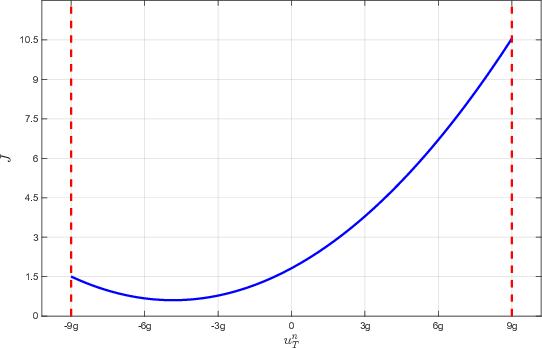
Figure 2: Expected cost J(uTn) as a function of candidate control uTn; the optimal control is always at one of the extrema (bang-bang solutions).
Comparative Evaluation: TSE vs. Standard Stochastic Maneuver Models
Through extensive Monte Carlo simulations, the efficacy of TSE is benchmarked against classical stochastic evasion profiles: random telegraph signal (RTS), Singer process, and weaving (sinusoidal) maneuvers, which are standard in the literature but lack provable optimality under feedback and uncertainty. The simulation framework employs a Kalman filter (or MMAE) for posterior estimation, and both process and measurement noise are modeled.
Representative evader acceleration profiles under each strategy are contrasted in (Figure 3). The TSE profile, corresponding to analytically optimal switch timing, produces more advantageous lateral displacement at termination compared to the stochastic or deterministic alternatives.
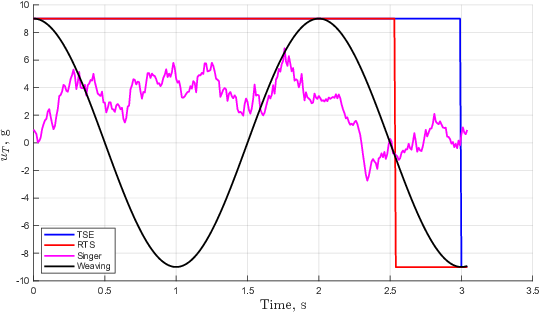
Figure 3: Evader acceleration commands for a representative run: TSE (blue), RTS (red), Singer (magenta), and weaving (black), demonstrating distinctive switching patterns.
The statistical superiority of TSE is evidenced by empirical CDFs of miss distance gathered over 10,000 MC runs (Figure 4). TSE consistently achieves larger terminal miss distances across all quantiles, yielding a notably reduced single-shot kill probability (SSKP) for the interceptor compared to other profiles. Quantitative metrics including mean and 95th percentile confirm that both mean and high-confidence miss distances are maximized under TSE, with SSKP differences sufficiently pronounced to suggest operational implications on resource allocation for interceptors.
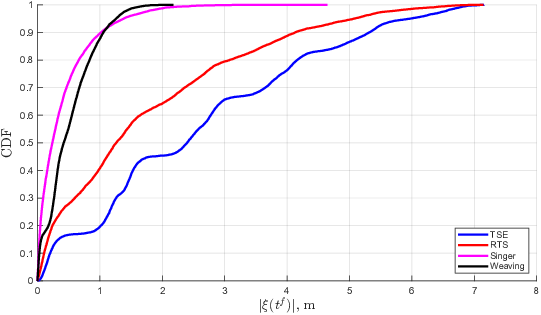
Figure 4: Empirical CDF of miss distances for TSE (blue), RTS (red), Singer (magenta), and weaving (black), highlighting TSE dominance in separation.
Theoretical and Practical Implications
The result that bang-bang structure persists as optimal under broad stochastic generality collapses the admissible policy space to a tractable combinatorial family. This consolidates the justification for extremal-control-based maneuver synthesis in practical endgame scenarios, even when adversaries are forced to operate on estimated information.
The analytic TSE policy operationalizes these structural results: it can be integrated into real-time systems with moderate compute, provides robustness to state, guidance law, and engagement time uncertainty, and outperforms existing heuristic and stochastic maneuver models.
From a theoretical standpoint, this work bridges a gap in the literature by extending deterministic optimality results for bounded-control pursuit-evasion to general stochastic systems. It also strengthens the role of the generalized separation theorem in stochastic dynamic games with bounded controls.
Outlook and Future Directions
These findings motivate several follow-on research directions:
- Extension to Higher-Dimensional and Nonlinear Dynamics: The analytical tractability of TSE is presently tailored to linearized planar engagements. Extending bang-bang stochastic optimality and terminal-set evaluation to general nonlinear dynamics, 3D kinematics, or constraints (e.g., in collaborative multi-agent evasion or interception) is a fertile area.
- Robust Estimation and Identification: The efficacy of TSE depends on the accuracy of the evader's posterior estimate; further work integrating robust and adaptive estimation (e.g., with unknown pursuer models) could further improve performance under extreme epistemic uncertainty.
- Adversarial Learning and Adaptive Pursuer Strategies: As pursuit/evader pairs co-evolve, understanding the implications of bang-bang optimality for learning (e.g., in reinforcement learning contexts) and adaptability may drive progress in autonomous engagement between intelligent agents.
- Real-Time Embedded Implementation and Hardware Testing: The analytic and computational streamlining enabled by TSE is well-suited to integration in embedded avionics; experimental validation in hardware loops will be valuable.
Conclusion
This work provides substantial theoretical and practical advances in stochastic pursuit-evasion with bounded control. It rigorously establishes the optimality of bang-bang evasion under broad uncertainty, and provides a closed-loop, estimator-coupled, analytic policy—Terminal-Set-Based Evasion—that is demonstrably superior to canonical stochastic maneuver models in maximizing terminal miss distance and minimizing interceptor lethality. These results are foundational for further development of robust evasion algorithms in next-generation aerial combat and missile defense systems.