- The paper introduces a PAT delay model that quantifies pointing and acquisition delays in FSO networks using simulation and mission data.
- The methodology employs coarse pointing calibration, beam search strategies, and validations against NASA TBIRD and DSOC missions.
- Results reveal significant impacts of PAT delays on network contact time, highlighting the need for refined scheduling and routing algorithms.
Modeling Pointing, Acquisition, and Tracking Delays in Free-Space Optical Satellite Networks
Introduction
The paper "Modeling Pointing, Acquisition, and Tracking Delays in Free-Space Optical Satellite Networks" (2511.16063) addresses critical challenges posed by Free-Space Optical (FSO) satellite networks, specifically focusing on Pointing, Acquisition, and Tracking (PAT) delays. Unlike traditional radio frequency communication systems, FSO networks offer significantly higher data rates, lower transmission power requirements, and reduced Size, Weight, Power, and Cost (SWaP-C). However, the precision necessary for establishing optical links imposes substantial delays, which often are not adequately accounted for in existing scheduling and routing algorithms.
Coarse Pointing and Calibration
Coarse pointing involves the initial orientation of the optical terminal towards the partner satellite or ground station, using mechanical slewing facilitated by components like reaction wheels or torque rods. This is a pivotal step for establishing Line-of-Sight (LOS) necessary for subsequent communication phases.
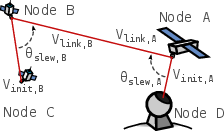
Figure 1: Example of the angle change for Node A when slewing its optical head from an optical ground station to a deep space satellite, Node B.
Accurate pose estimation is critical, relying on GPS data, star trackers, and inertial measurement units to compute the LOS vectors. The pointing delay is significantly influenced by the total angular change required, calculated using the slew angle θslew,n between the initial and target pointing vectors. Errors may arise from thermal expansion, launch vibrations, and ephemeris inaccuracies. Mitigation strategies include post-launch calibration and FSM-based boresight corrections.
Optical Link Acquisition
Link acquisition represents the phase where the receiver actively seeks and locks onto the incoming optical signal. Fine pointing and beam searching are integral sub-processes, performed by FSMs that enable precise alignment within narrow Fields of View (FOVs).
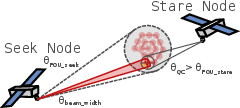
Figure 2: The seek satellite performing a beam search using a hexagonal spiral while the stare satellite detected the angle of incidence of the light using the quad-cell based track sensor.
A unilateral beam search strategy is utilized to simplify acquisition: one terminal performs a structured search (Figure 2), while the partner terminal remains fixed, using track sensors to detect signals. Beam scanning patterns, such as hexagonal spirals, optimize coverage of the search area relative to the Field of Uncertainty (FOU).
PAT Delay Model Analysis
The research validates the proposed PAT delay model by simulating contact opportunities in LEO and deep space missions. The generated distributions illustrate categorization based on link characteristics—e.g., prior link geometry and mission architecture, categorizing delays as multimodal.
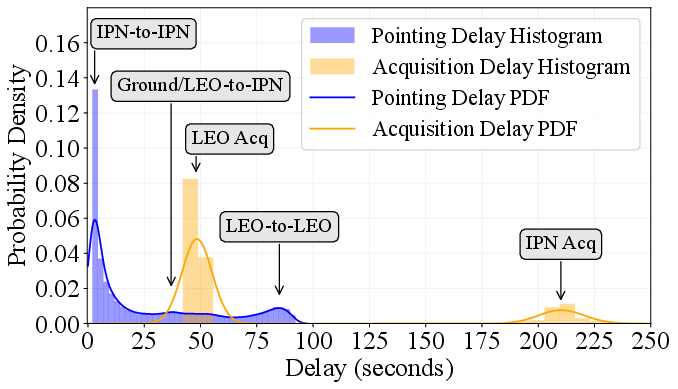
Figure 3: PDF overlayed with a histogram shows clear characterization of different types of optical links based on pointing and link acquisition delays.
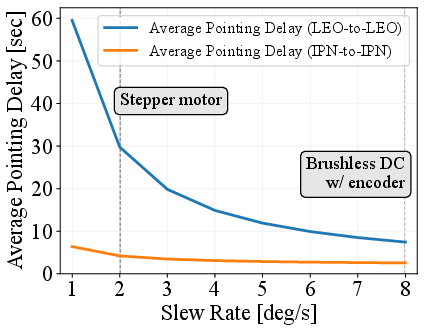
Figure 4: Average pointing delay increases exponentially for LEO-to-LEO links as CPA slew rate decreases, while IPN links have little difference.
Model validation against NASA TBIRD and DSOC mission data confirms the significant impact PAT delays have on contact time, highlighting the necessity for scheduling algorithms to explicitly factor these delays into network capacity evaluations.
Implications and Conclusion
The findings underscore the importance of robust PAT delay models in the design and development of future large-scale FSO networks. Integrating such models into routing and scheduling algorithms is crucial for enhancing network efficiency and capacity. Future work should focus on refining these models further and applying them to advanced scheduling algorithms, thus alleviating the operational constraints currently posed by long acquisition and setup times.
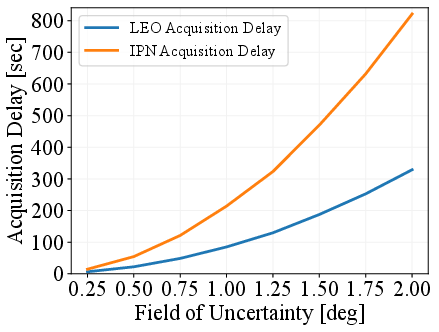
Figure 5: Both LEO and IPN acquisition delays increase exponentially as the FOU increases.
In conclusion, while FSO networks present promising solutions to address increasing demands for high-bandwidth satellite communications, addressing the inherent delays associated with PAT processes is essential for realizing their full potential. This paper offers foundational insights to optimize communication architectures in optical satellite networks, paving the way for more efficient and autonomous space networks.