- The paper presents a quantum annealing-based TDD approach that formulates test case minimization as a QUBO, achieving dramatic reductions in token consumption and generation latency.
- The framework employs exhaustive test generation followed by QUBO optimization to ensure complete feature coverage while eliminating redundant test cases for improved code quality.
- Experimental results reveal a sixteenfold speedup in optimization and significant improvements in cyclomatic complexity, token efficiency, and overall responsiveness.
Quantum-Guided Test Case Minimization Framework for LLM-Based Code Generation
Introduction
The integration of LLMs into software engineering workflows has introduced substantial advancements in code generation capabilities. However, these models exhibit suboptimal control over output, often producing functionally correct but redundant or inefficient code. This paper proposes a Test-Driven Development (TDD)-centered framework wherein LLM-generated test suites function as specifications, and the Test Case Minimization (TCM) problem is formulated as a Quadratic Unconstrained Binary Optimization (QUBO) task. Notably, this approach leverages quantum annealing hardware to accelerate optimization, yielding significant reductions in token consumption and improvements in code quality.
Framework Architecture
The framework is structured into three main stages: comprehensive test generation, test suite optimization, and optional code refinement. Initially, LLMs are prompted to produce exhaustive, feature-labeled test suites for existing code modules. Each test case explicitly targets a distinct functional feature, creating a clear bijection between tests and feature requirements. This mapping is instrumental for TCM.
Subsequently, the TCM problem is cast as a QUBO instance. For a set Tcomprehensive of candidate test cases, a binary variable ti is assigned to each case. The QUBO objective minimizes the aggregate selection cost and penalizes uncovered features:
min(i∑cost(ti)+λj∑Penaltyj)
where Penaltyj is imposed for each functional requirement not covered by any selected test, and λ modulates the penalty's strength. The QUBO formulation enhances compatibility with specialized hardware, particularly quantum annealers, while remaining amenable to classical solvers.
In the optional refinement step, the minimized suite T′ acts as an exact functional contract, guiding the LLM in refactoring code for optimal efficiency and maintainability. The explicit constraint ensures that semantic preservation is guaranteed, and extraneous logic is reliably excised.
Quantum Annealing for TCM Optimization
A principal focus of the study is benchmarked performance of quantum annealing versus simulated annealing for solving the QUBO-encoded TCM problem. Empirical results demonstrate a more than sixteenfold speedup on medium-scale test suites when using quantum annealers.
Quantum annealing enables substantial acceleration of combinatorial optimization in software pipelines, potentially transforming TCM from an infrequent batch operation into a real-time utility within CI/CD environments. This hardware advantage is a pivotal element of the proposed solution.
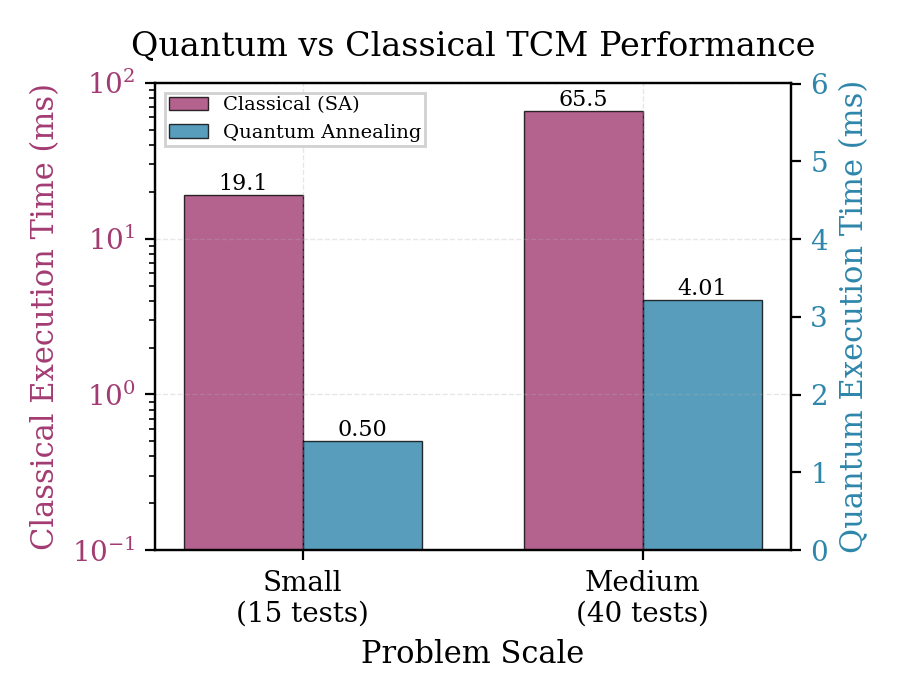
Figure 1: Quantum annealing exhibits marked speedup over simulated annealing for TCM QUBO optimization tasks.
Experimental Results
The framework was evaluated on two fronts: solver performance for test suite optimization and overall impact on code generation metrics. In direct comparison to simulated annealing, quantum annealing reduced QUBO solution times from $65.5$ ms to $4.008$ ms.
The paper further contrasts code generation outcomes between a baseline (comprehensive, unminimized test suite) and TDD-guided (minimized test suite) settings. Key results include:
- Token Efficiency: The TDD-guided approach reduced token consumption by 36.5%, offering quantifiable savings in API cost and runtime.
- Code Quality: Cyclomatic complexity, an established metric for maintainability, decreased by 26.1%, indicating more readable, modular code produced from the minimal suite.
- Generation Latency: Total code generation latency dropped by ti0, reflecting dramatic efficiency gains despite the additional optimization step.
These findings provide robust evidence that carefully curated minimal test suites, enabled by combinatorial optimization, not only economize LLM utilization but directly enhance resultant code structure and quality.
Practical and Theoretical Implications
The symbiosis between quantum optimization and generative AI establishes a new paradigm for automated software specification and code synthesis. Minimizing input artifacts via formal optimization reduces resource footprint and decreases the risk of over-constrained or ambiguous specifications, while preserving functional completeness.
Practically, the framework facilitates scalable integration of LLMs in high-throughput development pipelines, with real-time feedback and cost control. The quantum advantage positions such workflows to fully exploit next-generation hardware acceleration.
Theoretically, the QUBO encoding bridges the gap between generative modeling and rigorous combinatorial coverage, suggesting fertile grounds for further exploration, such as multi-objective suite minimization, adaptive penalty scaling, and hybrid quantum-classical solution strategies.
Future Directions
Potential avenues for future research include broader benchmarking on industrial-scale codebases, the investigation of alternative quantum algorithms (e.g., QAOA), and refinements to LLM prompting for explicit interpretability in generated test cases. Further, exploration of non-quadratic formulations may enable richer optimization in non-binary feature spaces and support advanced forms of code synthesis beyond TDD paradigms.
Conclusion
This paper demonstrates the efficacy of a quantum-guided framework for test case minimization in LLM-assisted code generation. The QUBO-based formulation harnesses quantum annealing for rapid optimization, delivering substantial improvements in computational resource consumption, code clarity, and generation efficiency. These results validate the convergence of generative AI and quantum computing in modern software engineering, opening new prospects for highly efficient, automated development methodologies.