- The paper introduces the V-PoP auction mechanism that hybridizes VCG and posted pricing using side information to counteract collusive bid shading.
- It rigorously analyzes collusive strategies in VCG auctions, showing that bid shading reduces auctioneer surplus while preserving bidder welfare.
- Empirical results demonstrate that V-PoP significantly improves revenue and welfare, approaching ideal VCG outcomes as non-colluder participation increases.
Introduction
This paper addresses the vulnerability of classical multi-unit auction mechanisms—specifically Vickrey-Clarke-Groves (VCG)—to collusive manipulation by subsets of bidders. While VCG is efficient and dominant-strategy truthful in non-collusive environments, coordinated bid shading among bidders can dramatically reduce the auctioneer’s revenue and, in some scenarios, social welfare. Prior impossibility results demonstrate that fully collusion-proof and truthful mechanisms must resort to posted-price auctions, which provide very weak efficiency guarantees. The authors propose a new paradigm: assuming access to a collusion detection signal (side information), they design a hybrid mechanism that interpolates between VCG and posted pricing and achieves strong theoretical and empirical performance guarantees.
Collusion under VCG: Strategic Analysis
The paper rigorously analyzes the strategic behavior of colluding agents in standard VCG multi-unit auctions. The central findings can be summarized as:
- Strategic Bid Shading: Colluding agents do not engage in bid loading (overbidding or attempting to win more items than in a truthful equilibrium) since increased allocations would raise prices and decrease total collusive payoff due to the linearity of utility. Instead, they shade bids (bid below value or report zero) to reduce equilibrium prices.
- Distributional Impact: Bid shading by colluders cannot harm the utility of non-colluding agents; it exclusively transfers surplus from the auctioneer to winners, maintaining or increasing welfare for all bidders.
- Bulow-Klemperer-Type Result: Formally, adding colluding agents to the bidder pool increases (or does not decrease) both welfare and revenue as compared to running VCG only among non-colluders, paralleling classical “more competition helps” theorems but with collusive agents.
VCG-Posted Price (V-PoP) Mechanism: Design and Guarantees
The authors introduce the VCG-Posted Price (V-PoP) auction, which partitions the bidders into those flagged as colluding (by a side information black-box) and non-colluders. VCG is run among non-colluders, allocating k∗ items, and the remaining items are sold to qualifying colluders at a posted price derived from the marginal VCG price among non-colluders. The mechanism is optimized with respect to the expected welfare (or a proxy thereof when valuation distributions are partially known).
- Truthfulness: V-PoP is proven ex-post dominant-strategy incentive compatible for both colluders and non-colluders, as posted pricing remains the only collusion-proof mechanism under side payments.
- Welfare/Revenue Guarantee: The expected welfare and revenue of V-PoP always weakly exceeds that of VCG among non-colluders only, and under regularity conditions asymptotically approaches the ideal truthful VCG outcome as the number of non-colluding bidders increases.
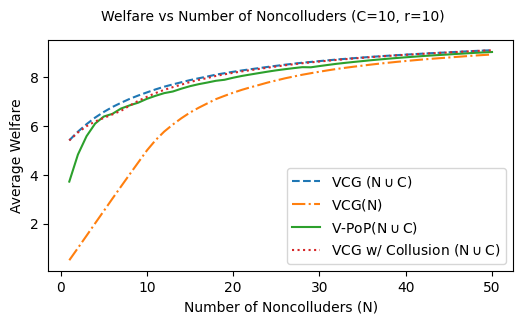
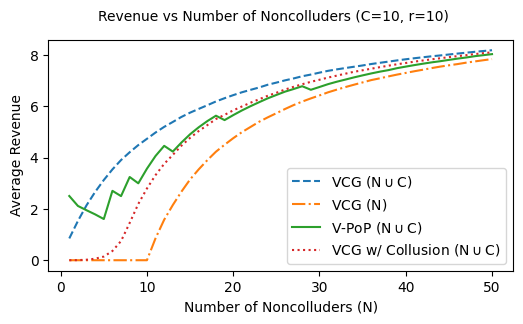
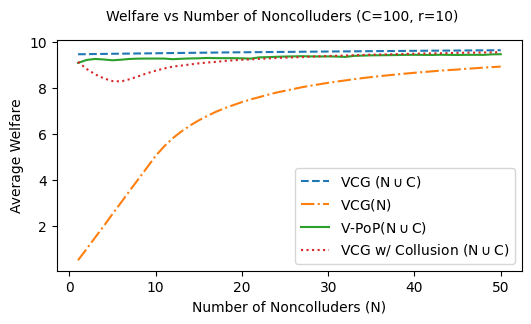
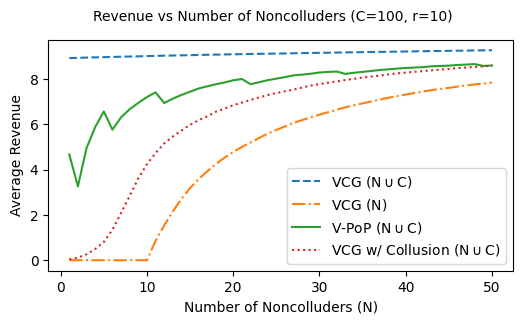
Figure 1: Representative numerical experiment showing that V-PoP outperforms non-colluder-only VCG and closely tracks ideal VCG outcomes as the non-colluder base increases.
Theoretical Implications
The main theoretical contributions are:
- Optimal Collusion Response Characterization: Sharp characterization of collusion strategies under VCG shows no incentive for overbidding or excessive item grabbing, establishing bid-shading as the optimal collusive strategy.
- Hybrid Mechanism Design with Side Information: By leveraging imperfect but actionable side information, the restriction to inefficient posted-price-only mechanisms is broken, connecting recent themes in learning-augmented mechanism design with robust auction theory.
- Distributional Minorant Analysis: The welfare optimization procedure can accommodate cases where the value distribution is only partially known, by leveraging minorant bounds constructed from properties of quantile functions (e.g., linear lower bounds on quantiles).
Empirical Results
Extensive simulations over a range of valuation distributions (uniform, trapezoidal, quadratic, sinusoidal) consistently demonstrate:
- V-PoP Strictly Outperforms VCG Limited to Non-Colluders: In all regimes, welfare and revenue are higher in V-PoP, with performance tightly bracketing that of ideal VCG with all-truthful participation.
- Colluder Pool Size Impact: When the flagged colluder set is large, the probability that all posted-price items are sold increases, strengthening V-PoP’s performance.
- Asymptotic Behavior: As the number of non-colluders increases, the gap to the fully truthful VCG outcome vanishes.
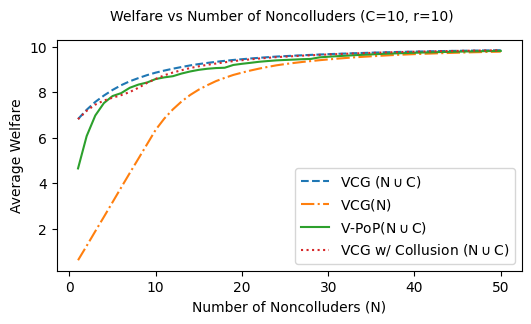
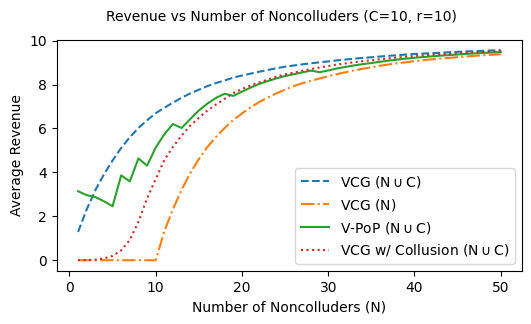
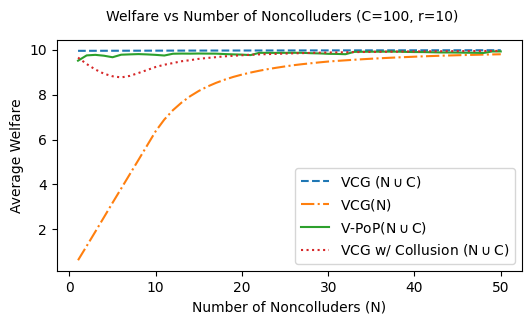
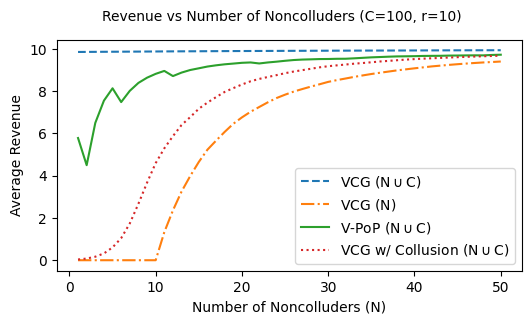
Figure 2: Simulated welfare curves as a function of the proportion of non-colluding bidders, with the V-PoP mechanism matching ideal VCG for large markets.
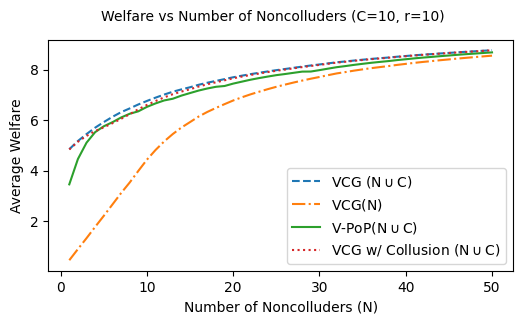
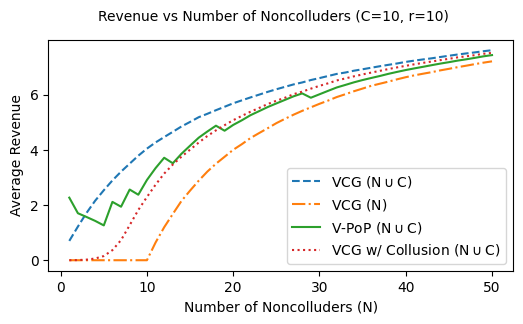
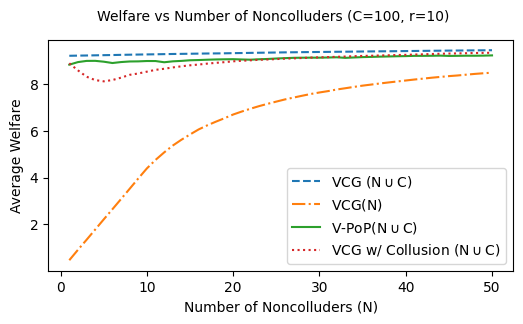
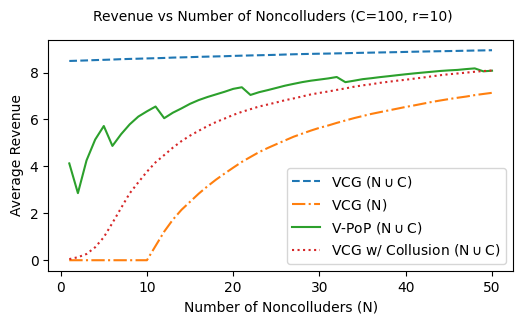
Figure 3: Revenue curves display the same pattern; V-PoP leverages side information to recover auctioneer surplus lost to collusion in standard VCG.
Practical Implications and Future Directions
The V-PoP framework suggests a paradigm shift in practical auction design for procurement, spectrum, and other high-stakes multi-unit settings:
- Actionable Side Information: Even noisy or heuristically derived collusion detection can be formally integrated into the mechanism with provable guarantee improvements over classical posted pricing or VCG-only.
- Layered Security in Mechanism Design: Instead of requiring legal-level proof of collusion, statistical side signals suffice to incentivize better auctions, offering practical credence to learning-augmented approaches.
- Extensions: Key theoretical challenges remain, including generalizing to heterogeneous/multi-dimensional items and relaxing the error-free collusion detection assumption.
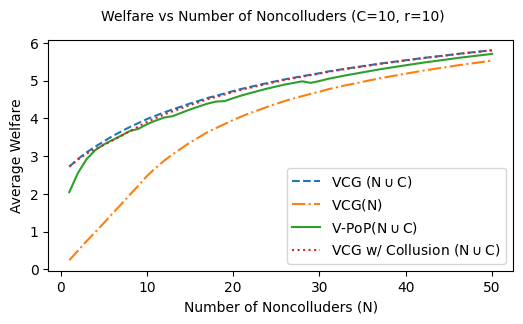
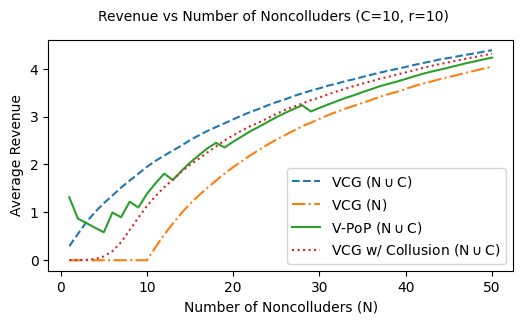
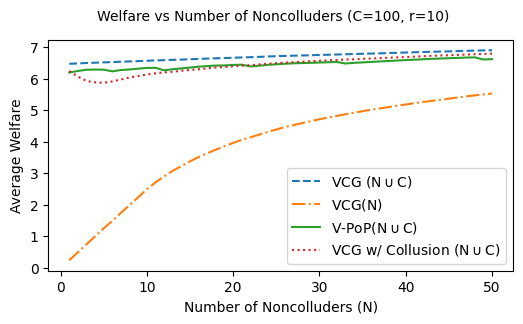
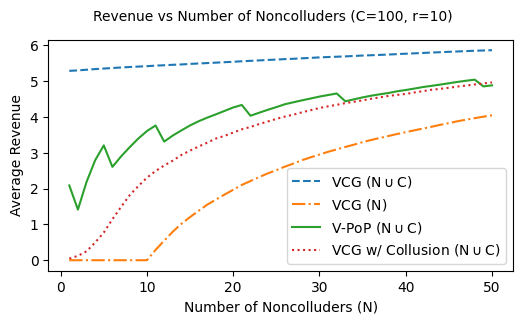
Figure 4: V-PoP performance remains robust across a variety of value distributions, confirming broadly applicable guarantees.
Conclusion
This research provides rigorous theoretical and empirical evidence that incorporating side information about collusion into auction mechanism design enables strong incentive and efficiency guarantees, unattainable by prior collusion-resistant mechanisms. By carefully partitioning allocation and pricing strategies contingent on flagged collusion, the V-PoP mechanism offers a principled, implementable solution that closes the gap to optimal truthfulness and welfare in collusion-prone environments. The approach opens an avenue for further synthesis between algorithmic mechanism design, collusion detection, and robust auction formats.
Reference: "Collusion-proof Auction Design using Side Information" (2511.12456)