- The paper introduces two principal frameworks—POD-based compression and DMD-based spectral analysis via Koopman operator approximation—to extract network eigenmodes.
- It demonstrates that leading eigenmodes capture significant variance, enabling high-fidelity reconstruction and revealing latent dynamics in both synthetic and real-world networks.
- The study extends concepts from fluid mechanics and dynamical systems to temporal networks, offering new avenues for forecasting, control, and cross-disciplinary research.
Eigendecompositions of Temporal Networks: Theory, Algorithms, and Applications
Introduction
This paper introduces two mathematically principled eigendecomposition frameworks for temporal networks (TNs): (1) a proper orthogonal decomposition (POD)-based approach for optimal low-rank compression and reconstruction, and (2) a dynamic mode decomposition (DMD)-based method for spectral characterization of latent graph dynamics via a numerical approximation of the Koopman operator. Both approaches leverage concepts from fluid mechanics and dynamical systems theory, extending them to the analysis of time-ordered sequences of adjacency matrices. The paper provides rigorous theoretical foundations, efficient computational strategies, and empirical validation on synthetic and real-world temporal network models.
Mathematical Frameworks for Temporal Network Decomposition
Proper Orthogonal Decomposition (POD) of Temporal Networks
Temporal networks are represented as ordered sequences of m adjacency matrices A(t)∈Rn×n, which are flattened and mean-centered to form vectors a(t)∈Rn2. Stacking these vectors yields the data matrix S∈Rn2×m. The covariance matrix SS⊤ is then eigendecomposed to obtain orthogonal network eigenmodes {ϕj}, ordered by their associated eigenvalues {λj}, which quantify the variance (energy) captured by each mode.
Each network snapshot can be optimally projected onto the subspace spanned by the leading r eigenmodes:
a(t)≈∑j=1rαj(t)ϕj
where αj(t) are the projection coefficients. This yields a compressed, low-dimensional representation of the TN, with reconstruction error controlled by the sum of discarded eigenvalues. The approach is equivalent to PCA and SVD-based dimensionality reduction, but is tailored to the structure of temporal networks.
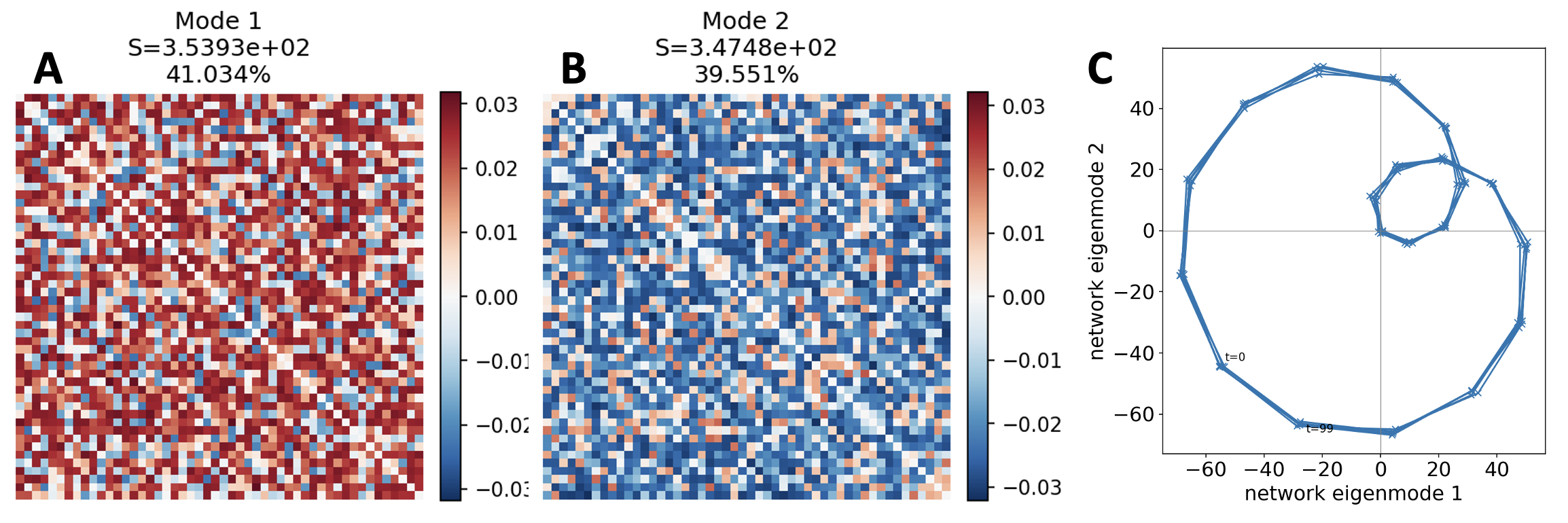
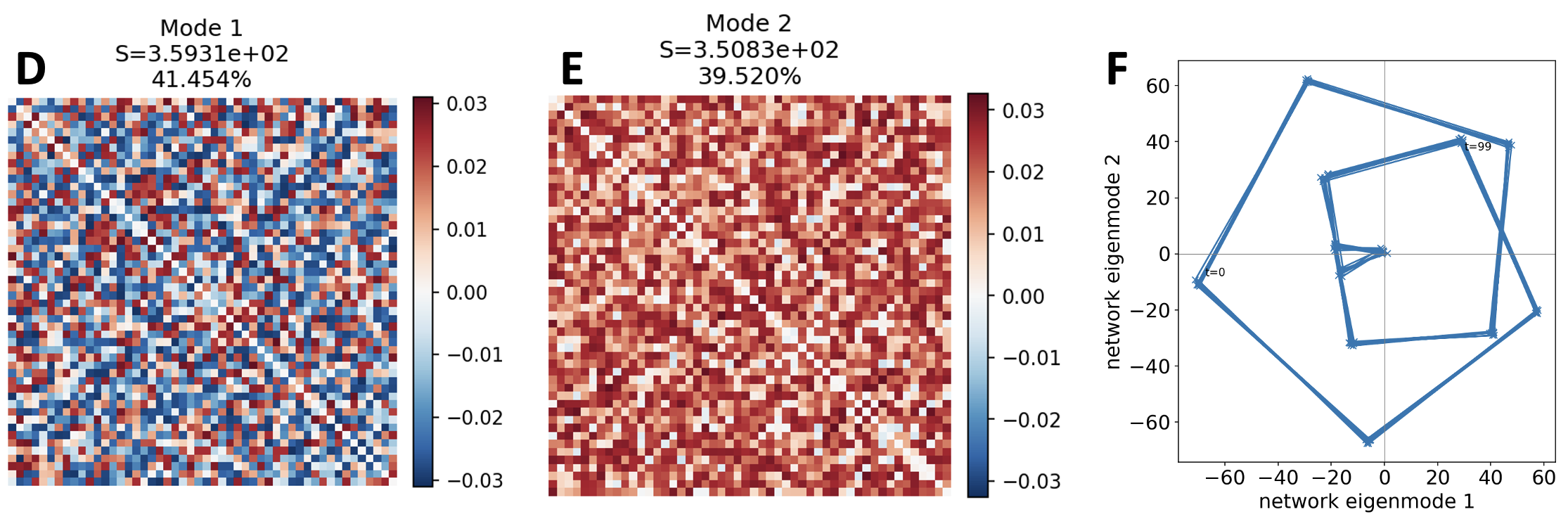
Figure 1: The first two network eigenmodes for a TN with asynchronous, noisy sinusoidal link dynamics; these modes capture 80% of the variance.
Dynamic Mode Decomposition (DMD) and Koopman Operator Approximation
The second framework approximates the latent graph dynamics by fitting a linear operator A(t)∈Rn×n0 such that A(t)∈Rn×n1. This is achieved via least-squares minimization:
A(t)∈Rn×n2
where A(t)∈Rn×n3 and A(t)∈Rn×n4 are overlapping matrices of consecutive TN snapshots. The eigendecomposition of A(t)∈Rn×n5 yields dynamic modes and their temporal growth/decay rates, providing a spectral characterization of the TN's intrinsic dynamics.
To avoid direct computation of the large, often ill-conditioned A(t)∈Rn×n6, the method leverages SVD to project the dynamics onto the leading network eigenmodes, diagonalizing a reduced operator A(t)∈Rn×n7 in A(t)∈Rn×n8. The eigenvalues of A(t)∈Rn×n9 correspond to those of a(t)∈Rn20, and the dynamic modes are reconstructed via:
a(t)∈Rn21
where a(t)∈Rn22, a(t)∈Rn23, and a(t)∈Rn24 are derived from the SVD and eigendecomposition steps.
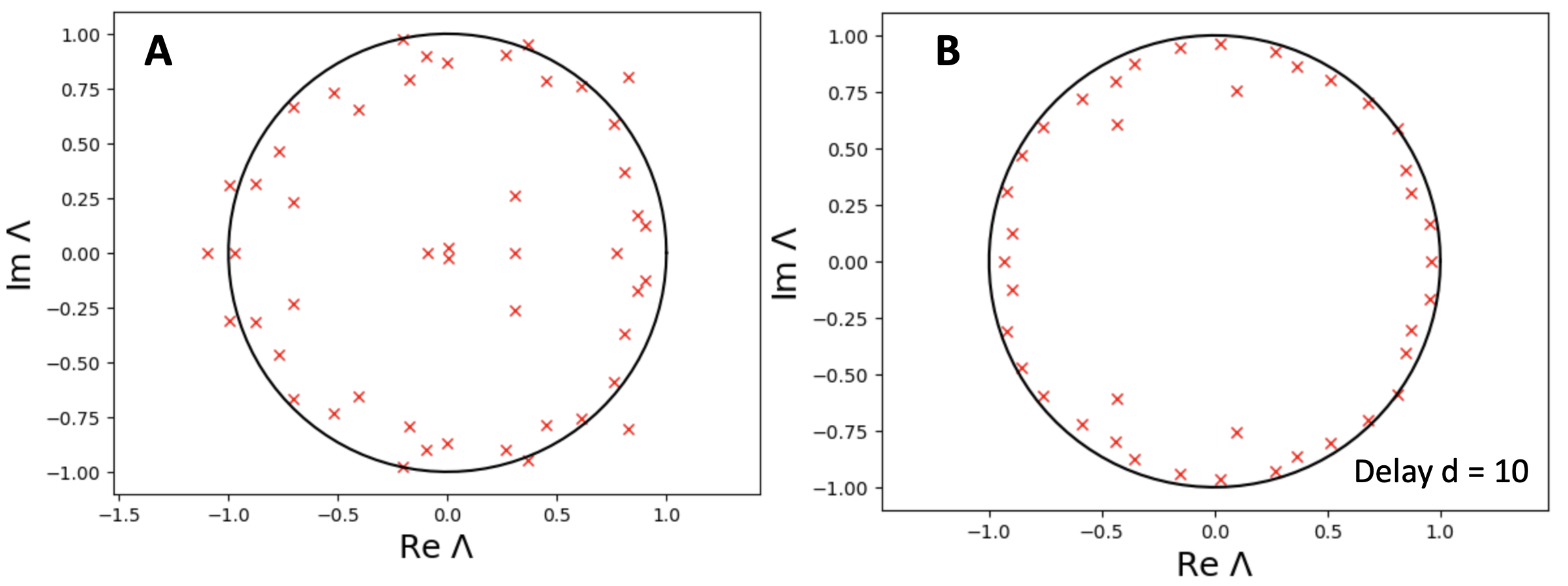
Figure 2: Spectrum of a(t)∈Rn25 for a noisy sinusoidal TN, illustrating spurious unstable modes that disappear after delay embedding.
Empirical Validation and Applications
Compression and Reconstruction of Synthetic Temporal Networks
The POD-based eigendecomposition is validated on a suite of synthetic TN models, including white noise, periodic, autoregressive (DARN(a(t)∈Rn26)), and chaotic dynamics. For all models except white noise, the first few eigenmodes capture a substantial fraction of the variance, enabling high-fidelity compression and reconstruction.
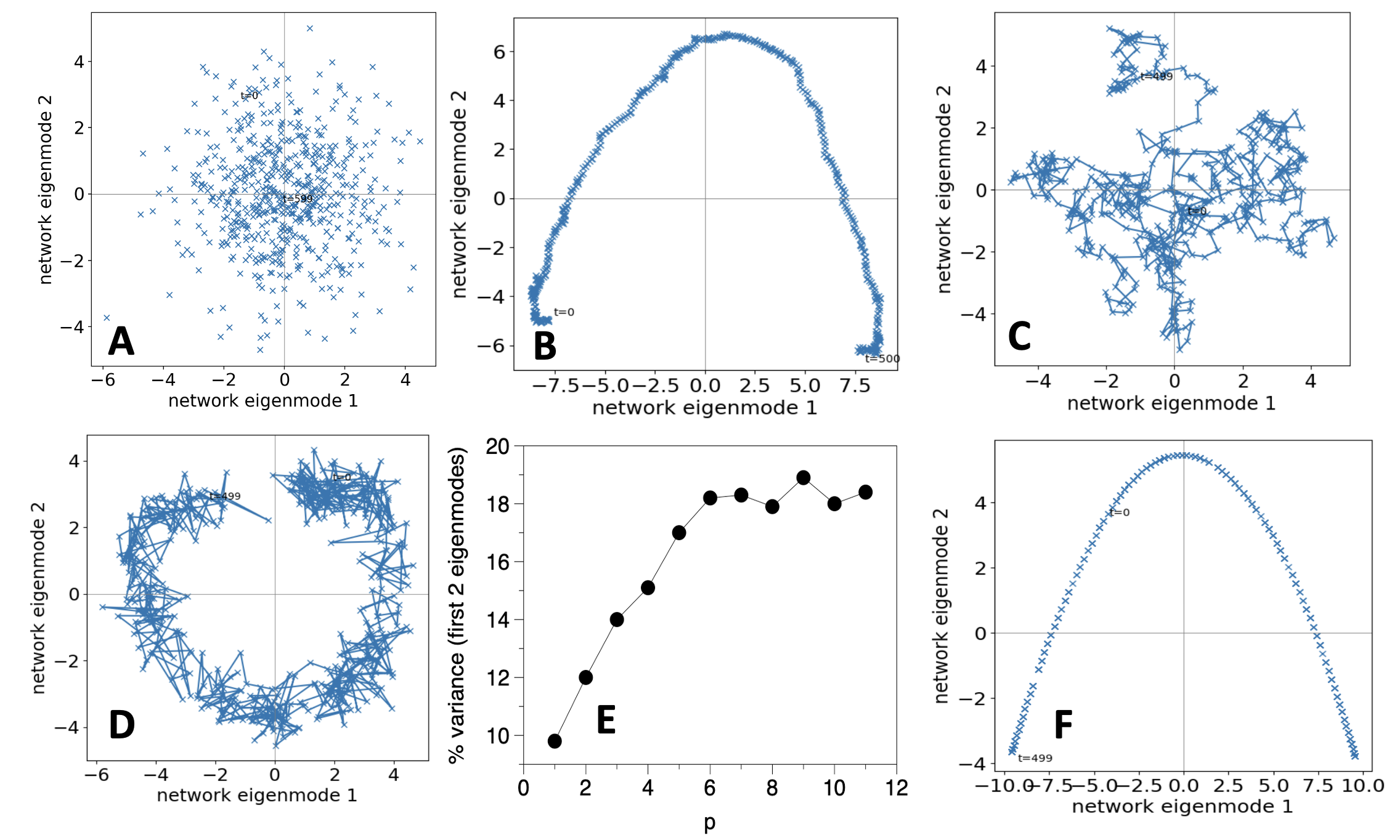
Figure 3: Projection of various TN models into the space of the first two network eigenmodes, showing distinct orbit structures and variance capture.
For periodic TNs constructed by concatenating blocks of Erdos-Renyi graphs, the first a(t)∈Rn27 eigenmodes (where a(t)∈Rn28 is the period) capture nearly all variance, and the projected trajectory forms a periodic orbit. In TNs with asynchronous, multi-period link dynamics, the projected orbit is quasi-periodic, with period equal to the least common multiple of the intrinsic periods.
Analysis of Cellular Automata as Temporal Networks
Conway's Game of Life is interpreted as a TN, with each state represented as an adjacency matrix. The projection onto the leading eigenmodes reveals a trajectory similar to a random walk with memory, consistent with the unpredictable but non-random nature of the automaton.
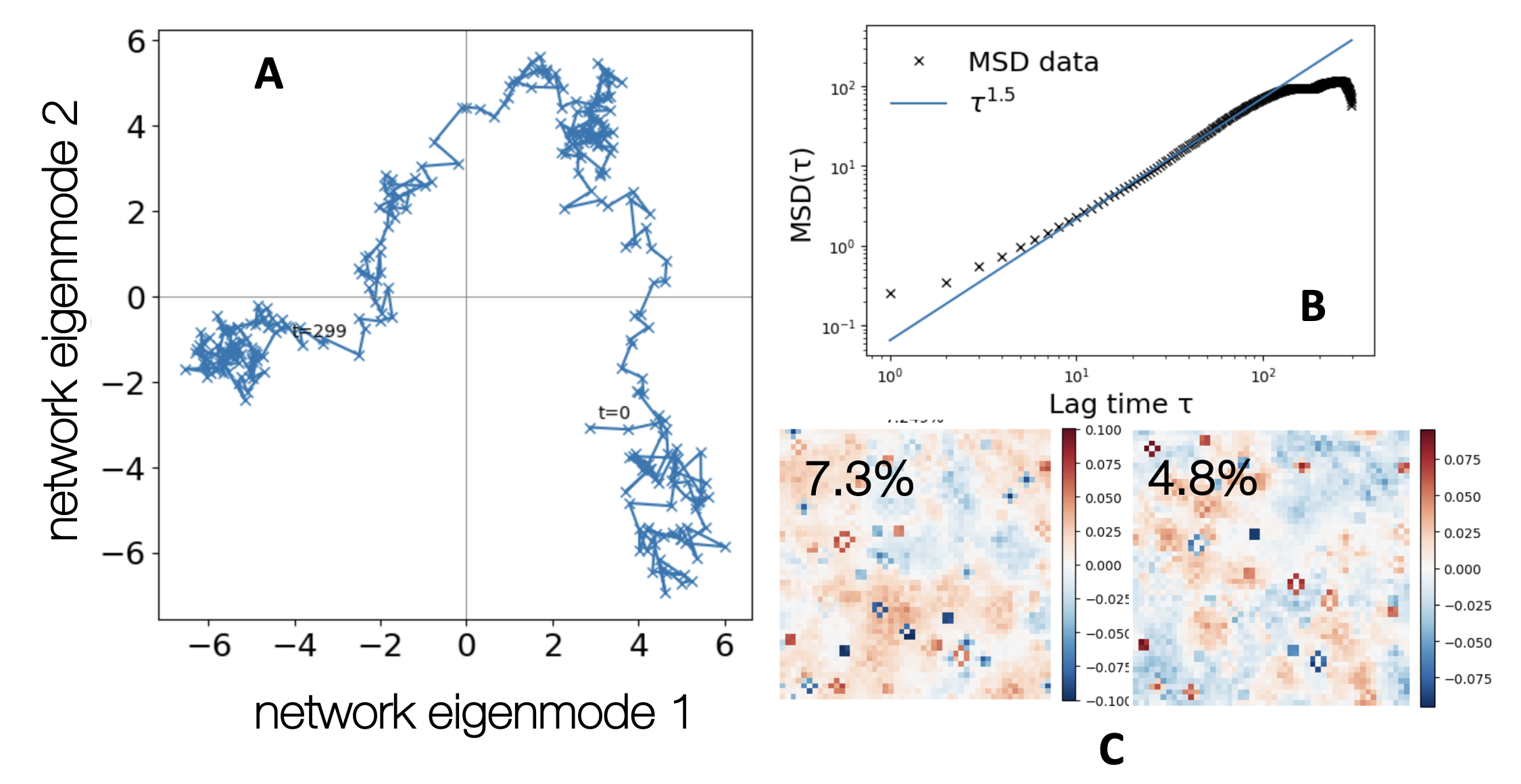
Figure 4: Evolution of Conway's Game of Life in the space of the first two network eigenmodes, exhibiting superdiffusive behavior.
Koopman Operator Approximation and Spectral Analysis
The DMD-based approach is tested on TNs generated by permutation dynamics and noisy periodic processes. For permutation matrices, the approximation to the Koopman operator is exact, with the leading eigenvalues matching those of the permutation matrix and yielding periodic orbits in eigenmode space.
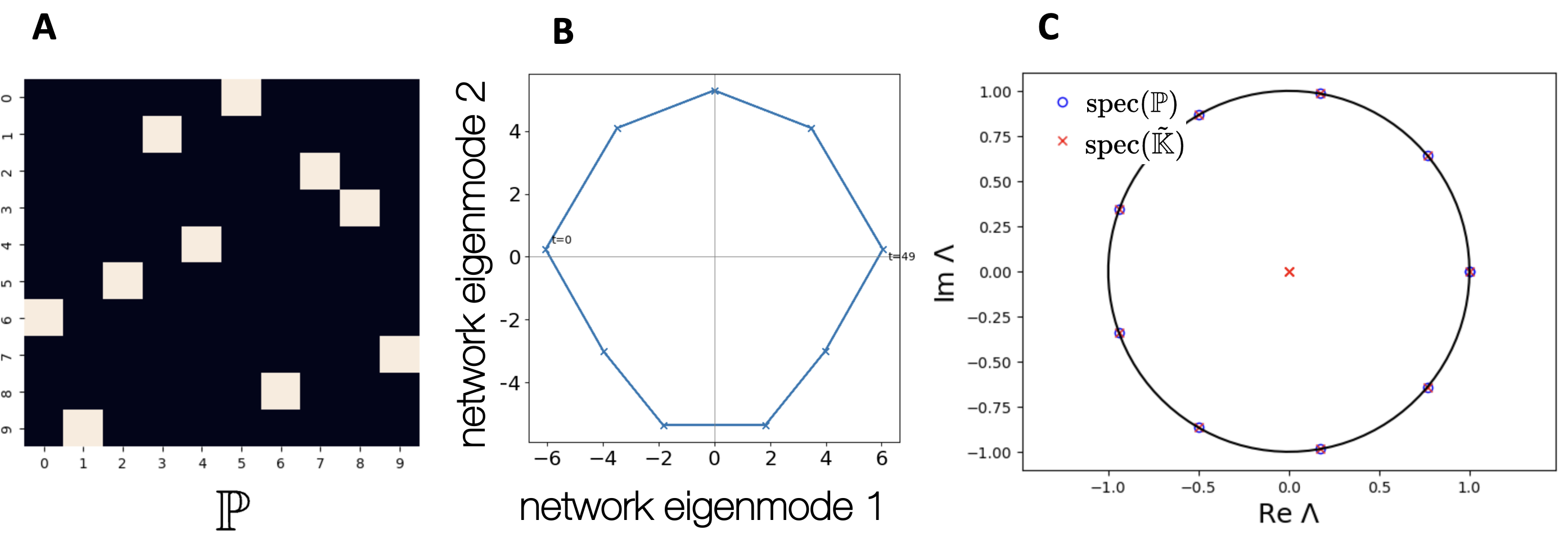
Figure 5: (A) Permutation matrix; (B) TN trajectory under permutation dynamics; (C) Spectrum comparison between a(t)∈Rn29 and the permutation matrix.
For TNs with fluctuating matrix norms, the basic Koopman approximation yields spurious unstable modes. These are eliminated by constructing a time-delay embedding of the TN trajectory, in accordance with Takens' theorem, resulting in a more accurate spectral characterization.
Implementation Considerations
- Computational Efficiency: For large S∈Rn2×m0, it is preferable to compute the eigendecomposition of the S∈Rn2×m1 covariance matrix S∈Rn2×m2, exploiting the equivalence of non-null eigenvalues and the relationship between eigenvectors.
- Node Labeling: The methods assume consistent node labeling across snapshots; relabeling can obscure patterns and reduce interpretability. Extensions to unlabeled networks are needed for broader applicability.
- Choice of Observable: The Koopman approximation is most effective when the latent dynamics are close to linear and the number of links is approximately conserved. For highly nonlinear or norm-fluctuating TNs, delay embedding or alternative observables are required.
- Compression Quality: The fraction of variance captured by the leading eigenmodes provides a quantitative measure of compressibility and reconstruction fidelity.
Implications and Future Directions
The proposed eigendecomposition frameworks enable principled, data-driven compression, embedding, and spectral analysis of temporal networks. These methods facilitate the study of intrinsic TN dynamics, forecasting, and control, with potential applications in social, biological, and engineered systems. The extension of fluid mechanics and dynamical systems concepts to network science opens avenues for cross-disciplinary research, including the development of control-theoretic interventions for TN stability and the characterization of unlabeled or heterogeneous networks.
Further research should address the limitations related to node labeling, explore nonlinear observables for Koopman analysis, and validate the approaches on empirical TN datasets from diverse domains.
Conclusion
This work establishes a rigorous foundation for the eigendecomposition of temporal networks, providing efficient algorithms for low-rank compression and spectral characterization of latent dynamics. The empirical results demonstrate the utility of these methods across a range of synthetic and real-world TN models. The frameworks presented herein offer valuable tools for the analysis, modeling, and control of complex time-varying networks, with broad implications for network science and dynamical systems theory.

