- The paper introduces an optimization-freeze-reuse strategy using simulated annealing and Powell optimization to efficiently design a variational quantum ansatz for TSP.
- The paper achieves near-optimal solutions with perfect accuracy on 4-city instances and high probability for 5- and 6-city problems, despite scalability challenges at 7 cities.
- The paper demonstrates significant qubit efficiency by reducing requirements to O(n log n), making the approach suitable for NISQ device constraints.
Freeze and Conquer: Reusable Ansatz for Solving the Traveling Salesman Problem
The paper "Freeze and Conquer: Reusable Ansatz for Solving the Traveling Salesman Problem" introduces a novel approach to solving the Traveling Salesman Problem (TSP) using variational quantum algorithms (VQAs). This methodology leverages a reusable ansatz to efficiently tackle combinatorial optimization issues with quantum computing.
Ansatz Optimization and Reusability
The cornerstone of this research is the optimization-freezing-reuse strategy employed for the variational circuit, or ansatz. Initially, the best ansatz is discovered using a simulated annealing (SA) algorithm, specifically designed to navigate through the fertile landscape of quantum circuit topologies. This ansatz, once optimized on a training instance, is frozen and reused on novel instances with minor parameter adjustments.
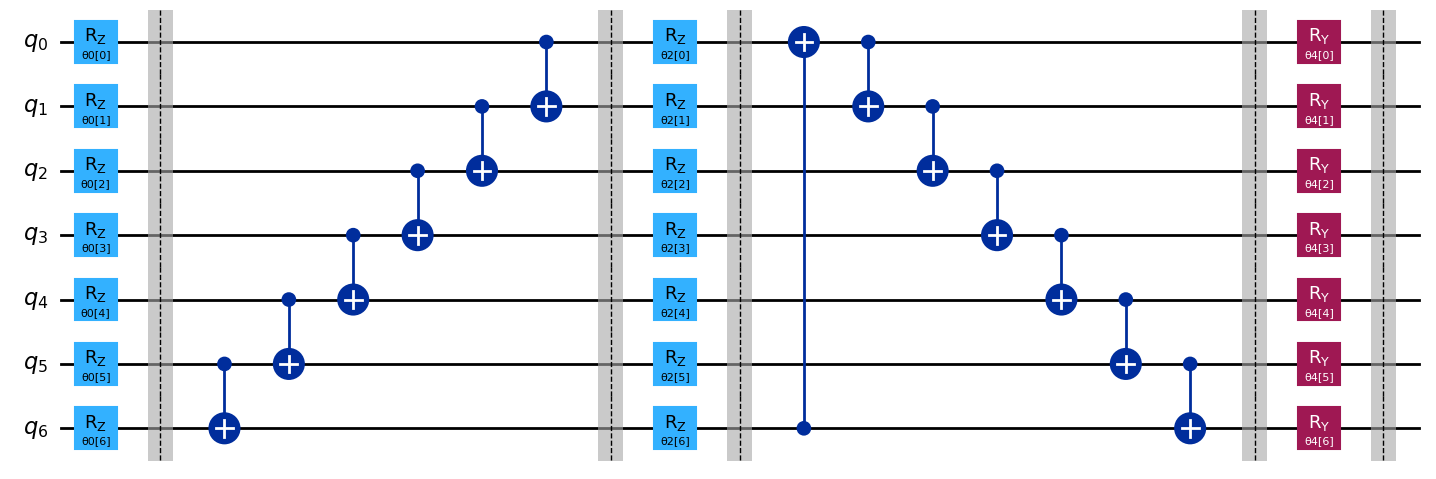
Figure 1: Quantum Circuit associated to example in (\ref{eq:ansatzexample}).
The ansatz optimization uses compact permutation encodings, significantly reducing the qubit requirement to O(nlogn). The optimization process iteratively refines the ansatz for a given TSP instance, utilizing the Powell optimization method due to its effectiveness in non-gradient landscapes. The final output is a shallow quantum circuit capable of delivering near-optimal solutions with reduced circuit depth, which is advantageous given the constraints of NISQ devices.
The proposed algorithm demonstrates strong performances for small TSP instances, achieving perfect accuracy when addressing 4-city problems and a high probability of optimal tour retrieval for 5-city and 6-city instances. Specifically, the sampling probability for 5-city problems showed a high consistency, while a moderate but noticeable decline was detected for 6-city problems, highlighting potential scalability issues.
However, as the complexity increases to 7 cities, the sampling probability of finding the optimal solution decreased significantly, denoting the onset of scalability limitations concerning both the algorithm and the quantum hardware requirements. This restriction reveals the impairments posed by exponentially growing search spaces associated with larger city sets.
Implementation and Experimentation
The implementation was conducted using the Qiskit library, and the experiments were designed under controlled conditions using synthetic TSP instances. Here are some insights into the experimental setup and results:
- Qubit Efficiency: By using an efficient permutation encoding, the qubit count required for the experiments was substantially reduced, marking a clear advancement over traditional methods.
- Reused Ansatz Robustness: Experimental outcomes confirmed robust generalization capabilities for moderate TSP sizes. Tolerances for success probability thresholds illustrated the ansatz's adaptiveness in delivering near-optimal solutions across instances.
- Algorithmic Details: The optimization hinged on a two-phase process—training via SA and parameter adjustment—leading to an efficient reuse paradigm, thereby bypassing costly ansatz structure searches for each new instance.
Conclusion and Future Work
The paper emphasizes the utility of the optimize-freeze-reuse platform to accelerate solution times while ensuring high-quality results without extensive circuit reconfiguration. This methodological advancement is anticipated to bear fruit in broader contexts like Vehicle Routing and Job-Shop Scheduling, covering larger combinatorial optimization problems.
Future research directions include real-world implementation on quantum hardware with error mitigation strategies, evaluating alternative optimizer roles within the circuit training phases, and extending the paradigm to more complex problem scenarios.

