- The paper introduces a novel hierarchical register indexing approach that boosts flexible-grained paper search with a 22.6 point improvement in recall.
- It employs an LLM-based extraction and bottom-up aggregation process to construct detailed hierarchical index trees from scientific papers.
- The method adapts queries using a trained view recognizer with hierarchical rewards, achieving higher accuracy and lower latency than traditional systems.
PaperRegister: Hierarchical Register Indexing for Flexible-Grained Paper Search
Motivation and Problem Statement
Traditional academic paper search systems predominantly rely on abstract-based indexing, which is insufficient for supporting queries at varying levels of granularity, especially those requiring fine-grained details such as specific module configurations or methodological operations. As research queries become more nuanced, the inability of abstract-based systems to retrieve papers based on detailed aspects becomes a significant bottleneck. The PaperRegister framework addresses this limitation by introducing a hierarchical register indexing approach, enabling flexible-grained paper search that adapts to the specificity of user queries.
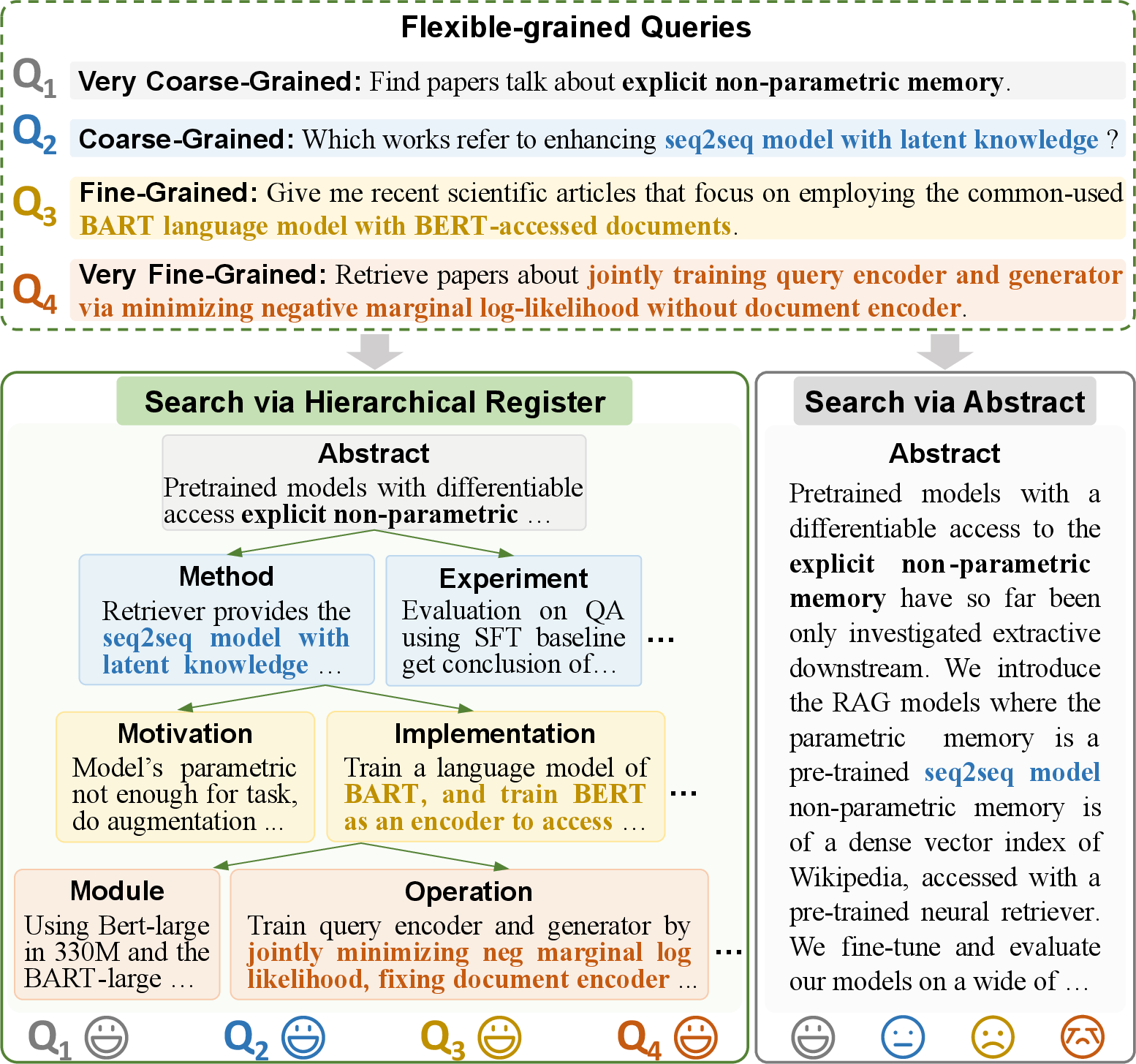
Figure 1: PaperRegister can support flexible-grained paper search through the hierarchical register, while traditional method fails due to abstract cannot contain required details.
System Architecture
PaperRegister consists of two main stages: offline hierarchical indexing and online adaptive retrieval. The core innovation lies in transforming the traditional flat, abstract-based index into a hierarchical index tree, constructed via fine-grained content extraction and bottom-up content aggregation, guided by a hierarchical register schema.
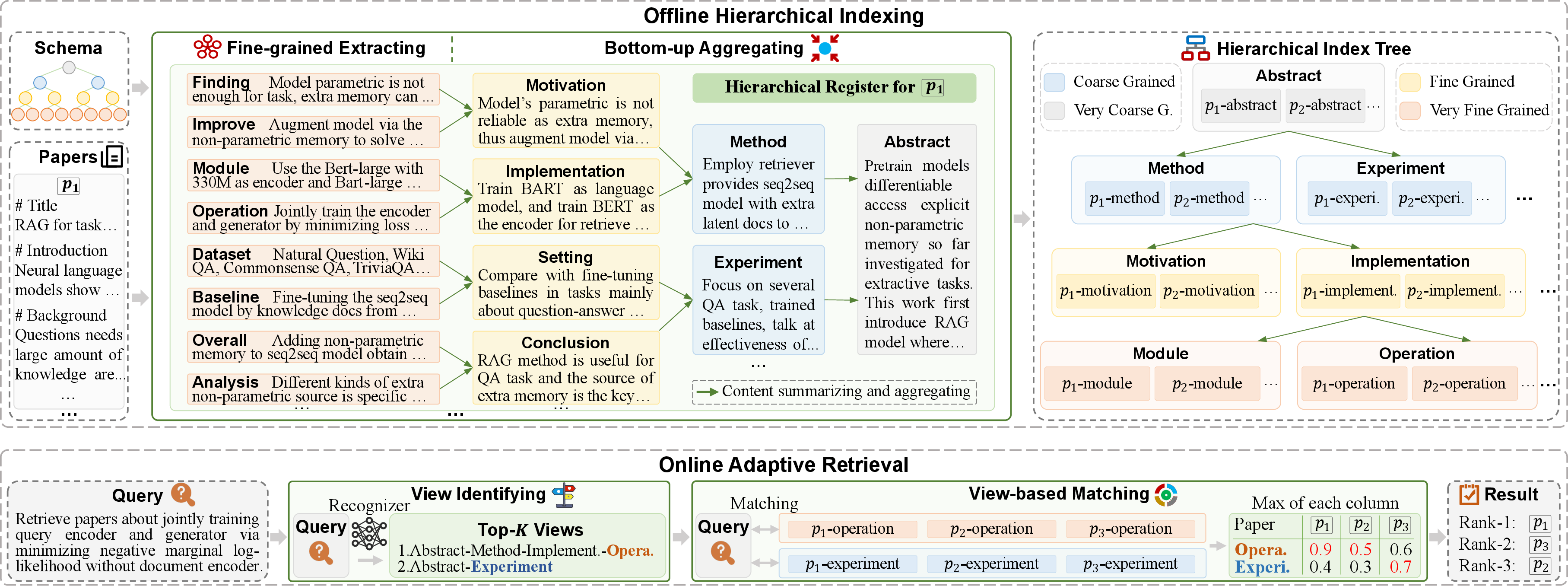
Figure 2: The overview of PaperRegister, including hierarchical indexing and adaptive retrieval. In offline stage, PaperRegister constructs hierarchical index tree via fine-grained content extracting and bottom-up content aggregating based on hierarchical register schema. In online stage, PaperRegister first identify the views of input query and then conduct view-based matching.
Hierarchical Register Schema
The hierarchical register schema is a multi-layered structure, where each node represents information at a specific granularity. Shallow nodes encode coarse-grained information (e.g., overall method), while deeper nodes capture fine-grained details (e.g., module configuration, training operation). Five distinct schemas are designed to accommodate different paper types: algorithm innovation, benchmark construction, mechanism exploration, survey, and theory proof.
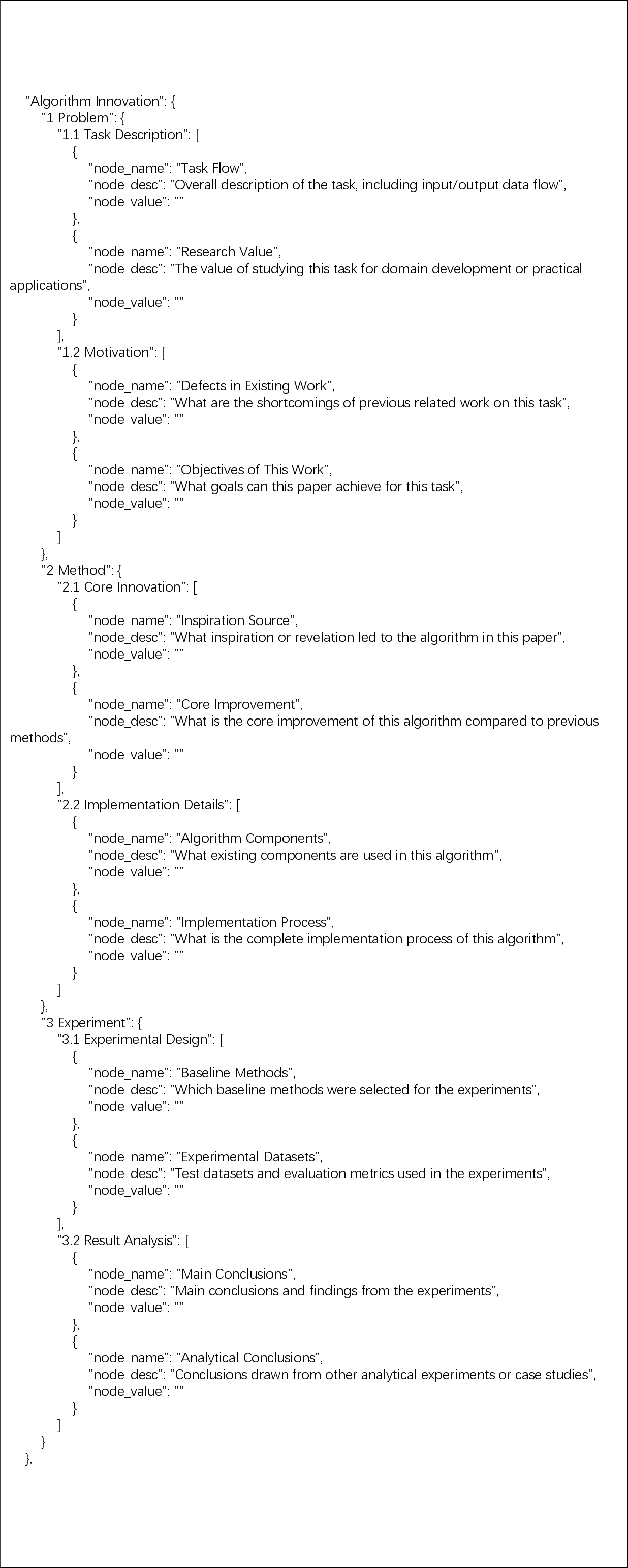
Figure 3: The first kind of hierarchical register schema.
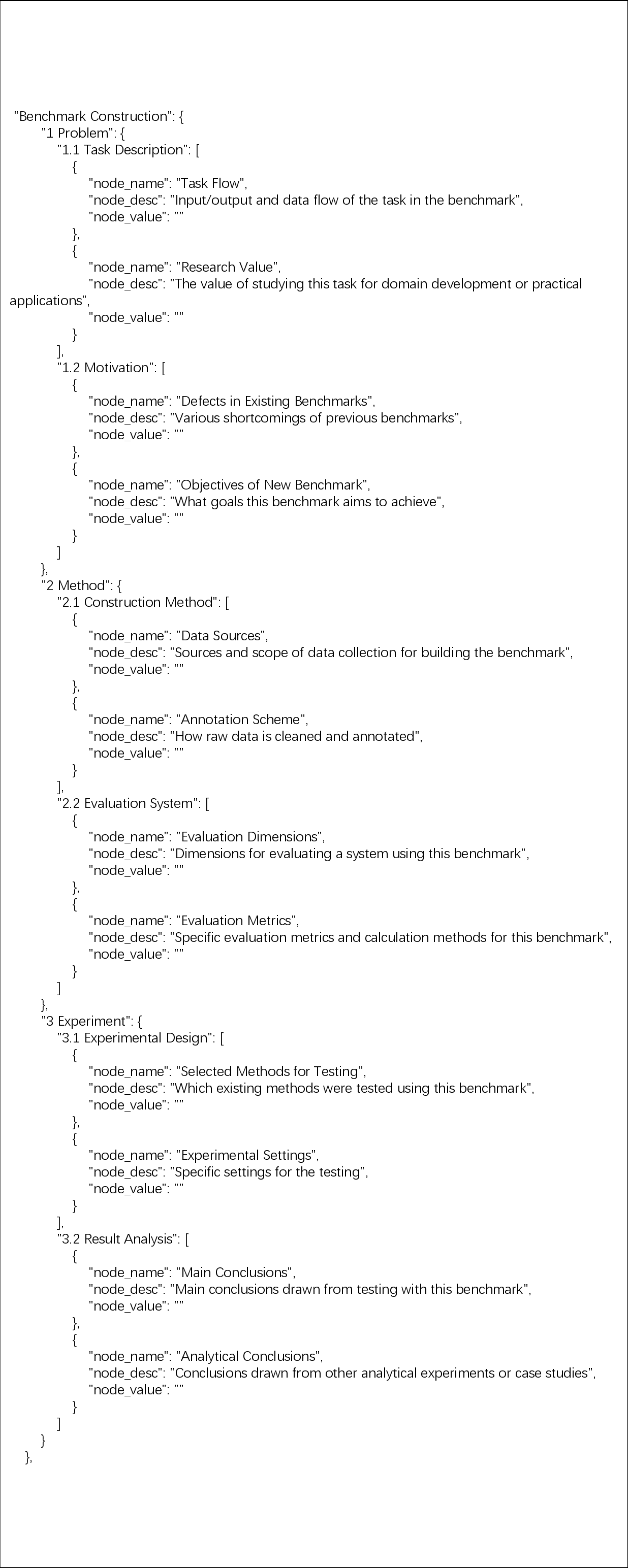
Figure 4: The second kind of hierarchical register schema.
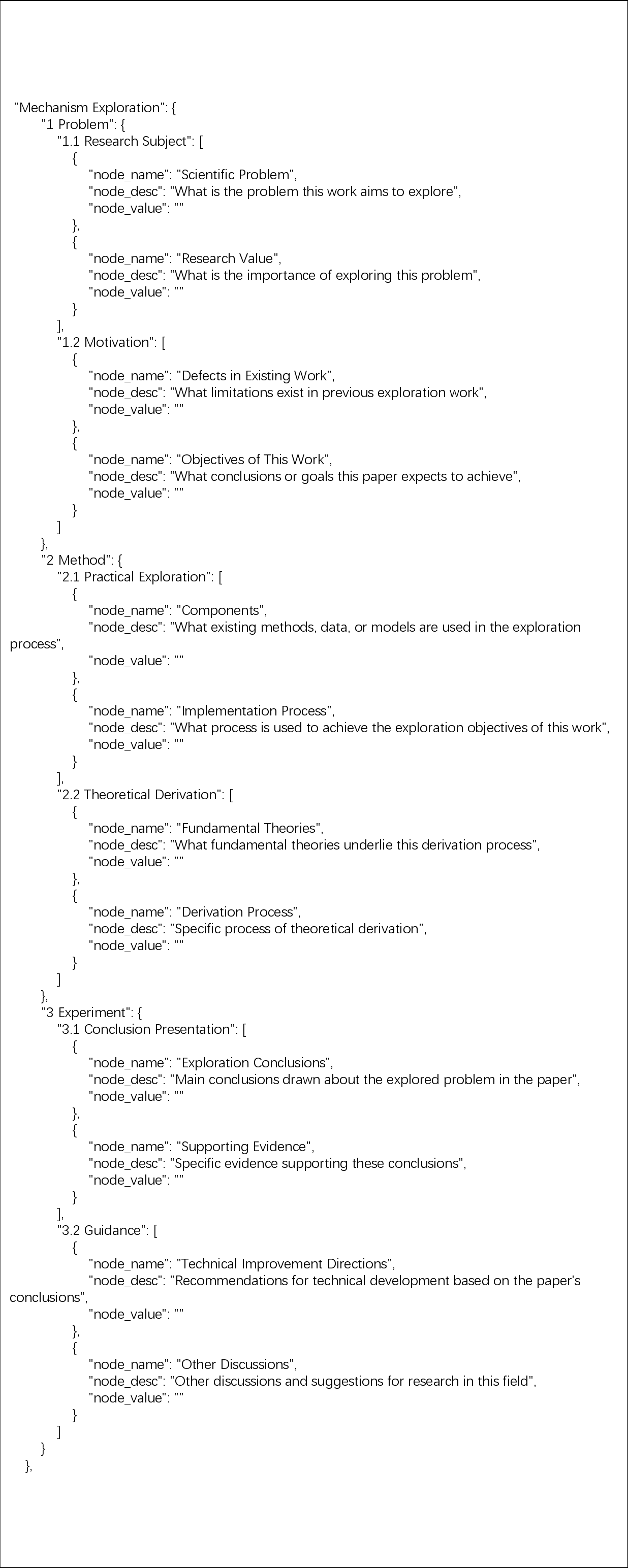
Figure 5: The third kind of hierarchical register schema.
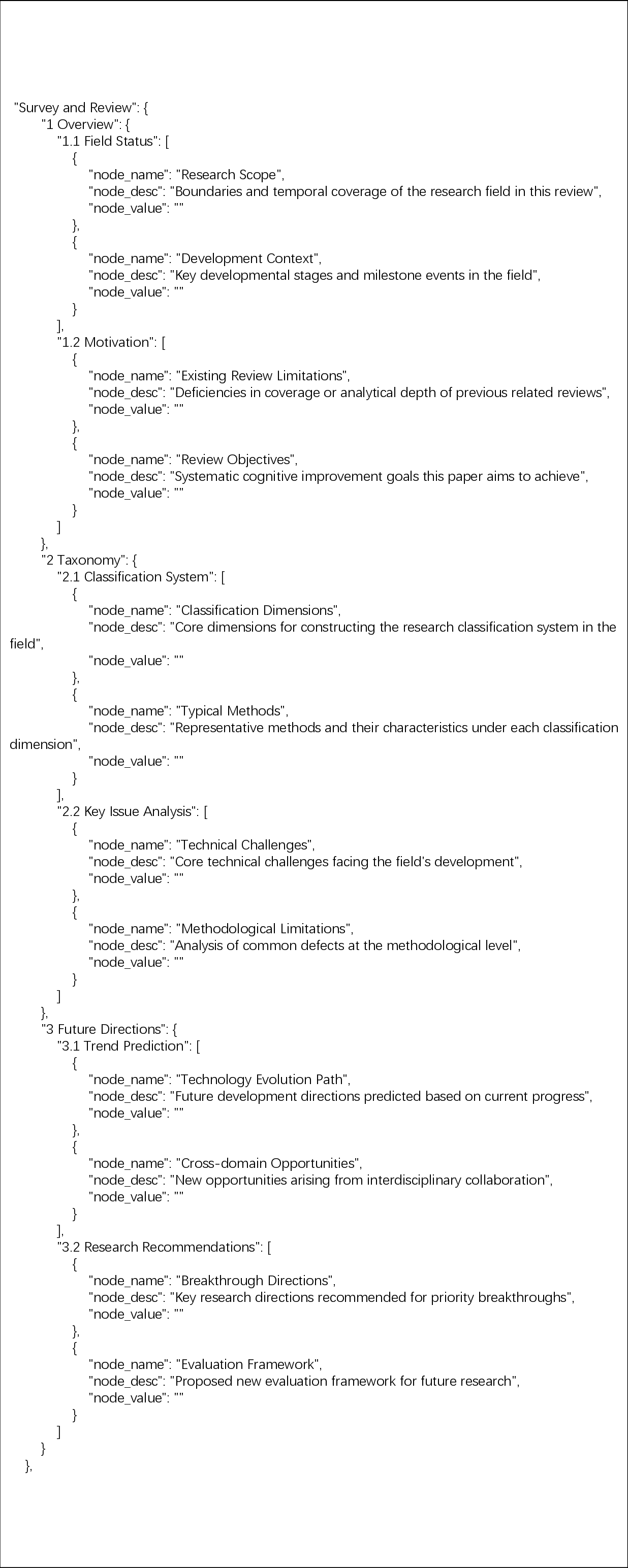
Figure 6: The fourth kind of hierarchical register schema.
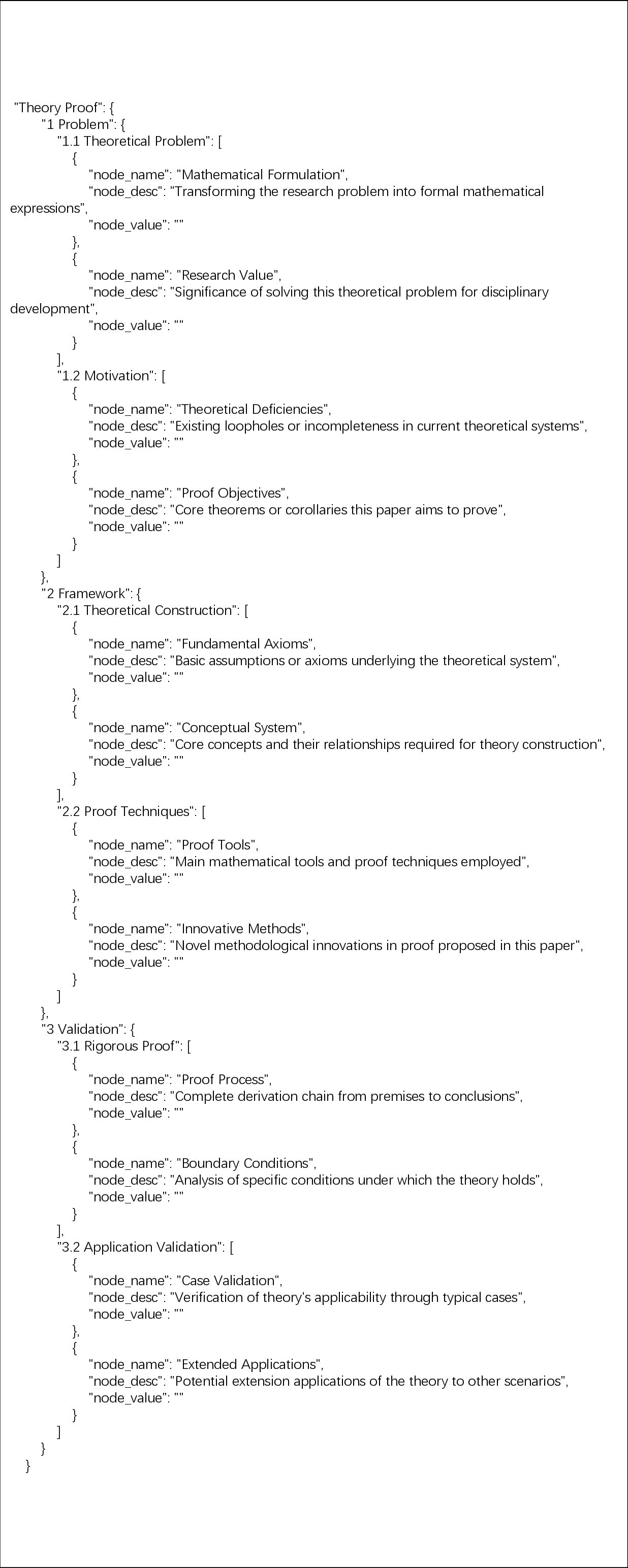
Figure 7: The fifth kind of hierarchical register schema.
Fine-Grained Content Extraction and Aggregation
For each paper, a LLM is used to extract content for each leaf node in the schema. The extraction is guided by node-specific prompts, and missing information is left blank. Subsequently, a bottom-up aggregation process uses the LLM to summarize and condense child node contents into their parent nodes, recursively building the hierarchical register for each paper.
Hierarchical Index Tree Construction
The hierarchical registers of all papers are merged to form a hierarchical index tree. Each node in the tree corresponds to a specific view (i.e., a path in the schema) and is indexed using standard retrieval modules (e.g., BM25, DPR).
Online Adaptive Retrieval
At query time, PaperRegister employs a view recognizer to identify the relevant views (node paths) in the hierarchical schema that match the user's query. The system then retrieves papers by matching the query against the corresponding indexes in the hierarchical index tree, enabling precise retrieval at the appropriate granularity.
View Recognizer: Training and Optimization
The view recognizer is a small-scale LLM (0.6B parameters) trained to map queries to schema views. The training pipeline consists of supervised fine-tuning (SFT) followed by group relative policy optimization (GRPO) with a hierarchical reward. The hierarchical reward is computed based on the path overlap between the predicted and gold views in the schema, ensuring that partial matches are appropriately rewarded according to their proximity in the hierarchy.
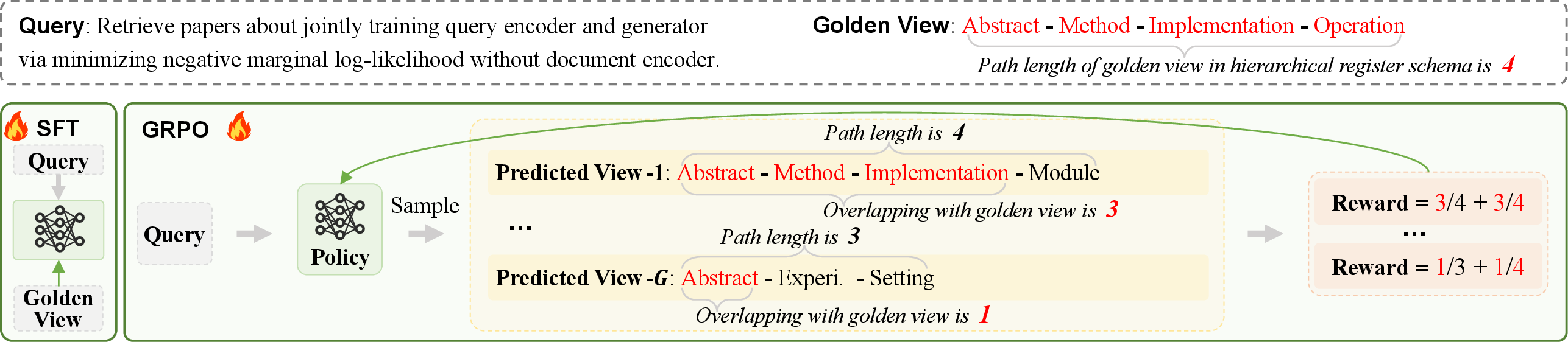
Figure 8: Illustration of view recognizer training, including SFT and GRPO via hierarchical reward, which is calculated based on the closeness level of predicted view and golden view in the hierarchical register schema.
Empirical results demonstrate that the accuracy and latency of the view recognizer are critical to overall system performance. The hierarchical-reward GRPO training yields a recognizer with both high accuracy and low latency, outperforming larger LLMs in both respects.
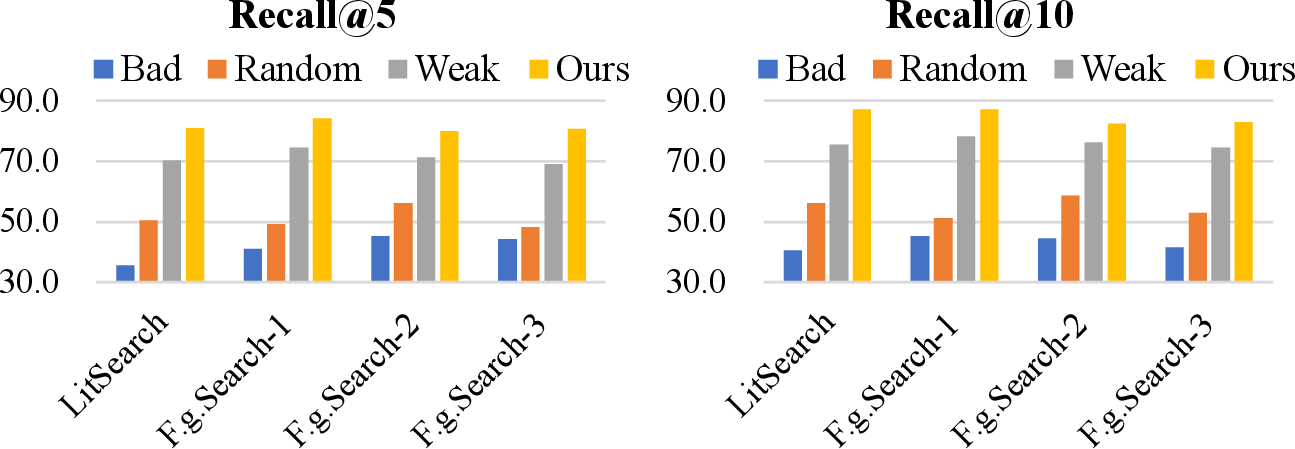
Figure 9: Paper search performance of the PaperRegister with different view recognizer. The figure shows strong recognizer is with obvious positive impact on overall system.
Experimental Results
PaperRegister is evaluated on both coarse-grained (LitSearch) and fine-grained (Flexible-grained Search) paper search tasks. Across all datasets and both BM25 and DPR retrieval backends, PaperRegister achieves state-of-the-art recall@5 and recall@10, with improvements becoming more pronounced as query granularity increases. For example, in the finest-grained setting (F.g.Search-3, DPR-based), PaperRegister achieves recall@5 of 80.8, compared to 58.2 for abstract-based indexing—a 22.6 point improvement.
Ablation studies confirm that the hierarchical index tree is essential: using only a single layer of the schema results in substantial performance degradation, and different layers are optimal for queries at different granularities.
Integration with Complex Frameworks and Efficiency
PaperRegister is compatible with more complex paper search frameworks such as PaSa, where it can be integrated as a retrieval module to further enhance overall system performance.
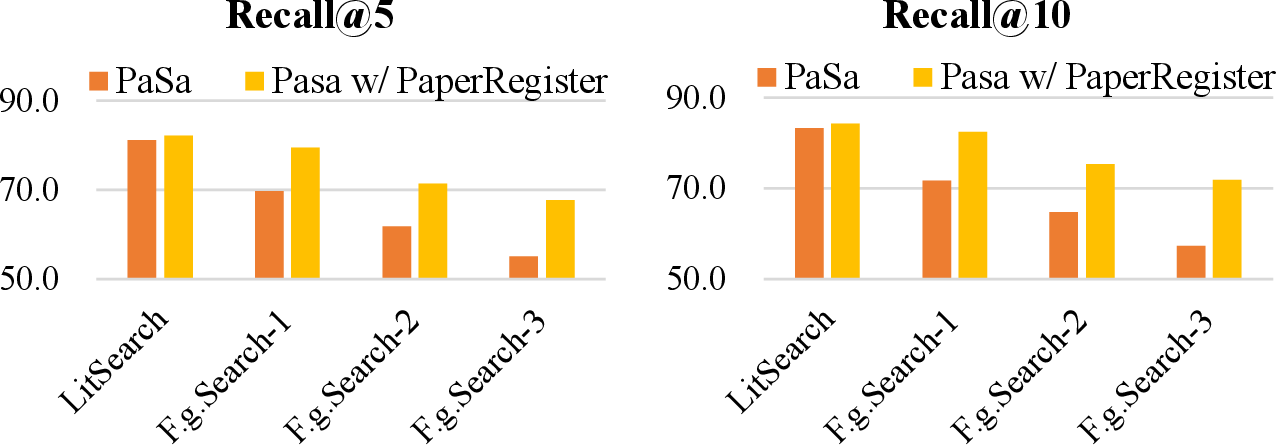
Figure 10: Performance of adding PaperRegister into the PaSa framework. The figure shows that PaperRegister can greatly cooperate with extra complex modules in PaSa framework.
In terms of online efficiency, PaperRegister demonstrates lower latency than all tested baselines, making it suitable for real-world deployment.
Theoretical and Practical Implications
The hierarchical register indexing paradigm introduced by PaperRegister provides a principled approach to bridging the gap between user query granularity and corpus representation. By leveraging LLMs for both extraction and aggregation, the system can flexibly adapt to diverse paper structures and information needs. The hierarchical reward in view recognizer training is a notable methodological contribution, enabling fine-grained control over model behavior in structured prediction tasks.
Practically, PaperRegister enables researchers to retrieve papers based on highly specific requirements, such as implementation details or experimental setups, which are not captured in abstracts. This has direct implications for literature review, meta-analysis, and reproducibility studies.
Future Directions
Potential future developments include scaling the system to larger corpora, automating schema adaptation for new domains, and extending the hierarchical indexing approach to other scientific document retrieval tasks. Further research may also explore joint optimization of extraction, aggregation, and retrieval components, as well as integration with agent-based or iterative search frameworks.
Conclusion
PaperRegister introduces a hierarchical register indexing framework that enables flexible-grained paper search, addressing the limitations of abstract-based systems. Through hierarchical content extraction, aggregation, and adaptive retrieval, it achieves superior performance, particularly for fine-grained queries. The approach is efficient, extensible, and compatible with complex retrieval pipelines, offering a robust foundation for next-generation academic search systems.

