Birational Invariants from Hodge Structures and Quantum Multiplication
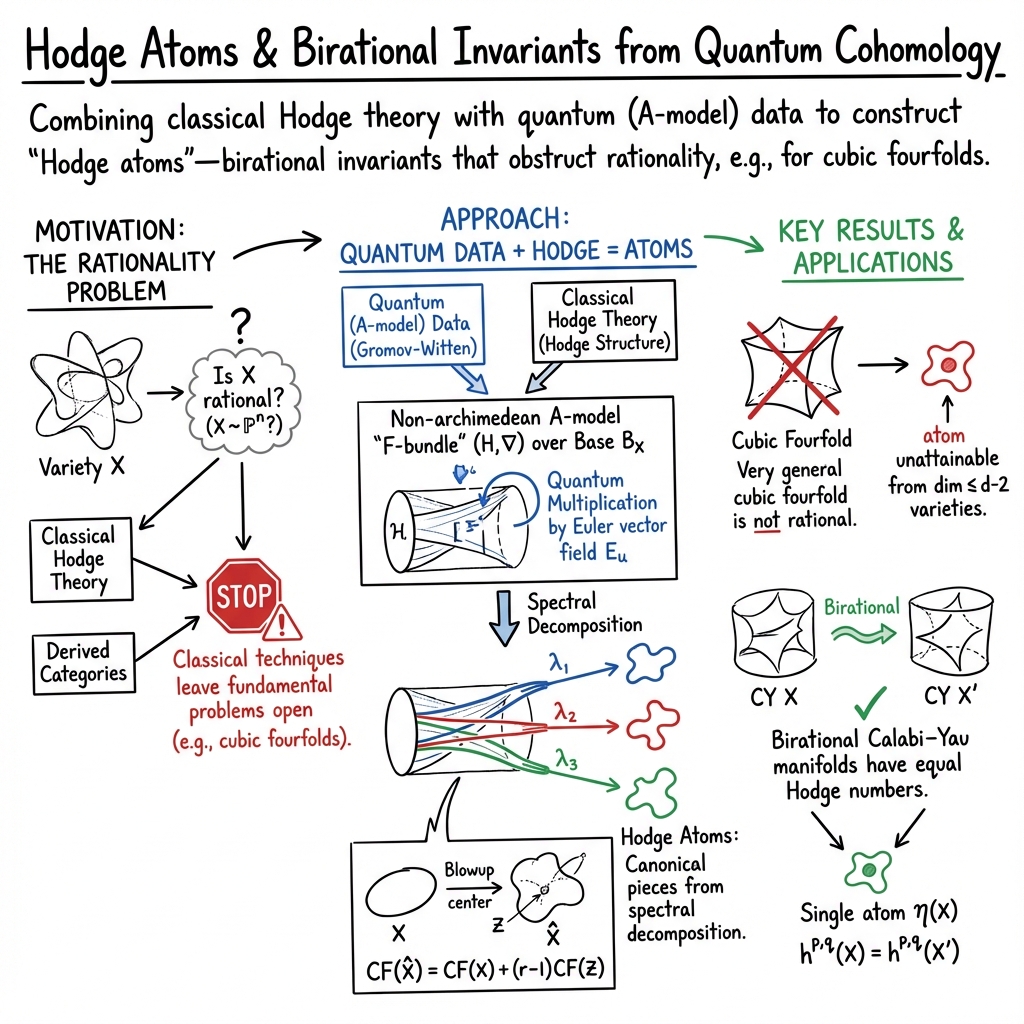
Abstract: We introduce new invariants of smooth complex projective varieties, called Hodge atoms. Their construction combines rational Gromov-Witten invariants with classical Hodge theory and relies on the notion of an F-bundle, which is a non-archimedean version of a non-commutative Hodge structure. The Hodge atoms arise from the spectral decomposition of the F-bundle under the Euler vector field action, and behave additively under blowups, in accordance with Iritani's blowup theorem. We compute several examples and demonstrate applications to birational geometry. In particular, we prove that a very general cubic fourfold is not rational. We also obtain a new proof of the equality of Hodge numbers of birational Calabi-Yau manifolds in any dimension. Furthermore, we show that the framework naturally extends to representations of other motivic Galois groups. This enables the theory of atoms to produce new obstructions to rationality over non-algebraically closed fields of characteristic zero as well.
Paper Prompts
Sign up for free to create and run prompts on this paper.
Top Community Prompts
Practical Applications
Immediate Applications
The following items can be deployed now in research and computation, leveraging results and constructions explicitly developed in the paper (F-bundles, spectral decomposition via the Euler field, Iritani’s blowup theorem, and the definition of Hodge/motivic atoms).
- Research-grade rationality obstructions for concrete classes of varieties
- Sector: Academia (algebraic geometry); Software (computational algebraic geometry)
- Use case: Apply the “chemical formula” CF(X) of Hodge atoms to obstruct rationality for smooth projective varieties where Gromov–Witten (GW) data is accessible (e.g., many Fano and toric classes, hypersurfaces where mirror/Givental techniques are known).
- Tool/workflow:
- 1) Compute big quantum product and Euler field action in the A-model F-bundle;
- 2) Extract eigenvalues/eigenspaces and form the spectral cover over the Hodge locus;
- 3) Read off atoms and multiplicities;
- 4) Compare with atoms from low-dimensional varieties via the blowup additivity rule to produce obstructions.
- Dependencies/assumptions: Characteristic 0; smooth projective input; availability of GW data or mirror-theoretic I-functions; non-archimedean formalism for spectral decomposition; use of Iritani’s blowup theorem; “very general” statements are generic (not necessarily effective for a specific model).
- A new, teachable proof strategy for birational invariance of Hodge numbers for Calabi–Yau manifolds
- Sector: Academia; Education
- Use case: Incorporate the atoms-based proof of equality of Hodge numbers for birational Calabi–Yau manifolds into graduate courses and seminars as an alternative to motivic integration or p-adic methods.
- Tool/workflow: Present F-bundle formalism, spectral decomposition, and atom additivity (blowups/projective bundles) as a self-contained path to the result.
- Dependencies/assumptions: Calabi–Yau condition; characteristic 0; foundational results on F-bundles and the Euler field action.
- Arithmetic rationality obstructions over non-algebraically closed fields (motivated atoms)
- Sector: Academia (arithmetic geometry); Software
- Use case: For varieties defined over number fields or subfields of C, use motivated atoms (representations of the motivic Galois group Mot) to detect non-rationality by analyzing how Galois groups permute factors/components and constrain decomposition of the associated representations.
- Tool/workflow:
- 1) Build the A-model F-bundle of a model over k;
- 2) Compute the Euler action and its generalized eigenspaces;
- 3) Interpret them as Mot-representations;
- 4) Use Galois action constraints to rule out decompositions into atoms from low-dimensional k-varieties.
- Dependencies/assumptions: Access to models over k; knowledge of Galois action on factors; computation of GW data over k; characteristic 0.
- Prototype software for “Hodge Atom Calculators”
- Sector: Software; Academia; Education
- Use case: Implement research-grade scripts to compute atomic compositions CF(X) for classes with known GW/mirror data (e.g., toric complete intersections, Fano hypersurfaces).
- Tool/workflow:
- A Macaulay2/SageMath module wrapping: (i) GW/I-function computation (Givental formalism), (ii) construction of the quantum connection and Euler operator, (iii) formal non-archimedean spectral decomposition, (iv) extraction of atoms and multiplicities, (v) blowup/projective bundle bookkeeping.
- Dependencies/assumptions: Libraries for GW invariants (existing Macaulay2 packages, mirror toolkits), symbolic manipulation over Novikov rings/formal power series; non-archimedean handling (modeled via Puiseux/formal Laurent series).
- Curated datasets of atomic compositions for standard families
- Sector: Academia; Education; Open data
- Use case: Publish a small initial database of Hodge atoms for catalogued varieties (e.g., Fano 3-folds, low-degree hypersurfaces, surfaces with pg = 0/pg ≠ 0) with pointers to birational applications and known blowup relations.
- Tool/workflow: Compute CF(X) with the prototype and validate against known birational geometry; distribute as JSON/CSV with documentation for reuse in research/teaching.
- Dependencies/assumptions: Reliable GW/mirror data; community validation.
- Visualization tools for Euler-spectrum and atom splitting
- Sector: Education; Software
- Use case: Visualize eigenvalue clusters and their deformations under parameter changes (as in the paper’s blowup example) to teach Frobenius manifold geometry and atom formation.
- Tool/workflow: Lightweight Python/JS visualizations of eigenvalue loci and spectral cover branching over the Hodge locus; overlays of blowup/projective bundle decomposition effects.
- Dependencies/assumptions: Access to computed spectra; simple plotting libraries.
- Cross-checks and complements to derived-category and decomposition-of-diagonal techniques
- Sector: Academia
- Use case: Use atoms to generate independent obstructions that complement Kuznetsov component criteria and decomposition-of-diagonal methods when one technique alone is inconclusive.
- Tool/workflow: Parallel pipelines—(i) atoms from A-model F-bundles; (ii) semiorthogonal/derived methods; (iii) decomposition of the diagonal; then integrate conclusions.
- Dependencies/assumptions: Availability of derived-categorical data; compatibility of assumptions across methods.
Long-Term Applications
These items require further development (theory extensions, computational scaling, or broader datasets) but outline realistic paths to impactful tools and workflows.
- General-purpose “Atomic Invariant Engine” for birational classification at scale
- Sector: Academia; Software; Open science infrastructure
- Use case: A robust platform that, given a smooth projective variety (symbolic description), returns its atomic composition and birational obstructions, integrating GW solvers, mirror symmetry, and non-archimedean spectral algorithms.
- Potential products:
- A cloud service/API for atomic invariants;
- Integration with existing ecosystems (Macaulay2, SageMath, Oscar);
- A companion “AtomsDB” with coverage of large families (Fano, GM, cubic fourfolds, conic bundles, higher-dimensional analogues).
- Dependencies/assumptions: Scalable GW computation (symbolic/HPC); broader libraries of mirror theorems; improved non-archimedean computation support; community curation.
- Enhanced atoms (K-theory/Mukai pairings/Serre automorphisms) for finer rationality and derived equivalence tests
- Sector: Academia; Software
- Use case: Detect finer birational and derived equivalence phenomena where coarse Hodge atoms are insufficient; potentially resolve long-standing cases (beyond cubic fourfolds) by exploiting extra structure.
- Potential products:
- “Enhanced-Atoms” package reading topological K-theory images, Mukai pairings, Serre automorphisms into the nc-Hodge/F-bundle framework to refine spectral blocks;
- Certification workflows combining enhanced atoms with derived-category invariants.
- Dependencies/assumptions: Completion of the enhanced-atom theory; availability of K-theoretic inputs and pairings; stable algorithms for new invariants.
- Arithmetic pipelines for rationality over number fields via motivated atoms
- Sector: Academia (arithmetic geometry); Software
- Use case: Systematically test rationality/unirationality over Q or number fields, using the Mot-representation perspective and Galois constraints on atomic decompositions; interface with explicit models and reduction techniques.
- Potential products:
- A “Mot-Atoms” toolkit computing motivated atoms from F-bundles and tracking Galois action on eigenblocks;
- A repository of examples with certified (non-)rationality over specific fields.
- Dependencies/assumptions: Practical ways to compute GW data over number fields; integrated Galois-module computations; verified functoriality across field extensions.
- Moduli-space stratification and machine-assisted conjecture generation
- Sector: Academia; Data science for mathematics
- Use case: Stratify moduli by atomic composition to uncover patterns in birational geometry; use embeddings of atoms into vector spaces (e.g., via character vectors of Hod/Mot representations) to feed clustering and hypothesis generation.
- Potential products:
- “Moduli-by-Atoms” dashboards showing atomic strata, blowup flows, and predicted rationality walls;
- ML-assisted conjecture tools cross-referencing atoms with Hodge diamonds, derived data, and Noether–Fano type conditions.
- Dependencies/assumptions: Large, reliable datasets; careful interpretation of ML outputs; community vetting.
- Non-archimedean spectral-decomposition libraries with broader applicability
- Sector: Software (symbolic/numerical math); Academia (p-adic analysis, D-modules)
- Use case: General libraries for formal/non-archimedean spectral decomposition of meromorphic connections (circumventing Stokes issues), with potential spin-offs in p-adic differential equations, arithmetic D-modules, and mirror symmetry computations.
- Potential products:
- A reusable “NA-Spectral” library supporting connections on formal disks, spectral covers, and eigenbundle tracking;
- Bridges to p-adic solvers where similar spectral issues arise.
- Dependencies/assumptions: Algorithmic advances; rigorous certification of decompositions; performance engineering.
- Curriculum and outreach modules illustrating modern birational tools
- Sector: Education; Science communication
- Use case: Develop modular teaching units on F-bundles, Frobenius manifolds, and atoms, including interactive demos (eigenvalue splitting under blowup, spectral covers over Hodge loci) for graduate courses and summer schools.
- Potential products:
- Open-source courseware with notebooks and visualization widgets;
- Instructor guides connecting classical birational geometry and modern enumerative/Hodge approaches.
- Dependencies/assumptions: Stable prototype software and datasets; pedagogical testing.
- Policy-facing case studies on the value of fundamental computation in pure math
- Sector: Policy (science funding and infrastructure)
- Use case: Use the resolution of long-standing questions (e.g., the rationality status of very general cubic fourfolds) and the concurrent development of computational frameworks as exemplars for supporting foundational research coupled with software/HPC.
- Potential products:
- White papers and case studies illustrating timelines, computational needs, and cross-community benefits;
- Proposals for shared repositories and compute grants dedicated to enumerative geometry and Hodge-theoretic software.
- Dependencies/assumptions: Collaboration across institutions; sustained community interest.
Notes on feasibility and assumptions (cross-cutting)
- Mathematical scope: The paper’s methods assume characteristic zero, smooth projective input, and rely on non-archimedean F-bundle formalism to avoid Stokes phenomena; “very general” claims are generic and may not give a certificate for a specific explicit variety without further work.
- Computational scope: Practical deployment hinges on accessible GW data (mirror theorems, I-function technology) and formal-algebra support (Novikov rings, Puiseux/Laurent series). Complexity grows rapidly in higher dimension and with intricate Picard groups.
- Interoperability: Greatest near-term impact arises from integration with existing computational ecosystems (Macaulay2, SageMath, Oscar) and known datasets (toric/Fano databases).
- Validation: New obstructions are strongest when triangulated with independent methods (derived categories, decomposition of the diagonal, specialization techniques).

