Patterns of imbalance states between sub-brain regimes during development in the resting state
Abstract: The functional brain network is the result of neurons and different areas working together in a coordinated manner. The findings indicate that the spatial distribution of anticorrelations in the brain network is not inherent. In this study, using Heider balance theory, we examine the network of imbalanced triangles with negative links in the brain, which undergoes dynamic changes across development. By analyzing the age-related transformations in the connectivity of imbalanced triangles at the level of brain subnetworks. We show that anticorrelations evolve from childhood to adulthood, reflecting a developmental trajectory from a locally modular organization in childhood, through a flexible and reconfigurable architecture during adolescence, to a highly segregated and functionally specialized network system in adulthood. This mature configuration supports a balance between internally directed cognition and external task demands, enabling efficient and adaptive cognitive control. Specifically, in childhood, prominent anticorrelations were observed between the default mode network (DMN) and the dorsal attention network (DAN), as well as between the default mode network (DMN) and the ventral attention network (VAN). During adolescence, these anticorrelations persisted but became weaker. By adulthood, dominant anticorrelations were observed between the DMN and both the DAN and the frontoparietal network (FPN).
Paper Prompts
Sign up for free to create and run prompts on this paper using GPT-5.
Top Community Prompts
Explain it Like I'm 14
Overview
This paper looks at how different parts of the brain “work together” and “work against each other” while you’re simply resting (not doing a task), and how this changes from childhood to adulthood. The big idea is that some brain systems naturally push and pull in opposite ways—like a seesaw—so you can switch between daydreaming and paying attention. The authors study these “opposites” (called anticorrelations) using a simple idea from social psychology about friendship groups, but applied to brain networks.
The big questions
The researchers focused on two simple questions:
- Do “opposite” connections between brain areas (anticorrelations) stay local (only a few areas) or spread across the brain as we grow up?
- How do these “opposites” show up between larger brain systems (like attention or control networks) in children, teens, and adults?
How the study was done
Who took part
- 215 healthy people: children (7–11), adolescents (12–17), and adults (18–30).
- Everyone lay in an MRI scanner while resting with their eyes open.
How brain activity was measured
- The team used resting-state fMRI, which tracks slow changes in blood flow as a stand-in for brain activity.
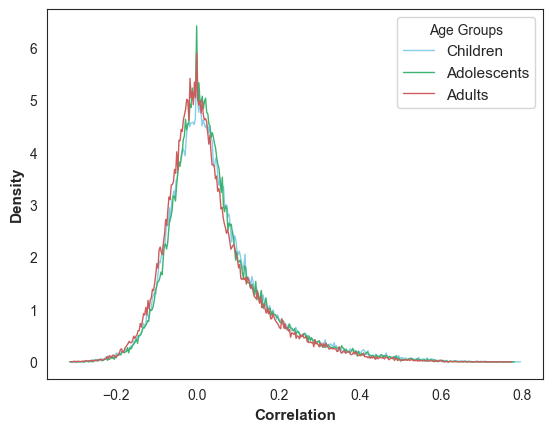
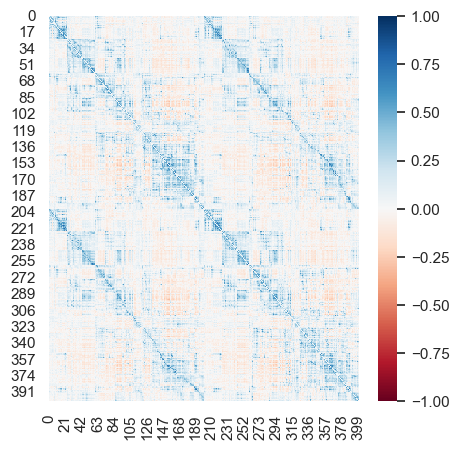
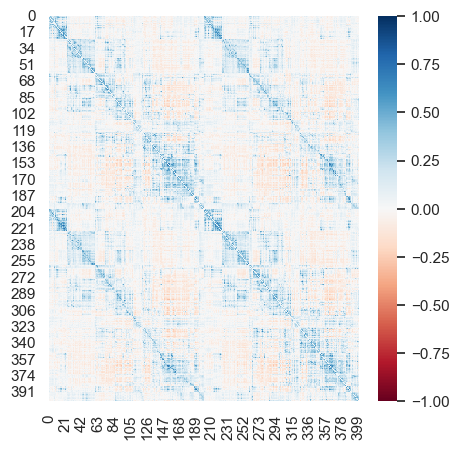
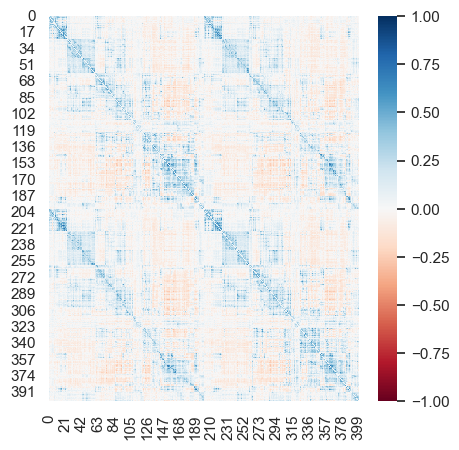
- The brain was divided into 400 small regions. The researchers checked how each pair of regions moved together:
- If two regions went up and down together, that’s a positive link.
- If one went up while the other went down, that’s a negative link (an anticorrelation).
What “triangles” and “balance” mean
Think of three people in a friend group:
- A positive link = friendship.
- A negative link = not getting along.
- For any three people, you can draw a triangle of their relationships. Some triangles feel “stable” (balanced) and some feel “tense” (imbalanced). For example:
- Balanced: “a friend of my friend is my friend,” or “the enemy of my enemy is my friend.”
- Imbalanced: “we all dislike each other” or “two of us are close but the third is at odds.”
The paper uses this idea for brain networks: each “person” is a brain region, and each “friendship” is a positive or negative connection. They focus especially on the most tense triangle type—where all three links are negative. In brain terms, that means all three regions are out of sync with each other (all pairs are in opposite phases), which is a strong form of “disagreement.”
What they compared across ages
- They counted and mapped where these “tense” triangles showed up.
- They asked whether these triangles were isolated (local) or linked together into bigger structures (global).
- They also zoomed out from individual regions to larger brain systems (subnetworks), like:
- Default Mode Network (DMN): inward focus, daydreaming, self-thought.
- Dorsal Attention Network (DAN): focusing attention on the outside world.
- Ventral Attention/Salience Network (VAN/SN): noticing important or surprising things.
- Frontoparietal Control Network (FPN): planning, decision-making, mental control.
What they found
As we grow up, the pattern of “opposite” connections shifts in meaningful ways.
- Childhood (local and modular)
- Strong anticorrelations appear between DMN (inward thinking) and attention networks (DAN and VAN).
- These “tense” triangles are more separated into clusters—meaning the brain’s “opposites” are more local and confined within certain groups.
- Think: separate neighborhoods working independently.
- Adolescence (reorganizing and flexible)
- The same DMN–attention anticorrelations are still there but weaker.
- The number of strong “tense” triangles is lowest, and the network looks like it’s in a transition—less rigid, more reconfigurable.
- Think: roads being rebuilt; boundaries soften so the system can reorganize.
- Adulthood (integrated and specialized)
- Anticorrelations become stronger and more widely connected across the brain.
- DMN shows strong “opposites” not only with attention (DAN) but also with the control network (FPN), which helps with switching goals and focusing.
- Many more “tense” triangles link together into a large, coordinated structure—signaling a global pattern.
- Think: a well-organized city where local neighborhoods are specialized but also tightly coordinated by highways.
Why this matters:
- These changes mirror cognitive development: children build basic separation (daydreaming vs. attention), teens gain flexibility, and adults reach efficient coordination—balancing inner thoughts with outside demands.
- The adult brain’s pattern supports quick switching between “mind-wandering” and “task focus,” which is key for self-control, learning, and problem-solving.
Why it matters
- Anticorrelations aren’t just noise—they’re a built-in feature that helps the brain switch modes.
- Understanding how these “opposite” links grow from local (childhood) to integrated (adulthood) helps explain how thinking skills mature.
- This framework could guide research on learning, education timing, and why some conditions (like attention or developmental disorders) may involve unusual patterns of these “opposites.”
Simple takeaway
As the brain develops, its “push–pull” relationships between major systems evolve from small, local pockets in children, to a flexible reshaping in teens, and finally to a strong, well-coordinated, and specialized network in adults. This mature setup helps adults balance inward thoughts with outward tasks—making thinking more efficient and adaptable.
Collections
Sign up for free to add this paper to one or more collections.