- The paper presents a novel modeling of expanding quantum Hall edges where gravitational anomalies create quantized energy flux analogous to Hawking radiation.
- It employs a geometric framework using Chern-Simons actions and Schwarzian derivatives to derive explicit energy-momentum tensors in both bulk and edge regions.
- The findings reinforce the anomaly inflow mechanism, linking edge state dynamics with bulk compensations in topologically protected quantum systems.
Anomalous Bulk Current in Quantum Hall Systems with an Expanding Edge
Introduction
The paper "Anomalous Bulk Current in Quantum Hall Systems with an Expanding Edge" explores the intricate dynamics of quantum Hall systems (QHS) under non-equilibrium conditions induced by an expanding edge. The study explores the interplay between bulk and edge states in a (2+1)-dimensional QHS, incorporating both gravitational and Weyl anomalies. These anomalies, traditionally seen as obstructions to conservation laws in quantum field theories, are analyzed using a geometric and topological framework, revealing novel energy flux mechanisms akin to Hawking radiation.
System Modeling and Gravitational Anomaly
The core of the research involves modeling a QHS where one spatial dimension expands over time, altering traditional static boundary conditions. The edge expands dynamically, affecting the propagation of excitations and simulating a (1+1)-dimensional curved spacetime. The gravitational anomaly emerges at the edge via the anomaly-inflow mechanism, where the bulk physics compensates for anomalies at the boundary. The paper meticulously derives the energy-momentum tensor on the edge and in the bulk, implementing the Chern-Simons action for gravitational fields.
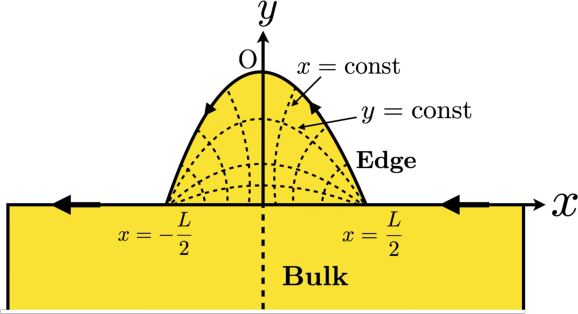
Figure 1: Schematic picture of the quantum Hall system with an expanding edge. The edge state exists at y=0 arrows, denoted by bold, while the region y<0 shows the bulk. The black dashed lines denote the lines where x and y coordinates are constant, respectively.
Anomaly Equation and Energy Flux on Expanding Edge
To extract physical implications, the paper solves the anomaly equations near the expanding edge. The authors derive expressions for the energy flux, evaluating it through both anomaly cancellation and Weyl anomaly perspectives. These derivations reveal the edge energy flux, which exhibits characteristics of Hawking radiation. The Schwarzian derivative plays a crucial role, linking the transformation of coordinates between different spacetime regions and capturing the deviation of energy flux from equilibrium.
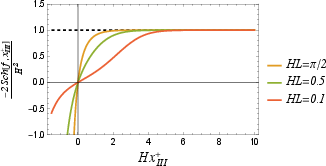
Figure 2: The function $-2\text{Sch}[f, x^{+}_{\rm{III}]/H^2$ as a function of $Hx^{+}_{\text{III}$ for HL=0.1,0.5,π/2.
Bulk Energy-Momentum Tensor
The analysis extends to the bulk energy-momentum tensor, highlighting the coupling between edge dynamics and bulk responses. The spatial profile functions, such as Gaussian and Fermi-Dirac distributions, dictate the smooth transition from flat to curved geometries. These profiles influence the scalar curvature and current flows within the bulk, underscoring the complexity of anomaly-induced energy distributions.
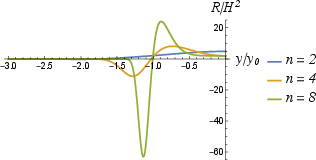
Figure 3: The behavior of the function f(y)=e−(y/y0)n as a function of y/y0 for n=2,10,100.
Quantized Energy Flux and Anomaly Inflow
A key result is the quantized nature of the total energy flux parallel to the expanding edge. Despite the bulk's energy-momentum tensor exhibiting spatial variation, the integrated energy flux remains constant, affirming the anomaly inflow mechanism. This conservation alludes to the fundamental connection between edge anomalies and bulk compensations, mirroring the topological protection inherent in quantum Hall systems.
Figure 4: The behavior of the scalar curvature R/H2 as a function of y/y0 for n=2,4,8. We adopted c−=1, and Ht=1.
Conclusion
The investigation of expanding edges in QHS enriches our understanding of topological phases and anomalies in condensed matter systems. By framing the problem in a geometric context, the paper not only elucidates the mechanisms behind edge and bulk currents but also opens pathways for observing condensed matter analogs of relativistic phenomena like Hawking radiation. Future work might extend these concepts to non-equilibrium scenarios or experimentally realize temperature detection schemes to corroborate theoretical predictions.