- The paper establishes that bulk null focusing directly induces the formation of von Neumann algebras in boundary CFTs.
- It rigorously connects causal wedge reconstruction with precise algebraic conditions that underpin gravitational area laws.
- The work demonstrates sector-dependence in holography, offering a framework for addressing finite-N corrections and quantum gravitational effects.
Introduction and Motivation
This paper rigorously investigates the emergence of von Neumann algebras in the context of AdS/CFT, focusing on the algebraic structure of single-trace operator algebras associated with arbitrary boundary regions. The central result is the identification of a precise holographic dual mechanism: the sector-dependence of von Neumann algebra formation in the boundary theory is mirrored by the focusing properties of null geodesic congruences in the bulk. This connection is formalized through a series of theorems that establish when causal wedge reconstruction is valid and when the associated boundary algebra is von Neumann.
The work is motivated by the need to understand the quantum origin of gravitational area laws, such as the Hawking area theorem, and the limitations of information-theoretic approaches in this context. The algebraic route taken here provides a framework for bulk reconstruction and the emergence of spacetime geometry from boundary data, with direct implications for the generalized second law (GSL) in quantum gravity.
Subregion/Subalgebra Duality and Causal Wedge Reconstruction
The subregion/subalgebra duality equates bulk spacetime subregions with emergent type III1 von Neumann subalgebras of the boundary CFT in the large-N limit. Causal wedge reconstruction is a key tool: for a boundary domain of dependence D[σ], the associated subalgebra should be von Neumann, and the corresponding bulk region is the causal completion of the causal wedge, (Jbulk+[D[σ]]∩Jbulk−[D[σ]])′′.
The paper generalizes this to arbitrary causally convex boundary regions, such as time bands, and establishes the conditions under which the single-trace operator algebra is von Neumann. The identification relies on the causal structure of the bulk and the focusing of null geodesics, which determines the causal wedge and its reconstruction.

Figure 1: Three examples of causally convex regions: union of two causal diamonds, a time band, and a wiggly region, each with a marked Cauchy surface.
GNS Sector Dependence and Bulk Focusing
A central technical result is the demonstration that whether the single-trace algebra YY associated with a causally convex region Y is von Neumann depends on the GNS sector, i.e., the quantum state of the boundary theory. This sector-dependence is dual to the pattern of caustics in bulk null congruences: null geodesics fired from the boundary into the bulk and then back to the boundary generally do not coincide due to focusing and intersections, except in special cases (e.g., infinite temperature thermofield double states).
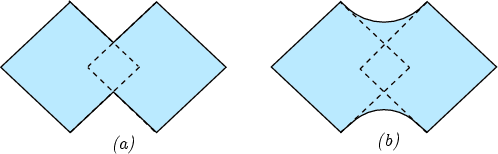
Figure 2: The union of two intersecting causal diamonds in (1+1)-dimensions; the single-trace algebra is not von Neumann in the vacuum, but becomes von Neumann in the infinite temperature thermofield double state.
The paper proves that the algebra YY is von Neumann if and only if the causally complete bulk region Y=(Jbulk+[Y]∩Jbulk−[Y])′′ satisfies Y∩B=Y, where B is the boundary manifold. This provides a holographic criterion for causal wedge reconstruction and the formation of von Neumann algebras.
Technical Theorems and Bulk-Boundary Correspondence
A sequence of theorems rigorously establishes the correspondence between bulk and boundary causal regions, the existence of appropriate Cauchy slices, and the identification of minimal bulk domains of dependence. The proofs rely on global hyperbolicity, causal convexity, and the properties of null congruences.
The main result is that for maximal causally convex regions Ymax, the boundary algebra YYmax is von Neumann and coincides with the bulk algebra MD[CY], where CY is the minimal bulk region defined by the intersection of future and past bulk causal sets with a Cauchy slice. For non-maximal regions, the boundary algebra is not von Neumann, and the minimal von Neumann algebra is given by its double commutant.
Implications for the Hawking Area Theorem and Generalized Second Law
The identification of von Neumann algebras with bulk causal wedges provides a quantum explanation for the Hawking area law. The area of the edge of the causal wedge is shown to correspond to the entanglement entropy of the associated algebra, suggesting an algebraic route to the generalized second law (GSL) in fully dynamical spacetimes.
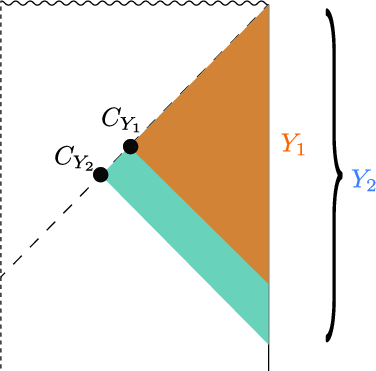
Figure 3: The area law ensures monotonic increase of area from CY2 to CY1, reflecting the nesting of maximal boundary regions and their associated algebras.
The paper speculates on finite-N extensions, proposing that there exists a type I algebra at finite N whose entropy converges to the generalized entropy Sgen[CY] in the large-N limit. This would provide a nonperturbative understanding of the area term in the GSL and a CFT derivation of the law in general dynamical settings.
Future Directions and Theoretical Implications
The results have significant implications for bulk reconstruction, the emergence of spacetime geometry, and the algebraic structure of quantum gravity. The sector-dependence of von Neumann algebra formation is directly tied to bulk causal structure, providing a new perspective on the encoding of locality and causality in holographic theories.
Potential future developments include:
- Extension of the results to causally concave regions and more general boundary submanifolds.
- Explicit construction of finite-N type I algebras and their entropies.
- Algebraic derivations of the GSL in fully dynamical spacetimes, including quantum gravitational corrections.
- Investigation of the interplay between bulk focusing, entanglement wedge reconstruction, and quantum error correction in holography.
Conclusion
This paper provides a rigorous algebraic framework for understanding the formation of von Neumann algebras in AdS/CFT, grounded in the causal structure of the bulk and the focusing of null geodesics. The results clarify the conditions for causal wedge reconstruction, the sector-dependence of boundary algebras, and the quantum origin of gravitational area laws. The work opens new avenues for the algebraic study of holography, bulk reconstruction, and the generalized second law in quantum gravity.