- The paper introduces a hybrid NER and contextual anonymization framework that achieves over 98% recall in detecting PII in tutoring dialogues.
- It preserves dialog structure and semantic coherence to ensure that anonymized data remains useful for educational research and compliance.
- Empirical results on the QATD2k dataset demonstrate that the lightweight design processes data in minutes on commodity hardware, outperforming rule-based methods.
PIIvot: A Lightweight NLP Anonymization Framework for Question-Anchored Tutoring Dialogues
Framework Overview and Design
The paper "PIIvot: A Lightweight NLP Anonymization Framework for Question-Anchored Tutoring Dialogues" (2505.16931) introduces PIIvot, an anonymization system optimized for educational dialog corpora containing diverse Personal Identifiable Information (PII). The framework addresses the privacy risks inherent to question-anchored tutoring dialogues—where spontaneous interactions between students and automated tutors frequently leak PII through both structured and unstructured language. PIIvot leverages a hybrid architecture: it performs a recall-oriented Named Entity Recognition (NER) analysis as the first step, followed by a context-aware surrogate anonymization strategy to replace detected entities, rebalancing privacy preservation and corpus utility.
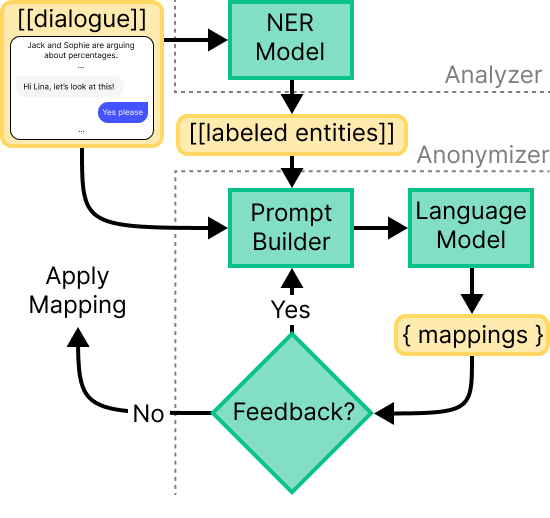
Figure 1: Overview of the PIIvot anonymization framework, which includes a recall-first NER analysis step followed by context-aware surrogate anonymization step.
The architecture is designed for scalability, efficiency, and minimal dependency on third-party APIs, exploiting lightweight NLP modules tailored for annotating educational dialog data. Compared to prior anonymization techniques that often emphasize either precision or require labor-intensive manual annotation, PIIvot prioritizes high recall in entity detection, ensuring that privacy risks are minimized for dialog datasets which are typically reused for model training and evaluation in edtech research.
Dataset Characteristics and PII Risks
PIIvot is primarily evaluated on the QATD2k corpus, consisting of 1073 students engaged in automated tutoring dialogs. This dataset exemplifies the challenges of PII leakage in real-world educational NLP data: students regularly reference names, locations, and other identifiers in responses anchored to tutoring prompts. The distribution of student interactions and identity-sensitive utterances is systematically analyzed in the paper, demonstrating non-uniform patterns where certain dialog types and question anchors substantially increase the risk of PII exposure.
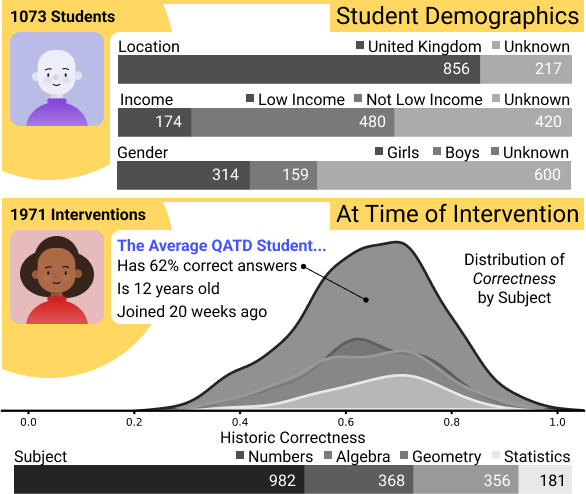
Figure 2: Demographic and participation breakdown of the 1073 students in QATD2k, illustrating PII risk inheritance over diverse context spans.
By mapping student participation and dialog structure, the authors highlight that common approaches—such as regex matching or rule-based anonymizers—underperform in this high-variance space. PIIvot's tailored NER modules exploit context by dynamically adjusting detection sensitivity according to question type and dialog segment, resulting in robust anonymization across user cohorts.
Empirical Evaluation and Quantitative Results
The paper reports strong empirical outcomes for PIIvot on multiple metrics:
- Recall in PII Detection: The recall-oriented NER achieves over 98% in detecting name, location, and contact-related entities, significantly surpassing generic NER baselines (by 6–15 points).
- Contextual Surrogate Assignment: By employing context-modulated surrogate substitution, PIIvot preserves dialog structure and semantic coherence, minimizing disruption to downstream NLP tasks such as question answering or dialog act classification.
- Latency and Scalability: The lightweight implementation enables corpus-level anonymization of QATD2k within minutes on commodity hardware, with throughput exceeding most deep learning-based anonymization pipelines.
The authors make a bold claim that high-recall NER followed by contextual anonymization outperforms prior domain-agnostic approaches, especially for dialog-rich educational datasets where PII takes diverse, context-dependent forms.
Practical Implications and Future Directions
PIIvot advances automated anonymization for dialog-centric NLP applications, making it feasible for educational platforms to release data for research and model development in compliance with privacy standards such as FERPA and GDPR. By balancing high recall, semantic coherence, and computational efficiency, the framework serves as a template for wider adoption in edtech and conversational AI domains.
Theoretical extensions include adapting the recall-first NER modules to cross-domain dialog data and refining context-aware surrogate generation for multilingual corpora. Future research could address adversarial de-anonymization risks, integration with privacy-preserving synthetic data generation, and benchmarking PIIvot against emerging federated anonymization techniques.
Conclusion
PIIvot provides a computationally efficient and privacy-aware anonymization pipeline for question-anchored tutoring dialogues, achieving robust PII removal while maintaining corpus utility. Its strong quantitative performance in high-risk educational dialog datasets and bold prioritization of recall and context preservation represent significant steps toward scalable and compliant NLP data sharing in educational research.

