- The paper introduces a dual-weight update method that decomposes weight vectors into separate target and non-target components for enhanced learning.
- It mitigates biases by independently averaging weight contributions and reduces noise through adaptive regularization based on gradient magnitudes.
- Empirical results show lower test losses and robust performance under noise, demonstrating improved generalization across tasks.
Revisiting Gradient Descent: A Dual-Weight Method for Improved Learning
Introduction
The paper "Revisiting Gradient Descent: A Dual-Weight Method for Improved Learning" introduces an innovative approach to weight updates in neural networks by decomposing the weight vector into distinct components that represent target and non-target features. Traditional gradient descent approaches lack the explicit modeling of contrast between these features, which is crucial for accurate learning representations. The proposed dual-weight method enhances the learning process by separately updating target (W1) and non-target (W2) components, thus providing a more refined updating mechanism for neural network weights.
Methodology
Traditional vs. Proposed Weight Update Strategy
In conventional neural network training, weights are updated using a single composite vector W. The proposed method, however, conceptualizes this process as W=W1−W2, with W1 and W2 updated independently based on the input gradients:
- W1 aggregates adjustments when the neuron should enhance its response (negative gradients), while
- W2 captures adjustments where suppression of activation (positive gradients) is desired.
This approach mirrors biological excitatory-inhibitory interactions, creating more adaptive and stable learning dynamics.
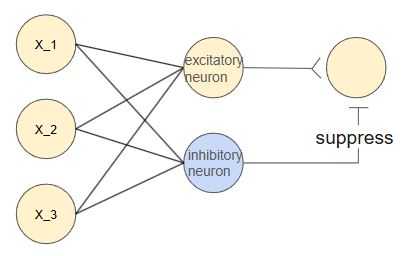
Figure 1: Both the excitatory neuron (top) and the inhibitory neuron (bottom) receive the same inputs x1,x2,x3. The excitatory neuron uses W1 while the inhibitory uses W2.
Advantages of the Dual-Weight Model
The dual-weight model offers several advantages:
- Mitigation of Sample Imbalance: By independently averaging the target and non-target weight contributions, the proposed approach diminishes the bias introduced by imbalanced sample distributions.
- Noise Reduction in Non-Informative Dimensions: Regularization based on gradient magnitude ensures non-essential weights diminish, reducing noise.
- Adaptive Regularization: Dynamic adjustment of weights based on relevance prevents the indiscriminate penalization common in blanket regularization methods such as L2 regularization.
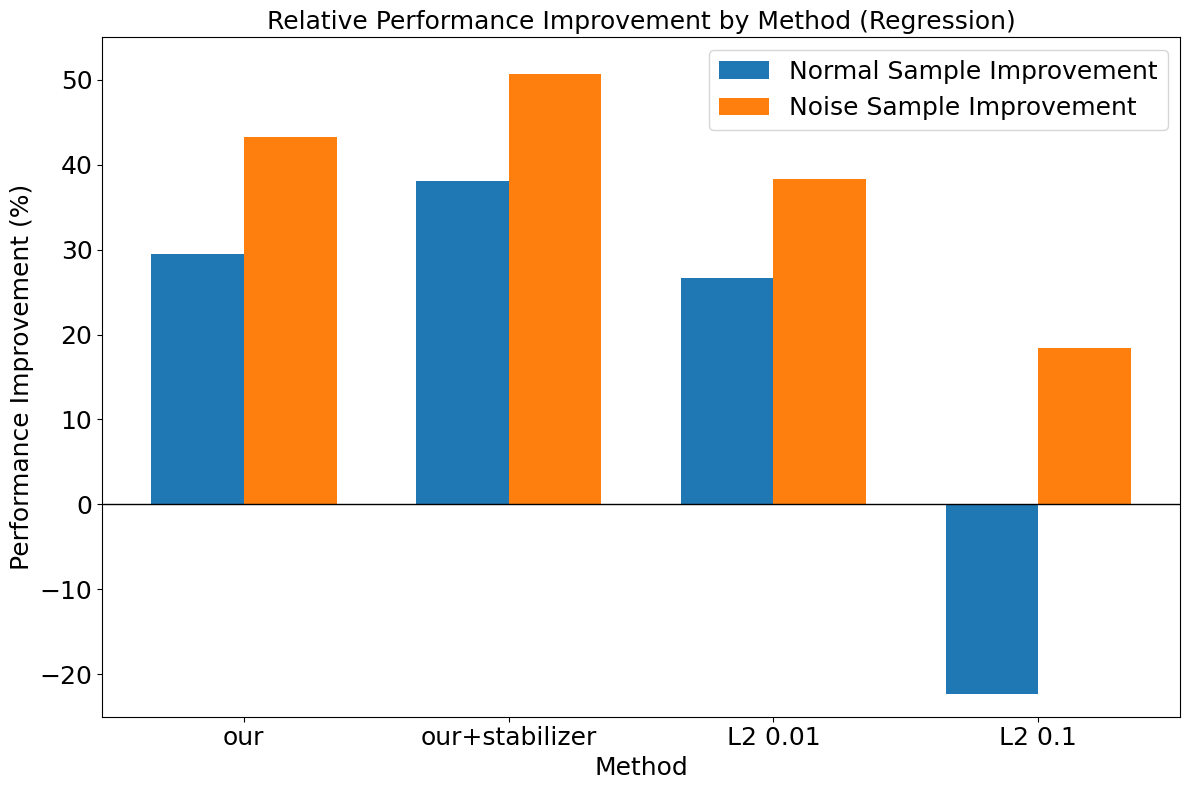
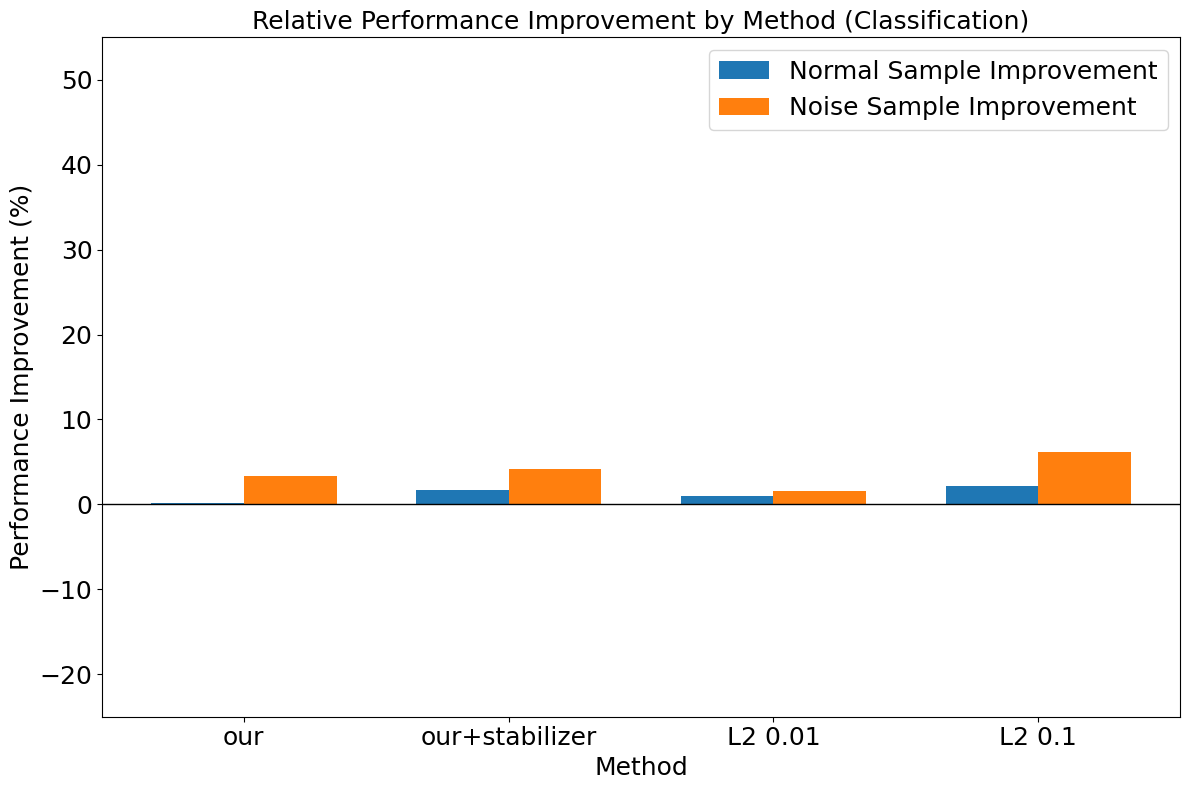
Figure 2: Relative performance improvement over the gradient method: (Top) regression task, (Bottom) classification task.
Results
Empirical results demonstrate that the proposed dual-weight methodology often results in improved generalization across diverse datasets. In regression tasks, the method showed consistently lower test losses in comparison to traditional gradient descent and L2 regularization approaches. The method also displayed robustness to distribution shifts, as evidenced by performance consistency under added noise conditions.
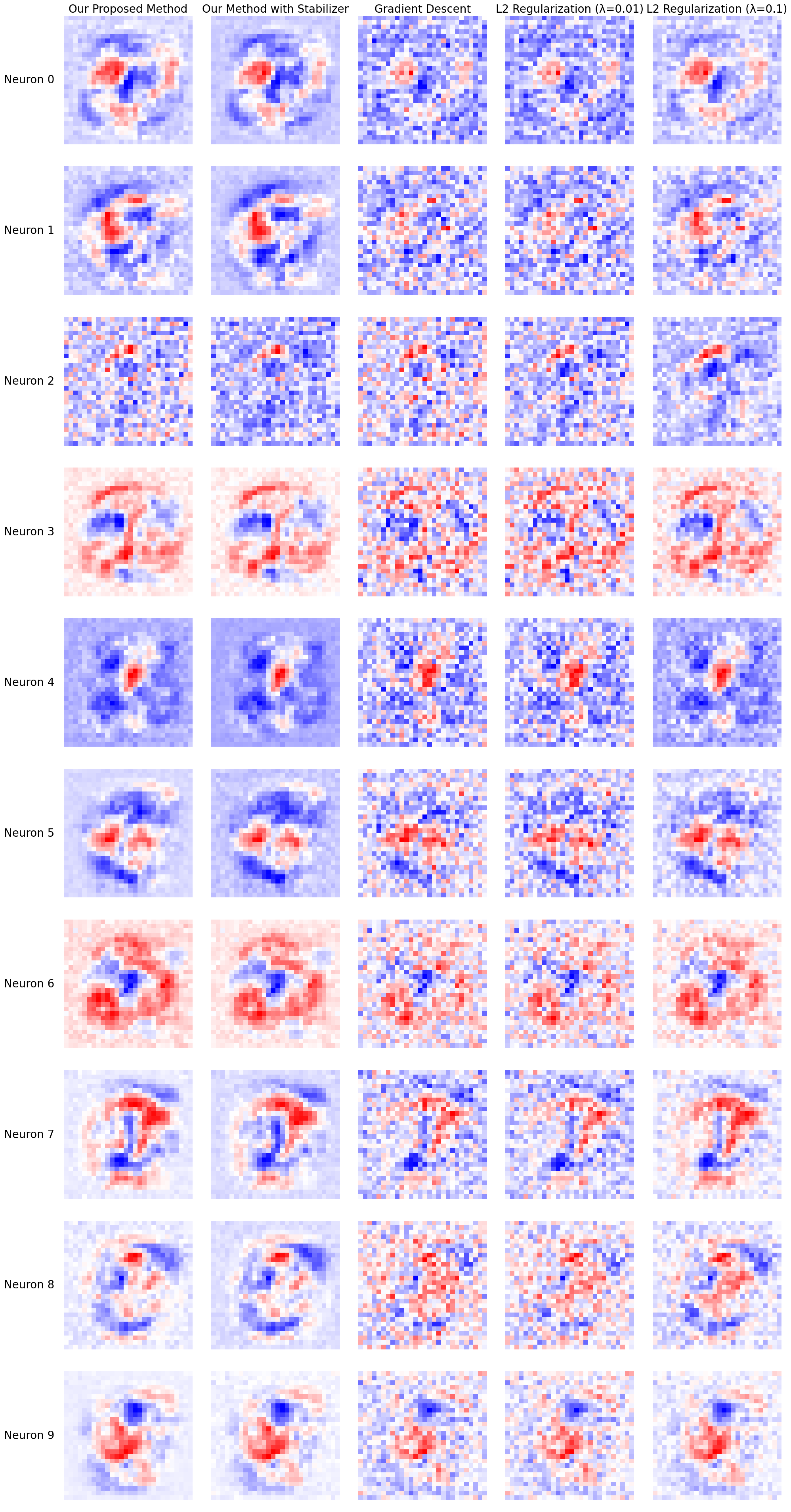
Figure 3: Visualization of receptive fields of neurons across models.
Implications and Future Work
The dual-weight model proposes significant implications for both theoretical development and practical deployment in machine learning frameworks. By offering a neuron-level contrastive learning perspective, it opens new avenues for constructing robust models in environments of varying complexity. However, challenges such as ensuring stability during learning iterations and scaling large outputs within bounded neuron capacities require further exploration.
Future work could focus on integrating batch training techniques to enhance stability and explore the application of this dual-weight mechanism in unsupervised learning paradigms, drawing parallels to contrastive learning methodologies at a granular neuron level.
Conclusion
The dual-weight method proposed in this study provides an innovative advancement in weight update strategies within neural networks, addressing critical limitations of traditional approaches. Its ability to distinguish, decompose, and dynamically adjust its learning representations based on target and non-target reactions marks a significant step in enhancing the precision and resilience of learning models. The approach holds promise for improved performance across various complex datasets, although challenges pertaining to stability and output scaling remain areas for future research.

