Beyond Outlining: Heterogeneous Recursive Planning for Adaptive Long-form Writing with Language Models
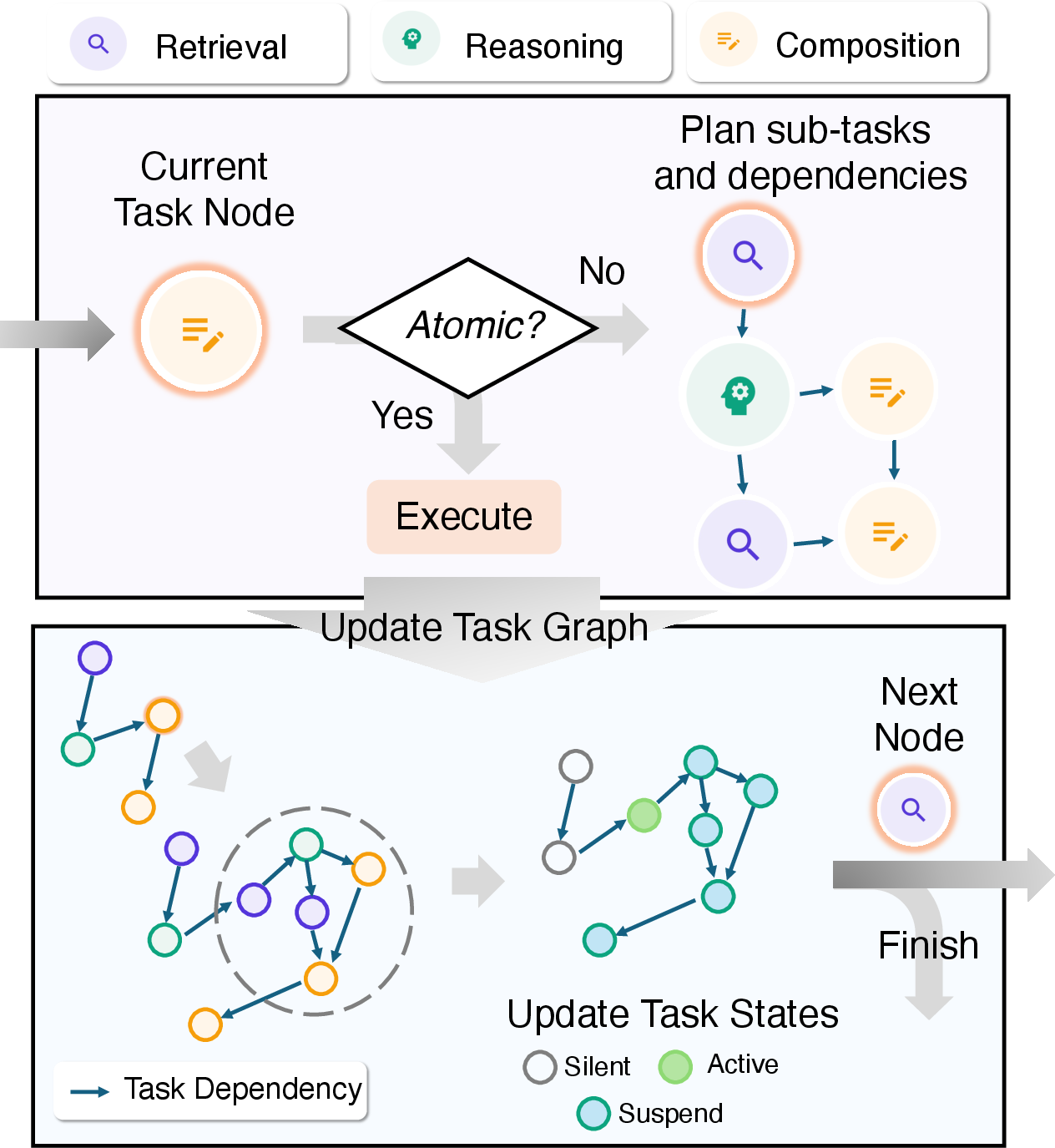
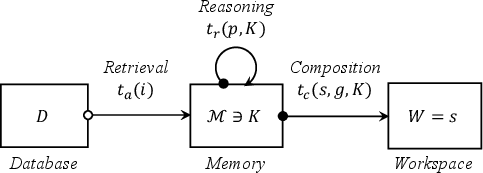
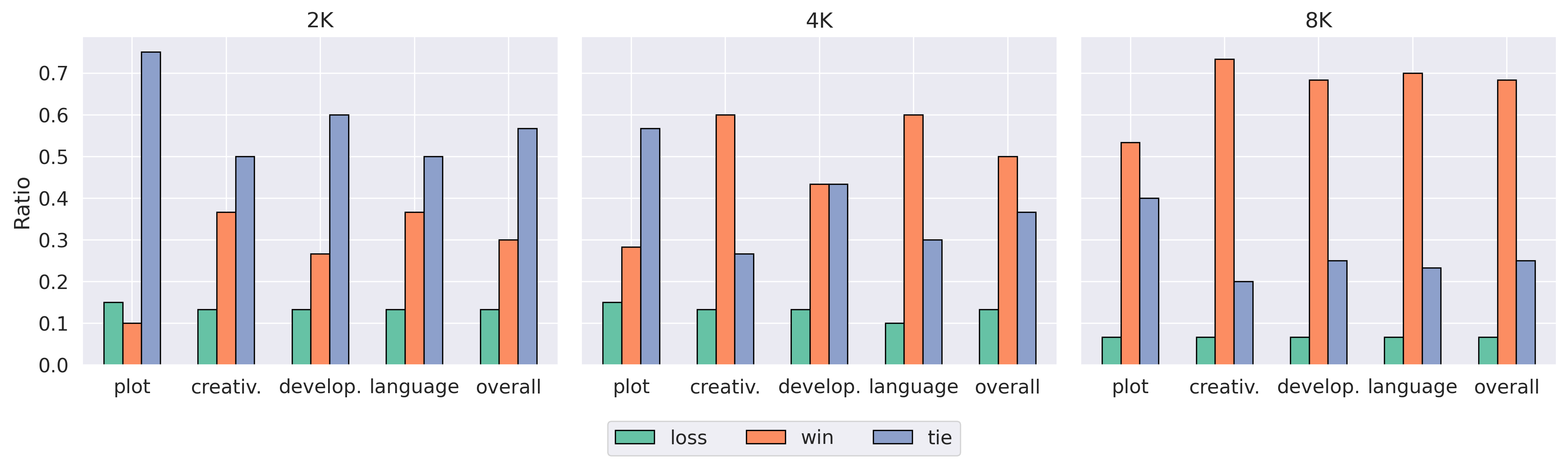
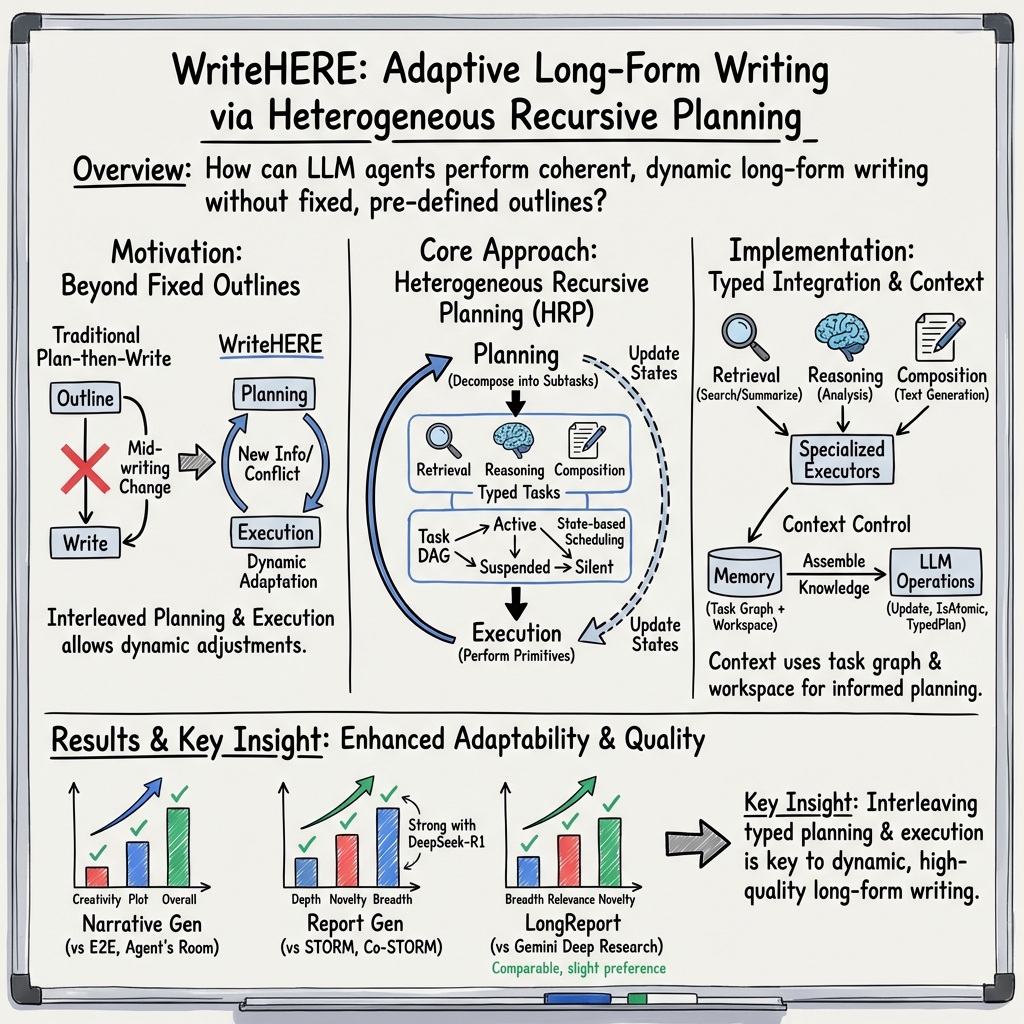
Abstract: Long-form writing agents require flexible integration and interaction across information retrieval, reasoning, and composition. Current approaches rely on predefined workflows and rigid thinking patterns to generate outlines before writing, resulting in constrained adaptability during writing. In this paper we propose WriteHERE, a general agent framework that achieves human-like adaptive writing through recursive task decomposition and dynamic integration of three fundamental task types: retrieval, reasoning, and composition. Our methodology features: 1) a planning mechanism that interleaves recursive task decomposition and execution, eliminating artificial restrictions on writing workflow; and 2) integration of task types that facilitates heterogeneous task decomposition. Evaluations on both fiction writing and technical report generation show that our method consistently outperforms state-of-the-art approaches across all automatic evaluation metrics, demonstrating the effectiveness and broad applicability of our proposed framework. We have publicly released our code and prompts to facilitate further research.
Paper Prompts
Sign up for free to create and run prompts on this paper using GPT-5.
Top Community Prompts
Knowledge Gaps
Unresolved gaps due to missing paper content
Because the full text of (Xiong et al., 11 Mar 2025)v1 is inaccessible, the following critical gaps cannot be assessed and remain open:
- Full, authoritative source is unavailable; it’s unclear where to obtain the official text to verify claims, methods, and results.
- Research objectives and hypotheses are unspecified, leaving the problem scope, definitions, and intended contributions ambiguous.
- Methodological details are missing: study design, models/algorithms, assumptions, parameter choices, and justification for key decisions.
- Data provenance and characteristics are unknown: datasets used, collection procedures, preprocessing, inclusion/exclusion criteria, sample sizes, and licensing.
- Evaluation protocol is unspecified: metrics, baselines, train/test splits, cross-validation strategy, statistical significance testing, and handling of multiple comparisons.
- Reproducibility artifacts are absent: code, configuration files, dependency versions, random seeds, and hardware/software environment.
- Results reporting cannot be assessed: effect sizes, confidence intervals, variance across runs, error analysis, and negative/failed experiments.
- Robustness and generalization remain unexplored: performance under distribution shift, sensitivity to hyperparameters, ablations, and stress tests.
- Comparative positioning in the literature is unclear: systematic benchmarking against closely related work and articulation of novelty or incremental value.
- Limitations and threats to validity are unarticulated: internal/external validity, selection bias, confounders, measurement error, and scope boundaries.
- Ethical and societal considerations are unknown: bias/fairness analysis, privacy/data protection, potential harms, and IRB/ethics approvals where applicable.
- Scalability and deployment constraints are unspecified: computational cost, memory footprint, latency, and feasibility in real-world or resource-constrained settings.
- Theoretical guarantees or formal analysis (if claimed) are not available: proofs, assumptions under which claims hold, and known counterexamples.
- Failure modes and boundary conditions are unexplored: cases where the approach degrades or breaks, out-of-distribution behavior, and safety considerations.
- Applicability domain and target users are undefined: contexts where the approach is appropriate, generalizability to other domains, and prerequisites for adoption.
- Availability and licensing of artifacts are unresolved: where to access code/data, licensing terms, documentation quality, and maintenance plans.
Practical Applications
Note on missing paper content
The text you provided is an arXiv system message indicating that the PDF for (Xiong et al., 11 Mar 2025)v1 is unavailable. It does not contain the research paper’s title, abstract, methods, results, or conclusions. Without the paper’s content, I cannot extract specific, actionable applications.
How to proceed
Please provide one of the following so I can complete the application analysis:
- The full paper text, or at least the abstract and key findings
- A direct link to the paper’s source (e.g., an external PDF or the author’s repository)
- A summary of the problem addressed, methodology, and main results
Once you share the paper content, I will map its findings to practical applications across sectors, categorize them as immediate vs. long-term, and note assumptions and dependencies.
Immediate Applications
- Pending paper content. With the paper’s methods and results, I will identify deployable use cases (e.g., tools, workflows, integrations) and link them to relevant sectors such as healthcare, education, software, robotics, energy, or finance, noting any required datasets, infrastructure, or regulatory conditions.
Long-Term Applications
- Pending paper content. With the paper’s innovations and limitations, I will outline applications that require further validation, scaling, or development, including potential product roadmaps, policy implications, and research directions, along with dependencies like standardization, safety evaluation, or market readiness.
Glossary
- abstract: A brief summary of a research paper’s content used to quickly convey its main ideas. "Return to the abstract for an alternative link to the source, or to find an email address to contact the author."
- archive: A repository or category used to store and organize documents; on arXiv, it denotes subject-area collections (e.g., cs, math). "remembering to specify the problematic archive and paper number."
- arXiv: An open-access repository for electronic preprints of scientific papers. "Link back to: arXiv, form interface, contact."
- arXiv Operational Status: A service status page that reports the current health and availability of arXiv systems. "arXiv Operational Status"
- automated source to PDF conversion system: An automated pipeline that compiles submitted source files (e.g., LaTeX) into a PDF. "Our automated source to PDF conversion system has failed to produce PDF for the paper: (Xiong et al., 11 Mar 2025)v1."
- Simons Foundation: A private foundation that funds research in mathematics and the basic sciences. "We gratefully acknowledge support from the Simons Foundation and member institutions."
- Web Accessibility Assistance: Resources and support to ensure web content is usable by people with disabilities and compliant with accessibility standards. "Web Accessibility Assistance"
Collections
Sign up for free to add this paper to one or more collections.

