- The paper's main contribution is GATE, a dynamic model integrating AI development, task automation, and macroeconomic outcomes.
- It employs a compute-based AI development module, a CES automation framework, and a Cobb-Douglas production function to simulate resource allocation and economic growth.
- The model enables simulation of various AI and economic scenarios, offering actionable insights for policymakers, researchers, and industry professionals.
GATE: An Integrated Assessment Model for AI Automation
The paper "GATE: An Integrated Assessment Model for AI Automation" introduces GATE, a model designed to evaluate the economic impacts of AI automation by integrating computer science and economic insights. The model is a dynamic integrated assessment tool that combines a compute-based model of AI development, an AI automation framework, and a semi-endogenous growth model. It allows users to simulate various scenarios of AI development and assess their economic implications.
Structure of GATE
GATE consists of three distinct modules that together encapsulate the interaction between AI development and economic outcomes:
- AI Development Module: This module links investment in AI capabilities to the stock of effective compute, crucial for AI training. It centers on the accumulation of compute resources and algorithmic improvements that drive AI capabilities.
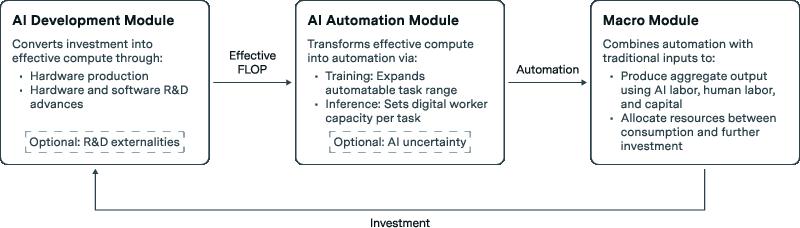
Figure 1: A high-level schematic of GATE's three modules and their feedback loops.
- AI Automation Module: This module converts the compute resources into the ability to automate labor tasks. It examines both the extensive and intensive margins of automation, mapping compute investments to operational AI systems capable of performing tasks traditionally carried out by humans.
- Macroeconomic Module: This module translates the automation of labor tasks into macroeconomic outcomes, such as output growth, consumption, and investment. It examines the feedback loop from economic growth to AI investment flows.
Each module operates autonomously but is interconnected to ensure the model accurately represents the continuous feedback between AI developments and economic metrics.
AI Development Module
The AI development module is a compute-centric approach that tracks how investments translate into computing resources available for AI training and deployment. Effective compute, a synthesis of computational power adjusted for algorithmic efficiency, is vital for understanding AI capabilities.
- Effective Compute: Defined as FLOPs weighted for algorithmic advancements, effective compute encapsulates both hardware and software improvements, serving as a pivotal metric for AI progress.
- Training-Inference Trade-off: GATE models the balance between training compute (used to improve models) and inference compute (used for model deployment and task performance), highlighting the trade-offs in resource allocation for AI system development.
AI Automation Module
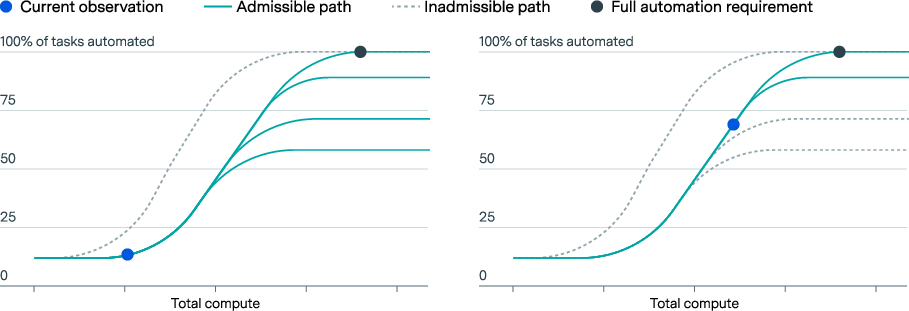
The automation module tackles the gradual transition of AI systems towards automating an increasing array of tasks. It uses a CES aggregator to model the range of tasks AI can automate as a function of effective compute. This dynamic adjustment represents the core economic impact of AI innovations.
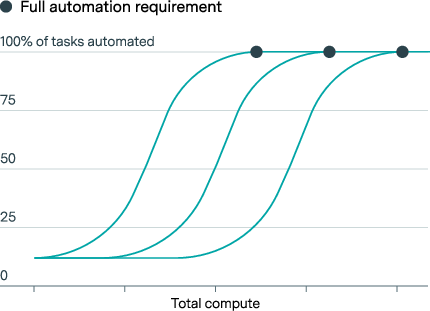
Figure 2: Relationship between total compute and task automation.
- Extensive Margin of Automation: The model uses effective compute to expand the set of tasks that AI systems can perform, based on predefined task complexity and required compute resources.
- Intensive Margin of Automation: GATE models how allocation of more runtime compute translates into a larger number of "digital workers" for each task, effectively increasing the labor force participating in economic activities.
Macroeconomic Module
This module connects AI-driven task automation to economic outputs, optimizing over investment decisions to maximize consumption utility for a representative agent.
Model Functionality and Implications
The GATE model offers powerful simulations of macroeconomic trajectories under diverse assumptions regarding AI development and economic policy interventions. It presents implications for various scenarios, such as rapid automation versus gradual adoption, varying degrees of investment in AI R&D, and effects of policy interventions like regulation and subsidies.
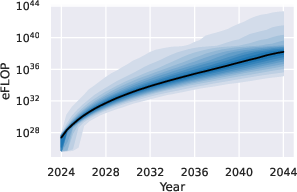
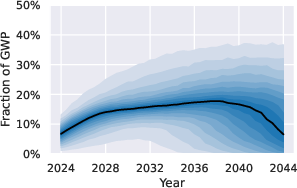
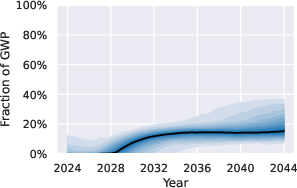
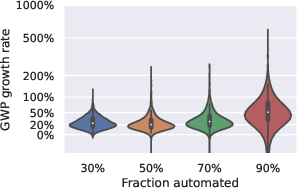
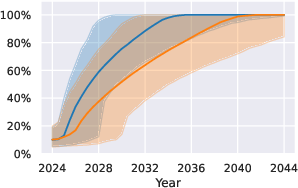
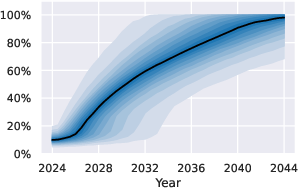
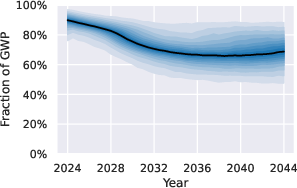
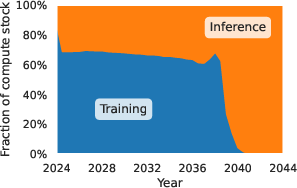
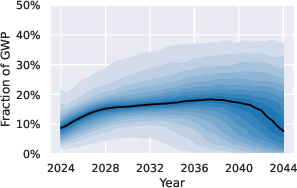
Figure 4: Projected size of largest AI training runs.
By synthesizing the computational and economic dimensions of AI progress, GATE aids policymakers, economists, and AI researchers in anticipating the economic transformations driven by AI advancements.
Conclusion
GATE represents a pioneering effort in aligning AI development with economic forecasting, emphasizing the need for interdisciplinary dialogues between computer science and economics. Future research should address model limitations, such as incorporating broader TFP growth and exploring the nuanced interaction between data and compute requirements. Engaging the academic community with GATE can further refine predictions and enhance strategy formulations for navigating AI's profound economic implications.