- The paper introduces a multigrid preconditioning strategy for FD-DLM formulations that robustly reduces condition numbers.
- It employs geometric multigrid with SOR smoothers and Vanka-type techniques for saddle-point blocks, ensuring mesh-independent convergence.
- Numerical results indicate that block triangular preconditioners outperform diagonal variants, establishing viability for complex interface problems.
Multigrid Preconditioning for FD-DLM in Elliptic Interface Problems
Problem Setting and Discretization
This work addresses efficient solution strategies for elliptic interface problems using the Fictitious Domain with Distributed Lagrange Multipliers (FD-DLM) finite element formulation. Elliptic interface problems feature discontinuous coefficients or physical parameters across an internal interface, common in scenarios such as fluid-structure interaction (FSI). The FD-DLM method applies finite element discretization using unfitted meshes coupled to a fictitious domain approach, which circumvents remeshing requirements for evolving interfaces.
The underlying PDE system leads to a coupled saddle-point problem with a 3×3 block matrix structure when using FD-DLM. The discrete formulation involves three fields: the primal variable on the background domain, the variable on the immersed domain, and a Lagrange multiplier enforcing interface conditions, discretized using either continuous or discontinuous finite element spaces for the multiplier.
Two relevant element combinations are systematically analyzed:
- [Q1−Q1−Q1], employing continuous bilinear elements for all fields;
- [Q1−(Q1+B)−P0], utilizing bubbles for stability in the immersed domain variable and piecewise constants for the multiplier.
The well-posedness of the discretized saddle-point system is guaranteed under mild assumptions on the interface coefficient contrast, and the matrix blocks inherit standard elliptic and saddle-point problem structure.
Preconditioning Strategies
Solving the resulting large, ill-conditioned linear systems efficiently demands effective preconditioners. Three block preconditioning structures are studied:
- P1: block upper-triangular,
- P2: block lower-triangular,
- P3: block diagonal.
The theoretical justification for preconditioner invertibility relies on coercivity of A1 (standard background elliptic operator) and saddle-point well-posedness of the block B, ensured via an inf-sup condition and ellipticity on relevant subspaces.
Multigrid and Vanka Preconditioning
The innovation of this work is the deployment of multigrid iterative methods in the construction of the preconditioner inverses, specifically for the elliptic blocks where direct solvers were previously used. For A1−1, classical geometric multigrid with SOR smoothers is adopted. The more challenging block B (owing to its saddle-point structure and zero diagonal blocks) motivates the use of Vanka smoothers—overlapping Schwarz-type procedures optimized for problems involving Lagrange multipliers and proven effective for saddle point systems.
Hybridization of direct and multigrid approaches is systematically tested, exploring four combinations per preconditioner: direct/multigrid inversion of A1 and B.
The numerical investigation utilizes canonical 2D interface problems with high contrast coefficients. Condition numbers and solver iteration counts across a range of mesh sizes are reported for each preconditioner and FE-multiplier choice.
Notably, block triangular preconditioners (P1, P2) consistently deliver strong condition number reduction and stabilize iteration counts, regardless of mesh refinement or multiplier continuity:
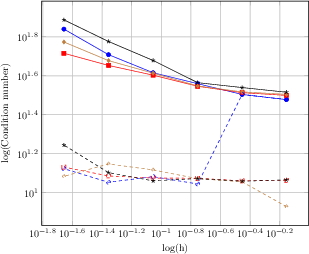
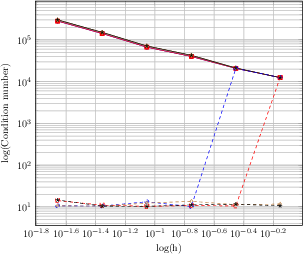
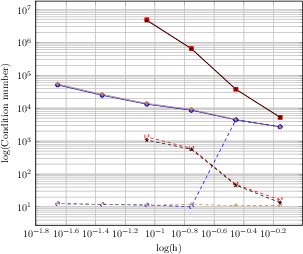
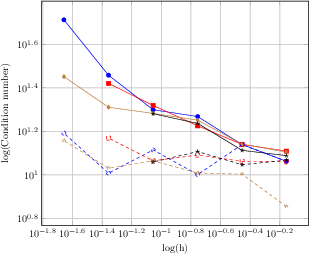
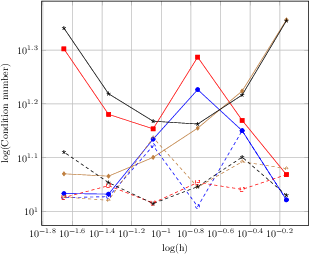
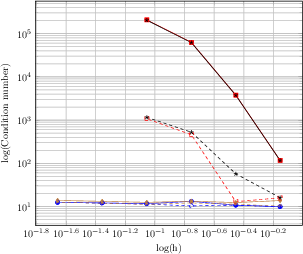
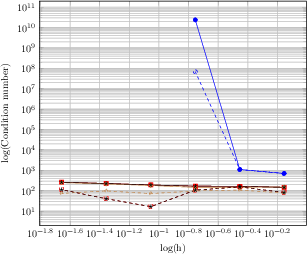
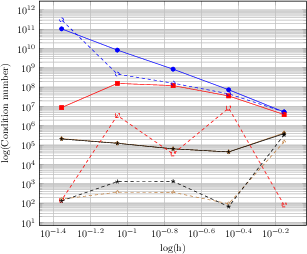
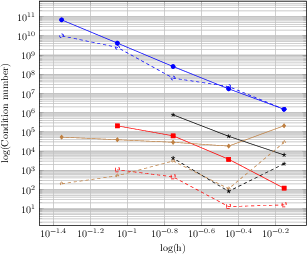


Figure 1: Initial and final condition number of the full system matrix A.
Application of multigrid—in place of direct solvers—preserves and often enhances these properties, with "md" (multigrid for B−1, direct for A1−1) configurations performing robustly. "mm" (multigrid for both) methods match or improve upon direct solution efficacy, confirming the viability of multigrid preconditioning even for complex interface saddle-point problems.
In contrast, the block diagonal preconditioner (P3) generally underperforms in both condition number reduction and iteration count, with performance highly sensitive to the use of multigrid.
A detailed assessment of solving times versus iteration count shows that, for well-chosen preconditioners and smoother configurations, optimal (mesh-independent) convergence rates are achievable:
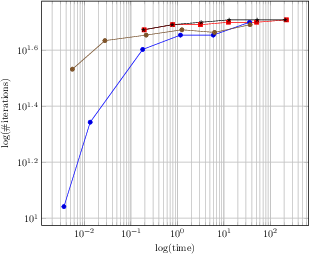
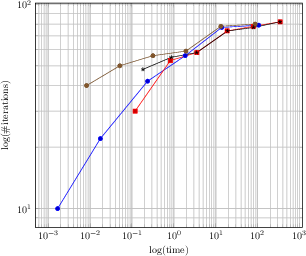
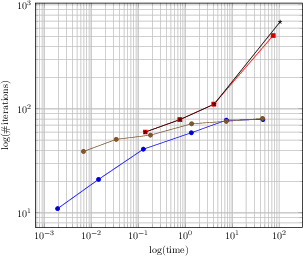
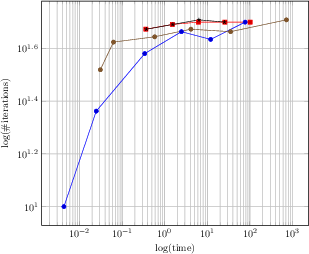
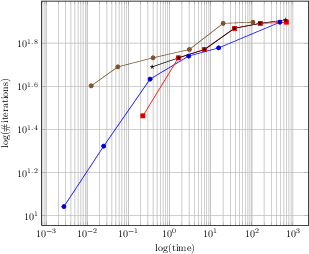
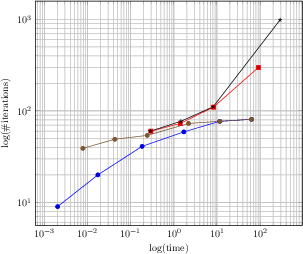
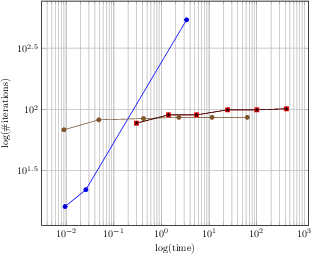
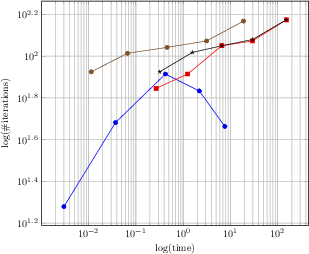
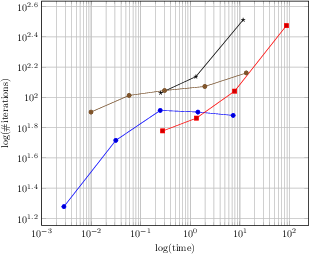

Figure 2: Iteration number relative to the solving time.
A case of diminished multigrid effectiveness is observed for [Q1−(Q1+B)−P0] with P3, indicating the limitations of Vanka smoothers for certain interface FE-multiplier pairings.
Theoretical and Practical Implications
This study provides rigorous confirmation that multigrid-accelerated preconditioners can deliver near mesh-independent convergence rates for block-structured FD-DLM formulations. Several points are reinforced:
- Block triangular preconditioners (P1, P2) are robust, while diagonal variants often lack efficacy.
- For discontinuous Lagrange multiplier discretizations, careful design of the smoother (e.g., Vanka) is critical to unlocking the full potential of multigrid.
- Purely diagonal preconditioners are not suitable for these saddle-point systems, especially for discontinuous multipliers.
The data further suggest that multigrid smoothing parameters (such as number of pre/post-smoothing steps and block-locality in Vanka updates) merit further optimization for interface problems, especially as FE spaces become more complex or when moving toward fully unstructured meshes.
Future Directions
Potential avenues for advancing the state-of-the-art include:
- Theoretically-grounded analysis of multigrid convergence rates for full 3×3 block systems.
- Design and evaluation of preconditioners leveraging the entire matrix structure rather than approximate 2×2 reductions.
- Extension of the approach to time-dependent interface dynamics and three-dimensional geometries.
- Adaptive smoothing and V-cycle parameter selection, possibly using machine-in-the-loop optimization, to maximize preconditioner performance for arbitrary FE discretizations and interface geometries.
Conclusion
The application of multigrid-based block preconditioners to FD-DLM discretizations of elliptic interface problems is validated. Triangular block preconditioners in combination with geometric multigrid for elliptic blocks and Vanka-type smoothers on the saddle-point block exhibit excellent stability, efficiency, and scalability with mesh refinement. This work establishes a solid platform for future algorithmic and theoretical advances in efficient interface problem solvers, with clear extensions to multiphysics and moving interface scenarios.