- The paper unifies safety and security in multimodal foundation models by applying an information-theoretic framework alongside game-theoretic defenses.
- It employs analysis of information flows, channel capacity, and defense strategies to counter misleading, mislearning, and inference attacks.
- The work underscores the need for integrated model-level and system-level safeguards, paving the way for future research in robust AI systems.
The Security-Safety Continuum in Multimodal Foundation Models
The paper "SoK: The Security-Safety Continuum of Multimodal Foundation Models through Information Flow and Game-Theoretic Defenses" addresses the safety and security challenges inherent in Multimodal Foundation Models (MFMs). It proposes an information-theoretic framework to unify safety and security concepts and categorizes threats at both the model and system levels, offering a structured approach to developing defense mechanisms.
Multimodal Foundation Models and Their Challenges
MFMs integrate diverse data modalities like text, images, and audio, enabling them to perform complex tasks adaptable to a wide range of applications. However, this integration introduces unique safety and security challenges, especially when deployed in high-stakes environments. The paper highlights the intertwined nature of safety (reliability and harm-free operation) and security (protection against malicious attacks) in the context of MFMs, where the richer data forms lead to more complex and covert attack vectors compared to simpler unimodal models.
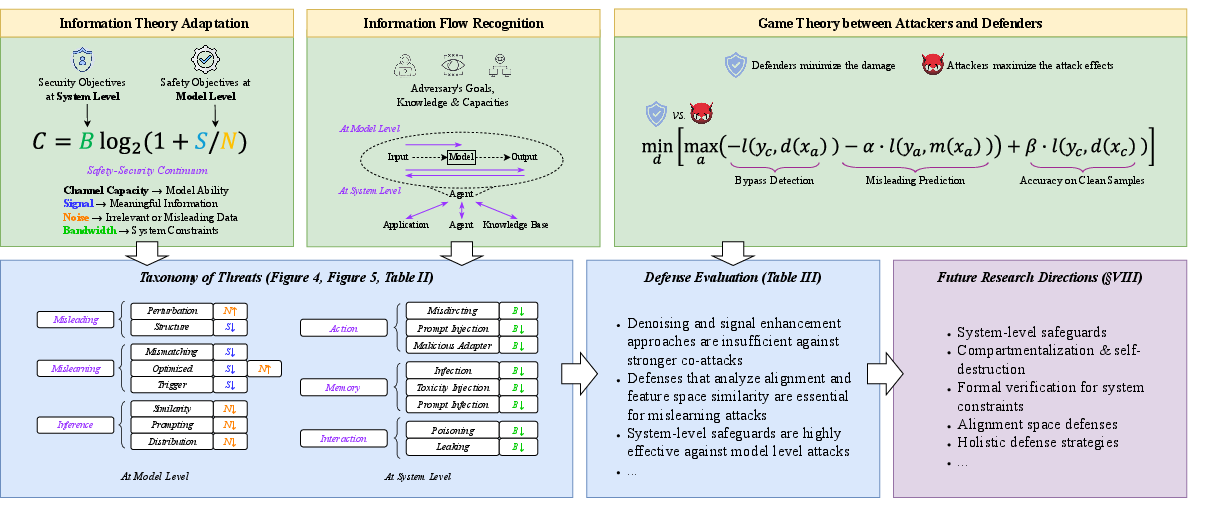
Figure 1: An overview of the SoK, illustrating the combination of information-theoretic frameworks and minimax game-theoretic defenses.
The paper proposes using an information-theoretic approach, adapting concepts from the Shannon-Hartley theorem, to analyze and categorize threats in MFMs. By examining channel capacity, signal, noise, and bandwidth, the framework provides a way to understand how information flows through MFMs and how vulnerabilities can emerge. At the model level, safety threats reduce signal quality or amplify noise, degrading the model's reasoning and reliability. System-level analysis considers bandwidth constraints, revealing risks from interactions between agents and components.
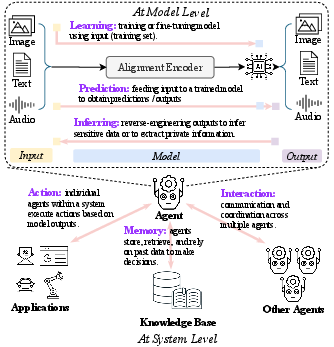
Figure 2: An illustration of information flows within an MFM system.
Threats and Attacks
The paper categorizes threats into three main types at the model level: misleading, mislearning, and inference attacks. Misleading attacks deceive models during inference, while mislearning attacks compromise the training process, causing the model to learn incorrect patterns. Inference attacks extract private information from the model by exploiting its outputs.
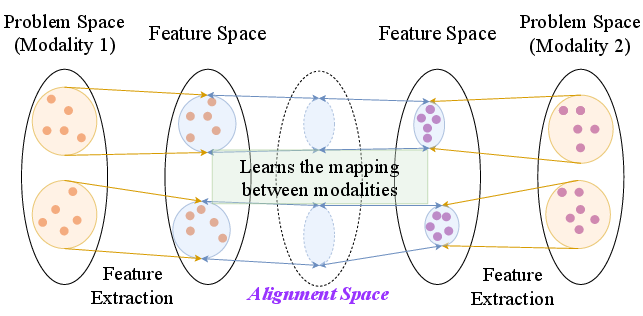
Figure 3: An illustration of multimodal learning, showing the integration of continuous feature spaces from different modalities.
Defense Strategies
Defenses are explored through a minimax game-theoretic approach, framing interactions between attackers and defenders. At the model level, defense strategies include noise reduction, signal enhancement, and bandwidth constraints. However, the paper emphasizes the limitations of model-level defenses alone and advocates for system-level safeguards. These include imposing constraints on the system's information flow to block unauthorized or harmful data, complemented by system-level safety filters that reinforce the model's outputs.
Directions for Future Research
The paper identifies several areas for further research, including the security of agent-enabled systems, formal verification of system constraints, and cryptographic controls for oversight over critical operations. The need for holistic defense strategies that integrate model-level and system-level protections to ensure comprehensive resilience against multimodal threats is also highlighted.
Conclusion
By unifying safety and security analysis under an information-theory framework, the paper offers a new perspective for understanding and mitigating threats in MFMs. Through a comprehensive review of existing works and identification of research gaps, it lays the groundwork for developing more robust and trustworthy MFM systems. This work serves as a spur for further discussions and explorations into safeguarding complex AI systems.

