- The paper introduces a novel, ethnically diverse 3D facial mesh dataset with 188 high-fidelity models and detailed 68-landmark annotations.
- It leverages FaceBuilderHead and the dlib 68-landmark model to achieve precise facial topology capture and feature alignment.
- The dataset's extensive demographic coverage supports training unbiased, robust models for advanced 3D facial reconstruction and analysis.
3D2M Dataset: A 3-Dimension Diverse Mesh Dataset
Introduction to the 3D2M Dataset
The "3D2M Dataset: A 3-Dimension diverse Mesh Dataset" presents a comprehensive dataset of 3D facial meshes designed to address the complexities of facial reconstruction. This dataset is pivotal for advancing 3D reconstruction techniques due to the inherent challenges of accurately modeling human faces, characterized by their intricate geometries and the necessity for high fidelity to small features. The dataset contains 188 3D facial meshes with detailed landmark annotations, reflecting a diverse blend of 45 ethnic backgrounds. It encapsulates both male and female samples, thereby ensuring an inclusive resource for enhancing facial reconstruction models.
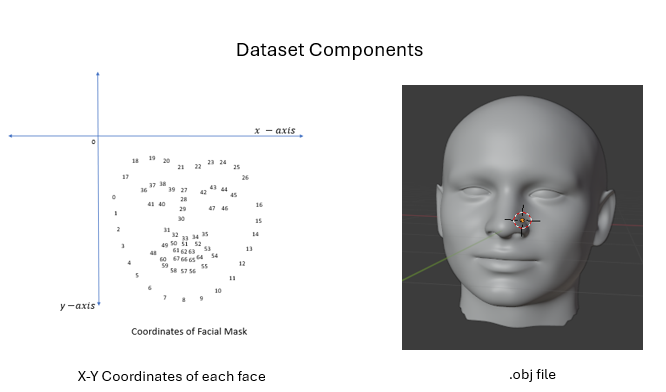
Figure 1: The dataset consists of .obj files and keypoints vector files.
Dataset Composition and Structure
The 3D2M dataset includes 188 facial meshes, divided into 73 female and 114 male samples. These meshes are stored in .obj files (simplified format by [liu20213d]), with each containing around 17,000 vertex points defined with normals. The dataset is bolstered by its ethnic diversity, representing 45 unique ethnicities, which is crucial for training facial models with minimal bias. The dataset's folder structure categorizes facial meshes into male and female subsets, with meticulous organization facilitating accessibility and usability within various research applications.
Methodology and Feature Selection
The methodology for constructing the 3D meshes leverages FaceBuilderHead, which ensures accurate topology capture aligned with the vertex and face normal design. The dataset uses the dlib 68-landmark model, highlighting essential facial feature points and assisting in the precise alignment of facial landmarks. These landmark coordinate points are stored alongside the OBJ mesh files, forming a comprehensive dataset resource.
The inclusion of well-defined feature selection via the dlib 68-landmark technique enhances the dataset's application in numerous facial analysis domains, allowing for accurate tracking and manipulation of facial dynamics essential for emotion recognition, identity verification, and video stream real-time representations.
The development of the 3D2M dataset aligns with recent advancements in 3D facial reconstruction, where significant datasets like AFLW2000-3D, FaceWarehouse, and others have contributed to the field. Notably, these datasets vary in their coverage of demographic diversity, which is foundational to minimizing bias in facial recognition tasks. The 3D2M dataset addresses these gaps by providing extensive ethnic representation, thus fulfilling a critical need for training models that demonstrate reliable performance across multifaceted demographic attributes.
Compared to alternative models and datasets, the 3D2M utilizes a robust annotation scheme greatly supporting neural network training for facial feature recognition and 3D reconstruction tasks. This strength is juxtaposed against the backdrop of increasing reliance on deep learning strategies, such as GANs and CNNs, which benefit significantly from heterogeneous training data.
Conclusion and Future Directions
The 3D2M dataset represents a robust tool for researchers engaged in 3D reconstruction and facial analysis domains, characterized by its comprehensive ethnic diversity, gender inclusivity, and the precision of its landmark annotations. It supports the development of sophisticated models capable of handling demographic variations and advancing realism in 3D facial reconstructions.
Future work envisions extending the 3D2M dataset by incorporating texture maps for each facial model, enhancing visual realism necessary for applications in VR, AR, and more nuanced facial technology systems. This addition will potentiate the dataset's usefulness, broadening its applicability across diverse fields and scenarios.