- The paper introduces the PID model that integrates physical infrared laws to translate RGB images into authentic infrared representations.
- It leverages a latent diffusion framework with TeV decomposition and augmented physical losses to enforce thermal properties.
- Experiments on KAIST and FLIR datasets show significant improvements in SSIM, PSNR, and LPIPS compared to conventional methods.
Introduction to the Concept
The paper presents the Physics-Informed Diffusion (PID) model, a novel approach for translating RGB images into infrared images through a physics-informed diffusion model. This method addresses the limitations of conventional RGB-to-infrared translation techniques that often overlook the physical laws governing infrared imaging. By integrating infrared physical laws into the training process of diffusion models, PID ensures adherence to real-world physical characteristics, significantly enhancing the quality and authenticity of the translated infrared images.
Theoretical Framework
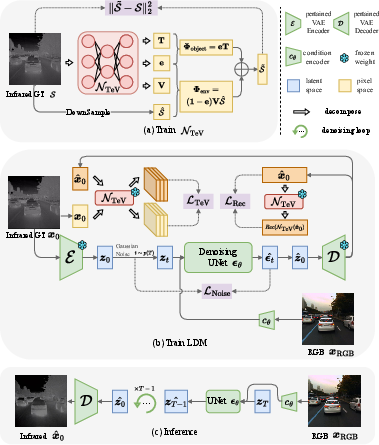
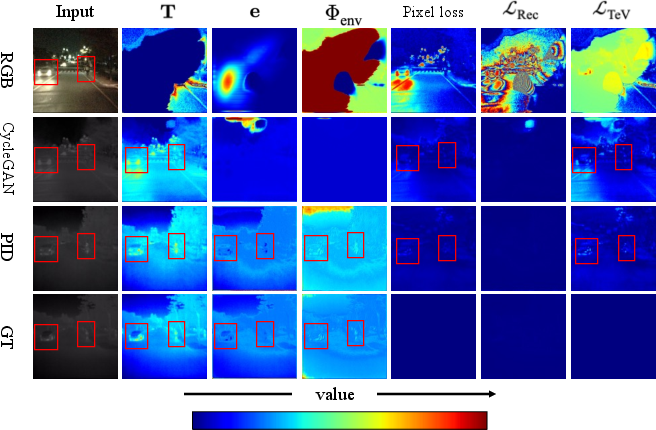
Infrared image generation traditionally suffers from the lack of explicit consideration of physical principles. The PID model proposes a methodology that incorporates these principles into the generative process. Specifically, the latent diffusion model is leveraged for iterative optimization, introducing physical constraints using a self-supervised TeV decomposition network. The fundamental physical components—Temperature (T), Emissivity (e), and Thermal texture (X)—are computed, forming the backbone of the imposed physical constraints during the diffusion model's training.
Methodology
Diffusion Model Overview
The core of the PID model relies on the key concept of diffusion models, which employ a stochastic process to iteratively refine noisy images back to their clean state. The process is governed by the following sequence:
- Noising Process: Starts with a clean image x0 and successively adds Gaussian noise controlled by a parameter αt, following a Markov chain.
- Denoising Process: Commences with a pure noise vector, iteratively refining it through a learned variance-based schedule to revert it to a high-quality image.
Introduction of Physical Losses
The integration of physical laws is achieved by:
- TeV Decomposition: A custom decomposition mechanism designed to handle superimposed spectra from standard infrared cameras. This facilitates the prediction of thermal characteristics by transforming RGB images into conformant infrared representations.
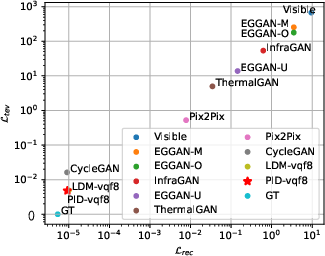
- Loss Augmentation: Two additional losses are introduced:
Experimental Evaluation
The PID model was rigorously tested on prevalent datasets like KAIST and FLIR to demonstrate its efficacy. Key performance metrics utilized include SSIM, PSNR, LPIPS, and FID, comparing PID against various baseline models, including GANs and conventional diffusion models.
Results on KAIST and FLIR
Conclusion and Future Work
The PID model significantly advances the translation of RGB images to infrared imagery by embedding physical laws into diffusion processes, resulting in more genuine infrared representations. The practical implications are expansive, promising better data augmentation methodologies for autonomous systems. Future endeavors will aim to refine the accuracy of the physical decomposition and enhance the diffusion model's generative capabilities, paving the way for more realistic synthesis of infrared imagery.