Determination of the Néel vector in rutile altermagnets through x-ray magnetic circular dichroism: the case of MnF$_2$
Abstract: We present a numerical simulation of the X-ray magnetic circular dichroism (XMCD) at the $L_{2,3}$ edge of Mn in altermagnetic MnF$_2$ using a combination of density functional + exact diagonlization of an atomic model. We explore how the dichroic spectra vary with the light propagation vector and the N\'eel vector. We show how XMCD in rutile structures can be employed to determine the orientation of the N\'eel vector. An exact relationship between the XMCD spectra for different orientation of the N\'eel vector valid in the absence on the valence spin-orbit coupling and core-valence multipole interaction is derived and its approximate validity demonstrated by numerical calculation for the full Hamiltonian.
Paper Prompts
Sign up for free to create and run prompts on this paper using GPT-5.
Top Community Prompts
Explain it Like I'm 14
What is this paper about?
This paper shows a new, simple way to figure out which way the tiny magnetic “arrows” inside a special kind of magnetic crystal are pointing. The team focuses on MnF2 (manganese fluoride), a crystal with a rutile structure, and uses a light-based technique called x-ray magnetic circular dichroism (XMCD) to read out the direction of its Néel vector—the arrow that tells you the overall direction of antiferromagnetic order. Their key message: by looking only at XMCD and how it changes with direction, you can tell not just the direction in the plane, but even the “sign” (which of two opposite directions it points to) of the Néel vector in this kind of material.
What questions were they trying to answer?
- Can XMCD alone tell us the in-plane direction of the Néel vector in rutile “altermagnets” like MnF2?
- Is there a clean, predictable link between how the XMCD signal looks and the angle of the Néel vector?
- How much do complicated atomic effects (like spin-orbit coupling and core–valence interactions) change that link in real materials?
How did they study it?
Think of the atoms in MnF2 like a small neighborhood of spinning tops (electrons). In an antiferromagnet, neighboring tops point in opposite directions, so there’s no net magnetization like in a bar magnet. The Néel vector is like a single arrow summarizing that opposite arrangement.
To read out that arrow, they used:
- XMCD: Shine x-rays whose electric field “twirls” either right or left (right- and left-circularly polarized light) onto the material. If the material absorbs right-twirling light differently than left-twirling light, that difference (XMCD) depends on the magnetic arrangement inside. You can imagine this like two special pairs of sunglasses that let in slightly different colors when the spins are arranged a certain way.
- The Mn L2,3 edges: These are specific x-ray energies that excite electrons from deep “2p” levels up into “3d” levels in manganese. They are especially sensitive to the magnetic and orbital states of Mn.
- Computer modeling at two levels:
- Density Functional Theory (DFT): A standard quantum method to get the crystal’s electronic environment (the “landscape” the electrons live in).
- Atomic multiplet model with exact diagonalization: A detailed atom-based model that solves all relevant quantum states of the Mn atom plus its interactions, so it reproduces the fine structure of the x-ray spectra.
They also tested how the results change when they include or ignore:
- Spin-orbit coupling (SOC): A tiny link between an electron’s spin and its orbital motion.
- Core–valence interactions: How the excited “core hole” (left behind when a 2p electron jumps up) interacts with the 3d electrons, shaping the spectral lines.
Finally, they simulated what happens when a strong magnetic field tilts the spins slightly out of the plane (this happens in MnF2 at about 9–10 tesla, called a “spin-flop” transition).
What did they find?
Here are the main takeaways:
- XMCD reveals the in-plane Néel direction in rutile MnF2:
- If the Néel vector points along the c-axis (out of the plane), symmetry forces the XMCD to vanish.
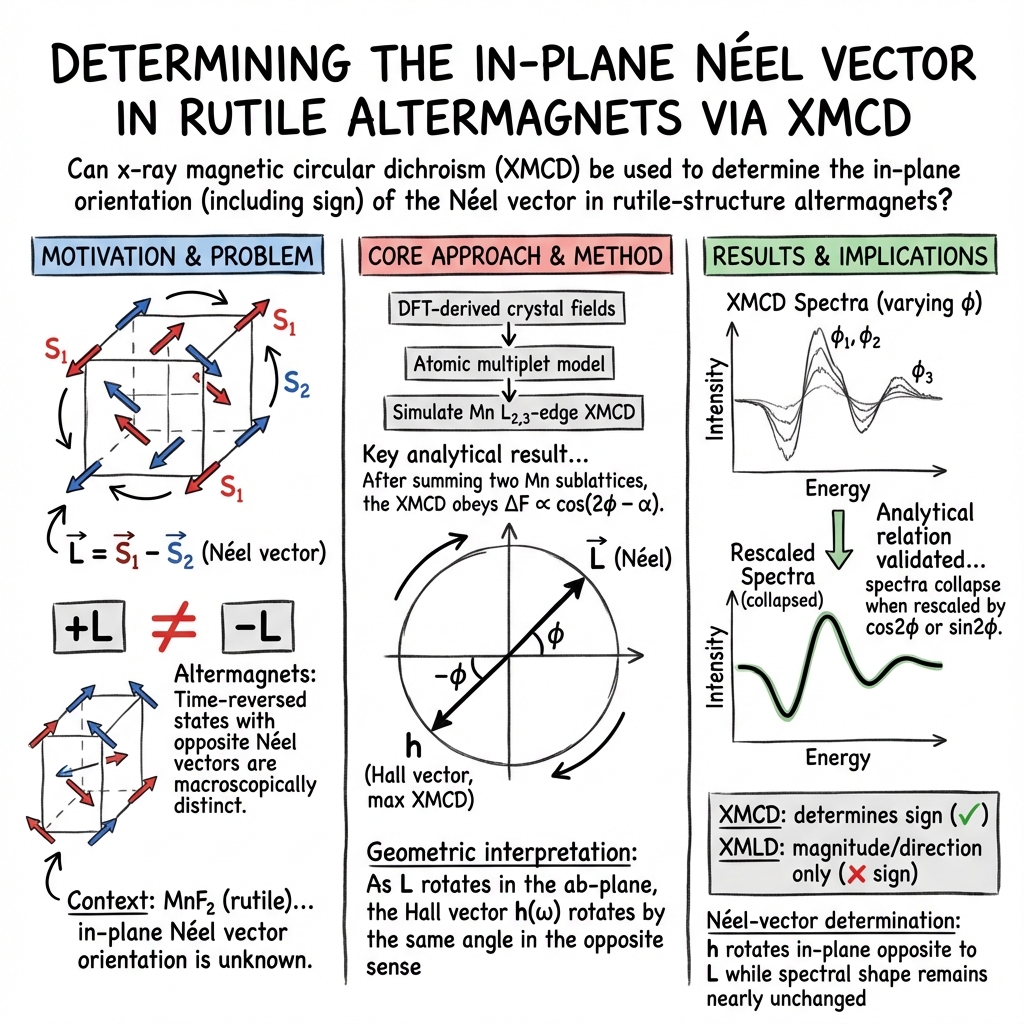
- If the Néel vector lies in the ab-plane, XMCD appears—and its behavior is strongly tied to the Néel vector’s angle in that plane.
- A simple rotational rule links XMCD and the Néel vector:
- Neglecting two small effects (valence spin-orbit coupling and a certain part of the core–valence interaction), the shape of the XMCD spectrum stays the same as you rotate the Néel vector in the plane.
- Only the direction of the “XMCD Hall vector” h (the direction where XMCD is strongest) rotates, and it rotates in the opposite sense to the Néel vector. In plain words: spin arrow turns one way, the XMCD “pointer” turns the other way by the same amount.
- The XMCD intensity changes with angle in a predictable wave-like way (like a cosine of twice the angle). This makes it possible to back-calculate the Néel direction just from XMCD measurements taken at different beam directions.
- The rule still works well even with full physics:
- When they put back the small effects (valence SOC and the detailed core–valence multipole interaction), the simple rotation-and-rescaling rule remains a very good approximation. In other words, the practical method still works.
- XMCD can distinguish the “sign” of the Néel vector:
- In many antiferromagnets, standard x-ray linear dichroism (XMLD) can tell you the axis but not whether the Néel vector points “this way” or the exact opposite.
- Here, XMCD changes sign when you flip the Néel vector, so it can tell those two apart—very useful for altermagnets where opposite Néel states are physically distinct.
- Tilted spins add a separate XMCD “fingerprint”:
- In the real spin-flop state, the spins tilt a little out of the plane because of the field. This adds a small, extra XMCD component along the c-axis.
- That extra piece has a different spectral shape, so you can separate it from the main altermagnetic XMCD. This helps correct for experimental misalignments.
- Compared to a similar material (like MnTe), symmetry matters:
- Even though MnF2 and MnTe both have Mn2+ (spin 5/2) and are insulating, their crystal symmetries differ, and that changes the “allowed” XMCD.
- In MnF2, XMCD is larger and remains strong even if you ignore certain interactions; in MnTe, XMCD is weaker and relies more on those interactions. This shows that crystal symmetry is the key player.
Why does this matter?
- A practical “compass” for antiferromagnets and altermagnets: The method gives a clean, all-optical way to read the Néel vector’s in-plane direction—and its sign—using XMCD alone. That’s a big deal because controlling and reading Néel states is central to antiferromagnetic spintronics, a technology field aiming for faster, more stable, and less power-hungry memory and logic devices.
- Simpler experiments: You don’t need extra probes or complex setups—just measure XMCD at different beam directions and use the rotation rule to decode the Néel vector.
- Design insight: The work shows how symmetry, more than small atomic effects, decides whether XMCD will appear and how strong it will be. That helps researchers choose or design materials where magnetic states can be read and controlled more easily.
- Broader impact: The approach can apply to other materials with similar symmetries, not just MnF2, making it a useful tool across studies of magnetism in crystals.
In short, the paper turns XMCD into a straightforward “direction finder” for the hidden magnetic order in MnF2-like crystals, paving the way for better magnetic devices and clearer experiments.
Collections
Sign up for free to add this paper to one or more collections.