- The paper introduces a novel ML framework that uses blockchain transaction graphs for Bitcoin price prediction, outperforming traditional feature engineering methods.
- It employs a k-order subgraph approach and occurrence matrices to encode transaction patterns, providing a robust representation of historical blockchain data.
- Experimental evaluation shows lower MAPE values compared to baselines, illustrating significant improvements in prediction accuracy for investment strategies.
A Blockchain Transaction Graph Based Machine Learning Method for Bitcoin Price Prediction
Introduction
Bitcoin, a leading cryptocurrency, exhibits significant price volatility, making accurate price prediction crucial for investors. Traditional methods rely heavily on feature engineering, integrating data from blockchain information, financial metrics, and social media sentiment, which requires extensive manual effort and may lack robustness. This paper introduces a novel automated approach leveraging transaction graphs to uncover latent patterns in Bitcoin blockchain data for more precise price forecasting. This method significantly outperforms existing state-of-the-art approaches, providing a comprehensive framework for predicting Bitcoin prices using only blockchain transaction data.
Methodology
The proposed methodology utilizes a k-order transaction subgraph approach to represent Bitcoin blockchain data, capturing different transaction patterns by considering transaction flows across varying scopes.
Problem Definition
The Bitcoin price prediction is treated as a regression problem, where the task is to predict the future price Pt+h based on historical blockchain data from the period [t−i,t]. Defining and computing features from the blockchain as input to machine learning models is central to this approach.
Transaction Graph and k-Order Subgraphs
The transaction graph G=(A,T,E) represents the Bitcoin network, where A is the set of addresses, T is the set of transactions, and E consists of directed edges indicating inputs and outputs between addresses and transactions. The k-order transaction subgraphs extend this representation by including paths of transactions, capturing deeper transaction patterns within the blockchain network.
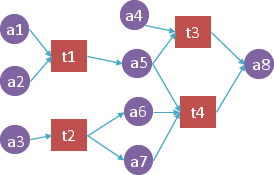
Figure 1: A Simple Transaction Graph.
The occurrence matrices encode transaction subgraph patterns, capturing the frequency of different input-output patterns in the blockchain. This information is processed through a sequence of matrix multiplications to derive transition and occurrence matrices iteratively, allowing efficient computation of pattern frequencies.
- Transition Matrix Calculation: For a k-order graph, matrices H, P, and Q are utilized to derive the transition matrix Mk through iterative multiplication. The occurrence matrix OCk is then derived from Mk.
- Pattern Encoding: Based on the number of input and output addresses, subgraphs are categorized into patterns and encoded in occurrence matrices, OCk.
(Figure 2 and Figure 3)
Figure 2: $1$ Order Transition Matrix M1 of Transaction Graph.
Figure 3: $2$ Order Transition Matrix M2 of Transaction Graph.
Experimental Evaluation
The proposed method was evaluated on Bitcoin price data from two intervals and compared with state-of-the-art methods.
Data Preparation
Data from the Bitcoin blockchain and historical price records were collected for two periods, each comprising both training and testing datasets. The performance was measured using Mean Absolute Percentage Error (MAPE), providing a robust comparison metric.
(Figure 4 and Figure 5)
Figure 4: Bitcoin Daily Closing Price of Interval 1.
Figure 5: Bitcoin Daily Closing Price of Interval 2.
Results
The method demonstrated significantly improved prediction accuracy over Mallqui et al.'s SVM model, especially when integrating models across varying historical periods.
- Prediction Accuracy: The method achieved lower MAPE compared to baseline models, validating the effectiveness of the transaction graph-based features and multiple historical period integration.
(Figure 6 and Figure 7)
Figure 6: Price Prediction Results on interval1.
Figure 7: Price Prediction Results on interval2.
Conclusion
This study presents an effective machine learning framework to predict Bitcoin prices using transaction graph-based features, auto-encoded from blockchain data. By mining latent transaction patterns and employing a multi-period modeling strategy, the method provides superior predictive performance. The implications for practical investment strategies in cryptocurrency markets are significant, and future research could explore similar approaches for other blockchain-based assets.