- The paper introduces a model where firms integrate discrete ideas to form innovative technologies while balancing secrecy with openness.
- It employs a multiplicative interaction rate and equilibrium analysis to reveal a critical threshold between sparse and dense network connectivity.
- The study proposes policy interventions, such as using informational intermediaries, to overcome strategic inefficiencies and enhance innovation.
Introduction
The paper "Innovation and Strategic Network Formation" (1911.06872) explores a model of innovation where multiple firms generate new technologies by integrating a variety of discrete ideas. This process is influenced by firms' strategic decisions to interact with others, leading to a dynamic network of learning and competition. Firms must balance between maintaining secrecy to protect proprietary ideas and openness to facilitate learning from others. These decisions ultimately form a learning network that impacts the rates of innovation and overall welfare. The paper analyzes the equilibrium properties of these networks and suggests policy interventions to enhance innovation rates.
Model
The model consists of n firms, each capable of discovering distinct ideas and potentially combining them to create new technologies. The complexity of a technology is determined by the parameter k, which is the number of ideas required to form a technology. Interaction rates between firms, influenced by each firm's openness, determine the likelihood of firms learning ideas from one another. The interaction is characterized by a multiplicative rate ι(qi,qj)=qiqj, influencing both direct and indirect learning opportunities.
Firms' profits are defined by the technologies they can monopolize, with a firm profiting if it uniquely holds all the component ideas of a technology. Competition erodes these profits if other firms also learn the necessary ideas, making firms' strategic choice of interaction and investment levels critical.
Equilibrium and Network Structure
The study investigates the equilibrium states of these strategic networks and identifies a critical threshold at which the networks transition from sparse to dense. At equilibrium, the networks are poised at this critical threshold, implying that firms are neither too connected nor too isolated, which results in significant inefficiencies. The learning network's equilibrium exhibits sparse connections where firms interact minimally to avoid excessive competition, despite the potential for enhanced innovation through deeper connectivity.
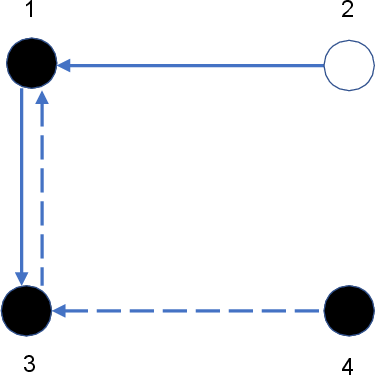
Figure 1: Network with four firms and k=3. Black circles are firms that discover ideas while white circles do not discover ideas. Arrows represent information flow, with direct and indirect learning indicated by dashed and solid lines.
(This structure is visualized in Figure 1, where learning paths between firms differ due to strategic choices.)
Implications for Innovation and Policy
The model reveals substantial room for improvement in innovation and welfare by increasing interaction rates beyond equilibrium levels. Current equilibria exhibit learning networks that hinder potential innovation due to the competitive costs of openness. The study suggests that strategic interventions could potentially alter these networks to exceed the critical threshold, resulting in higher innovation rates. Proposed interventions include informational intermediaries, such as public innovators, who facilitate idea flow without competitive secrecy, effectively enhancing connectivity and idea dissemination.
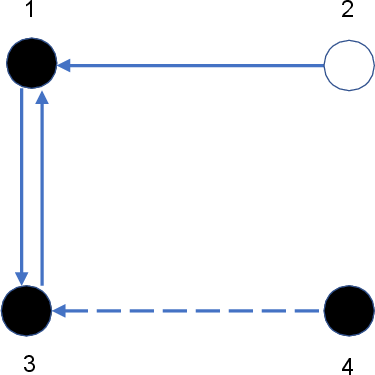
Figure 2: Network enhancement through indirect learning, where additional interactions increase overall connectivity and innovation potential.
(Figure 2 illustrates how introducing indirect learning pathways can bridge across existing network voids, enhancing overall connectivity and innovation potential.)
Robustness and Extensions
The findings extend to scenarios involving asymmetric learning probabilities, varying firm propensities for openness, and changes to profits under competition. The critical network threshold remains robust across these variations, showing that factors like heterogeneity in firm behavior or changes in profit dynamics primarily influence the degree of openness but not the qualitative state of equilibrium.
In cases where firms derive positive profits under competition, the equilibrium can become supercritical, encouraging more interaction and innovation. Conversely, increasing competitive costs can drive the equilibrium into a subcritical state, reducing connectivity and innovation rates.
Conclusion
The research underscores the substantial inefficiencies present in equilibrium learning networks formed by competing firms. Policymakers and industry stakeholders can exploit these inefficiencies by designing incentives and structures that move networks beyond critical thresholds, potentially transforming the competitive landscape into one that fosters higher rates of innovation and welfare. Public innovators, or strategically introduced intermediaries, are highlighted as practical solutions to bridge firms and diffuse ideas effectively, driving the network dynamics towards a more collaborative and productive state.