Epistemic vs Ontic Classification of quantum entangled states?
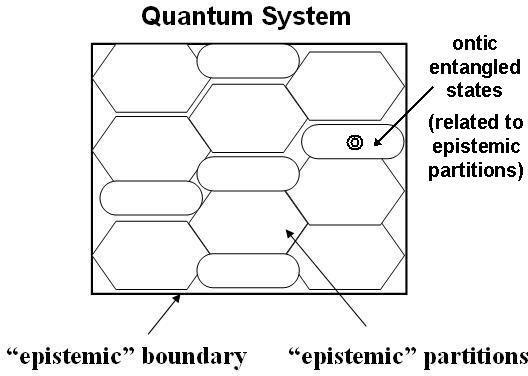
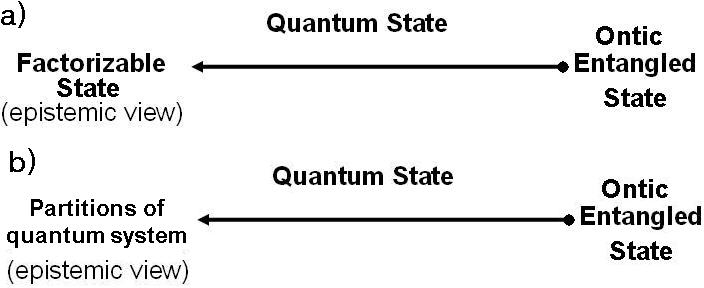
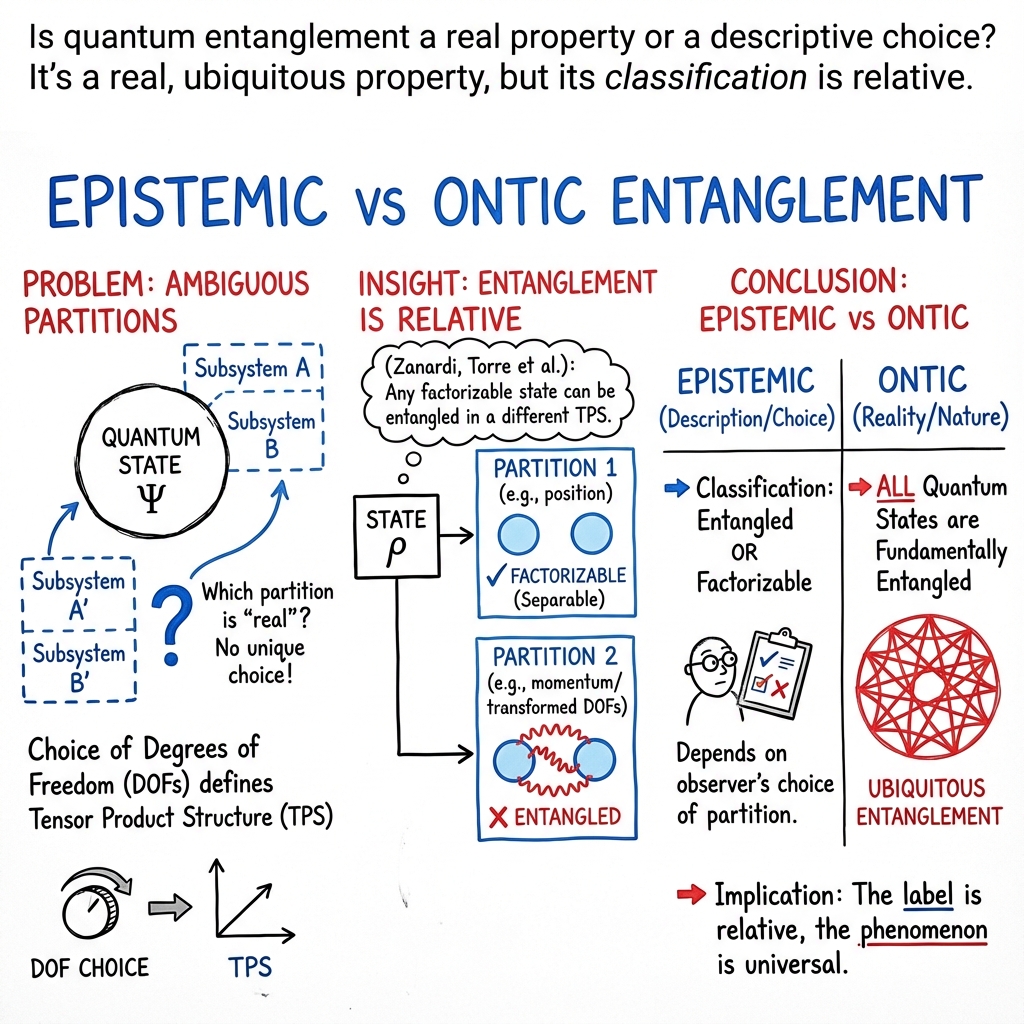
Abstract: In this brief paper, starting from recent works, we analyze from conceptual point of view this basic question: can the nature of quantum entangled states be interpreted ontologically or epistemologically? According to some works, the degrees of freedom (and the tool of quantum partitions) of quantum systems permit us to establish a possible classification between factorizable and entangled states. We suggest, that the "choice" of degree of freedom (or quantum partitions), even if mathematically justified introduces an epistemic element, not only in the systems but also in their classification. We retain, instead, that there are not two classes of quantum states, entangled and factorizable, but only a single class of states: the entangled states. In fact, the factorizable states become entangled for a different choice of their degrees of freedom (i.e. they are entangled with respect to other observables). In the same way, there are no partitions of quantum systems which have an ontologically superior status with respect to any other. For all these reasons, both mathematical tools utilize(i.e quantum partitions or degrees of freedom) are responsible for creating an improper classification of quantum systems. Finally, we argue that we cannot speak about a classification of quantum systems: all quantum states exhibit a uniquely objective nature, they are all entangled states.

Paper Prompts
Sign up for free to create and run prompts on this paper using GPT-5.
Top Community Prompts
Knowledge Gaps
Knowledge gaps, limitations, and open questions
Below is a single, actionable list of what the paper leaves uncertain or unexplored, focusing on gaps future researchers could address.
- Provide a rigorous, domain-general theorem (or counterexamples) establishing whether “every quantum state is entangled” under some change of degrees of freedom or tensor-product structure (TPS), specifying precisely the allowed transformations (e.g., global unitaries, linear canonical transformations, Bogoliubov transformations) and covering pure/mixed states and finite/infinite-dimensional Hilbert spaces.
- Define what counts as a physically admissible change of partitions/degrees of freedom: formulate operational constraints (locality, symmetry, superselection rules, conservation laws, energy scales, accessibility of observables, control limitations) that restrict TPS changes to those realizable in experiments.
- Clarify and formalize the role of the observer: model “observer-dependence” via sets of accessible observables/subalgebras and characterize how entanglement classification changes with different operational capabilities.
- Develop entanglement measures and monotones that are either invariant under the allowed TPS transformations or explicitly context-aware, and specify how resource theories (e.g., LOCC) should be reformulated when locality is defined relative to a variable TPS.
- Give explicit, experimentally viable protocols that take a state considered separable under a standard partition and demonstrate Bell-inequality violations (or other nonclassical correlations) under an alternative, physically implementable choice of observables/partitions, including noise and measurement-model details.
- Determine whether there exist “absolutely separable” or “absolutely entangled” states relative to a physically admissible set of TPS changes; characterize these sets and the conditions (symmetries, spectra, ranks) under which they arise.
- Provide algorithms to find a TPS (or degrees of freedom) that maximizes entanglement or renders a given state separable, given a system’s Hamiltonian and accessible control operations.
- Analyze dynamical constraints: specify how interaction terms and the system–environment Hamiltonian select or constrain natural partitions, and derive criteria for when a TPS is dynamically robust or fragile.
- Address the impact of decoherence and pointer states: investigate whether environment-induced superselection effectively privileges certain partitions, potentially undermining the claim that no partition has ontologically superior status.
- Extend the analysis beyond finite-dimensional systems to continuous-variable systems and quantum field theory, where local algebras and type-III von Neumann factors complicate TPS definitions and entanglement notions.
- Distinguish mathematically induced entanglement (via abstract TPS refactorizations) from operationally relevant spatial entanglement between physically separated subsystems; specify which TPS changes preserve spatial locality and relativistic causality.
- Formalize the conditions under which a “separable” state can violate Bell inequalities after a change of observables: provide necessary and sufficient conditions and examine compatibility with locality constraints and Fine’s theorem.
- Strengthen the treatment of mixed states: extend the paper’s largely pure-state reasoning to mixed states with realistic noise, and quantify how entanglement can emerge or vanish under TPS changes for mixed states.
- Build a taxonomy of TPS families generated by symmetries and physically meaningful transformations (e.g., mode-mixing, Gaussian operations, Bogoliubov maps), and systematically map their effects on entanglement generation and detection.
- Integrate superselection rules and conserved quantities into the framework: specify how TPS changes interact with charge, particle number, and parity sectors, and how these constraints alter entanglement detectability.
- Provide an operationally testable definition of the paper’s “ontic entanglement of all states”: articulate empirical consequences that differentiate this stance from the standard view where separability is partition-relative.
- Reconcile the claim of ubiquitous entanglement with the emergence of classicality: construct models showing how effective classical separability arises from ubiquitous ontic entanglement under coarse-graining, decoherence, and limited control.
- Offer a precise, non-ambiguous mathematical definition of “epistemic” vs “ontic” properties in this context (e.g., via operational-probabilistic theories, categorical frameworks, or algebraic quantum theory) and apply it to classify partitions and entanglement claims.
- Specify the limits of the Torre/Zanardi arguments: identify assumptions under which their conclusions hold and where they may fail (e.g., restricted control, locality, SSRs), and quantify the scope of their “entanglement for all states” claim.
- Connect the paper’s conceptual stance to unresolved classification problems (multipartite entanglement, continuous variables, mixed states): propose concrete pathways (proof techniques, invariants, operational criteria) for advancing these open areas under a TPS-relative framework.
Practical Applications
Immediate Applications
Below are actionable use cases that can be deployed now, derived from the paper’s findings on the relativity of entanglement with respect to partitions and degrees of freedom, and the notion of “virtual subsystems.”
- Entanglement-aware experimental design and reporting
- Sector: Academia, Policy, Quantum Industry
- Use case: Experimental groups explicitly specify the chosen tensor-product structure (TPS), degrees of freedom, and measurement bases when claiming entanglement or separability. Report entanglement witnesses along with the operational constraints (the accessible observables and operations).
- Tools/products/workflows: “Entanglement Context Tagger” for lab notebooks and publications; templates for device certification reports; extensions to quantum tomography software to annotate TPS and basis choices.
- Assumptions/dependencies: Requires community acceptance that entanglement is relative to a chosen TPS; depends on practical ability to implement and verify basis changes and observable sets.
- Virtual subsystems and noiseless subspaces encoding
- Sector: Quantum software and hardware (superconducting qubits, trapped ions, photonics)
- Use case: Encode logical qubits into “virtual subsystems” (noiseless subsystems/decoherence-free subspaces) to mitigate noise by redefining subsystems per Zanardi’s framework.
- Tools/products/workflows: “Virtual Subsystems Encoder” library integrated with Qiskit/Cirq; compilers that automatically identify and map to DFS/noiseless subsystems; calibration workflows that discover stable virtual partitions.
- Assumptions/dependencies: Requires controllable operations to realize encoded bases; depends on stable symmetries/noise models; overhead from encoding must not negate benefits.
- Basis/domain selection for disentanglement in quantum control
- Sector: Quantum control and sensing (NMR/MRI, trapped ions, superconducting circuits)
- Use case: Use canonical/normal-mode transformations to temporarily reduce operational entanglement (or decouple spectator modes) during gates or spectroscopy.
- Tools/products/workflows: Basis-change pulse libraries; normal-mode control toolkits; composite pulse sequences that exploit mode redefinitions to suppress error propagation.
- Assumptions/dependencies: Physical realizability of the DOF transformation; accurate system identification; control bandwidth and calibration fidelity.
- Adaptive partitioning in classical simulation to reduce computational cost
- Sector: Software/HPC, Materials/Energy
- Use case: Choose bipartitions/degrees of freedom to minimize entanglement across tensor network cuts (DMRG/TEBD/MPS), enabling more efficient simulations of many-body systems and materials.
- Tools/products/workflows: “TPS Manager” plugins for tensor-network libraries (ITensor, TeNPy) that auto-select partitions and bases to minimize entanglement entropy; heuristics that adapt partitions during simulation.
- Assumptions/dependencies: Entanglement entropy reduction must align with the system’s physics; gains depend on accurate entanglement estimates and adaptive strategies.
- Quantum compiler optimizations via TPS-aware mapping
- Sector: Quantum software/toolchains
- Use case: Use virtual subsystem identification and basis changes to reduce gate counts, SWAP overhead, and crosstalk by aligning algorithmic entanglement with hardware connectivity.
- Tools/products/workflows: Compiler passes that insert basis-change gates, remap logical qubits to virtual subsystems, and co-design with hardware topology; integration with hardware-aware schedulers.
- Assumptions/dependencies: Additional gates for basis change must lead to net benefit; relies on accurate hardware models and stable connectivity.
- Entanglement detection via multi-basis measurement strategies
- Sector: Academia, Quantum Industry (metrology, device validation)
- Use case: Reveal entanglement in states considered separable under one TPS by switching to alternative observable sets; design entanglement witnesses that vary with context.
- Tools/products/workflows: “Adaptive Entanglement Witness Designer” that proposes measurement settings to maximize Bell inequality violations relative to accessible operations; contextual tomography protocols.
- Assumptions/dependencies: Requires access to multiple measurement bases; finite statistics and noise can limit witness sensitivity.
- Context-aware variational ansatz design for near-term algorithms
- Sector: Software, Finance/Chemistry/Materials (VQE/QAOA/quantum ML)
- Use case: Choose ansätze and measurement partitions that balance expressivity with controllable entanglement to improve optimization stability and reduce barren plateaus and hardware errors.
- Tools/products/workflows: Ansätze libraries that expose basis-change options; auto-tuning tools that select partitions to match problem structure and hardware constraints.
- Assumptions/dependencies: Benefits depend on problem structure and hardware quality; risk of overfitting to specific partitions.
- Education and training on entanglement relativity
- Sector: Education, Academia
- Use case: Curricular modules and interactive demos showing how “separable” states can display entanglement under alternative partitions and measurement sets, clarifying the observer’s role and reporting standards.
- Tools/products/workflows: Interactive notebooks and visualizations; standardized lab exercises that compare entanglement measures under different TPS choices.
- Assumptions/dependencies: Requires clear didactic materials and alignment with existing curricula; community buy-in.
Long-Term Applications
Below are use cases that will require further research, development, or scaling to be viable.
- Standards for entanglement certification and reproducibility
- Sector: Policy, Quantum Industry, Academia
- Use case: Regulatory and standards bodies (e.g., IEEE, NIST) mandate explicit declaration of TPS, accessible operations, and measurement context when certifying entanglement-based devices (e.g., QKD, quantum sensors).
- Tools/products/workflows: Context-aware certification protocols; compliance tools that audit TPS specifications; registries of entanglement metrics tied to operational constraints.
- Assumptions/dependencies: Community consensus on definitions and reporting; robust legal/technical frameworks; interoperability across platforms.
- Runtime-reconfigurable virtual architectures
- Sector: Quantum hardware/software
- Use case: On-the-fly redefinition of subsystems during program execution to minimize operational entanglement where it is costly (noise-prone) and amplify it where it is a resource, guided by live telemetry.
- Tools/products/workflows: Closed-loop controllers detecting entanglement patterns; reconfigurable compilers adjusting TPS in real time; co-designed hardware supporting fast basis transforms.
- Assumptions/dependencies: High-fidelity and fast control; reliable entanglement estimation in situ; overhead from reconfiguration must be amortized.
- Partition-robust entanglement metrics and resource theories
- Sector: Academia (theory), Software
- Use case: Develop and adopt entanglement measures that are robust across families of partitions or quantify entanglement “ubiquity,” improving cross-experiment comparability and algorithm design.
- Tools/products/workflows: Libraries computing multi-context entanglement profiles; benchmarks that test algorithm performance under partition variations.
- Assumptions/dependencies: Requires new theoretical advances; computational feasibility for large systems; validation across platforms.
- Entanglement-aware hardware design and materials engineering
- Sector: Hardware, Energy/Materials
- Use case: Engineer couplers, lattices, and materials to align natural modes with desired virtual partitions, optimizing entanglement where needed and suppressing it elsewhere (e.g., noise isolation, integrability).
- Tools/products/workflows: Co-design frameworks coupling Hamiltonian engineering with TPS-aware algorithm libraries; mode engineering (e.g., parametric couplers, phonon routing).
- Assumptions/dependencies: Sophisticated fabrication and control; reliable modeling of many-body interactions; economic viability.
- Quantum networks and cryptography with contextual entanglement strategies
- Sector: Telecom/Security
- Use case: Dynamic partitioning and basis selection across network nodes to adapt entanglement distribution to channel conditions and adversarial models; context-annotated proofs in device-independent protocols.
- Tools/products/workflows: Network orchestration layers that manage TPS/basis across links; adaptive entanglement swapping strategies; certification of context in security proofs.
- Assumptions/dependencies: Multi-node synchronization; reliable basis control; updated security standards accommodating contextual definitions.
- Automated discovery of useful degrees of freedom via machine learning
- Sector: Software/AI, Academia
- Use case: ML systems that learn transformations revealing low-entanglement partitions for efficient simulation or robust high-entanglement partitions where quantum advantage is needed.
- Tools/products/workflows: “DOF Discovery” models (autoencoders, manifold learning); integration into compilers/simulators; explainability modules to justify chosen partitions.
- Assumptions/dependencies: Sufficient training data; generalization across systems; tractable search in large Hilbert spaces.
- Advanced sensing and imaging via DOF engineering
- Sector: Healthcare (MRI), Chemistry/Materials (NMR), Metrology
- Use case: Design measurement and control sequences that exploit basis changes to enhance sensitivity, suppress unwanted couplings, or reveal entanglement-based contrasts in complex environments.
- Tools/products/workflows: Next-gen pulse design platforms; context-aware calibration; hybrid classical-quantum optimization of sensing protocols.
- Assumptions/dependencies: Hardware capable of precise basis control; validated models of signal enhancement; clinical and regulatory approvals where applicable.
- Cross-disciplinary frameworks for epistemic-ontic clarity in quantum technologies
- Sector: Academia, Policy, Industry
- Use case: Formal guidelines distinguishing epistemic choices (partitions, DOF selection, observer constraints) from ontic claims (device behavior), reducing misinterpretation in R&D and public communication.
- Tools/products/workflows: Best-practice documents; training programs for interdisciplinary teams; audit tools for claims in tech transfer and investment due diligence.
- Assumptions/dependencies: Cultural and institutional adoption; integration with existing scientific norms and funding policies.
Glossary
- Bell pair: A two-qubit maximally entangled state from the Bell basis. "A pure state like the one from Eq.2 is called a maximally entangled state of two qubits, or a Bell pair"
- Bell's inequalities: Bounds on correlations predicted by local realism; their violation signals quantum nonlocality. "pairs of observables that will violate Bell's inequalities."
- bipartite entanglement: Entanglement involving two subsystems. "the complete classification of mixed-state bipartite entanglement"
- complete system of commuting observables: A set of mutually commuting observables that can fully specify states; used to define tensor-product structures. "quantum systems admit a variety of tensor product structures depending on the complete system of commuting observables chosen for the analysis;"
- degrees of freedom: Independent parameters or observables that characterize the state and dynamics of a quantum system. "entanglement in systems with continuous degrees of freedom"
- density matrix formalism: The operator-based framework for representing mixed states and calculating expectation values. "entanglement generally requires a density matrix formalism"
- disentanglement: Transforming an entangled state into a separable/ factorized form, often by re-choosing degrees of freedom. "find an interesting application in the 'disentanglement' of a state;"
- entangled state: A quantum state that cannot be written as a product of subsystem states. "At the same time, the property of the entangled state is objective."
- factorization of the Hilbert space: Decomposing the global state space into a tensor product of subsystem spaces. "the factorizability of states is not invariant under a different factorization of the Hilbert space."
- factorizable state: A state expressible as a tensor product of subsystem states; not entangled with respect to a given partition. "Suppose it is given that the system has a factorizable, non entangled, state"
- Hilbert space: The complete inner-product vector space in which quantum states reside. "The state of the system belongs then to the Hilbert space"
- maximally entangled state: An entangled state that exhibits the greatest possible entanglement for given subsystems. "A pure state like the one from Eq.2 is called a maximally entangled state of two qubits"
- mixed states: Statistical mixtures of pure states, represented by density matrices. "In the general case of mixed states"
- multipartite entanglement: Entanglement among more than two subsystems. "the classification and quantification of multipartite entanglement for arbitrary quantum states."
- non-local correlations: Correlations between spatially separated systems that cannot be explained by classical local models. "It carries non-local correlations between the different systems"
- non-separable state: A state that cannot be expressed as a product of subsystem states; synonymous with entangled. "Quantum entanglement describes a non-separable state of two or more quantum objects"
- non uniqueness of the decomposition: The fact that a system can be split into subsystems in multiple, inequivalent ways. "non uniqueness of the decomposition of a given system into subsystems"
- ontologically superior status: A purported privileged, more “real” partition or structure; rejected in this context. "the partitions of a possible system do not have an ontologically superior status with respect to any other"
- partitions: Choices for subdividing a quantum system into subsystems; generally non-unique and observer-dependent. "as Zanardi stressed, given a quantum system, the way to subdivide it (via partitions) in subsystems it is not unique;"
- quantum observables: Operators corresponding to measurable physical quantities in quantum theory. "expectations of quantum observables in different, physically relevant sets"
- qubit: A two-level quantum system serving as the basic unit of quantum information. "two-level systems, i.e. qubits"
- relative concept: A notion whose applicability depends on the chosen framework or partition; here applied to entanglement. "entanglement is an inherently relative concept"
- separable: A state that can be written as a product (or a convex sum of products) of subsystem states; not entangled. "Otherwise, the mixed state is called separable."
- subsystems: Components defined via a partition of the global system, each with its own Hilbert space. "given a physical system , the way to subdivide it in subsystems is in general by no means unique."
- tensor product: The mathematical operation that combines subsystem state spaces into a composite system space. "it is not a tensor product of individual states for each one of the parties"
- tensor product structures: Specific ways of factoring the total Hilbert space into subsystem spaces. "quantum systems admit a variety of tensor product structures depending on the complete system of commuting observables chosen for the analysis;"
- two-level systems: Quantum systems with a two-dimensional Hilbert space, often used to model qubits. "Today the bipartite entanglement (two-level systems, i.e. qubits) is well understood"
Collections
Sign up for free to add this paper to one or more collections.

