- The paper's main contribution is evaluating and recommending Lunar Coordinate Time (TCL) as the optimal approach for lunar timekeeping.
- It details the methodology involving relativistic corrections in the Lunar Celestial Reference System and provides equations for Earth–Moon time scale conversions.
- Implications include enhanced clock synchronization and precise Position Navigation and Timing (PNT) services crucial for future lunar exploration.
Authoritative Summary of "Lunar Time"
Introduction to Lunar Time Considerations
The resurgence of lunar exploration missions led by NASA, ESA, and China necessitates the establishment of an accurate and consistent lunar timekeeping system. With programs such as LunaNET and Moonlight aiming to provide robust Position Navigation and Timing (PNT) services, the requirement for a standardized lunar time scale capable of providing nanosecond-level accuracy is imperative. This paper undertakes an analysis of various strategies for implementing a lunar time reference and concludes that the use of Lunar Coordinate Time (TCL), as recommended by International Astronomical Union (IAU) resolutions, is the optimal approach.
Relativistic Time Scales and Reference Systems
The study details the construction of Lunar Celestial Reference System (LCRS) by drawing parallels with the well-established frameworks of Barycentric Celestial Reference System (BCRS) and Geocentric Celestial Reference System (GCRS). It elucidates the necessity of incorporating general relativistic effects to provide a time scale that aligns with precision requirements in lunar environments, similar to Terrestrial Time (TT) and its relationship with Universal Coordinated Time (UTC). The paper provides equations for converting between terrestrial and lunar time scales, highlighting the intrinsic relativistic corrections essential for maintaining coherent time measurement between Earth and lunar propositions.
Evaluation of Lunar Time Scale Options
Three options for lunar time reference are meticulously assessed:
- Option 1 – Use of TCL Directly: This approach involves adopting TCL without additional scaling, simplifying Earth-Moon time transfer computations and leveraging existing IAU resolutions.
- Option 2 – Scaled TCL Based on Lunar Surface Clocks: This involves scaling TCL so that it reflects the proper time rate consistent with the lunar geoid, introducing a scaling factor approximately 3.14×10⁻¹¹.
- Option 3 – Scalability to Compliance with UTC: A scale adjustment to offset secular drifts between lunar and terrestrial time, effectively aligning periodic variations with UTC and employing a scaling factor of about 6.8×10⁻¹⁰.
For each scenario, the implications of additional scaling on physical constants, distances, and computation complexities are discussed, with the minimal scale adjustment akin to existing terrestrial strategies being favored to avoid computational and operational pitfalls.
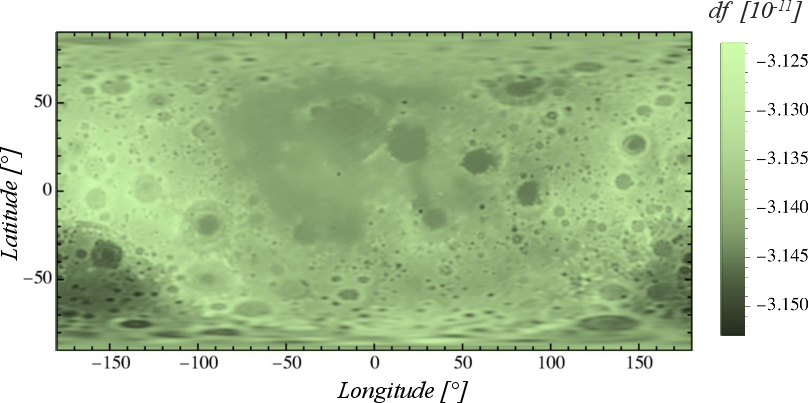
Figure 1: Map of the relative frequency difference between the proper time of a clock at rest on the lunar surface and TCL. The origin of the longitude represents lunar prime meridian.
The Role of Proper Timing and Clock Synchronization
The study navigates through the perceived and calculated disparities between clocks situated on the lunar surface and the reference TCL timeline. It explores the relativistic influence of the lunar topography on time dilation effects, as visualized in Figure 1, underscoring the significance of account these variations in ensuring accurate synchronization needed for PNT services. The analysis points towards terrestrial experiences where clock errors are managed through systematic steering adjustments to align with periodic external calibrations using Earth-bound timekeeping systems.
Conclusion and Recommended Approach
The paper concludes by advocating for the adoption of TCL (Option 1) as the fundamental lunar reference time. It argues this choice mitigates unnecessary complexities associated with scaling while ensuring compatibility with future planetary timekeeping endeavors. Acknowledging the advent of specialized applications, the emphasis remains on leveraging UTC for high-precision synchronization due to the intrinsic interdependencies demanded by lunar and Earth systems.
In summary, this research consolidates the case for a pragmatic approach to lunar timekeeping that aligns technological feasibilities with established astrophysical governance.