- The paper establishes a framework for calculating Lunar Coordinate Time (TCL) in general relativity via IAU-approved transformation equations.
- It employs mathematical formulations that capture both secular drifts and periodic variations, addressing relativistic time dilation on the Moon.
- The proposed model ensures precise synchronization between lunar and terrestrial timekeeping systems, vital for future lunar missions.
Lunar Time in General Relativity
The paper "Lunar Time in General Relativity" presents a comprehensive framework for defining and calculating Lunar Coordinate Time (TCL) within the principles of general relativity, aligned with International Astronomical Union (IAU) standards. By laying out the mathematical transformation between TCL and Geocentric Coordinate Time (TCG), the authors explore the complex relativistic effects that influence timekeeping on the Moon. This includes not only the intrinsic factors related to lunar motion and gravitational fields but also the periodic variations induced by tidal forces within the solar system.
Relativistic Time Scale Framework
The paper introduces TCL based on the IAU resolutions, drawing parallels to TCG and emphasizing the necessity of establishing a relativistic time framework suitable for lunar operations. Given the Moon's weaker gravitational potential compared to Earth and its orbital dynamics, an atomic clock on the lunar surface would experience a different time rate relative to its Earth counterpart. This discrepancy is attributable to various relativistic effects, including the Moon’s motion and the combined gravitational potentials of the Earth and Moon.
The authors derive transformation equations for converting TCG to TCL, exposing both secular and periodic components manipulating the two timescales. This is achieved by accounting for effects such as relativistic time dilation due to orbital velocities and gravitational influences. Several mathematical tools, like intrinsic multipole moments and perturbing tidal potentials, are employed to capture the subtleties of these transformations. The equations demonstrate:
- Secular drifts which depict the constant rate differences between clocks.
- Periodic variations arising from lunar and solar tidal forces.
- Position-specific effects defined by selenographic coordinates.
Practical Implementation
The paper successfully bridges theoretical findings with practical application by providing a model for real-world implementation. The sophisticated integration displays how proposed lunar time scales can be realized, ensuring precise synchronization between terrestrial and lunar systems. These considerations are pivotal for future lunar missions involving navigation and communication systems, potentially requiring synchronization to levels within nanoseconds.
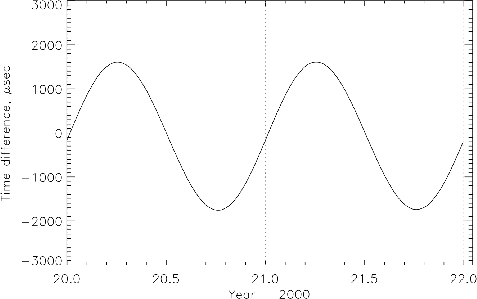
Figure 1: The time difference TCB--TCG, computed at the geocenter. The secular drift of 1.2794 ms/day has been removed.
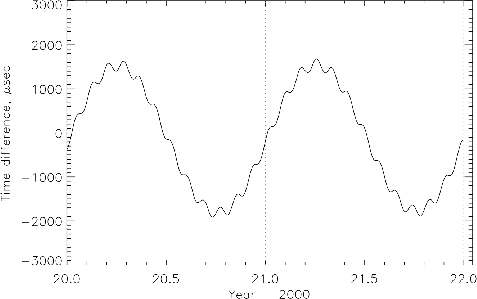
Figure 2: The time difference TCB--TCL, computed at the center of mass of the Moon. The secular drift of 1.2808 ms/day has been removed.
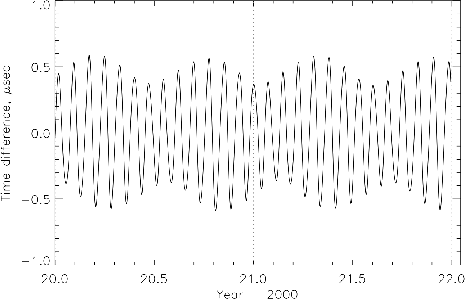
Figure 3: Time difference TCL--TCG, with the secular drift removed, computed by evaluation of equation for 10 years.
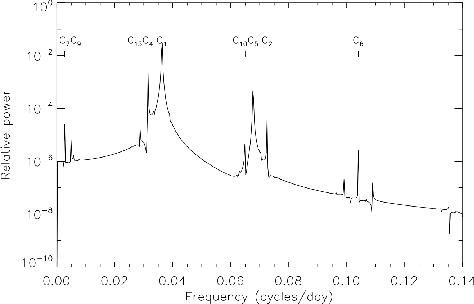
Figure 4: The power spectrum of periodicities in the integration result, showing components affecting TCL--TCG.
Conclusion
The lunar time framework detailed in this paper is essential for the upcoming era of lunar exploration and settlement. By accounting for relativistic effects accurately, we obtain a robust model that anticipates discrepancies and paves the way for synchronized lunar timekeeping systems, critical for scientific exploratory endeavors and establishing a navigational satellite infrastructure akin to GPS on the Moon.
Future work can extend this framework by incorporating more complex gravitational and angular factors or exploring its implications on navigation satellite systems specific to lunar conditions. The presented methodologies for evaluating TCL–TCG transformations serve as foundational blocks for ongoing and future lunar scientific missions.