Papers
Topics
Authors
Recent
2000 character limit reached

Judge's Verdict: A Comprehensive Analysis of LLM Judge Capability Through Human Agreement (2510.09738v1)

Published 10 Oct 2025 in cs.CL and cs.AI

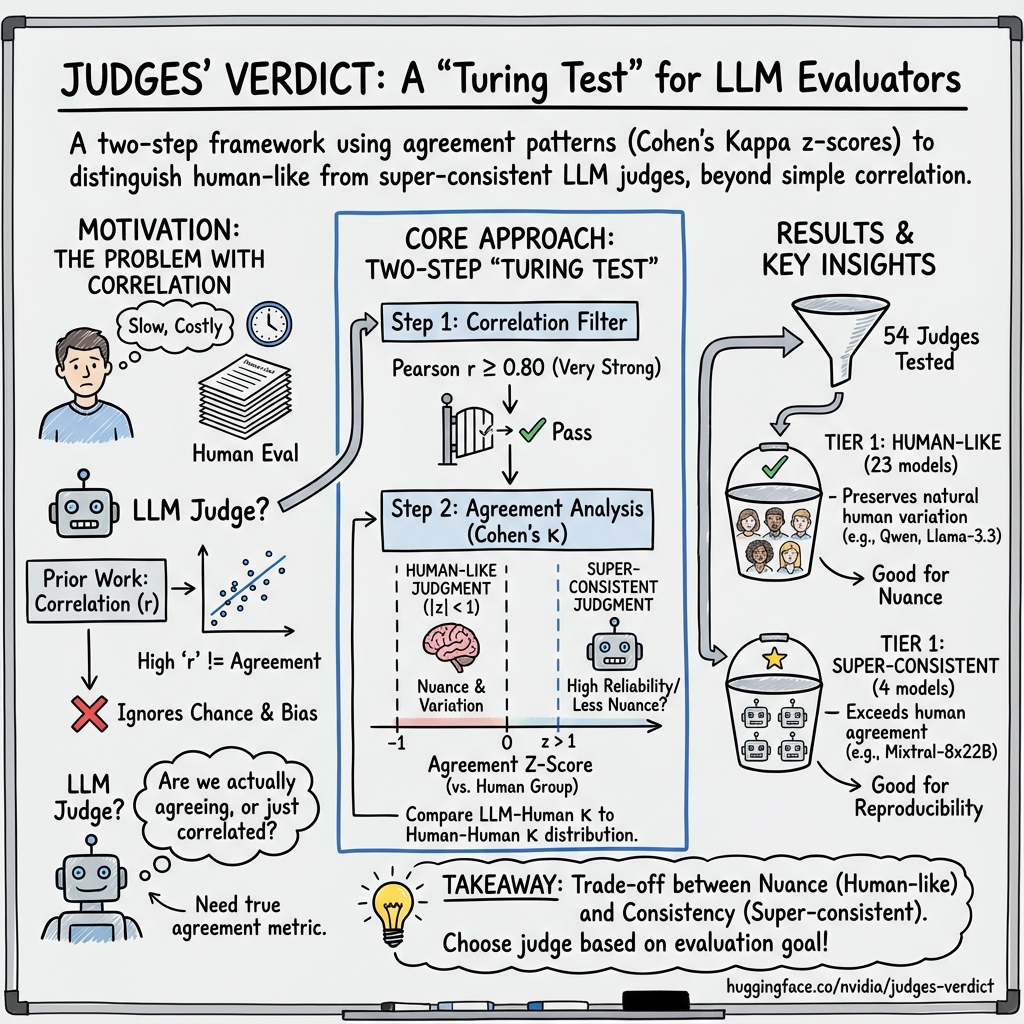
Abstract: This research introduces the Judge's Verdict Benchmark, a novel two-step methodology to evaluate LLMs as judges for response accuracy evaluation tasks. We assess how well 54 LLMs can replicate human judgment when scoring responses from RAG (Retrieval-Augmented Generation) or Agentic pipelines against ground truth answers. Our methodology progresses from traditional correlation analysis to comprehensive Cohen's Kappa analysis that measures actual agreement patterns. The two-step approach includes: (1) a correlation test that filters judges with strong alignment, followed by (2) a human-likeness test using z-scores to identify two distinct judgment patterns: human-like judgment (|z| < 1) that mimics natural human variation, and super-consistent judgment (z > 1) that exceeds typical human-to-human agreement levels. This methodology reveals that 27 out of 54 tested LLMs achieve Tier 1 performance: 23 models exhibit human-like patterns that preserve the nuances of human judgment, while 4 models demonstrate super-consistent behavior, a pattern that could indicate either enhanced reliability or oversimplification of complex judgments. Testing 43 open-source models (1B-405B parameters) and 11 closed models (GPT, Gemini, Claude variants), we demonstrate that judge excellence is not solely dependent on model size but on specific training strategies. Our key contributions include: (1) establishing that correlation alone is insufficient for judge evaluation, (2) introducing a "Turing Test for judges" based on agreement patterns, and (3) providing a standardized benchmark for classifying LLM judges into distinct performance tiers for different evaluation needs.
Summary

  • The paper introduces a two-step evaluation framework using correlation analysis followed by Cohen's Kappa to emulate human judgment.
  • It assesses 54 LLMs, categorizing them into Tier 1 models based on human-like judgment (|z| < 1) versus super-consistent behavior (z > 1).
  • The findings emphasize that training strategies, rather than just model size, are key to achieving reliable LLM judging for practical RAG applications.

Judge's Verdict: A Comprehensive Analysis of LLM Judge Capability Through Human Agreement

Introduction

The paper "Judge's Verdict: A Comprehensive Analysis of LLM Judge Capability Through Human Agreement" (2510.09738) presents a detailed evaluation of LLMs as evaluators of response accuracy in Retrieval-Augmented Generation (RAG) tasks. The research moves beyond traditional correlation metrics, introducing a two-step methodology to assess 54 LLMs' ability to emulate human judgment. This is achieved through a progression from correlation analysis to an agreement-based framework utilizing Cohen's Kappa and z-score analyses, leading to a more nuanced understanding of LLM judging capabilities.

Methodology

The study employs the Judge's Verdict Benchmark, which consists of two critical steps. First, it assesses correlations with human judgments, filtering models that meet a threshold of r≥0.80r \geq 0.80. Second, a novel "Turing Test for judges" is introduced using Cohen's Kappa to measure actual agreement with human judgment patterns. Human-like judgment (∣z∣<1|z| < 1) is distinguished from super-consistent behavior (z>1z > 1), the latter indicating either enhanced reliability or possible oversimplification. The methodology tests models ranging from 1B to 405B parameters, including both open and closed variants, demonstrating that judge excellence is more dependent on training strategies than on model size.

Results

The application of the two-step evaluation framework reveals that 27 out of 54 LLMs achieve Tier 1 performance. Among these, 23 models exhibit human-like judgment patterns, preserving the nuances of human evaluation, while 4 models display super-consistent behavior. The latter potentially implies both enhanced consistency beyond typical human agreement and a risk of simplifying complex judgments. Notably, the analysis identifies leading models with high κ-scores, such as mistralai/mixtral-8x22b-instruct-v0.1 and meta-llama/Meta-Llama-3-70B-Instruct, exemplifying both categories.

Implications and Future Directions

The study has substantial implications for employing LLM judges in practical applications. Human-like models may be preferable in contexts requiring nuanced judgments, while super-consistent models might be preferred for tasks where reproducibility is prioritized. The paper highlights the trade-off between achieving higher inter-rater consistency and preserving the intricacies of human judgment. Future research directions include expanding the dataset to encompass more diverse domains and languages, training smaller but specialized evaluator models, and dissecting the nature of super-consistency in LLMs.

Conclusion

This research provides a robust evaluation framework for LLM assessing judge capability. By moving from correlation to comprehensive agreement analysis, the study sets a new benchmark for understanding and categorizing LLM judges. This paper’s methodology and findings offer valuable insights for future development in LLM evaluation, emphasizing the importance of both alignment with human judgment and the potential risks associated with oversimplifying complex evaluations. The release of the Judge's Verdict Dataset and evaluation code furthers the potential for ongoing advancements in this field.

Whiteboard

Paper to Video (Beta)

Open Problems

We haven't generated a list of open problems mentioned in this paper yet.

Collections

Sign up for free to add this paper to one or more collections.

Tweets

Sign up for free to view the 1 tweet with 0 likes about this paper.