- The paper presents a structured framework that assesses the impact of multimodal data on recommendation systems, especially in sparse interaction scenarios.
- The study reveals that task-specific effectiveness of modality features varies, with textual or visual data contributing differently in domains like e-commerce and short videos.
- The analysis shows that ensemble-based learning for modality integration outperforms fusion-based methods, emphasizing efficient data integration over larger model sizes.
Does Multimodality Improve Recommender Systems as Expected? A Critical Analysis and Future Directions
The paper "Does Multimodality Improve Recommender Systems as Expected? A Critical Analysis and Future Directions" explores the integration of multimodal data into recommendation systems, a trend that has gained popularity due to its potential to enhance system performance by enriching data sources. Despite this trend, the paper critically assesses whether multimodal data integration actually results in improved recommendations, further exploring how and when these improvements occur.
Evaluation Framework
The authors introduce a structured framework to systematically evaluate multimodal recommendations across four dimensions: Comparative Efficiency, Recommendation Tasks, Recommendation Stages, and Multimodal Data Integration. This framework allows for a benchmark of existing multimodal models against traditional recommendation algorithms that rely solely on user-item interactions.
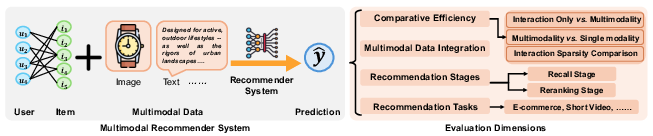
Figure 1: Framework for evaluating the impact of multimodal data on recommendation systems across four key dimensions: Comparative Efficiency, Multimodal Data Integration, Recommendation Stages, and Recommendation Tasks.
Findings and Observations
- Sparse Interaction Scenarios: Multimodal data proves particularly beneficial in sparse interaction scenarios. The inclusion of modality data addresses the cold start and data sparsity issues prevalent in environments where interaction data is limited. This advantage is most evident at the recall stage of the recommendation pipeline, where multimodal models are more effective in identifying candidates from large item pools.
- Task-Specific Modality Importance: The contribution of each modality varies significantly with the recommendation task. In e-commerce settings, textual features tend to be more instrumental than visual features, while the opposite holds true for short-video recommendations. This task-specific effectiveness highlights the necessity for domain-adapted modality selection frameworks.
- Integration Strategies:
The evaluation of different multimodal integration strategies reveals that Ensemble-Based Learning consistently outperforms Fusion-Based Learning. This finding suggests that independently managing modal features before final fusion enhances model effectiveness. It confines the noise from low-quality modalities and maintains the integrity of collaborative signals throughout the recommendation process.
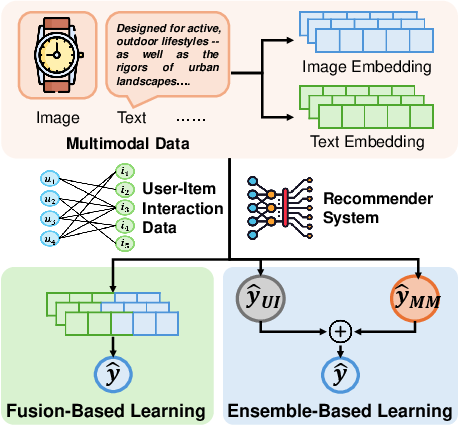
Figure 2: Approaches for learning multimodal features, including Fusion-Based and Ensemble-Based Learning.
The paper identifies a significant observation regarding the relationship between model size and performance: larger models do not necessarily lead to better results. This suggests that computational resource allocation should focus more on efficient modality integration rather than merely expanding the model's complexity.
Case Studies
Real-world examples from datasets like DY (short-video) and Baby (e-commerce) illustrate scenarios where multimodal models outperform traditional interaction-based ones, and vice versa. These case studies underscore the importance of modality alignment and quality in determining recommendation efficacy.

Figure 3: Example items from DY

Figure 4: Example items from Baby
Future Directions
The paper outlines several future research avenues to address current challenges in the field of multimodal recommendations:
- Modality Fusion: Developing robust fusion techniques that effectively combine multimodal data while mitigating the impact of noise or missing modalities remains crucial.
- Collaborative and Modality Signal Integration: Exploring adaptive curriculum learning approaches may optimize how multimodal and interaction signals are integrated over the training process.
- User Modality Preferences: Incorporating user-aware attention networks can dynamically adjust modality influence based on user profiles for personalized recommendations.
- Cross-Domain Implementations: Leveraging multimodal data to enhance cross-domain recommendation system effectiveness opens up possibilities for broader applicability.
Conclusion
The paper provides a thorough evaluation of multimodal recommendation systems, highlighting the nuanced benefits of modality integration and stressing the importance of tailored, task-specific strategies to maximize performance improvements. Future developments in modality fusion and adaptive learning models hold promise for transforming research insights into effective, scalable real-world applications.