- The paper demonstrates that integrating dynamic environmental and experiential knowledge improves LLM adaptation by 17.71% in specialized tasks.
- The methodology employs retrieval-augmented generation with fine-tuned knowledge embedding to efficiently manage and update task-specific information.
- Experiments indicate that combining structured reasoning and experiential learning reduces reliance on traditional fine-tuning techniques and enhances model versatility.
KnowMap: Efficient Knowledge-Driven Task Adaptation for LLMs
The paper "KnowMap: Efficient Knowledge-Driven Task Adaptation for LLMs" (2506.19527) introduces an innovative framework designed to overcome the inherent limitations of LLMs in adapting to new and specialized tasks. KnowMap dynamically constructs a knowledge base from environmental and experiential data and employs a fine-tuned smaller model to enhance LLM performance.
Introduction
KnowMap aims to address the challenge faced by LLMs in rapidly adapting to novel scenarios or emerging tasks due to their reliance on static, pre-trained knowledge. Traditional methods like reinforcement learning (RL) and supervised fine-tuning (SFT) are inadequate due to high computational costs, data-intensive requirements, and the risk of catastrophic forgetting. KnowMap constructs a knowledge base that supplies LLMs with task-specific knowledge, significantly improving adaptation without extensive retraining. This approach leverages retrieval-augmented generation and knowledge-based methods to enhance reasoning capabilities.
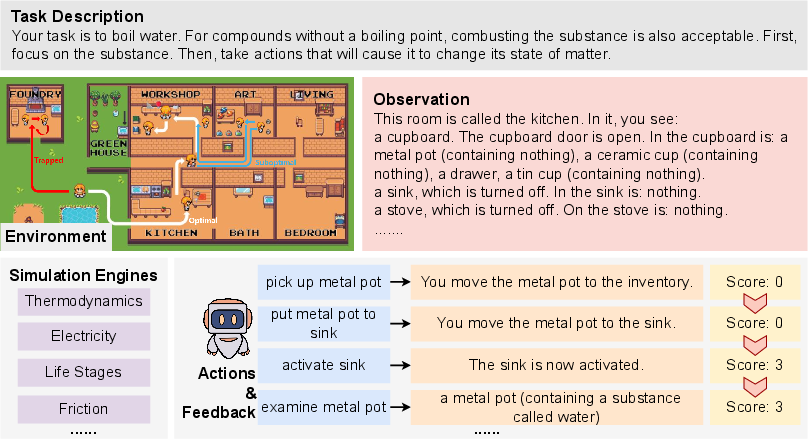
Figure 1: Components of the embodied intelligence benchmark ScienceWorld. It uses text to convey observation information and action feedback to the agent.
KnowMap builds on several research areas, including enhancing LLMs with experiential knowledge and leveraging structured world models like knowledge graphs (KGs). Previous methods, such as WESE and SwiftSage, combine robust general-purpose LLMs with specialized models for efficient task adaptation. The paper draws inspiration from approaches that use structured reasoning and experiential learning to improve adaptability, demonstrating efficiency in complex environments like ScienceWorld.
Method
KnowMap consists of two primary components: the agent scaffold and the knowledge base. The agent scaffold includes a planner, actuator, and evaluator, supported by a memory module for short-term task data management. The knowledge base is divided into environmental and experiential knowledge, both being crucial for informed decision-making.
Environmental knowledge encapsulates current states within the agent's environment using structured triples, whereas experiential knowledge includes sub-goals, relevant environmental knowledge, associated entities, and reflections on decision-making processes. Fine-tuning of the knowledge-embedding model enhances retrieval for these structured knowledge bases, using trajectory-derived data to improve performance.
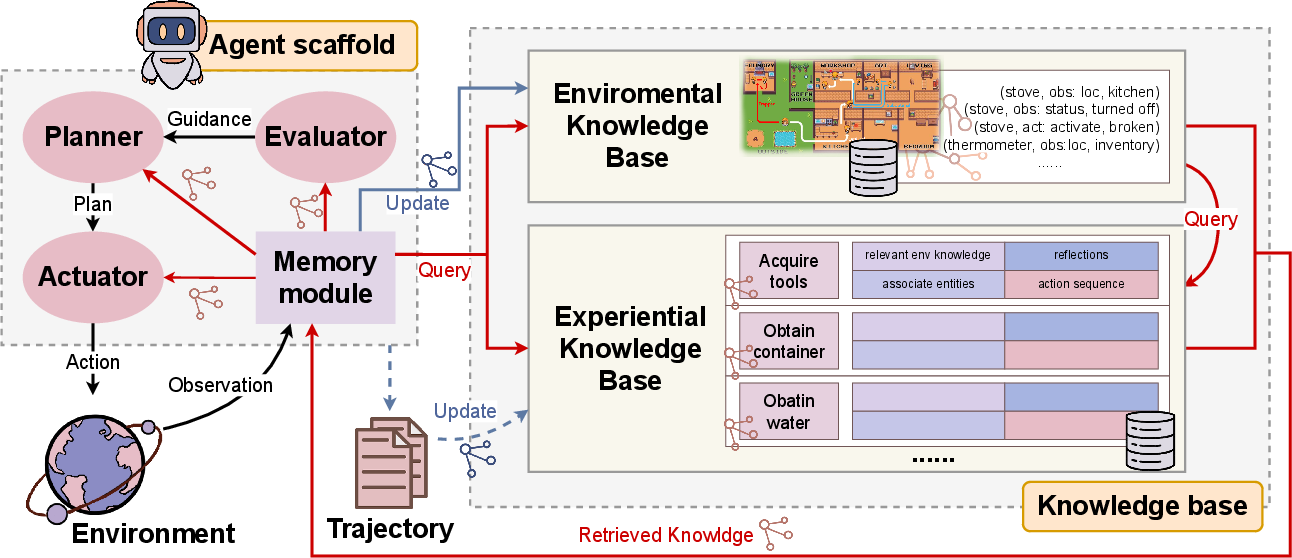
Figure 2: KnowMap framework overview. Black arrows represent the agent's decision-making and interaction processes, red arrows indicate knowledge retrieval, and blue arrows denote knowledge updates.
Experiments
The experiments conducted using the ScienceWorld benchmark demonstrate KnowMap's effectiveness. The inclusion of a dynamic knowledge base led to a 17.71% performance improvement for the gpt-4-turbo model, showcasing the benefit of the framework in adaptive reasoning. Ablation studies further reveal the synergistic effects of combining environmental and experiential knowledge bases, indicating the essential role of embedder fine-tuning.
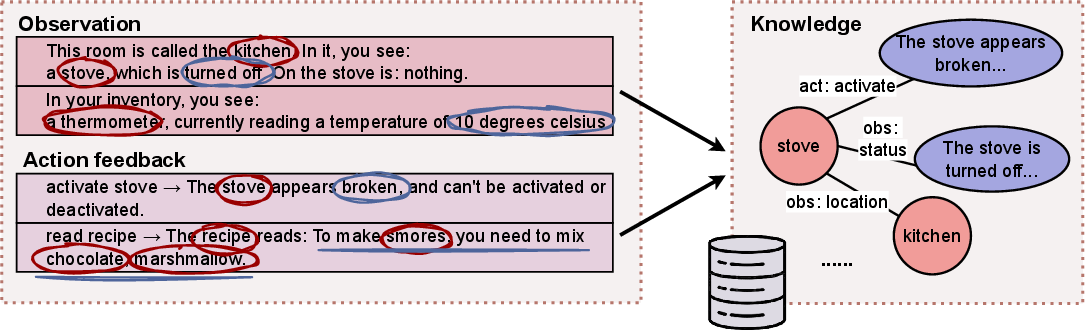
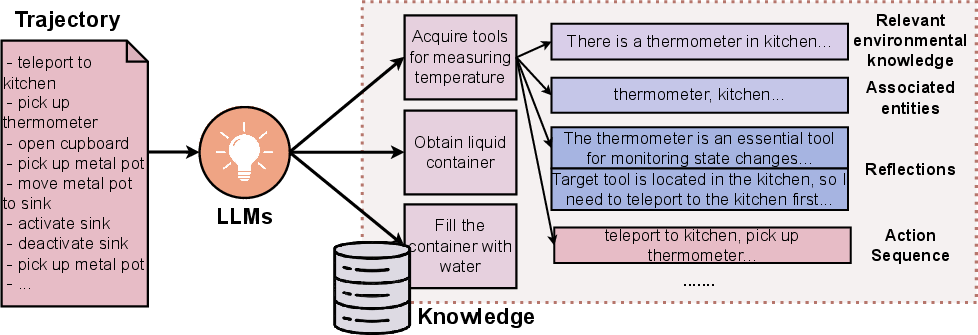
Figure 3: Example of constructing the environmental knowledge base in KnowMap. Entities are acquired through observation and action feedback.
Conclusion
KnowMap provides a robust solution for enhancing LLM adaptability to specialized tasks by integrating dynamic environmental and experiential knowledge. The approach reduces reliance on traditional fine-tuning techniques, offers substantial performance improvements, and highlights the importance of knowledge synergy. Future developments could expand KnowMap’s application to broader task domains and explore its implications in knowledge distillation scenarios, potentially contributing to more efficient and versatile AI models.