- The paper introduces an off-diagonal Weingarten loss to regularize neural SDFs in CAD models, significantly reducing computational complexity compared to full Hessian evaluations.
- It presents two implementation variants—finite-difference and automatic differentiation—that balance efficiency and accuracy in curvature regularization.
- Results on the ABC benchmark demonstrate that FlatCAD achieves comparable or improved geometric fidelity while using less GPU memory and training time.
FlatCAD: Fast Curvature Regularization of Neural SDFs for CAD Models
Introduction
The paper introduces FlatCAD, a novel method focused on fast curvature regularization for neural signed-distance fields (SDFs), specifically tailored to the needs of computer-aided design (CAD) models. Traditional methods employing Gaussian-curvature penalties require full Hessian evaluations, which result in high computational cost and memory usage. FlatCAD bypasses these limitations by introducing an off-diagonal Weingarten loss that regularizes the mixed shape operator term, effectively minimizing the gap between principal curvatures, thereby flattening the surface without needing full Hessian assembly.
Methodology
Curvature Gap Regularization
FlatCAD focuses only on the off-diagonal term of the Weingarten shape operator. This term represents the difference between principal curvatures, κ1 and κ2, enforcing flatness in hyperbolic and parabolic regions and rounding elliptic regions uniformly. By minimizing this term, the method suppresses unnecessary warp and encourages planar and spherical-like regularization.

Figure 1: Principal curvatures κ1 and κ2 are the eigenvalues of the Weingarten map S. Their product gives the Gaussian curvature K=κ1κ2=detS.
Implementation Variants
Two variants of the regularizer are proposed:
- Finite-Difference (FD) Approach: Using forward and backward offsets for SDF evaluations, this variant approximates second-order derivatives without second-order graphs.
- Automatic Differentiation (AD) Approach: Utilizes a single Hessian-vector product via two reverse mode sweeps, avoiding full Hessian assembly.
Both methods allow for curvature-aware SDF learning that is framework-agnostic.
Quantitative Evaluation
FlatCAD was tested on the ABC benchmark, showing that both variants of the Weingarten loss either match or slightly outperform Hessian-based baselines. Importantly, the method requires significantly less GPU memory and training time, enhancing scalability for large-scale, engineering-grade applications.
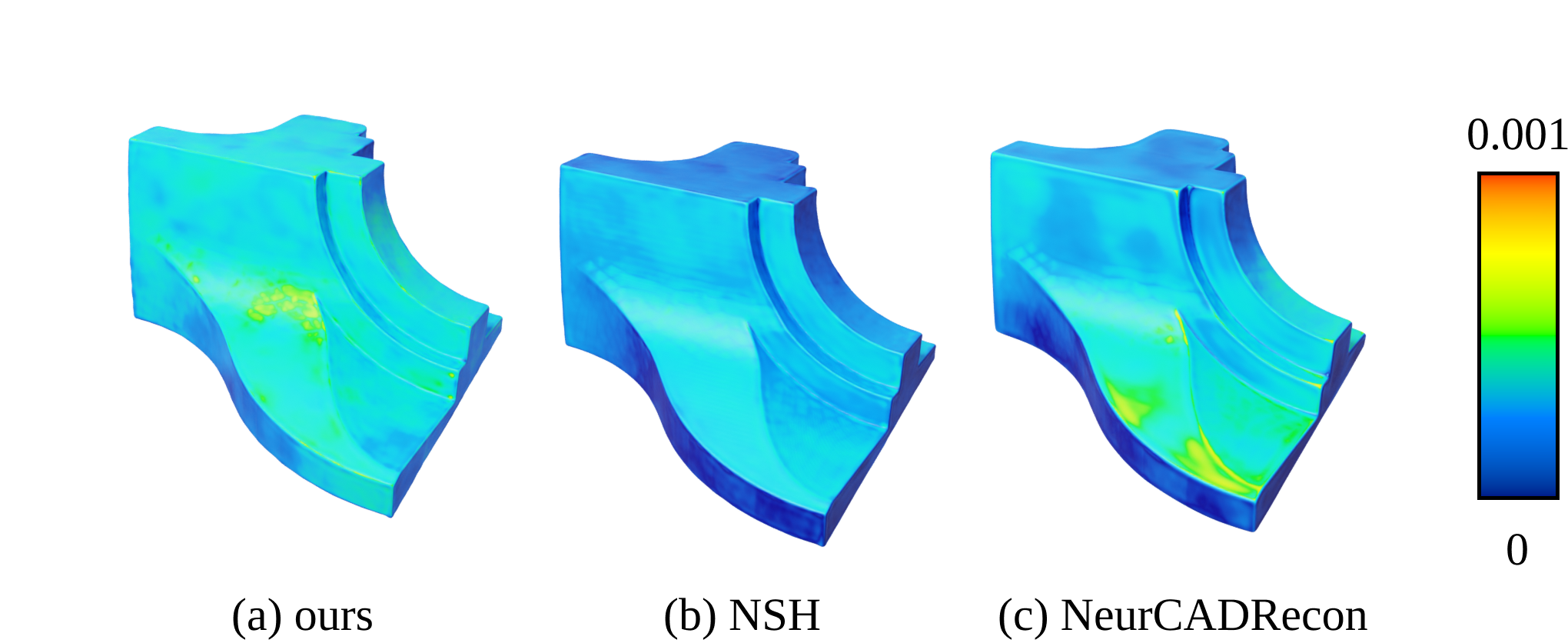
Figure 2: Hausdorff–distance heat maps (blue → low, yellow → high) for the fandisk model reconstructed with ours, NSH, and NeurCADRecon.
Efficiency and Accuracy
The method’s lightweight design allows it to be implemented in existing pipelines without excessive computational overhead. It efficiently balances loss of accuracy with streamlined resource usage, providing practical solutions for engineering applications.
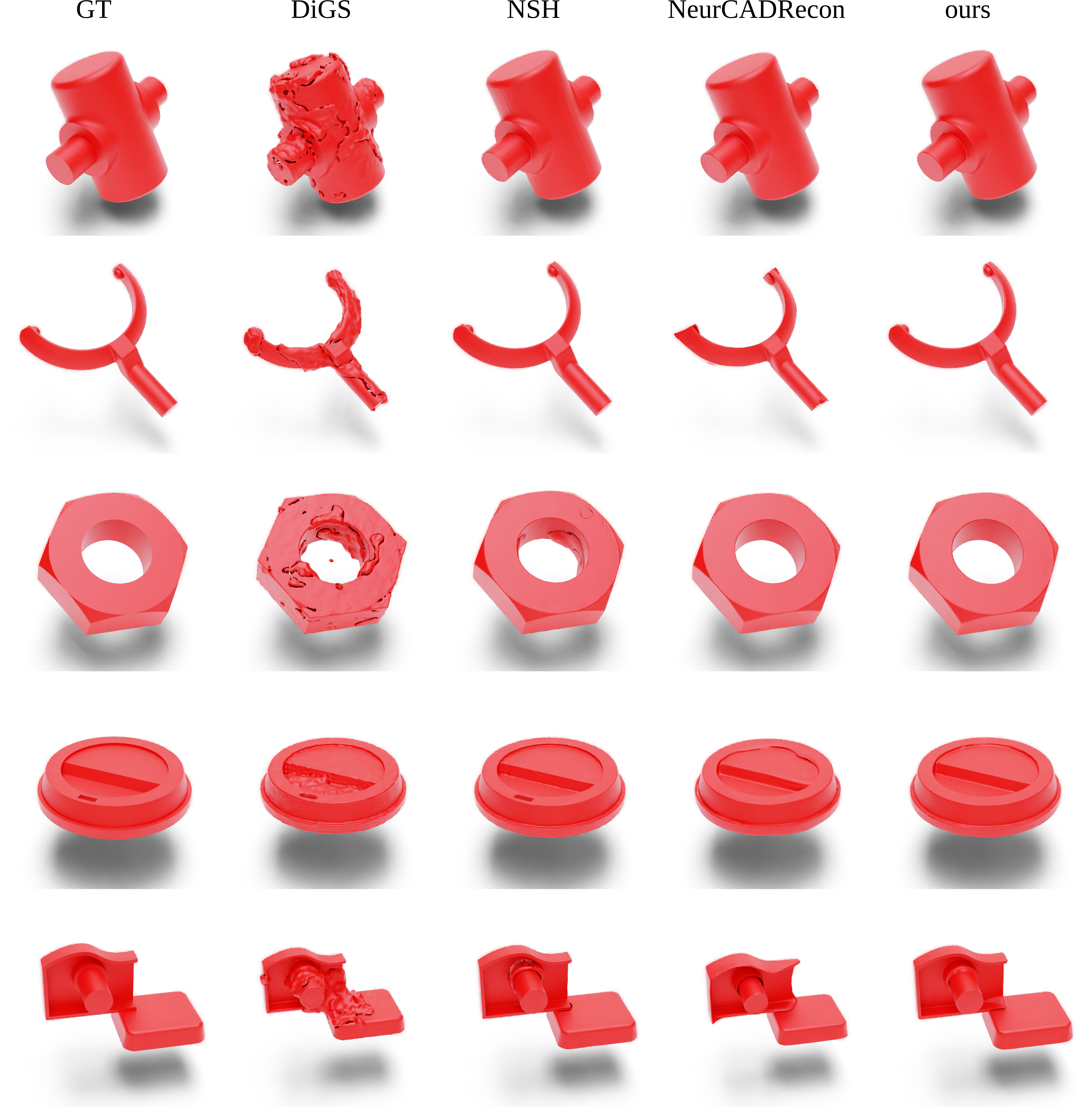
Figure 3: Comparison with state-of-the-art surface reconstruction. Our method and NeurCADRecon demonstrate superior performance in recovering clean, complete, and geometrically accurate surfaces, benefiting from curvature-aware regularization.
Implications and Future Directions
The simplifying feature of FlatCAD’s approach to curvature, via the off-diagonal Weingarten loss, opens up possibilities for refined geometric representations in CAD environments. Future developments could explore adaptive weighting schemes to enhance sharp feature retention or joint optimization methods that integrate mesh extraction with curvature regularization.
Considering the constraints and potential enhancements, FlatCAD lays the groundwork for efficient, scalable neural SDF applications in CAD model reconstruction, promising advancements in the fidelity and utility of 3D geometric representations.
Conclusion
FlatCAD introduces a streamlined method for CAD model reconstruction using neural SDFs. By leveraging off-diagonal Weingarten loss, it successfully reduces computational complexity while maintaining high precision in geometric surface modeling. This approach offers an efficient path forward for curvature-aware SDF learning, setting the stage for further innovation in computational design and graphics applications.
(Figure 4)
Figure 4: Using incomplete point cloud as input, our method is able to plausibly fill in missing planar regions while preserving global surface continuity and topological correctness.