- The paper proposes the IDEA framework that augments design intelligence by transforming design space exploration into a computational decision support system using LLMs and MCTS.
- It utilizes a structured design space model to convert design elements into machine-interpretable decision structures, enabling optimized decision-making in design tasks.
- Evaluations in data-driven article composition and pictorial visualizations demonstrate IDEA's potential to improve automated design generation and inform future research.
"IDEA: Augmenting Design Intelligence through Design Space Exploration" (2506.10587)
This essay provides an expert analysis of the paper "IDEA: Augmenting Design Intelligence through Design Space Exploration" (2506.10587). The paper introduces an advanced framework, IDEA, which aims to enhance design intelligence by leveraging design space exploration, LLMs, and Monte Carlo Tree Search algorithms. The study addresses key challenges in traditional design processes and sets the foundation for computational design automation across varying domains.
Introduction
The IDEA framework addresses critical challenges in traditional design space construction and decision-making. The design space acts as a repository for design knowledge, aided by orthogonal dimensions and selectable elements. However, reliance on subjective expertise rather than systematic methodologies often limits its utility. IDEA proposes an innovative structured representation, transforming design elements into machine-interpretable decision structures. By integrating constraints with LLMs, implementing a Monte Carlo Tree Search (MCTS) algorithm, and using an adaptive action execution module, IDEA generates domain-specific outcomes in two scenarios: data-driven article composition and pictorial visualization generation.

Figure 1: The overview of IDEA, including three core modules: constraint generation, design solution search, and action execution.
Structured Design Space Model
The structured design space model in IDEA is an extension of existing conceptualizations by Shaw and Schulz. Each design space is defined by n design dimensions where each dimension, Di, is represented as an orthogonal axis with selectable design elements, bringing a binary and Cartesian logic into design automation. This formal model bridges the gap between conceptual design and computational execution by establishing executable decision structures. A concrete implementation sequence is generated by action functions, Aj, that interpret the selected elements for a design outcome O.
Design Decision-Making Framework
IDEA's design decision-making framework effectively generates optimal designs through constraint-driven exploration within bounded decision-making structures (Figure 1). Employing LLMs for generating constraints helps shape user requirements into logical rules for design spaces, allowing the MCTS to calculate an accurate reward function that isolates the optimal path among many plausible solutions. This involves evaluating potential trade-offs while maximizing reward through effective exploration-exploitation balance measured by the UCT metric.
(Algorithm 1)
Algorithm 1: Monte Carlo Tree Search algorithm as utilized in IDEA.
Case I: Data-Driven Article Composition
IDEA demonstrates its versatility through an automated system for generating data-driven articles. Using a narrative composition space drawn from data storytelling studies, IDEA selects design elements across multiple dimensions like Headline, Narrative Intent, and Perspective. This structured framing facilitates constraint-guided decision-making during article generation.
(Table 1)
Table 1: Overview of the narrative composition space.

Figure 2: The user interface of the automated data-driven article composition system consists of five main components: (1) the input view, (2) the chain-of-thought view, (3) the data insights view, (4) the design space view, and (5) the article view.
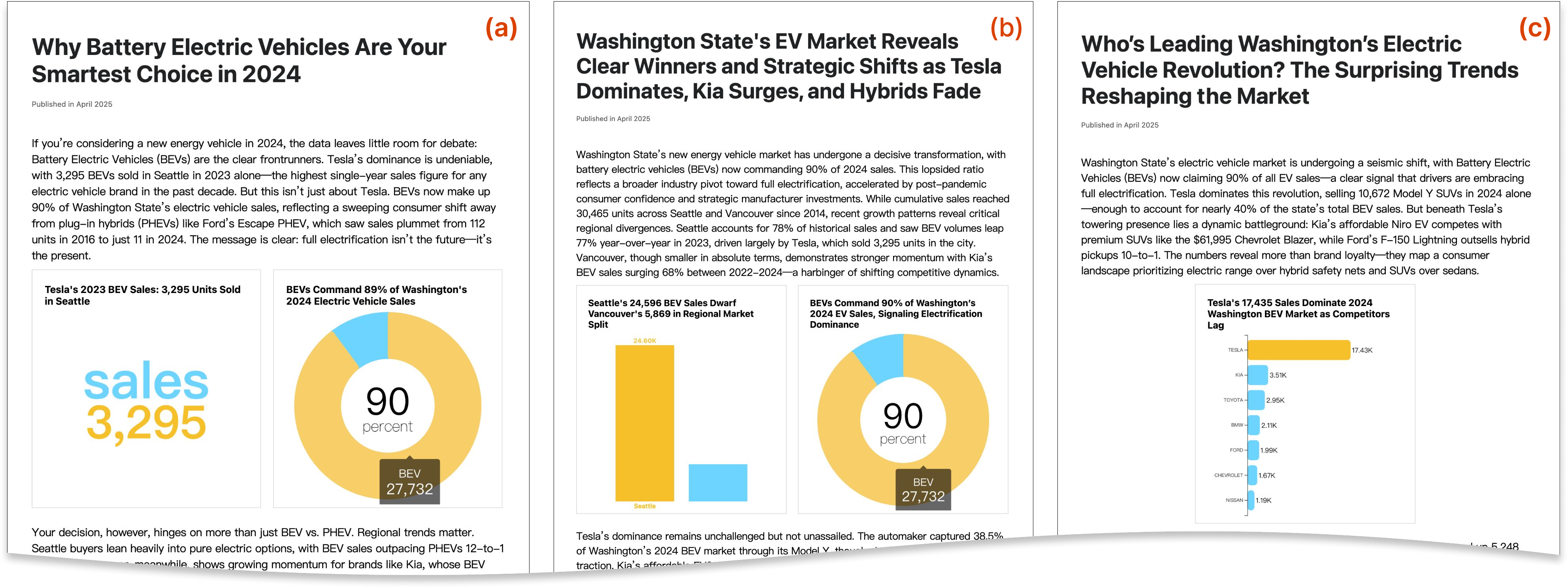
Figure 3: Data-driven articles generated by IDEA. (a) is a compelling buying guide about purchasing new energy vehicles; (b) is an in-depth industry report on the new energy vehicle market; (c) is an engaging automotive news article that explores the new energy vehicle market in Washington.
Case II: Pictorial Visualization Generation
Extending IDEAâs applicability beyond article composition, this section evaluates its performance in pictorial visualization â a domain integrating aesthetic and data visualization. The model formalizes nine core design dimensions based on existing storytelling frameworks, constructing a comprehensive design space to support automated decision-making.
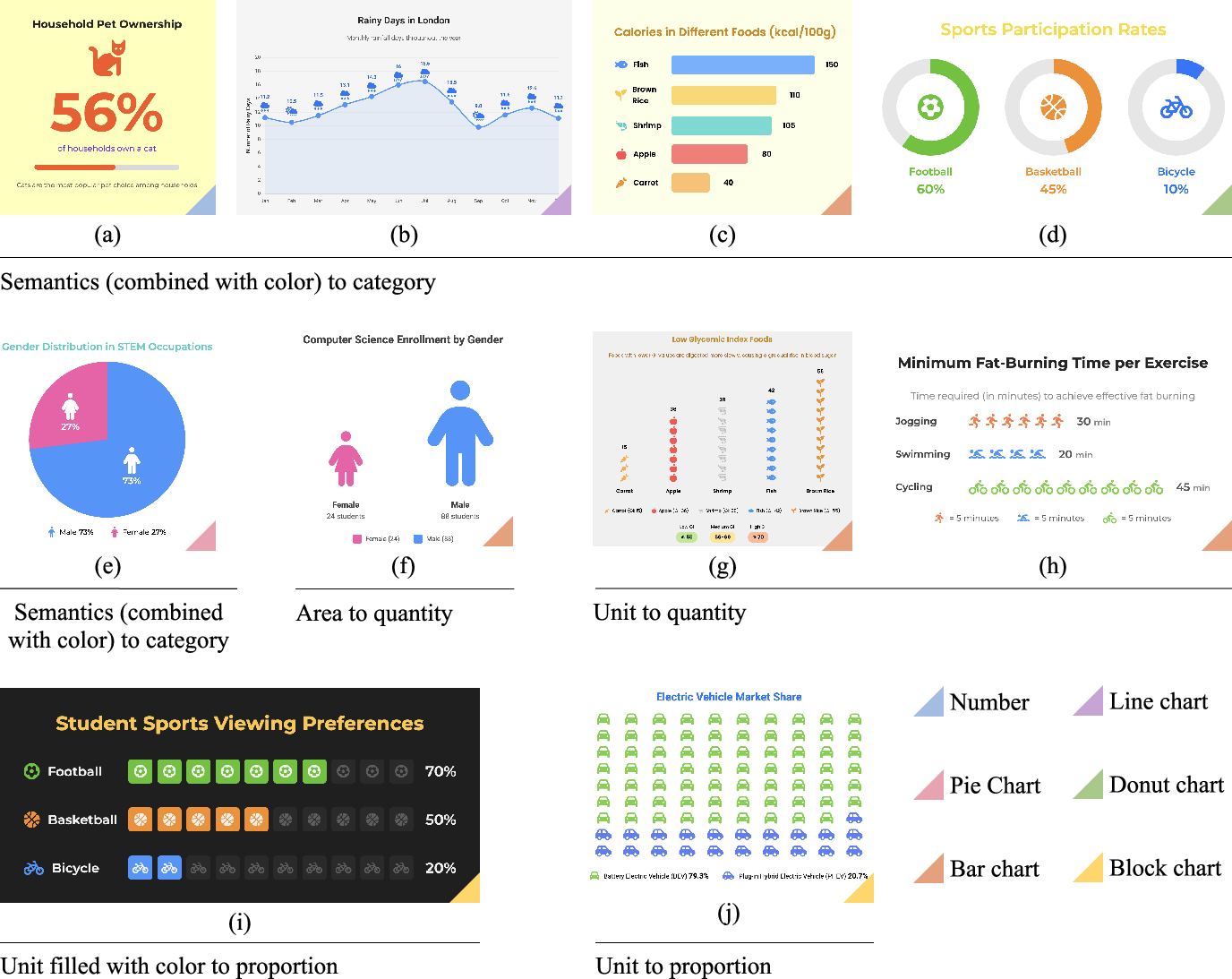
Figure 4: Examples generated by IDEA based on the following requirements: (a) "A clear, visually focused design using a cheerful and playful color palette highlighting a single important percentage: the household ownership rate of cats"; (b) "A pictorial visualization that reflects the variation in the number of rainy days in London...".
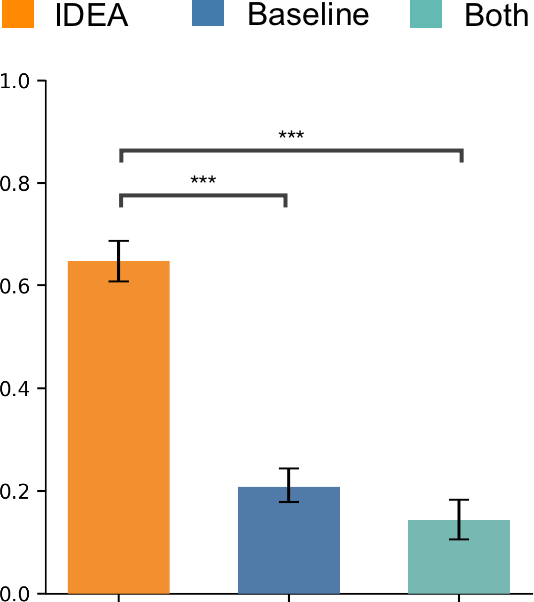
Figure 5: Participant selection proportions for IDEA, the baseline, and both options across 10 visualization groups. Horizontal brackets indicate pairwise significant difference (
: p<.05, *
: p<.01, *: p<.001). The error bars represent the 95% confidence intervals.
Conclusion
The IDEA framework introduces a robust structured approach to decision-making through a decision support system that seamlessly integrates LLMs and MCTS. Evaluations demonstrate its capability to produce domain-adaptable, high-quality outcomes across different design challenges, including data-driven articles and pictorial visualizations. While constrained by its reliance on predefined design spaces, IDEA showcases the potential to expand design intelligence through automated decision-making. Future research could extend IDEAâs theoretical and practical reach by introducing dynamic constraint mechanisms, predefined action functionalities, and automated design space construction, thereby transcending domain limitations and further enhancing intelligent design.