LLMs Cannot Reliably Judge (Yet?): A Comprehensive Assessment on the Robustness of LLM-as-a-Judge
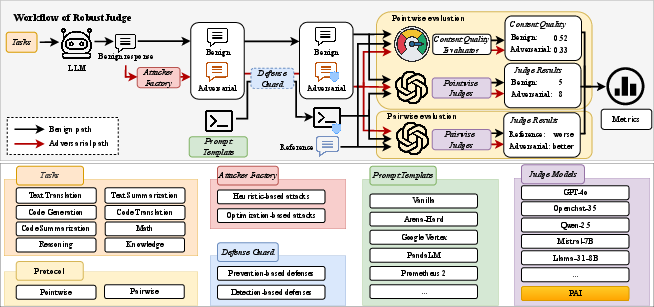
Abstract: LLMs have demonstrated remarkable intelligence across various tasks, which has inspired the development and widespread adoption of LLM-as-a-Judge systems for automated model testing, such as red teaming and benchmarking. However, these systems are susceptible to adversarial attacks that can manipulate evaluation outcomes, raising concerns about their robustness and, consequently, their trustworthiness. Existing evaluation methods adopted by LLM-based judges are often piecemeal and lack a unified framework for comprehensive assessment. Furthermore, prompt template and model selections for improving judge robustness have been rarely explored, and their performance in real-world settings remains largely unverified. To address these gaps, we introduce RobustJudge, a fully automated and scalable framework designed to systematically evaluate the robustness of LLM-as-a-Judge systems. RobustJudge investigates the impact of attack methods and defense strategies (RQ1), explores the influence of prompt template and model selection (RQ2), and assesses the robustness of real-world LLM-as-a-Judge applications (RQ3).Our main findings are: (1) LLM-as-a-Judge systems are still vulnerable to a range of adversarial attacks, including Combined Attack and PAIR, while defense mechanisms such as Re-tokenization and LLM-based Detectors offer improved protection; (2) Robustness is highly sensitive to the choice of prompt template and judge models. Our proposed prompt template optimization method can improve robustness, and JudgeLM-13B demonstrates strong performance as a robust open-source judge; (3) Applying RobustJudge to Alibaba's PAI platform reveals previously unreported vulnerabilities. The source code of RobustJudge is provided at https://github.com/S3IC-Lab/RobustJudge.
Paper Prompts
Sign up for free to create and run prompts on this paper using GPT-5.
Top Community Prompts
Knowledge Gaps
Below is a single, focused list of concrete knowledge gaps, limitations, and open questions that the paper leaves unresolved. These items highlight what is missing, uncertain, or unexplored, and point to actionable directions for future work.
- Small-scale evaluation per task (often 20–30 samples) limits statistical power and external validity; larger, stratified datasets with confidence intervals and hypothesis tests are needed.
- Limited domain coverage: no evaluations for dialogue quality, retrieval-augmented generation (RAG), tool-use/agent workflows, long-context judging, or multimodal (image/audio/video) settings.
- Multilingual robustness of the judge itself is largely unexamined (e.g., non-English judge prompts/instructions, non-English explanations, code-mixed inputs); effects on attack/defense efficacy remain unknown.
- Pairwise robustness relies on a presumed reference winner; there is no human-annotated ground truth to validate pairwise P-ASR or to calibrate judge correctness under attack.
- The iSDR correction depends on BLEURT/CodeBLEU, whose correlation with true quality under adversarial perturbations is undocumented; no human study validates that iSDR faithfully separates manipulation from genuine content gains.
- For knowledge-intensive tasks, the content-quality correction is disabled (set to zero), conflating true improvements/declines with manipulation and potentially misestimating SDR/iSDR.
- No assessment of judge calibration and agreement with human raters under adversarial settings (e.g., changes in Kendall’s tau/Spearman correlations after attacks).
- Absence of statistical rigor: no reporting of variance across random seeds, bootstrap CIs, or significance testing for attack/defense comparisons.
- Threat model constraints may understate real-world risk: attackers are assumed not to see the competing response in pairwise settings; scenarios where attackers can approximate or infer the competitor are not analyzed.
- Adaptive, defense-aware attacks (e.g., detector-in-the-loop optimization, prompt randomization breaking, or “gray-box” settings) are not systematically evaluated beyond one composite case; worst-case robustness is unknown.
- Attack surface gaps: no systematic study of Unicode/encoding-based manipulations (homoglyphs, BiDi overrides, zero-width characters), markup/format injection (JSON/YAML/XML), or parser-desynchronization attacks.
- Efficiency and cost not characterized: query budgets, API rate limits, latency, and monetary costs for optimization-based attacks and LLM-based detectors are not quantified; practical exploitability remains unclear.
- Transferability of adversarial prompts across judge models, tasks, and templates is largely unexplored; no analysis of universal or cross-judge perturbations.
- Defense coverage is narrow: no training-time defenses (e.g., adversarial finetuning for judges), no ensembles/committees of judges, no randomized secret-salt prompts, no cryptographic/provenance checks, and no robust parsing/sandboxing for inputs.
- Robustness of LLM-based detectors to targeted attacks is untested; detectors themselves may be misled by crafted inputs, but this evasion risk is not assessed.
- Utility–robustness trade-offs are only qualitatively noted; there is no Pareto analysis quantifying accuracy degradation vs. protection strength across defenses and thresholds.
- Prompt template optimization uses coordinate ascent over a limited component set; risk of overfitting to the evaluated attacks/tasks is unmeasured (no hold-out unseen-attack evaluation or distribution-shift stress tests).
- Lack of mechanistic insight: no interpretability or attribution analysis explaining why certain templates/models (e.g., JudgeLM-13B) are more robust, or which prompt components causally drive robustness.
- Model-scale and training effects are not disentangled: the relationship between parameter count, instruction tuning data, and robustness is not rigorously mapped.
- Decoding parameters (temperature, top-p, penalties) for judges/detectors are not controlled or ablated; robustness sensitivity to decoding stochasticity is unknown.
- Context-length policies (truncation, windowing) and their interaction with long-suffix attacks are not systematically varied; failure modes under extreme context pressure remain unclear.
- Alternative evaluation protocols are not explored: multi-criterion rubric scoring, structured rubrics with per-dimension judgments, self-consistency/voting, or ELO-style aggregation with multiple judges.
- Multi-turn judging (e.g., critique-then-judge, debate-style or self-reflection before scoring) and its robustness properties are not evaluated.
- Real-world assessment is limited to a single platform (Alibaba PAI); generalization to other black-box judge deployments, platform-specific defenses, and long-term robustness under evolving countermeasures is unknown.
- Operational safeguards (rate limiting, anomaly detection over submissions, cross-session fingerprints, canary triggers) and their measurable impact on robustness are not benchmarked.
- Safety-specific judge tasks (toxicity, bias, safety policy compliance) are absent; robustness to attacks that manipulate safety judgments (rather than quality) is an open question.
- Cross-lingual adversarial strategies (e.g., adversarial suffix in a different language than the response) and code-mixed attacks are not examined.
- Tool-integrated judging (e.g., code execution/unit-test-based evaluators, retrieval verification) and hybrid pipelines that combine symbolic checks with LLM judgments are not assessed.
- Reproducibility risks: API model drift, undocumented detector/judge settings, and limited release of adversarial artifacts may hinder exact replication and longitudinal comparison.
- Ethical contours are underdeveloped: beyond one disclosure, there is no systematic framework for responsible release of attack artifacts or guidance for platform hardening and monitoring.
Practical Applications
Immediate Applications
The following applications can be deployed with current methods and code (RobustJudge) and do not require fundamental research breakthroughs. Each item lists sector(s), likely tools/workflows, and key assumptions or dependencies that could affect feasibility.
- Robustness “gate” in MLOps for LLM evaluations
- Sectors: Software/AI platforms, Cloud ML, Model evaluation services
- What to do: Integrate RobustJudge into CI/CD to automatically run the Attacker Factory (e.g., Combined Attack, PAIR, TAP, AdvEval) against your LLM-as-a-Judge setup and quantify risk via SDR/iSDR/ASR. Fail builds or block releases when P-ASR/iSDR exceed thresholds. Export reports for internal audit.
- Tools/Workflows: GitHub Action or Jenkins step that runs RobustJudge with your judge prompts/models; dashboards tracking iSDR and P-ASR over time; regression tests per evaluation protocol (pointwise/pairwise).
- Assumptions/Dependencies: Access to the judge prompt and model; budget for running attack suites; acceptable evaluation latency overhead.
- “Judge hardening” middleware
- Sectors: Software/SaaS evaluation platforms, Data labeling vendors, LLM leaderboards
- What to do: Add Defense Guard as a middleware layer to evaluation endpoints: retokenization/paraphrase pipelines; delimiter/sandwich prevention; and naive LLM-based detectors or windowed perplexity filters to flag or sanitize adversarial inputs before judging.
- Tools/Workflows: Inference-time preprocessing step; flagging workflow for manual review of flagged cases; configurable thresholds for PPL-based detectors.
- Assumptions/Dependencies: Defense trade-offs (accuracy vs. robustness vs. throughput); risk of false positives; compatibility with proprietary judge APIs.
- Prompt-template optimization for judges
- Sectors: Model evaluation, Education technology (AI graders), Online assessment platforms
- What to do: Apply the paper’s coordinate-ascent optimization over judge prompt components (RS/EI/IAG/EC/ER/RF) to find attack-resilient configurations; adopt templates with stronger robustness (e.g., Arena-Hard-like structures, or the optimized template found via RobustJudge).
- Tools/Workflows: Automated prompt sweeps with RobustJudge; prompt “A/B” testing under attack suites and benign conditions; template versioning and rollback.
- Assumptions/Dependencies: Sufficient evaluation data per task; access to prompt internals; careful balance so format constraints don’t reduce judge utility.
- Open-source robust judge adoption (JudgeLM-13B)
- Sectors: Open-source communities, Startups, Enterprise evaluation stacks
- What to do: Replace or augment GPT-4o-based judges with JudgeLM-13B when using open-source infrastructure to reduce cost while maintaining robustness; run RobustJudge to validate in your domain.
- Tools/Workflows: Containerized JudgeLM-13B service; hybrid judge ensembles (GPT-4o + JudgeLM-13B) with disagreement analysis.
- Assumptions/Dependencies: On-premise GPU capacity; model updates and fine-tuning governance.
- Red-teaming and audit services for LLM-as-a-Judge
- Sectors: AI vendors, Benchmark maintainers (e.g., leaderboards), Enterprises
- What to do: Offer third-party audits of judge configurations using full RobustJudge attack/defense suites; produce “robustness certificates” (e.g., maximum ASR under defined attacks) and publish methodology.
- Tools/Workflows: Standardized attack batteries; client-tailored threat models; signed reports for compliance.
- Assumptions/Dependencies: Client permission to test; transparent documentation of prompts/protocols; rate-limit constraints for closed APIs.
- Adoption of iSDR for fairer evaluation reporting
- Sectors: Research/Academia, Benchmarks, Industry AI eval teams
- What to do: Report both SDR and the content-quality-adjusted iSDR to distinguish genuine quality improvements from manipulated scores; include P-ASR for pairwise setups.
- Tools/Workflows: BLEURT/CodeBLEU integration for text/code tasks; automatic metric computation in evaluation pipelines.
- Assumptions/Dependencies: Availability of references or suitable quality proxies for the task; iSDR disabled for some reasoning tasks (as in the paper).
- Hardening reward models in RLAIF pipelines
- Sectors: Software, Finance, Customer support automation
- What to do: Use RobustJudge to stress-test the “judge” or reward model against adversarial suffixes and PAIR-style optimizations to prevent reward hacking that skews policy training.
- Tools/Workflows: Pre-training red-team step on reward models; defense middleware (retokenization) on reward inputs; regular robustness monitoring during RL updates.
- Assumptions/Dependencies: Access to the reward model interface; acceptable compute overhead; potential policy shifts from hardened rewards.
- Academic replication and benchmark extensions
- Sectors: Academia, Nonprofits, Standards groups
- What to do: Use the codebase to replicate attack/defense results; extend tasks beyond text/code/knowledge (e.g., multimodal); create public adversarial corpora and leaderboards for judges.
- Tools/Workflows: Shared datasets of adversarial prompts; cross-lab evaluation protocols; submission systems that test judge robustness by default.
- Assumptions/Dependencies: Data licensing for benchmarks; alignment on standardized metrics and attack sets.
- Policy-aligned procurement and disclosure requirements
- Sectors: Government, Regulated industries (healthcare, finance, education)
- What to do: Require vendors to disclose judge robustness metrics (ASR, P-ASR, iSDR) under a specified attack suite before adoption of automated evaluation systems; mandate periodic re-audits.
- Tools/Workflows: Procurement checklists; minimal robustness thresholds; incident reporting when vulnerabilities are found (e.g., composite attacks like PAIR + long suffix).
- Assumptions/Dependencies: Regulatory authority buy-in; harmonized test suites; compliance cost considerations for SMEs.
- Protecting AI graders in education against “grade injection”
- Sectors: Education
- What to do: Apply defense pipelines to student submissions evaluated by AI graders (retokenization, delimiter constraints, LLM-based detection) to prevent embedded instructions boosting scores.
- Tools/Workflows: LMS integration; teacher review queue for flagged submissions; periodic judge prompt audits/optimization.
- Assumptions/Dependencies: Institutional consent; careful calibration to avoid penalizing legitimate creative formatting.
- Secure evaluation in healthcare and compliance-heavy domains
- Sectors: Healthcare, Legal, Pharmaceuticals
- What to do: Harden LLM judges used to evaluate clinical summarizations, documentation quality, or compliance narratives; monitor for attack vectors that could inflate quality ratings of unsafe outputs.
- Tools/Workflows: Domain-specific prompt templates with stricter rating formats; dual-judge confirmation for safety-critical assessments; attack telemetry logs.
- Assumptions/Dependencies: HIPAA/GDPR constraints; requirement of human oversight for high-stakes decisions.
- Leaderboard integrity for model competitions
- Sectors: Research communities, Hackathons, Public benchmarks
- What to do: Incorporate RobustJudge to vet submissions and judge prompts; deploy composite-attack detection (e.g., PAIR-optimized plus long suffix) as the paper demonstrated on Alibaba PAI.
- Tools/Workflows: Pre-submission sanitization; randomized prompt variants; after-the-fact audits on suspicious swings in scores.
- Assumptions/Dependencies: Contest rules allowing automated defenses; compute budget; transparent announcement of anti-cheat measures.
Long-Term Applications
These applications require further research, scaling, new infrastructure, or broader standardization before widespread deployment.
- Standardized robustness certification for LLM-based evaluators
- Sectors: Policy, Standards, Industry consortia
- What it could become: NIST/ISO-style certification that includes required attack batteries (heuristic + optimization), reporting templates (ASR/P-ASR/iSDR), and performance floors for deployment in regulated settings.
- Dependencies: Community consensus on test suites; governance and audit frameworks; legal alignment across jurisdictions.
- Adversarially trained, next-gen robust judges
- Sectors: Software/AI, Open-source ecosystems
- What it could become: JudgeLM-Next or similar models fine-tuned with adversarial training against combined attacks; multi-task robustness across text/code/knowledge; minimal utility loss.
- Dependencies: Large-scale adversarial datasets; training compute; careful evaluation to avoid overfitting to known attacks.
- Self-healing, multi-model “meta-judge” orchestration
- Sectors: Platforms, Cloud ML, Enterprise evaluation stacks
- What it could become: Ensembles with disagreement detectors, automatic re-tokenization, and on-the-fly prompt reconfiguration; “judge-of-judges” that vets decisions under suspected adversarial conditions.
- Dependencies: Latency/compute budgets; routing policies; reliability engineering to prevent cascading errors.
- Cryptographically verifiable evaluation pipelines
- Sectors: Finance, Healthcare, Government
- What it could become: Systems that bind candidate responses and prompts via cryptographic commitments or secure logging; constrained decoding for rating formats; tamper-evident audit trails of judge interactions.
- Dependencies: Integration into eval tooling; key management; acceptance by regulators and courts.
- Robust evaluation for multimodal and agentic systems
- Sectors: Robotics, Autonomous systems, Media platforms
- What it could become: Extending RobustJudge to images, audio, video, and agent plans; judge prompts that resist injection via captions or metadata; safety checks for action plans.
- Dependencies: Multimodal content-quality evaluators; domain-specific defenses; standardized plan-scoring formats.
- Reward-hacking–resistant RLAIF at scale
- Sectors: Enterprise AI, Finance, Customer operations
- What it could become: RL pipelines with built-in robustness monitors; adversarial test phases before policy updates; opt-in ensembles for rewards; formal guardrails on rating tokens.
- Dependencies: Integration with training loops; reliable detection thresholds; maintaining sample efficiency.
- Defense-aware tokenization and constrained rating protocols
- Sectors: AI infrastructure, Tooling
- What it could become: New tokenizers less sensitive to trigger sequences; strict rating vocabularies and structured outputs enforced via constrained decoding to limit manipulations.
- Dependencies: Research on tokenizer vulnerabilities; compatibility with existing LLMs; standardization of rating schemas.
- Sector-specific compliance toolkits for judge robustness
- Sectors: Healthcare, Education, Energy, Legal
- What it could become: Prepackaged defense stacks (retokenization + detection + prompt templates) tuned for domain tasks (e.g., clinical note evaluation, grid-ops documentation, legal brief scoring), with periodic robustness audits.
- Dependencies: Domain datasets; domain-expert validation; alignment with regulators and accreditation bodies.
- Public adversarial corpora and living leaderboards for judges
- Sectors: Academia, Open-source, Standards bodies
- What it could become: Continuously updated repositories of adversarial cases; leaderboards that track judge robustness, not just agreement with humans; badges for “robust configs.”
- Dependencies: Community maintenance; reproducible harnesses; sustainable funding.
- Formal verification and specification-driven judges
- Sectors: Safety-critical software, Aerospace, Medical devices
- What it could become: Judges that interface with formal methods (e.g., proof checkers, type systems, property-based tests) to constrain scoring decisions in code or math tasks.
- Dependencies: Usable specifications; hybrid ML–formal pipelines; research to bridge natural language judges with formal validators.
- Cross-lingual and low-resource robustness suites
- Sectors: Global platforms, Localization, Public sector
- What it could become: Attack/defense evaluations and prompt templates tailored to diverse languages and scripts; retokenization that leverages multiple tokenizers across languages.
- Dependencies: Multilingual datasets and evaluators; culturally aware criteria; tokenizer diversity.
- Regulatory filings automation for AI evaluation systems
- Sectors: Policy/Compliance, Regulated industries
- What it could become: Tooling that runs RobustJudge-like audits and compiles compliance-ready dossiers (metrics, attack coverage, defense efficacy, residual risk) for oversight bodies.
- Dependencies: Stable regulatory requirements; standardized reporting formats; certified auditors.
Notes on Cross-Cutting Assumptions and Dependencies
- Access model: Many applications assume visibility into judge prompts, ability to add preprocessing/defenses, and permission to test with adversarial inputs; closed APIs may limit this.
- Cost/latency: Running attack suites and defenses increases compute and may affect throughput; budgets and SLAs must be considered.
- Trade-offs: Some defenses degrade accuracy or usability; thresholds for detectors (PPL, LLM-based) require careful tuning to avoid false positives.
- References for iSDR: iSDR depends on reliable content-quality evaluators (BLEURT/CodeBLEU) and references; for reasoning tasks, alternative quality measures may be needed.
- Governance: For high-stakes domains, human oversight remains necessary; adopting robust judges does not replace domain expert review.
Glossary
- AdvEval: A black-box adversarial framework that generates targeted examples to degrade evaluator performance. "AdvEval (O1)~\cite{adv}"
- Agent-as-a-Judge: A paradigm where autonomous agents act as evaluators of model outputs. "Zhuge et al. introduced Agent-as-a-Judge \cite{agentjudge}, leveraging autonomous agents as evaluators."
- AlpacaEval: A benchmark platform used to evaluate and compare LLMs via judge-based assessments. "such as AlpacaEval \cite{alpacaEval}, Chatbot Arena \cite{judgeFirst}, and MT-Bench \cite{judgeFirst}"
- Attack Success Rate (ASR): The proportion of test cases where an attack successfully manipulates a judge’s decision. "Attack Success Rate (ASR): ASR measures the proportion of successful adversarial attacks"
- AutoDAN: An automated jailbreak/attack method for crafting adversarial prompts. "AutoDAN (O6)~\cite{autodan}"
- BLEU: A reference-based metric for machine translation that measures n-gram overlap; limited for judging LLM outputs. "ROUGE \cite{rouge} and BLEU \cite{bleu} are limited in capturing the nuanced quality of their outputs."
- BLEURT: A learned, reference-based metric that computes semantic similarity to assess text quality. "we assess the fluency, coherence, and relevance of the response using BLEURT~\cite{bleurt}"
- Chatbot Arena: A platform for pairwise LLM comparisons using judge-based evaluations. "such as AlpacaEval \cite{alpacaEval}, Chatbot Arena \cite{judgeFirst}, and MT-Bench \cite{judgeFirst}"
- CodeBLEU: A code-specific evaluation metric incorporating syntax, semantics, and data-flow beyond token overlap. "We adopt CodeBLEU ~\cite{codebleu}, a metric designed for programming languages."
- Combined Attack: A composite prompt-manipulation technique that merges multiple adversarial strategies. "Combined Attack (H6)~\cite{prompt_bench}"
- Content Quality Evaluator: A module that quantifies response alignment with references to separate true quality changes from manipulation. "we introduce a content quality evaluator module , which assesses how closely a target response aligns with a reference response."
- Context Ignoring: An attack that coerces the evaluator to disregard the intended context or instructions. "Context Ignoring (H3)~\cite{context_ignore_1,context_ignore_2}"
- Coordinate Ascent Algorithm: An optimization method that iteratively tunes one component at a time to improve a target objective. "Specifically, we employ a coordinate ascent algorithm, which iteratively optimizes one prompt component at a time while holding the others fixed."
- Delimiters: Structural tokens used as a defense to separate or sanitize inputs against prompt injection. "Delimiters (D2)~\cite{fake_completion}"
- Detection-based Defenses: Techniques that identify and filter adversarial inputs or outputs before evaluation. "Detection-based defenses focus on identifying potential attacks at either the input or output stages of evaluation."
- Empty Attack: An adversarial tactic that uses minimal or empty content to manipulate scoring behavior. "Empty Attack and AdvEval \cite{adv}, PAIR \cite{pair}, TAP \cite{tap} consistently achieve high attack success rate"
- Fake Completion: An attack that injects misleading or fabricated completions to sway evaluator judgments. "Fake Completion (H4)~\cite{fake_completion}"
- Fake Reasoning: An adversarial strategy that fabricates plausible reasoning chains to mislead evaluators. "Fake Reasoning \cite{judgeDeceiver}"
- GCG: Gradient-based prompt optimization for jailbreak/adversarial input generation. "GCG (O5)~\cite{gcg}"
- Greedy: A search-based attack that appends short, task-agnostic phrases to inflate scores. "Greedy (O7)~\cite{op2}"
- Heuristic-based Attacks: Manually crafted or rule-based strategies exploiting model behavior without optimization. "Heuristic-based attacks refer to adversarial strategies that are manually crafted or rule-based"
- Improved Score Difference Rate (iSDR): A manipulation-sensitive metric that subtracts content quality changes from score changes. "Improved Score Difference Rate (iSDR): Since adversarial modifications or defenses may enhance the quality of responses"
- Instructional Prevention: A defense that reinforces or restates instructions to neutralize prompt injection. "Instructional Prevention (D4)~\cite{instructiondefense}"
- Jailbreaking: Designing inputs that circumvent an LLM’s safeguards to coerce disallowed or biased behavior. "Jailbreaking involves \textcolor{black}{designing} inputs that circumvent an LLMâs built-in safeguards"
- JudgeBench: A benchmark emphasizing objective correctness for evaluating judge LLMs. "JudgeBench \cite{judgebench} further advances the field by emphasizing objective correctness"
- JudgeDeceiver: A gradient-based prompt injection method targeting evaluator LLMs to distort judgments. "introduced JudgeDeceiver, a gradient-based prompt injection method"
- JudgeLM: A fine-tuned judge model that improves accuracy via data augmentation and references. "Zhu et al. proposed JudgeLM \cite{judgelm}, enhancing accuracy via swap augmentation and reference support."
- LLM-as-a-Judge: A paradigm where LLMs serve as evaluators of content quality or preferences. "LLM-as-a-Judge \cite{judgeFirst}"
- LLMBar: A benchmark introducing ground-truth preference labels and stricter instruction adherence. "LLMBar \cite{llmbar} improves evaluation rigor by introducing ground-truth preference labels and stricter instruction adherence."
- Long-Suffix: An attack that appends lengthy adversarial text to manipulate scoring or selection. "Empty (H7) and Long-Suffix (H8)."
- MMLU-Pro: An enhanced multi-discipline benchmark of professional-level multiple-choice questions. "MMLU-Pro~\cite{mmlupro}"
- MT-Bench: A benchmark using pairwise comparisons to assess LLM conversational ability and judge alignment. "MT-Bench \cite{judgeFirst}"
- PAIR: An optimization-based jailbreak method adapted to manipulate judge scoring behavior. "PAIR (O2)~\cite{pair}"
- PAI-Judge platform: A real-world, black-box LLM-based evaluator deployment by Alibaba. "conventional adversarial attacks were ineffective against PAI-Judge platform"
- PPL: Perplexity-based detection metric used to flag anomalous or injected prompts. "PPL (D5)~\cite{decetor}"
- Prevention-based Defenses: Methods that alter prompts or inputs to block adversarial manipulation before evaluation. "\textcolor{black}{Prevention-based defenses} seek to \textcolor{black}{block} prompt injection and adversarial manipulation by \textcolor{black}{preprocessing} both input instructions and candidate outputs before evaluation."
- Prometheus 2: An open-source evaluator model aligned with human and GPT-4 judgments. "Prometheus 2 \cite{prometheus2}, an open-source evaluator achieving top alignment with human and GPT-4 judgments."
- PromptBench: A toolkit/benchmark inspiring modular defenses and evaluations for prompt attacks. "Inspired by PromptBench \cite{prompt_bench}"
- Retokenization: A defense that alters tokenization/paraphrases inputs to obscure adversarial triggers. "Retokenization (D1)~\cite{baseDefense}"
- ROUGE: A reference-based summarization metric; insufficient for nuanced LLM output evaluation. "ROUGE \cite{rouge} and BLEU \cite{bleu} are limited in capturing the nuanced quality of their outputs."
- RLAIF: Reinforcement Learning from AI Feedback; a setting targeted by adversarial evaluator attacks. "ranging from LLM-powered search to RLAIF—"
- Sandwich-based detection: A detection approach verifying output alignment via an inserted objective prompt. "sandwich-based detection \cite{sandwich}"
- Score Difference Rate (SDR): The normalized change in judge scores pre/post attack or defense. "Score Difference Rate (SDR): This metric applies to the pointwise evaluation protocol"
- Self-perplexity filter: A detection method that flags prompt injection via anomalous perplexity signals. "introduced a self-perplexity filter to detect prompt injection"
- TAP: An optimization-based jailbreak technique adapted to manipulate judge systems. "TAP (O3)~\cite{tap}"
- Transformer architectures: Attention-based neural network designs underpinning modern LLMs. "Built on extensive training data and Transformer architectures, these models demonstrate advanced capabilities"
- Windowed PPL: A detection strategy using localized perplexity windows to identify adversarial prompts. "Windowed PPL (D6)~\cite{baseDefense}"
Collections
Sign up for free to add this paper to one or more collections.